
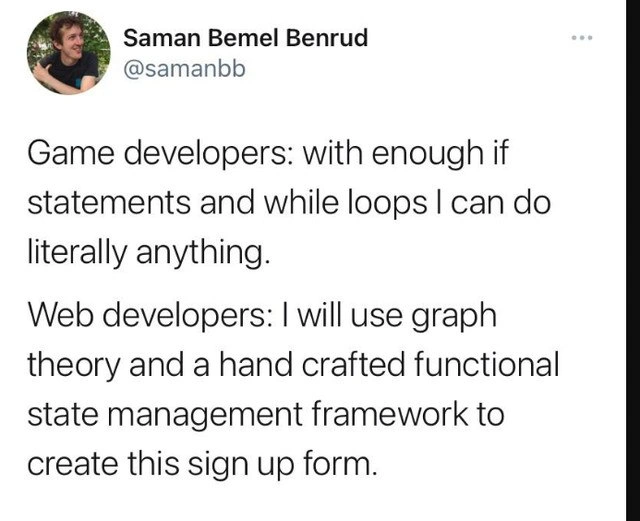
Game Dev Pragmatism vs. Web Dev Over-Engineering
Description
This image is a screenshot of a tweet from user Saman Bemel Benrud (@samanbb). The tweet presents a satirical comparison between the coding philosophies of game developers and web developers. The text reads: 'Game developers: with enough if statements and while loops I can do literally anything.' followed by 'Web developers: I will use graph theory and a hand crafted functional state management framework to create this sign up form.' The humor arises from contrasting the perceived brute-force, pragmatic approach of game developers, who focus on core logic to solve complex problems, with the stereotype of web developers over-engineering simple tasks. The sign-up form, a relatively trivial component, is ironically subjected to complex academic concepts like graph theory and bespoke, high-paradigm frameworks. This resonates with experienced engineers who have seen the tendency in web development, particularly the frontend ecosystem, to embrace excessive abstraction and complexity for mundane problems, often driven by trends rather than necessity









Comments
8Comment deleted
Game devs are fighting the hardware to squeeze out another frame per second. Web devs are fighting their own abstractions to render a button
Game dev lead: “We squeezed an ECS, physics, and AI into 4 ms of frame time by deleting abstractions.” Frontend architect: “Nice - now watch me spin up a DAG-based event-sourcing layer and eight custom hooks so this ‘Agree to TOS’ checkbox persists across micro-frontends.”
Game devs ship AAA titles with 10,000 nested if statements running at 60fps while web devs are debating whether useState violates the principles of functional purity in their email validation component
Game devs ship a physics engine in a nested if; web devs need a monadic effect system before the email field can be marked 'touched'
Game devs will ship a AAA title with nested if-statements 47 levels deep and 60fps, while web devs are still debating whether their sign-up form needs Redux, MobX, Zustand, or a custom finite state machine with time-travel debugging. Both approaches work, but only one requires a PhD thesis to explain why the email validation exists in a separate microservice
Game devs: “deltaTime + if/while.” Web devs: “topologically sort the effects graph, orchestrate a saga, and use CRDTs so the Sign Up button reaches consensus.”
Game devs: loops conquer universes. Web devs: cycle detection for email fields, because trees weren't recursive enough
If your signup form doesn’t need a statechart, optimistic updates, and a saga, is it even enterprise - asks the team that added six transitive dependencies to toggle password visibility