The Faces of Engineers Hearing Sales Promises
Why is this Stakeholders Clients meme funny?
Level 1: Too Big a Promise
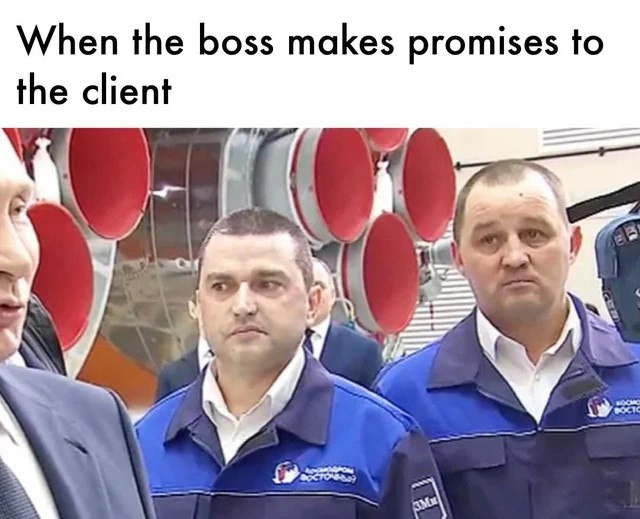
Imagine your teacher tells the whole class that you will build a giant rocket for the science fair by tomorrow – and you’re hearing this for the first time in front of everyone. You’d probably freeze and your eyes would go wide, right? You’d be thinking, “There’s no way I can do that in time!”
In this meme, the boss is like that teacher making a big promise, and the engineers are like you, the student who now has to do the impossible. The boss promised the client something huge and difficult (like building a rocket very fast). The two engineers in the picture have the same reaction you would have: they’re standing there in shock, kind of scared and speechless. Their blank look is basically saying, “Uh oh… we’re in trouble.”
It’s funny because we can all imagine being in that situation. Someone else (with good intentions, maybe trying to make others happy) says you’ll do something really hard or unrealistic. You didn’t agree to it, you weren’t asked, and now you’re expected to deliver. It’s like your parent volunteering you to bake 100 cupcakes for a party tomorrow when you’ve never baked that much before. You’d just stand there stunned, thinking, “How on earth am I going to do this?”
So the heart of the joke is this: a big promise was made by one person, and the people who actually have to fulfill it are left in panic. We find it funny (and a bit painful) because we feel sorry for those people – we know how it feels to be on the hook for something that seems impossible. The engineers’ faces say exactly that, and that’s why this meme hits home in a simple, clear way. It’s a picture of people realizing they have a huge task ahead and not much say in it, just like if someone promised something big on your behalf and you’re left blinking, wondering how you’re ever going to make it happen.
Level 2: Promises vs Reality
Let’s break down what’s happening here in simpler terms. The meme shows a boss (the guy in the suit on the left) who is talking big to a client. The text says, “When the boss makes promises to the client,” and you see the boss confidently speaking. Now, the client is the person or company that the boss is trying to impress – basically, the customer who wants something done. The boss is saying “Yes, we can do all the things you want!” with a big smile. That’s the promise.
On the right, we have two engineers (the guys in blue jackets) standing in front of a giant rocket engine. They represent the dev team – the people who actually have to build or deliver whatever the boss just promised. Look at their faces: they’re kind of blank and stunned (even blurred out, you can tell they’re like 😶). That blank stare is the reaction: they are in silent panic. Why? Because they just heard their boss commit them to a huge task or a tight deadline that they weren’t prepared for. It’s as if their eyes are saying, “Uhh... what did he just sign us up for?”
Now, a few key concepts here:
- Scope Creep: This is when the amount of work or features keeps growing beyond what was originally planned. For example, maybe the team was only supposed to build one part of the “rocket” (say, just one engine). But the boss, to impress the client, promised the whole rocket with multiple engines and a launch demo. Suddenly the scope (the work to do) has creeped up to something much larger. More features, more work – that’s scope creep.
- Unrealistic Deadlines: This means the due date to finish the work is not realistic – it’s too soon or too short. Imagine the boss told the client “We’ll have all this ready by next month,” even though the team knows it might take six months to do it right. That one-month deadline is unrealistic. The engineers know they can’t meet it without a miracle (or without working day and night, which still might not be enough).
- Deadline Pressure: When a deadline is approaching too fast or is too tight, the team feels a lot of pressure. They might have to rush, pull all-nighters, or cut corners. In the meme, the engineers feel this pressure the moment the promise is made – because they realize how little time they have versus how much work is now promised.
- Stakeholder (Client) Expectations: Stakeholders are people who have an interest in the project, like clients or bosses. Here, the client now expects something big (thanks to the boss’s promise). The client might be thinking, “Great, I’ll get a rocket (or a big software feature) delivered on time.” Their expectations have been set sky-high. The dev team’s expectations, on the other hand, are that this is going to be a nightmare to deliver. That mismatch is MisalignedExpectations. The client expects a big success; the developers expect a struggle.
- Communication Gap: This refers to the gap in understanding between the boss and the dev team. The boss might not fully understand how complex the request is (maybe he’s not an engineer, or maybe he’s just overly optimistic). He communicates one thing to the client (“sure, easy, we’ll do it!”) and something else – or nothing at all initially – to the developers. The developers feel like, “If only you had asked us first, we’d tell you that timeline is crazy.” That lack of proper communication leads to panic. The devs found out about the promise after it was made, which means they didn’t get to give input or push back.
In more relatable terms, think about a time at school or at a job where someone (like a team lead or project manager) said “Yes, we’ll get all these ten features done by Friday!” and you, as the person doing the work, realized that’s almost impossible. As a newer developer or student, you might initially feel scared or stressed – that’s exactly what’s going on in those engineers’ minds. They’re calculating, “We have X number of people and Y amount of time… this doesn’t add up.”
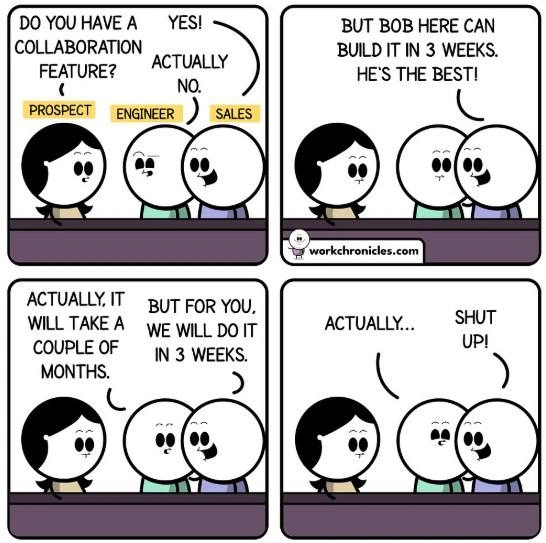
The reason this is humorous (in a shaking-your-head kind of way) to developers is because it happens a lot in the tech world. It’s a bit of ManagementHumor – jokes about managers and how they promise things. Often, sales teams or bosses want to keep clients happy, so they agree to big requests or short deadlines, expecting the development team to somehow “make it work.” The dev team then has to figure out how to deliver or risk failure. It’s stressful in real life, but seeing it in a meme, we can all relate and laugh nervously.
The rocket image also adds to the humor. Rockets are complicated and need careful preparation – you can’t build a rocket overnight. Putting these engineers in a rocket factory is like saying, “Look, this task is as hard as building a rocket, and the boss is still casually promising it like it’s nothing.” It’s an exaggeration that makes the point. Even if your project at work isn’t about actual rockets, it can feel that daunting when the boss overcommits. The big red rocket nozzles behind them are almost symbolic of the big fire that’s about to come (fire under the team to get moving, or a fire they’ll have to fight during the project!). And the engineers are wearing blue factory jackets – they look like real workers who handle serious machinery. Yet even they are floored by what they just heard. In software terms, it’s like promising a completely new app or a huge feature upgrade in an impossible timeframe; even skilled engineers will be like, “uhhh…”.
If you’re a junior developer, you might not have experienced this exact scenario yet, but it’s common. For example, you might be working on a website and your project manager tells the client “We’ll add live video chat and a recommendation engine to the site by next week.” You, the developer, suddenly have two big new features to build on top of everything else, with barely any time. You and your teammates might exchange looks or quietly message each other “Did he really just agree to that?!” That feeling is what this meme captures. The engineers in the picture can’t exactly facepalm or yell, especially not in front of the client. So they just stand there, blinking, maybe thinking of how to break it to the boss later that this is going to be incredibly hard (or outright impossible).
In summary, at this level we see promises vs reality: The boss’s promise (what the client hears) vs the developers’ reality (what’s actually doable). The humor comes from that huge difference, and the very relatable “deer in headlights” look of the devs. It’s a cautionary tale too: good communication and setting realistic expectations are really important. Otherwise, you end up with those blank stares and a backlog that’s about to overflow with last-minute tasks.
Level 3: Scope Creep Liftoff
When an overly eager boss overpromises to a client, it's like lighting the fuse on a rocket of scope creep. In this meme, the suited executive on the left is enthusiastically assuring the client that “Yes, we can absolutely do that!” – essentially promising the moon. Behind him, the two engineers (our developers) stand in front of a massive rocket engine with blank, pixel-blurred faces. Their expression? A thousand-yard stare of silent dread. They’ve seen this scenario before: the boss makes grand client_commitments without consulting the dev team, and now deadline pressure is about to skyrocket. The juxtaposition is painfully familiar in CorporateCulture: confident managerial sales talk up front, and stunned developers in the back wondering how they’re going to deliver.
This scenario is a classic case of MisalignedExpectations between management and engineering. The boss is likely under StakeholderPressure to impress or secure a deal, so he’s cheerfully promising a grand outcome (cue the giant rocket in the backdrop as a symbol of an enormous project). He might be saying something like, “Our team will have this complex feature ready by next month, no problem!” Meanwhile, the developers’ internal monologue is screaming, “Wait, we will what? By when?!” Their outward reaction, however, is just a blank stare – a polite poker face hiding delivery anxiety. In many organizations, developers learn to keep quiet in front of the client. They just blink in panic internally, because objecting on the spot might undermine the boss or embarrass the company. So they stand there, visually frozen, while their minds are racing through worst-case scenarios of nights and weekends lost to crunch time.
The rocket engine backdrop isn’t just for show – it’s a perfect metaphor. Building and launching a rocket is literally rocket science: a hugely complex endeavor that takes rigorous planning, testing, and realistic timelines. Yet here we have a boss casually treating it like it’s easy. It’s as if he walked into a rocket factory tour and spontaneously promised the client a Mars launch next week. This absurd confidence is the humor of the meme: everyone in development knows the joke “It’s not rocket science”, but in this case the project is rocket-level hard – and the boss still acts like it’s no big deal. The engineers know better. Their blank look says, “Houston, we have a problem.” They’re already mentally calculating how impossible this is. Perhaps they have only a single small engine built, but the boss just sold a full multi-engine rocket launch. That’s akin to a software manager promising an entire application rewrite or an unrealistic deadline for a complex feature because a client showed interest. The dev team is left holding the bag, thinking “We barely got the prototype working, and now we’re supposed to deliver the finished product early?”
From a senior developer’s perspective, this meme captures the dark comedy of ScopeCreep and UnrealisticDeadlines. When the boss promises extra features or a tighter timeline without adjusting resources, it violates the basic project management triangle of scope, time, and resources. In other words, if you double the scope (more features, bigger rocket) without extending the timeline or adding more engineers, you’re heading for disaster. Experienced devs know this, and that’s why these two engineers look shell-shocked. They can already foresee the long nights of overtime and the Jira board exploding with new tickets. It’s that familiar “oh no, here we go again” moment each time management commits to something without a reality check. They’ve been burned before: maybe last quarter the boss promised a major client an “AI-powered module” could be added in two weeks, and the team is remembering how that death march went. Now it’s happening again, hence the resigned, deadpan stare.
It’s worth noting the subtle details: their faces are blurred, emphasizing that they could be any developers anywhere. This isn’t about who they are, but what they feel – a universal developer reaction. And those big red nozzles of the rocket behind them? They almost look like giant warning signs or stress meters in the background. Red for danger: the project is about to overheat. The devs in blue uniforms stand out against that red, as if they’re directly in front of the impending blast. The image screams delivery_anxiety – the engineers are bracing themselves for the fallout of the boss’s words.
In the industry, we even have a term for when higher-ups do this: “vaporware” – selling a product or feature that doesn’t exist yet. It’s often done to keep clients happy or fend off competitors, but it leaves the engineering team scrambling to turn the promise into reality. When the boss says “Yes, we can do that by Q3” without checking feasibility, he’s basically signing the dev team up for a high-risk sprint, possibly without even realizing it. Maybe he assumes the team can just “work harder” or that adding a couple of extra developers will magically compress the schedule. A seasoned dev knows that adding people to a late software project often makes it later (that’s Brook’s Law from the classic book The Mythical Man-Month). But in the heat of closing a deal, those realities get ignored. The result? A comedic tragedy where the manager smiles and the devs freeze.
Let’s decode the humor in technical terms. The combination of ManagerExpectations and developer reality is like an unstoppable force meeting an immovable object. The boss’s promise is the force: it’s bold and can’t be taken back once said to the client. The immovable object is the actual physics of engineering and software development – some things just take time and effort, no matter how much you wish it otherwise. That tension produces absurd situations, like promising a fully tested rocket launch when only a prototype engine exists. Everyone with engineering experience knows that feeling when StakeholderExpectations far exceed what’s doable in the given time. It’s a mix of horror, stress, and a bit of “here we go again” dark humor. We laugh at memes like this because if we didn’t, we might just cry.
To put it in pseudo-code, the boss’s behavior triggers an immediate spike in the team’s stress and workload:
if boss_makes_new_promise_to_client:
dev_team.stress_level += 1000 # team goes into panic mode
project.scope *= 2 # scope doubles (more work is added)
project.deadline /= 2 # timeline halves (deadline pulled closer)
The code above is a tongue-in-cheek way of saying: a new promise means the team’s stress shoots up, the work to do multiplies, and the time to do it shrinks – a formula for chaos. The engineers’ blank stares in the meme are basically this code snippet in human form. They’re processing the sudden change in project parameters, and it’s not pretty.
In summary, at the senior level, this meme is a wink and a nod to every developer who’s endured scope creep liftoff. It highlights the CommunicationGap where management speaks in buzzwords and commitments, while engineers deal in realistic estimates and physics. The humor lands because it’s ManagementHumor grounded in truth: many of us have had a boss who promises a “rocket” and then expects the dev team to defy gravity. Those blank, blinking eyes say it all: “We’re in trouble, but let’s strap in.”
Description
This is a reaction meme featuring an image of two men in blue work jackets, likely engineers or technicians, standing in an industrial setting with what appears to be the nozzles of a rocket engine in the background. They are looking off-camera with expressions of profound weariness, skepticism, and silent dread. A partially visible figure in a suit stands before them. The caption at the top of the image reads, 'When the boss makes promises to the client'. The humor is derived from the all-too-relatable disconnect between management or sales and the technical teams responsible for implementation. The engineers' faces perfectly capture the internal monologue of 'You promised them what?' that occurs when a non-technical stakeholder agrees to unrealistic features or impossible deadlines without consultation. It's a visual representation of impending scope creep, technical debt, and long nights for the development team
Comments
8Comment deleted
That's the look of two principal engineers who just heard their sales VP promise a client 99.999% uptime on a system held together by a single cron job from 2007
“Sales just promised a ‘same-week, multi-region, zero-downtime launch’; meanwhile we’re still strapping the 2008 monolith to the rocket and praying the legacy Oracle driver doesn’t shake loose at liftoff.”
That's the face you make when you hear "blockchain-powered AI with real-time ML" knowing full well the client's infrastructure is still running PHP 5.3 on a shared hosting plan
Sales sold the feature, the boss confirmed the date, and engineering just learned about both - in front of the client, which is our official requirements-gathering process
That moment when your PM commits to a two-week delivery timeline for a feature that requires migrating the entire monolith to microservices, rewriting the authentication layer, and somehow achieving backwards compatibility with a legacy API that predates REST. The engineers' expressions perfectly capture the internal calculation: 'Do I start updating my résumé now, or after the first missed sprint?'
Sales just promised five-nines, multi-region, and real-time ML by Q3; I'm counting those nozzles to estimate how many emergency hotfix pipelines we'll need after the Friday cutover
Boss promises launch by Friday, global real-time, and five nines; we start estimating blast radius instead of story points
Boss commits to 'MVP lift-off by EOW' - devs arm abort systems, praying turbopumps don't cavitate