A Dog's Brutal Honesty About Tech Obsolescence
Why is this IndustryTrends Hype meme funny?
Level 1: Favorite Toy Replaced
Imagine you have a favorite toy that you absolutely love playing with. Now suppose a new, shinier toy comes out and suddenly all your friends want to play with that one instead. Over time, even the stores stop selling your old favorite because everyone only wants the new toy. It’s not that your toy was bad – it’s just that a newer toy became more exciting. This meme is saying that a similar thing happens to programmers with the tools they use. The dog isn’t biting the developer at all; instead, he’s hurting his feelings by telling a harsh truth. It’s as if the dog said, “One day, your favorite toy will be left behind because a new toy will take its place.” For a programmer, their “toy” is their favorite programming language, and hearing it might be left behind is sad. We smile at this comic because it’s a little bit funny (a talking dog giving tough love!) and also a little bit sad – it reminds us that in technology there’s always a new toy in town. Everyone understands that feeling of seeing something you love get replaced by something new.
Level 2: Trend Today, Legacy Tomorrow
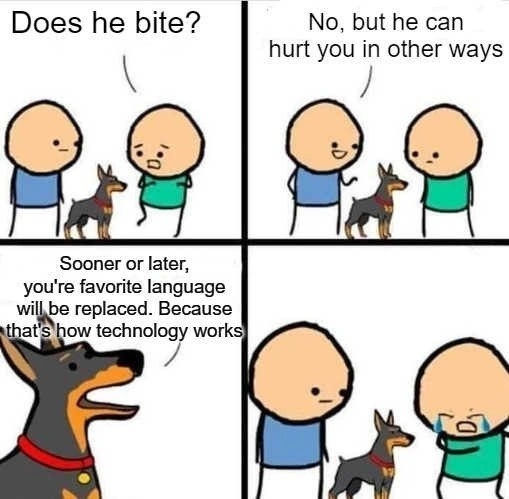
This comic spells out in plain terms what many developers discover as their careers progress. In the first panel, a developer asks if the dog is dangerous (“Does he bite?”). The owner replies that the dog doesn’t bite but can hurt you in other ways. The punchline comes when the dog speaks a tough truth: “Sooner or later, your favorite programming language will be replaced. Because that’s how technology works.” This idea of your favorite_language_replaced by the next big thing hits hard. The poor developer is left teary-eyed, not from a physical bite, but from the sting of that idea.
What the dog is saying is that programming languages – the tools and syntaxes we use to write software – don’t stay on top forever. A language that is super popular and loved today could become old news in a decade. In tech lingo, it might turn into a legacy system technology, meaning it’s mostly found in older projects. For example, if you love JavaScript now, you should know that 15–20 years ago many web developers preferred Flash/ActionScript or Java applets for interactive content. Those have since been replaced by newer solutions (no one really builds new Flash apps today). That doesn’t mean the old languages instantly vanish – instead, new projects just stop choosing them. They survive in maintenance mode, quietly running important older systems, while the industry trends move on.
This cycle of constant replacement (a phenomenon of programming_language_churn) is driven by progress and by hype. New languages appear, promising easier development, better performance, or more enjoyable syntax. Developers then start adopting those languages – this process is often called LanguageAdoption. As more people and companies use a language, its LanguagePopularity surges. You might see it trending on tech blogs or the front page of Hacker News. Often there’s a wave of excitement (and marketing) around a “hot” language – that excitement is the hype in those IndustryTrends_Hype cycles. But over time, hype settles down. A few years later, another new language or framework comes along and steals attention. The once “hot” language becomes just one of the many older tools you maintain rather than the shiny new choice for fresh projects. In short, tech_obsolescence is normal: technology evolves quickly, so something that was cutting-edge can become outdated as new solutions emerge.
Developers – especially early in their career – can get very attached to their tools. It’s common to have a favorite language (maybe because it was the first one you mastered or the one you find most comfortable). This kind of emotional attachment to a tool is that classic developer_attachment_to_tools feeling. You’ll also see plenty of LanguageComparison debates online (like “Ruby vs Python” or “Java vs C# – which is better?”) and even outright LanguageWars, where people defend their preferred language with almost fanatical passion. The meme plays on the emotional side of this: the dog’s comment basically says, “No matter how much you love X language, at some point it’s going to be replaced by Y (or by something entirely new).” That idea stings because we pour a lot of time into learning and loving our tools. It’s like spending years becoming great at one thing and then hearing that the world is moving on to something else.
For a junior developer, this message is both a reality check and a bit of humor. It’s a reminder not to get too comfortable with one technology stack. The developer humor here comes from how true and relatable the situation is. Even if you haven’t experienced it yet, you’ve probably heard older programmers joke (with a hint of worry) about having to “learn yet another new framework or language.” The comic exaggerates this feeling by having a dog deliver the news so bluntly. It’s funny in a tongue-in-cheek way, but it’s also giving a gentle warning: in this industry, the tools and languages you love will change, so always be ready to learn the next thing.
Level 3: No Language Lives Forever
The only constant in software is change. This meme hits seasoned engineers right in their accumulated wisdom (and scar tissue). It lampoons the fact that in the world of programming languages, today's hot, beloved tool inevitably becomes tomorrow's legacy artifact. The humor emerges from a painful truth: no matter how much you adore your favorite syntax, eventually it will be overshadowed by something new. This is the classic favorite_language_replaced gut-punch every programmer dreads. The dog isn’t literally biting the developer, but delivering a byte of reality – a sharp reminder of tech_obsolescence.
In every generation of computing, we’ve seen languages rise, dominate, then recede into specialized niches or LegacySystems. Ask a gray-bearded programmer and they’ll recount how FORTRAN and COBOL once ruled, how C and C++ took over systems programming, and how Java became the enterprise king of the early 2000s. Each wave promised to render the previous one obsolete. (Remember when every new language was touted as a “C-killer” or “Java-killer”?) Software TechHistory is littered with once-popular languages that are now punchlines or dreaded legacy code. (Anyone out there still wrangling with Visual Basic 6 or ColdFusion apps in a back office?) The "Does he bite?" meme format drives this point home by personifying that nagging thought every senior dev has had while updating their résumé: “Is the language I’m expert in still in demand, or is it already passé?”
The meme cleverly plays on LanguageEvolution and the hype-fueled cycle of IndustryTrends_Hype. Developers often engage in passionate LanguageWars — heated debates about whether Language X is superior to Language Y. We spend hours on LanguageComparison threads arguing performance benchmarks and syntax preferences. But deep down, experienced engineers know that the outcome of those wars might not even matter in the long run. Today’s winner can become tomorrow’s historical footnote. The blue-shirt developer’s tearful reaction is painfully relatable to anyone who’s invested years mastering a particular stack or toolset (classic developer_attachment_to_tools). One day you’re proudly a Ruby or Python guru, and a few years later you’re hearing that everything is moving to Go, Kotlin, or some brand-new language you’ve barely heard of. It’s a shared industry trauma expressed as a joke – pure RelatableHumor for developers who’ve been through this churn before.
Crucially, this isn’t just cynicism; there’s practical wisdom here. Technology stacks keep changing because of genuine improvements and shifting needs. A language might be replaced not because it was “bad” but because something newer addresses emerging requirements or developer pain points better. For example, as multi-core processors became standard, languages with modern concurrency models – like Go or Rust – gained popularity over older, single-thread-centric languages. Even the most popular language of a decade can start to feel dated as design paradigms shift. This constant turnover is essentially the programming_language_churn the dog is referring to. It hurts because it’s true: as developers, we have to continuously learn and adapt.
From a senior perspective, the comic is funny-sad because it’s a scenario we’ve all lived through. It’s the kind of dark DeveloperHumor that new engineers chuckle at nervously and veterans laugh at knowingly (while wiping away a single tear for their beloved Pascal or Objective-C). That doberman is essentially the voice of experience saying: “Don’t get too comfy with your current favorite tool, kid. I’ve seen empires of code rise and fall. Enjoy it while it lasts.” The absurdity lies in presenting this hard-earned lesson as a casual, innocent remark from a pet. We laugh, but in that knowing, head-shaking way – because we’ve seen hyped languages go from trending on Hacker News to being an outdated skill on our CV faster than we’d like. The meme strikes a chord across the industry by blending truth with just enough joke: it’s TechHumor drawn from real experience, making us smile and wince at the same time.
Description
This image uses the 'He can hurt you in other ways' four-panel comic format. In the first panel, a character in a green shirt nervously asks the owner of a Doberman dog, 'Does he bite?'. In the second panel, the owner calmly replies, 'No, but he can hurt you in other ways'. The third panel is a close-up of the dog, which delivers the hurtful statement: 'Sooner or later, you're favorite language will be replaced. Because that's how technology works'. The final panel shows the character in the green shirt bursting into tears, emotionally devastated by this truth. The humor stems from the unexpected and profound existential dread delivered by a dog. For software developers, this is a direct hit on the anxiety of keeping skills relevant. It speaks to the relentless cycle of technological advancement where today's cutting-edge language or framework becomes tomorrow's legacy system, reminding every developer that their hard-won expertise has a shelf life

Comments
8Comment deleted
My favorite language has been 'legacy' for five years now, which just means my job security is measured in geological time
The dog doesn’t bite - he just whispers that your decade of lovingly tuned Java 8 will be rewritten in Rust “for performance,” deployed as a serverless function that still cold-starts slower than the monolith, and suddenly teeth seem merciful
The real emotional damage is when you realize the "legacy" system you're desperately trying to replace was written in the same "modern" language you're advocating for, just 10 years ago
Don't worry - your favorite language won't die. It'll become 'legacy,' which pays better and hurts more
The dog speaks the uncomfortable truth every senior engineer knows but refuses to acknowledge: that COBOL developer who said 'this is just a fad' about Java is now watching Java developers say the same about Rust. The real bite isn't from the dog - it's from your LinkedIn profile still listing 'Expert in [deprecated framework]' and realizing your 15 years of deep expertise might need a rewrite. At least the dog's honest about it; your CTO will just call it 'modernization' and expect you to be excited about relearning everything on nights and weekends
He can’t bite - he just convinces leadership to “modernize” every OKR, turning your favorite language into glue code between migrations
The dog is your monolith: loyal until Kubernetes puppies overrun the yard
You know you’re senior when “favorite language” just means “temporary implementation behind a stable boundary - strangler migration already in the backlog.”