A Hostile Code Review for an HTML Pun
Why is this DevCommunities meme funny?
Level 1: When Puns Backfire
Imagine you’re hanging out with a friend who loves making silly jokes. Your friend asks, “What sound does a magic internet dog make?” Then, instead of a normal bark, they answer their own question with a made-up funny word that only they understand. It’s a totally cheesy joke. You pause for a second, feeling that mix of “oh no, that was so bad” and a tiny bit of “okay, that was kind of clever.” Rather than laughing, you roll your eyes and shout, “That’s not funny, stop it!” at them in pretend anger. You’re not truly mad — it’s just that the joke was so absurd and nerdy that the best way to react is by acting dramatically annoyed. The humor here comes from exactly that scene: one person says a goofy, complicated pun (in this case about a dog and computer code), and the other person responds with an over-the-top “Ugh, I can’t believe you said that!” Everyone ends up laughing, not really at the joke itself, but at how ridiculous the whole exchange is. It’s funny because we’ve all been there: a friend tells a joke that’s so bad it’s good, and we can’t help but groan and smile at the same time.
Level 2: Anchors and Attributes
Let’s break down the joke for those not as familiar with HTML or Discord. HTML (HyperText Markup Language) is the standard language used to create web pages. It uses tags enclosed in angle brackets (like <p> for a paragraph or <img> for an image) to tell the browser how to structure content. One important tag in HTML is the anchor tag written as <a>...</a>, which is used to create hyperlinks (clickable links to other pages or sections). The anchor tag usually includes an attribute called href. The href attribute specifies the link’s destination, typically a URL. In fact, href is short for “Hypertext REFerence” – basically the address or reference to the resource you’re linking to.
For example, in code you might see:
<a href="https://example.com">Visit Example</a>
Here <a> starts the link, href="https://example.com" is the destination (so clicking the link would go to example.com), and Visit Example is the text of the link. Every web developer learns about href early on, since you can’t make a single link without it. It’s pronounced by reading the letters “H-R-E-F” quickly, often sounding like “href” (roughly like “ref” with an “h” in front). Now, English speakers often write a dog’s bark as “ruff” or “woof.” Notice how “ruff” and “href” rhyme in a goofy way. That’s the pun: href_ruff_pun. In the meme, someone asks “what does the HTML dog say?” and then answers their own question with HREF HREF – as if an HTML-speaking dog would bark out the word “href” instead of “ruff.” It’s a play on words, combining a programming term with an animal sound. So the phrase “HTML dog” isn’t a real thing in tech – it’s just inventing a silly scenario where an ordinary dog speaks in HTML code. 🐶💻
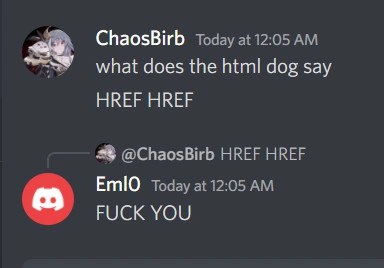
This conversation happens on Discord, which is an online chat platform popular with gaming and developer communities (think of it like a casual Slack). The screenshot shows two messages from a user named ChaosBirb, followed by a reply from another user, EmI0. ChaosBirb first posts the setup question, and then (likely using Discord’s reply feature to refer to their own question) posts the punchline “HREF HREF.” The little reply bubble with “@ChaosBirb HREF HREF” in the image indicates that second message was a reply referencing the first, to make the Q&A format clear. This timing is important – they deliver the joke immediately, as a one-two punch. Now, the humor is that this joke is very corny. It’s the kind of developer humor where you mix coding terms into everyday life. People in programming circles make these jokes to play with the double meanings of tech terms. Sometimes they’re genuinely funny, and sometimes they’re so bad they’re good (or just plain bad!). Here, “HREF HREF” is basically a groaner – a pun that’s met with playful annoyance.
So, how did the other person respond? User EmI0’s reply in big all-caps, “FUCK YOU”, is a deliberately over-the-top way of saying “UGH, that joke was awful (and I can’t believe I laughed a little).” In many dev chat rooms or Discord servers, friends rag on each other like this when someone drops a cringe-worthy pun. It might look harsh, but among friends this kind of mock-insult is pretty common, especially in text where tone is conveyed with exaggeration. The all-caps indicates they’re shouting in a joking manner. Essentially, EmI0 is voicing the “I hate how much I love this (not really)” sentiment. No one is actually offended; this is just how peers in a coding community might sarcastically “boo” a joke. It’s a bit of theater – the profanity_response is so blunt it becomes its own punchline. Think of it as the modern chat equivalent of a bad joke getting pelted with tomatoes in a theater, except the tomato here is a big, red Discord logo avatar yelling in text.
In summary, the meme is an example of tech humor blending programming with everyday silliness. The key things to know are:
- HTML is the language of web pages, and
hrefis an essential part of HTML links (it holds where the link goes). - A dog’s “ruff ruff” bark is being mimicked by the word “href href” because of how it sounds. That’s the entire joke — an anchor tag reference turned into a dog’s bark.
- The first person set up a classic call-and-response pun, and the second person responded with mock outrage. This dynamic is common in DevCommunities: friends jokingly roast each other to make the moment even funnier.
Now, whenever you see someone make a pun like “CSS is styling on us” or “Java got its coffee,” you’ll know it’s just developers being their geeky, playful selves. And if you’re in the chat when it happens, feel free to groan or even drop a joking “I hate you for that 😂” — you’re officially in on the joke!
Level 3: Barking Up the DOM Tree
This meme captures a late-night WebDev chat where a coder drops a pun so corny it practically triggers a runtime exception in the room. In the Discord conversation, user ChaosBirb asks “what does the HTML dog say?” and then immediately answers their own question with HREF HREF. The punchline plays on the HTML anchor tag’s href attribute sounding like “ruff ruff” (a dog’s bark). It’s developer humor at its finest (or worst): a niche HTML pun that only makes sense if you know web code. The second user, EmI0, responds in all caps “FUCK YOU”, which reads as a comically exasperated groan. This over-the-top reaction is the collective spirit of tired programmers everywhere, playfully voicing what we’re all thinking: “please, no more frontend puns.” 😅
Why is this funny to seasoned developers? First, it’s the absurd anchor tag wordplay. The <a href="..."> element is so fundamental in Web Development that even hearing it outside of code context can make a coder’s ears perk up. Here it’s dragged into a Dad-joke-style riddle, “what does the HTML dog say?” — a setup only a coding geek would conjure. It exploits the way href is pronounced (“aitch-ref” quickly becomes “h-ref” or just “href”), which kinda rhymes with a dog’s “ruff.” It’s the type of pun you groan at precisely because you immediately get it. The TechHumor is intentional: it rewards those who know what href means, while simultaneously poking fun at how cringey that knowledge can make jokes. In short, it’s an inside joke for people who speak HTML fluently.
Second, the context is a developer Discord server, a place where devs gather to talk code and occasionally drop silly memes at 12:05 AM. In these DevCommunities, there’s an unspoken tradition of nerdy puns and one-liners. Everyone’s used to jokes about syntax or the latest JavaScript framework, but there’s also a threshold for cheesiness. The moment ChaosBirb goes “HREF HREF,” you can almost hear an entire chatroom facepalm in unison. The reply “FUCK YOU” from another user (bearing Discord’s logo as an avatar, no less) is comedic hyperbole – a profanity_response that stands in for all the mock agony. It’s as if the whole channel shouted “oh shut up!” but in that affectionately fed-up way friends do. The bluntness is part of the joke: developers often express groaning disapproval with exaggerated drama. Nobody is actually angry; they’re just bonding over how terrible (and terribly amusing) the pun was. In a world of corny CodingHumor, sometimes the funniest part is how bad the joke is and how dramatically your peers react to it.
This meme also hints at the divide between enthusiastic newcomers and battle-weary veterans. A fresh Frontend developer might giggle and think, “Haha, the HTML dog says href href, that’s cute!” Meanwhile, the cynical senior (on their hundredth cup of coffee) has heard every "href/ruff" and "cache/cash" joke in the book and is done with it. The humor balances on that shared experience: even if you secretly chuckle, you perform an annoyed outburst because that’s the unwritten comedic language in dev circles. It’s a way to say, “Alright, we see what you did there, now take your pun and go home.” The anchor_tag_reference pun is so extra that it almost deserves a 404 – humor not found – and the reply delivers that verdict mercilessly. In the end, the exchange is all in good fun, showcasing how developers roast each other’s html_dog_joke to cope with the daily grind. After all, nothing builds camaraderie like groaning together at a truly facepalm-worthy Frontend pun.
Description
This image is a screenshot of a conversation in Discord, a popular chat application. The first user, named 'ChaosBirb' with an anime-style profile picture, tells a simple developer pun: 'what does the html dog say' followed by the answer 'HREF HREF'. The second user, 'EmlO', whose profile picture is the default Discord logo, replies directly to ChaosBirb, first repeating the punchline 'HREF HREF' and then bluntly responding with 'FUCK YOU'. The humor arises from the stark contrast between the innocent, nerdy pun and the aggressive, unprovoked hostility of the reply. For developers, the pun itself is relatable as 'href' is the HTML attribute used to specify a link's destination in an `<a>` tag, mimicking the sound of a dog's bark ('arf arf'). The expletive-laden response captures the chaotic and sometimes abrasive nature of online developer communities, where simple jokes can be met with comical, over-the-top negativity

Comments
8Comment deleted
Some devs have the same reaction to puns that old IE versions had to modern CSS: utter contempt and a complete breakdown
The only thing more hazardous than “the HTML dog goes HREF HREF” is shipping anchor tags without rel=“noopener” - one leaks your security context, the other leaks all goodwill in the code review
This is the exact moment when you realize your team's Slack channel has devolved from discussing distributed systems architecture to making HTML puns, and you're calculating how many more sprints until you can retire
HREF HREF is technically a valid bark - though without rel="noopener" the dog can be hijacked by whatever it links to
The beauty of this joke is that it works on multiple levels - it's simultaneously a dad joke about HTML fundamentals and a litmus test for who's been in web development long enough to remember when learning the <a href> tag was actually considered a skill worth mentioning on your resume. The visceral response from EmilO perfectly captures the senior developer experience of hearing the same HTML puns recycled through every bootcamp cohort since 1995
Every time someone barks “href,” product calls it a button, analytics hijacks onClick, security demands rel=noopener, and suddenly the dog routes through the SPA
HTML dog says HREF HREF; your SPA says div onClick - and that’s why a11y, SEO, and middle‑click quietly stop working
HREF HREF: the bark every frontend dev dreads when relative links turn absolute disasters in prod