Game Dev Rarity and the Unexpected Real-World Example of a Fresnel Shader
Why is this GameDev meme funny?
Level 1: Sparkles Mean Special
Imagine you’re looking for a very special toy in a toy box full of many toys. How do you make sure you (and everyone else) notice that one special toy right away? You could put a bright, shiny sticker on it or cover it in glitter so it sparkles when light hits it. In other words, you make it really shiny compared to everything else. That’s exactly what game developers do in a video game: if there’s a super special item (like a magical golden sword), they make it glow and shine so it stands out. In the meme, the developer is joking that they’ll just use their “magic shiny effect” (the Fresnel shader) to cover the rare item in sparkles, kind of like putting glitter on tights to make them flashy. It’s funny because it’s a very over-the-top, sparkly way to say, “Hey, look at this, it’s important!” – just like using a giant highlighter pen on the coolest treasure in the game.
Level 2: Shiny Means Rare
Let’s break down what’s happening here in simpler terms. In GameDevelopment, when we say “shader,” we mean a small program that tells the computer how to draw something on the screen. It decides how an object’s surface looks – its color, brightness, shininess, transparency, etc. One special kind of shader effect is called a Fresnel effect (named after a scientist, Augustin Fresnel). The Fresnel effect is all about angles: if a surface is viewed from the side (grazing angle), it tends to reflect more light and can look brighter at the edges. If you view the same surface straight on, it looks more normal. Take a shiny piece of glass: look directly and you see through it, look at a sharp angle and suddenly it’s very reflective and bright. That’s the Fresnel principle.
Game developers use this principle for a neat trick: making an object have a glowing outline or rim light. This is done with a Fresnel shader, which basically checks the angle between the camera’s view and the surface of the object, and then boosts the brightness or adds a color on the edges accordingly. You might have seen this in games when an important item or character has an eerie glow or halo as you move around it – that’s often a Fresnel-based shader at work. It’s like coating the object in invisible reflective paint that shines only at the edges.
Now, what about “rarity of this equipment”? In many games, especially role-playing or loot-based games, items have different rarity levels: common, uncommon, rare, epic, legendary, etc. Legendary is usually the very special tier – think super powerful or one-of-a-kind items. Developers want players to instantly recognize a legendary item when it drops. The easiest way to scream “this is special!” without words is visually. That’s where the visual_rarity_indicator comes in. Some games use color coding (like grey items vs. green vs. blue, purple, and orange for top-tier). Others go a step further and literally make the item shine or glow.
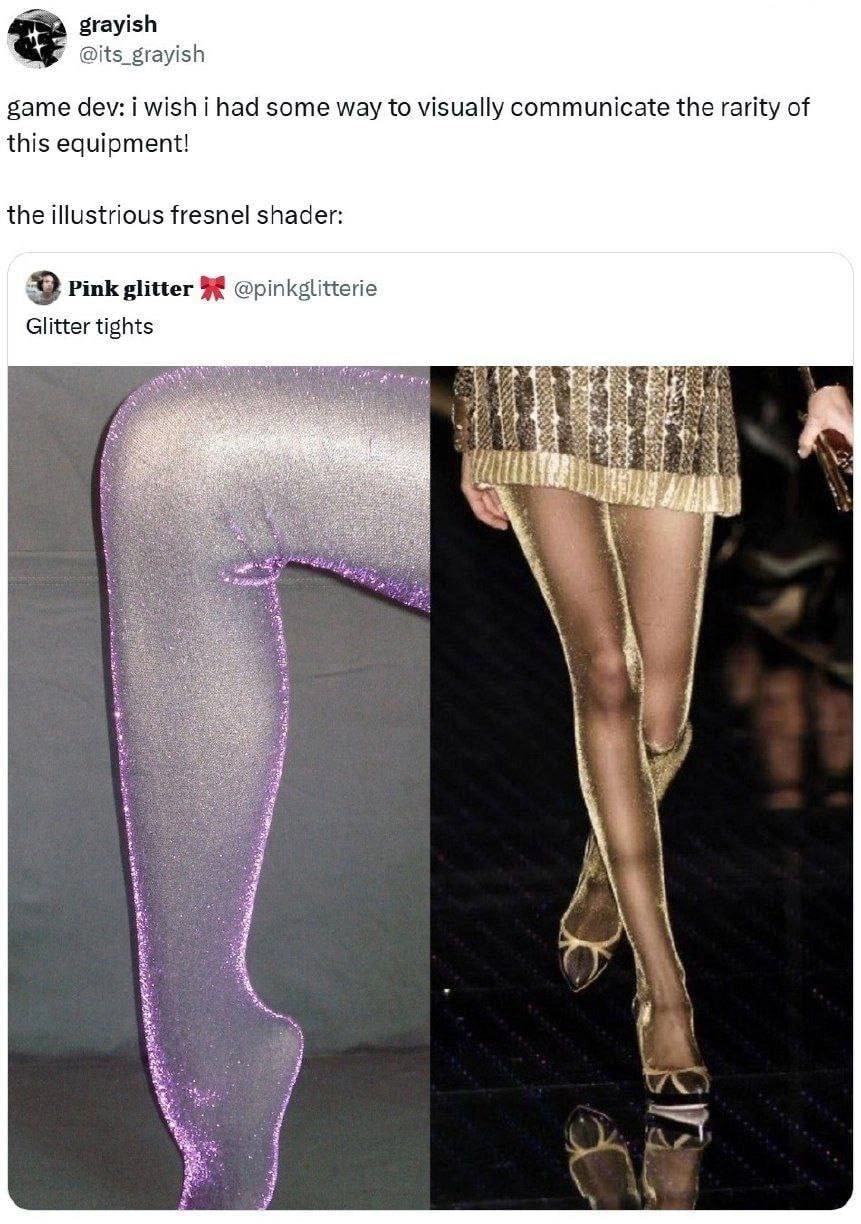
This meme jokes that the game dev is searching for a way to show an item is rare, and our trusty tool – the Fresnel shader – is the enthusiastic answer. Why? Because by adding a Fresnel effect, the item will have a bright, possibly animated, outline glow. In the tweet image, the user “grayish” writes the setup: the dev wishing for a way to show rarity. The next line “the illustrious fresnel shader:” implies the solution being presented dramatically. Then we see the second tweet with photos of “Glitter tights” – one purple leg, one gold leg, both sparkling like crazy. It’s a visual punchline. Basically, glitter in real life does what a Fresnel shader does in games: it makes edges and surfaces catch light and sparkle at you.
So the comparison is humorous and educational. The left image (purple glitter tights) shows a leg with a violet shiny outline – that looks just like when game artists apply a purple Fresnel glow to, say, a magic item. The right image (gold tights) is like a piece of legendary loot glowing gold. It’s as if the real world is saying “see, I can bling it up too!” For a budding game developer or someone new to Graphics, this meme actually reveals a common technique: you want something to stand out? Make it shimmer at the edges.
The GameDev and Graphics tags are there because this is a common scenario in game development, specifically in the realm of game art and graphics programming. GameEngine context means this kind of effect is implemented within game engines like Unity or Unreal Engine by writing a shader or using built-in material nodes. It’s not uncommon for an engine to have a checkbox or an easy node for “rim light” or “outline” effect – often harnessing the Fresnel calculation under the hood. The tags TechHumor and DeveloperHumor fit because you kind of have to be in on the joke: it’s poking fun at our own tendency to use overt visual tricks.
To someone early in their career (or a gamer starting to peek behind the curtain), the meme is a wink at how games communicate meaning through visuals. We don’t have a big label in the world saying “Legendary Item!” – instead, the item itself glows or sparkles to catch your attention. Just like a rare Pokémon in a card set might have a holographic shine, a rare item in a video game has a shader effect to set it apart. And the Fresnel shader is one of the sledgehammers in our toolbox for that job: simple math, big pretty result. Even if you didn’t know the term Fresnel, you’ve absolutely seen it – whenever something in a game has that neon outline or subtle (or not-so-subtle) halo as you walk around it, now you know what’s likely behind it!
Level 3: Legendary Glow-up
This meme hits home for anyone in GameDev because it lampoons a classic dev solution: when in doubt, make it glow. The tweet text sets up a faux conversation – the game dev wonders how to show an item’s rarity, and the “illustrious Fresnel shader” proudly answers by drenching it in glittery sheen. It’s funny because it’s true: developers often resort to an over-the-top glow or outline on legendary loot so players instantly know “this item is special!”
In practice, that Fresnel glow trick is practically a rite of passage in GraphicsProgramming. Senior developers know it well – maybe you’ve worked on a RPG or shooter where QA kept missing the key item on the ground. The quick fix? Slap a bright neon rim light on it! Suddenly that once-overlooked grey sword now has a purple aura visible from across the room. Problem solved (and a trope is born). It’s a bit of a running joke that in game development, the solution to make anything stand out is to apply enough bloom, outline, or particle effects until it can be spotted on a low-res screen from outer space. The Fresnel-based shader is one of those go-to solutions because it’s easy and dramatic.
The imagery of the meme underscores this humor perfectly. The top half (the tweet UI in plain white) is drab and mundane – akin to a developer’s genuine query “How do I indicate rarity?”. Then comes the bottom half: BAM! Glitz and glam – two photos of legs in absurdly sparkly tights, one purple with an almost fluorescent outline and one gold, glimmering from all angles. This is labeled “Glitter tights,” but it might as well be in-game screenshots of loot with legendary-tier shader effects. The contrast gets a chuckle because it’s like the Fresnel shader itself answered, “Step aside, I got this,” and blasted the item with Las Vegas-level shine. It’s an exaggeration of what we actually do in games, and the exaggeration is only barely an exaggeration. 😅
Every experienced game artist or programmer can recall a meeting where someone said, “It’s not obvious that item X is special.” And as sure as the sun rises, someone (often a tech artist or graphics coder) suggests, “We could add a highlight around it… maybe a pulsing one.” Eyes might roll, especially from the art team who spent time on a beautiful model and hoped for a subtle glow, not a disco ball. But nine times out of ten, that gaudy solution makes it to the final build because it works. Players immediately notice the item. The item_rarity_glow has saved the day, even if it’s not gentle on the eyes.
Historically, games have trained players with these visual cues: color and glow denote rarity. Common items are boring, legendary items glow gold. Think of classics like World of Warcraft or Borderlands – a purple or orange item is literally surrounded by colored light beams or outlines. Even newer engines like Unity and Unreal provide built-in Fresnel nodes for materials, because designers frequently ask, “Can we get it to sparkle more?” It’s become such a trope that seeing a real-life example (those runway glitter leggings) evokes a knowing laugh. As a dev, you chuckle thinking, “Those tights have better shaders than my last project’s loot!” It’s a bit of rendering_sarcasm – we poke fun at ourselves for using a physically-based lighting trick in a totally unphysical way.
The phrase “the illustrious fresnel shader” in the tweet is gold (pun intended). It anthropomorphizes a chunk of code as this proud, flamboyant hero swooping in. Seasoned developers recognize that tone: we often humorously credit or blame the shader when a visual effect is over-the-top (“Look at our friend Fresnel here, making everything sparkle”). It’s illustrious because it literally makes things illustrious in the visual sense, bathing them in light. There’s also irony: Fresnel calculations are usually part of making graphics realistic, but here we are cranking them up to make artificial-looking glitter. The meme embraces that absurdity – the same tech that makes a vinyl floor look right can be misused to turn a loot drop into a glowstick.
In essence, Level 3 understanding is recognizing a shared industry joke. It’s about the common dev experience: under pressure to communicate something to players, we often choose the blunt but effective instrument. Why be subtle when you can just FRESNEL the heck out of it? As the meme suggests, the result might resemble a pair of sparkly fashion tights – laughably unsubtle – but hey, nobody’s going to overlook those legendary boots on the ground, right?
Level 4: Angling for Radiance
At the most technical level, this meme’s punchline hinges on an optical phenomenon repurposed in GraphicsProgramming. The Fresnel shader is based on the Fresnel equations from physics, which describe how light reflects off a surface depending on the viewing angle. In simple terms, surfaces reflect more light at grazing angles than when looked at head-on. Mathematically, the Fresnel reflectance $R(\theta)$ increases as the angle $\theta$ between your eye (view vector) and the surface normal grows. At shallow angles, you get that intense shine on the edges – think of the glancing gleam on a lake at sunset or the sheen on a glossy table when viewed from the side. Game engines incorporate this as a Fresnel term in their shaders: it’s part of physically-based rendering, ensuring materials look realistic by boosting reflectivity near edges.
Now, instead of realism, imagine dialing that effect up to 11 for dramatic flair. That’s exactly what a “Fresnel shader going full glitter” does. It takes the same angle-dependent reflectance math and feeds it wild, saturated colors to create a neon outline. There’s even a well-known approximation (Schlick’s approximation) used in real-time shaders to compute this efficiently. It’s often written in code as:
// Schlick's approximation for Fresnel reflectance in a fragment shader
float cosTheta = dot(normal, viewDir); // angle between eye and surface
float R0 = 0.04; // base reflectance at 0° (for dielectric materials)
float fresnel = R0 + (1.0 - R0) * pow(1.0 - cosTheta, 5.0);
// fresnel now ranges from ~R0 (looking straight on) to ~1.0 (at glancing angles)
In a physically correct shader, fresnel might modulate reflection intensity on water or glass. But in our legendary loot context, developers abuse it as a visual_rarity_indicator. They’ll override R0 or the color to be something like bright purple or gold, regardless of real material, just to produce an eye-catching rim glow. Here’s a hypothetical snippet highlighting a “legendary item” effect:
vec3 viewDir = normalize(cameraPosition - worldPosition);
float angleFactor = 1.0 - max(dot(normal, viewDir), 0.0);
float glowIntensity = pow(angleFactor, 4.0); // amplify edge highlight
vec3 rimColor = vec3(0.8, 0.0, 1.0); // e.g. a rich purple glow color
fragColor = baseColor + rimColor * glowIntensity;
This code uses the surface normal and the view direction to compute a highlight that ramps up at shallow angles. glowIntensity will spike around the object’s silhouette, and we add a purple color times that intensity to the base color. The result? A shimmering purple outline that dances as the camera moves – basically a mathematically computed glitter effect. The outrageous sparkle in the meme’s images is a perfect real-world analog: the iridescent purple tights show a bright violet rim light on the curved leg, just like our shader would produce on a 3D model. Meanwhile, the gold tights glint under direct light, akin to a legendary item coated in a golden Fresnel glow.
From a rendering standpoint, it’s fascinating how game engines leverage this Shader trick. The Fresnel effect was originally derived by Augustin-Jean Fresnel in the 19th century to explain light polarization and reflection. Today, that same math runs on GPUs to make virtual armor gleam extra special. The meme jokingly personifies “the illustrious fresnel shader” as if this code is an over-eager graphics genie. Indeed, any seasoned engine programmer has this tool in their arsenal: need to highlight something important in the scene? Fresnel it – that’ll make it pop! It’s a clever cross of real physics and cheeky game design: abusing a physically accurate formula to achieve deliberately unsubtle visuals (much to an artist’s chagrin). Essentially, engineering meets sparkle – the CPU/GPU crunch the Fresnel math so the player’s eyes catch that legendary loot glinting from a mile away.
Description
This meme is a screenshot of a tweet that humorously explains a computer graphics concept using a real-world fashion item. The top text presents a hypothetical game developer's problem: 'i wish i had some way to visually communicate the rarity of this equipment!'. It then presents the solution: 'the illustrious fresnel shader:'. Below this, an embedded tweet shows two photos of glittery tights. The tights, one purple and one gold, exhibit a distinct shimmer and glow along their curved edges, while the surfaces facing the viewer are less reflective. The technical joke lies in the perfect visual analogy. A Fresnel shader is a graphics technique that makes objects appear more reflective at grazing angles (i.e., at their edges from the camera's perspective), creating a 'rim lighting' effect. This is commonly used in video games to make special items, like rare armor or magical weapons, pop visually. The glitter tights unintentionally provide a perfect, tangible demonstration of this complex rendering effect, making the technical concept instantly understandable and relatable

Comments
10Comment deleted
Senior graphics engineers spend weeks implementing custom Fresnel shaders, while the art director just points to a fashion catalog and says 'Make it look like that.'
Sure, the Fresnel pass makes it ‘epic’ - right up until QA files a bug that half the dungeon’s polygon budget is now inside your ankle highlights
After 15 years of implementing loot systems, you realize the entire game industry's visual language for 'legendary' items is just trying to recreate what happens when your significant other's glitter tights catch the light at the right angle - except we need 3 render passes and a custom BRDF to achieve what fashion solved with $20 of sparkly fabric
Ah yes, the Fresnel shader - the game developer's equivalent of adding 'enterprise' to a product name. When you absolutely need every piece of loot to scream 'I'M SPECIAL' with that telltale rim-light glow, regardless of whether it's a legendary sword or a common potato. It's the visual design pattern that says 'we have a rarity system' without actually requiring artists to create distinct visual identities. Bonus points if your shader parameters are hardcoded and the art director has been trying to tone it down for three sprints
Rarity is just 1 - dot(N, V) away - multiply by emissive, set bloom to 0.8, and marketing calls it “brand language.”
Fresnel so illustrious, it nails IOR=1.5 sparkle without tanking frame rates - unlike those tights on QA's retinas
Nothing says “legendary” like Schlick’s Fresnel at grazing angles - physics turned UX
Want Comment deleted
X Interact Comment deleted
Yes Comment deleted