Skip to content
DevMeme
3946 of 7435
The True Turing Test: Solving Traffic Light CAPTCHAs
AI ML Post #4295, on Apr 13, 2022 in TG

The True Turing Test: Solving Traffic Light CAPTCHAs

Why is this AI ML meme funny?

Level 1: Small Puzzle, Big Difference

Imagine you have a very smart robot friend who can talk and do chores, kind of like a helpful buddy. One day, this robot friend asks you a big question: “What makes someone a real human?” That’s a pretty deep question – you might think of things like having feelings, a heart, or imagination. But instead of giving a serious answer, you joke and point to a little game on your computer. It’s that game where you see a bunch of pictures and have to find all the pictures that contain, say, a traffic light. You tell the robot, “See this puzzle? Only real people can quickly find all the traffic lights here.”

Now the robot looks at those pictures, scratching its metal head, completely confused. It doesn’t see any traffic lights at all, even though to you there are clearly a few in there. The robot says, “I… I don’t see them. What traffic lights?” And you laugh and say, “Exactly! That’s what being human is – we can do this silly little puzzle.”

It’s funny because you took a very big idea (what is humanity) and answered with a very small everyday thing (finding stuff in a picture puzzle). It’s as if an alien asked, “What’s special about humans?” and we replied, “We’re really good at a game of Where’s Waldo.” 😂 The reason this joke works is that it feels so unexpected and goofy. We all know those “I am not a robot” tests on the internet can be annoying and kind of trivial. Turning that around and saying this is the ultimate proof of being human is ridiculous in a clever way.

So the emotional core here is a mix of surprise and relief: surprise that something so minor (clicking pictures of traffic lights) is presented as the key to humanity, and a bit of cheeky relief or pride that, hey, we humans can do it and robots can’t! It makes us laugh because it’s taking a frustrating little task everyone knows and crowning it as the defining human skill. It’s like saying the hardest test for a super-smart robot is an easy brainteaser for a kid. And that playful idea just feels both relatable and absurd, which is why it’s funny to us.

Level 2: Proving You’re Human

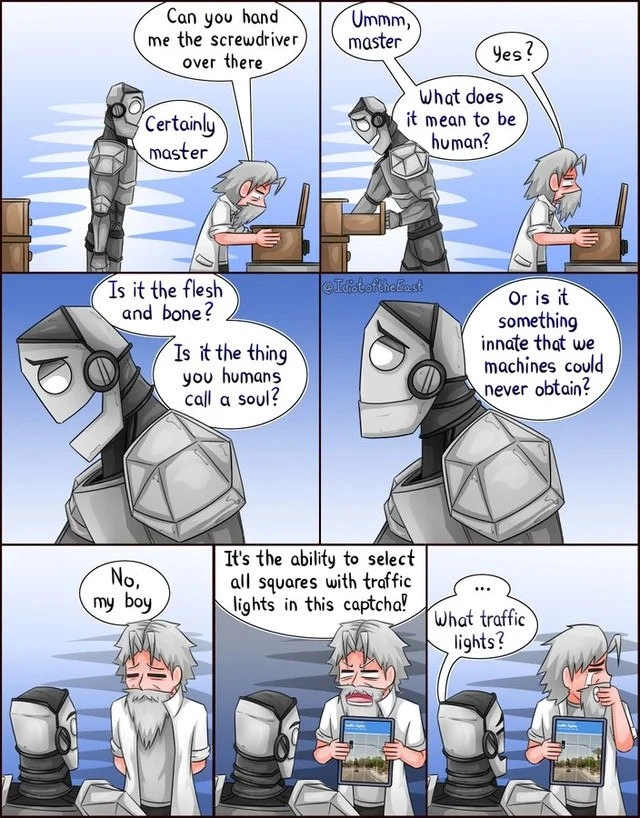
Let’s break down the scene and the tech references in more straightforward terms. In the comic, a human engineer and a helpful silver robot are working by the seaside. The engineer asks, “Can you hand me the screwdriver over there?” and the robot obediently says, “Certainly, master.” This establishes that the robot is pretty advanced — it understands language and can perform tasks. Then the robot pauses and asks, “What does it mean to be human?” This is the robot having an existential or philosophical moment (like a curious child asking a big question, but here it’s a machine asking its maker). The engineer is surprised (“Ummm, master” … “Yes?” cues that something unexpected is coming). The robot wonders aloud: is being human about having flesh and bone (a biological body)? Is it about having a soul (something spiritual or unique inside)? Or something innate (built-in) that machines could never have? These are big, heavy questions – what_is_humanity, basically.

Then comes the funny answer. The engineer facepalms (a classic gesture of oh no, here we go or frustration) and says, “No, my boy – it’s the ability to select all squares with traffic lights in this CAPTCHA!” He even holds up a tablet showing a grid of images – this is exactly the kind of CAPTCHA you’ve likely seen on websites. CAPTCHAs are those little tests like “Select all squares with traffic lights” or “Click all images that have a bus” that websites use to make sure you’re not a robot. In simple terms, a CAPTCHA is a security check. Websites don’t want automated programs (bots) spamming forms or creating fake accounts. So they give a test that a human can pass easily but a bot (or a robot) would struggle with. In older days, a common CAPTCHA showed you distorted text and asked you to type it out. Nowadays, the popular CAPTCHAs are image-based (called reCAPTCHA, a system originally developed at Carnegie Mellon University and now operated by Google). The “traffic lights” task is a prime example of an image CAPTCHA. You get a 3x3 or 4x4 grid of photos from real streets, and you must click every square that contains a traffic light (including tiny bits of a traffic light that might be in a corner!). If you do it correctly, the system concludes you’re likely human. If you mess up, it might give you another puzzle or fail the verification.

In the meme’s final panel, the poor robot stares at the tablet and says, “…What traffic lights?” It doesn’t see them at all. This implies that even though the robot is smart in many ways (it speaks, it reasons enough to ask about souls), it completely fails the captcha_struggle. It cannot perform this specific vision task that we humans find mundane. This is the crux of the humor: AI limitations are exposed by a simple challenge. The robot, representing artificial intelligence, is defeated by a bunch of everyday images.

From a junior developer perspective, this highlights how computers and humans still differ. As a developer, you might have learned that AI (artificial intelligence) and ML (machine learning) allow robots or software to recognize patterns and even identify images. For instance, you can train an ML model to recognize pictures of cats or traffic lights by showing it thousands of examples. However, these models aren’t perfect. They might misidentify things if the image is a weird angle, low quality, or something slightly off from what they’ve seen. Here, the CAPTCHA’s images are intentionally a bit pixelated and tricky. The robot hasn’t been explicitly trained to identify “traffic lights in small chopped-up photos with odd angles,” so it’s blind to them – hence the robot saying it sees no traffic lights at all (“What traffic lights?”).

For you and me (actual humans), picking out the traffic lights might be a minor annoyance, but it’s doable. We have general visual understanding: we know what traffic lights look like in different shapes and sizes, and we can infer that even if only a little piece is showing, it’s part of a traffic light. A machine, unless specifically trained to handle such partial images and context, might not catch that. That’s exactly why CAPTCHA challenges use these kinds of tasks – they exploit things that humans excel at but current bots do not.

Let’s also clarify why this is about security. Imagine you have a website and you don’t want bots (automated scripts) to overwhelm it. You put a CAPTCHA on your sign-up page. A human user will spend a few seconds to solve it and get through. A malicious bot, however, would need to solve it too, and that’s difficult without real AI vision capabilities or paying actual humans to do it. It’s like a gate that only humans can open easily. As a junior dev or someone new to web development, you’ll encounter CAPTCHAs either when using third-party services (like implementing Google reCAPTCHA on your site) or simply as a user. It’s a common task: “Prove you’re not a robot.” In fact, one version is literally a checkbox that says “I am not a robot.” When you check it, behind the scenes it’s analyzing your behavior (did you move the mouse like a human, etc.). If it’s unsure, then it gives you the image test (traffic lights or crosswalks, etc.).

Now, why do developers find this meme especially funny? Because it’s an AI humor double-layered joke. On one layer, it’s a robot soul-searching about humanity (which is a classic trope in sci-fi and tech circles). On the other layer, it’s a jab at how one of the hardest things for an AI to do is something we do when we’re half-asleep on a login page. The tags like HumanVsMachine and AILimitations are directly captured here: it’s humans 1, robots 0 in this particular game. Even though machine learning has beaten humans at chess, Go, and can drive cars, it gets flustered by a bunch of pictures of traffic lights. As a new dev, it’s a cool (and funny) example of how computer vision – a field of AI that trains computers to interpret and understand images – still has a long way to go to match the complex, general understanding that a real human has.

The scene by the sea, the friendly master-apprentice dynamic between the engineer and robot, and the facepalm are all storytelling devices to make the technical point accessible. The robot’s questions about “flesh and bone” and “soul” indicate it’s trying to grasp the intangible aspects of being human. Those are things even we humans debate about! But the engineer quips with a very tangible example – a task on a computer. It implies, “Forget the deep stuff; if you can do this one quirky task, you qualify as human in our book.” It’s an exaggeration, of course, but that’s what makes it TechHumor. You could imagine an earnest junior dev asking a senior, “How do we know our users are real people?” and the senior half-jokingly replies, “We give them a traffic light quiz. Real people struggle but pass. Bots just can’t (yet).”

So in summary, this meme is highlighting in a humorous way: what makes humans special in the age of AI is our ability to handle certain visual puzzles and ambiguity that machines currently can’t. It’s using the example of a CAPTCHA – something many of us have clicked through – to underscore that point. It teaches an underlying lesson too: if you ever implement a public-facing form, a CAPTCHA or similar human test can be crucial to keep the bad bots out. Just remember, even though it’s a simple concept, it stands on the frontier of what AI can and can’t do today.

Level 3: When Bots Hit a Red Light

For seasoned developers and techies, this comic hits on a familiar mix of frustration and irony. We’ve all been there — trying to log into a service or test a new feature, only to be confronted with “Please prove you’re human”. The specific instruction “select all squares with traffic lights” has become an inside joke in the tech community. It’s a quintessential HumanVsMachine showdown: even a cutting-edge robot (the kind an AI engineer might dream of building) gets stumped by a simple web CAPTCHA. The humor comes from the contrast in the setup. The robot asks a deep, almost philosophical question about humanity as if we’re in a sci-fi movie where the AI gains sentience. The bearded engineer even looks like a sage mentor, reminiscent of Geppetto and Pinocchio or a creator and his creation. You’d expect a serious answer about biology or the “thing you humans call a soul.” Instead, the engineer facepalms and delivers the punchline:

“No, my boy – it’s the ability to select all squares with traffic lights in this CAPTCHA!”

Cue the dramatic irony: the robot, who can probably calculate orbital trajectories or compile code in milliseconds, is left speechless staring at a grid of fuzzy street images. In the final panel, it asks “…What traffic lights?”— implying it completely fails to see them. This is classic AIHumor because it exaggerates a real limitation: current AI is notoriously bad at truly understanding images the way humans do. For developers, it’s a wink to all the times image_captcha_failure has made us question our own humanity. (How many times have you squinted at a CAPTCHA thinking, “Is that tiny corner a traffic light or not?” and then doubted yourself when you clicked wrong?)

The meme also satirizes the day-to-day security measures we grapple with. CAPTCHAs are a necessary evil in Security to keep out spam bots and scripts. As a senior dev, you know why they exist: without them, automated bots would create fake accounts, flood forms, or scrape data uncontrollably. We implement these tests to protect our sites, but we also curse under our breath when a CAPTCHA slows down our own workflow. This comic captures that absurdity: the ultimate gatekeeper for humanity online isn’t an epic philosophy or DNA test – it’s a low-res image quiz about traffic lights. It’s TechHumor gold because it’s so relatable.

Think about it: we’ve made amazing strides in AI/ML, yet one of the most reliable ways to tell a human user apart from a script is a task from a preschool workbook – find the object in the picture. The traffic_light_captcha in particular has a reputation. Developers joke that it’s the modern “entrance exam” to the internet. There’s even a running gag: if you fail a CAPTCHA, you momentarily wonder if you might secretly be a robot. The comic personifies that joke with an actual robot who cannot pass the test. It’s a lighthearted jab at how far AI still has to go, and at the same time, it’s poking us humans too – saying, “Look, the bar for being human online is so low that it’s literally this silly puzzle, and yet only we can do it.” The engineer’s facepalm is every developer who’s had to explain to non-tech folks, “No, the hardest part of launching our new feature wasn’t the coding or the cloud deployment – it was figuring out how to get past that darn CAPTCHA during testing.”

There’s also an embedded historical context here that senior devs appreciate. We remember earlier CAPTCHAs: text-based CAPTCHAs with squiggly letters and numbers that even humans had trouble reading (often impossible impossibly wavy text). As machine learning improved and bots learned to solve those, the challenges evolved. Google’s reCAPTCHA started using images of street signs, buses, and of course traffic lights – partly to train their self-driving car algorithms on the side. The meme’s author (@IdiotoftheEast) chose “traffic lights” specifically because it’s one of the most common (and infamously headache-inducing) prompts. Everyone who’s spent time on the web knows the tedium: click the wrong square or miss a tiny bit of traffic light hanging in one corner, and you get a new puzzle. It’s a tiny moment of defeat. Now imagine a robot—a symbol of high-tech perfection—facing that defeat. It’s comedic genius in a nerdy way.

In essence, this panel resonates with developers because it underscores a truth we joke about in private: for all the advanced algorithms, human intuition is still the gold standard for certain tasks. It’s AILimitations served with a side of humor. The robot_introspection angle (“Is it the flesh and bone? Is it a soul?”) spoofingly mirrors every AI ethics discussion, only to be undercut by a sysadmin’s reality: “Actually, we just click some pictures of traffic lights.” It’s a playful reminder that sometimes the simplest solutions (a goofy picture quiz) are our best defenses against high-tech threats. And that contradiction — trivial vs. advanced, human vs. machine — is what makes us crack a knowing smile.

Level 4: AI’s Kryptonite

At the deepest technical level, this meme pokes fun at a fundamental challenge in AI/ML: the gap between human visual perception and machine perception. The robot’s existential query — “What does it mean to be human?” — sets us up for a profound answer. Instead, the engineer’s punchline says true humanity is proved by solving a CAPTCHA with traffic lights. This is a sly nod to the Turing test in everyday form. In fact, CAPTCHA literally stands for Completely Automated Public Turing test to tell Computers and Humans Apart. It’s like Alan Turing’s famous idea of distinguishing humans from machines, but mass-produced on websites. Here the traffic_light_captcha is a mini Turing test using images.

From a computer vision standpoint, identifying all the tiny traffic lights in a gridded photo is deceptively hard for machines. Deep learning models (like convolutional neural networks) have become very good at recognizing objects, but they can stumble on things humans find obvious. Why? One reason is context and partial information: a traffic light might be split across two squares or obscured by pixels. A human brain effortlessly fills in those gaps using prior knowledge (we know what a traffic light looks like, even if we only see a corner of it). But a robot’s image classifier might treat each square in isolation, not realizing that a few colored pixels in one tile are part of a traffic light pole extending from another tile. This image_captcha_failure illustrates Moravec’s Paradox: tasks that are easy for humans (like vision) can be extremely hard for computers. The meme exaggerates it humorously — the robot_introspection about “flesh and bone” or a “soul” gets undercut by a mundane vision problem. It’s essentially saying: to be human, you need common sense vision.

There’s also a real security arms race behind this joke. Earlier CAPTCHAs showed warped text, but machines learned to read those (OCR technology improved), so creators moved to image identification CAPTCHAs. These are meant to be AI limitations as puzzles: distinguishing a blurry stoplight in a photo is something computers haven’t completely mastered yet. It’s almost an AI-hard problem, meaning if a machine could perfectly do it, it would imply human-level perception. So in a cheeky way, the meme claims “selecting all squares with traffic lights” is the pinnacle of human ability because it’s exactly what today’s AI often cannot reliably do. Until computer vision improves further (and it is improving every day), these CAPTCHAs remain AI’s kryptonite – trivial for a person, but a cue that stops a bot in its tracks. This humorously highlights a serious reality in Security: our web defenses literally rely on the subtle imperfections of machine learning. The robot’s blank “...What traffic lights?” response in the comic panel points to the failure of an otherwise advanced AI at a humble human task, emphasizing the intricate, almost poetic limit of algorithms. It’s a brilliant illustration of how even a sophisticated robot can be defeated by the kind of visual puzzle a toddler might solve — a modern twist on the Turing test where the tester is a simple grid of photos. And ironically, every time we humans solve one of these, we’re generating data to eventually train the AI to get better. The meme lives right in that tension: what’s easy for us, what’s hard for machines, and why that boundary defines “true humanity” in the digital age.

Description

This is a six-panel comic strip depicting a conversation between an elderly scientist in a lab coat and his humanoid robot. In the first few panels, the robot engages its creator in a deep, philosophical question: 'What does it mean to be human?' The robot speculates if it is about having 'flesh and bone,' a 'soul,' or something 'innate that we machines could never obtain.' The tone shifts abruptly in the final panels. The scientist, with a serious expression, dismisses the philosophical notions with 'No, my boy.' He then holds up a tablet displaying a classic image grid CAPTCHA and declares, 'It's the ability to select all squares with traffic lights in this captcha!' In the last panel, the robot stares blankly at the screen and asks, '...What traffic lights?', proving the scientist's point, who smugly sips from a mug. The humor is rooted in the subversion of a classic sci-fi trope. The profound question of human consciousness is ironically answered with a mundane, universally frustrating modern task. For developers, this is a multi-layered joke about CAPTCHA (a reverse Turing test), the historical challenges of image recognition for AI, and the absurdity of reducing the human experience to a bot-detection mechanism that often feels designed to fail everyone

Comments

8
Anonymous ★ Top Pick So our collective existential purpose is just to provide free, high-quality labeling for the training data of self-driving car models. Great
  1. Anonymous ★ Top Pick

    So our collective existential purpose is just to provide free, high-quality labeling for the training data of self-driving car models. Great

  2. Anonymous

    Before you declare AGI, see if it can pass the release pipeline’s final gate: a 16-pixel traffic-light CAPTCHA that’s harder than Go, protein folding, and migrating that 2007 XML schema - combined

  3. Anonymous

    We spent decades trying to pass the Turing test, only to discover that humanity's defining feature is arguing with other humans about whether that tiny sliver of pole counts as part of the traffic light

  4. Anonymous

    Descartes said 'I think, therefore I am.' Google revised it: 'I clicked all the crosswalks, therefore I am' - pending one more round because confidence was low

  5. Anonymous

    The ultimate irony: we've built AI systems that can drive cars autonomously, recognize faces with superhuman accuracy, and beat world champions at Go - yet we still gatekeep our websites with CAPTCHAs that half the time even humans can't solve. Nothing says 'humanity' quite like failing to identify whether that one pixel of a pole counts as part of a traffic light, while a robot contemplates the nature of consciousness. At this rate, the real Turing Test isn't whether machines can think like humans, but whether humans can still prove they're not machines to other machines

  6. Anonymous

    The modern Turing test: mislabel reCAPTCHA traffic lights fast enough that your OAuth token doesn’t expire - training the next-gen bot as collateral

  7. Anonymous

    AI crushes chess and code gen, but CAPTCHA grids? Still the great humbler of models and mobile devs alike

  8. Anonymous

    The modern Turing test is just a vague product spec: “select all squares with traffic lights” - humans pass by debating the off-by-one pixel and whether the pole is in scope

Use J and K for navigation