Skip to content
DevMeme
6639 of 7435
Game Dev Tutorial Pipeline to Lifelong Web Development Career
Career HR Post #7274, on Oct 14, 2025 in TG

Game Dev Tutorial Pipeline to Lifelong Web Development Career

Why is this Career HR meme funny?

Level 1: Careful What You Wish For

Imagine you just wanted to try something small for fun, and it turned into something big for a long time. For example, think of a kid who watches a cool video on how to bake a fancy cake. They only meant to bake one cake as a treat. But suddenly, that experience pulls them in, and they end up becoming a bakery chef who bakes cakes and bread every single day as their job! That’s a bit like what this picture is joking about. The teenager only wanted to make one video game after watching a tutorial, but unexpectedly they got sucked into a lifetime of doing web stuff (making websites) as a career. It’s funny and ironic because the teen’s dream was one thing (making a fun game), but the reality turned out to be something else much bigger (a whole career building things on the internet). In simple terms: be careful with a small wish – you might get a huge surprise along with it, just like a tiny hobby turning into your life’s work!

Level 2: Game Dev vs Web Dev

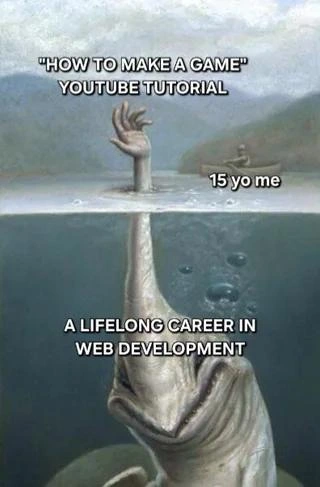
Let’s break down what’s happening in this meme and why it’s funny, in simpler terms. The image shows a 15-year-old (just an arm sticking out of the water labeled "15 yo me") reaching toward a YouTube video titled "How to Make a Game". This represents a teenager (maybe you, maybe any aspiring coder) who is trying to learn game development from an online tutorial. Game development means creating video games – for example, using a game engine like Unity or writing code that controls characters, graphics, and game rules. It’s something a lot of teens get excited about, because who wouldn’t want to make their own game, right?

Now, hidden just below the water’s surface in the image is a huge, dinosaur-like sea creature with text on it that says “A LIFELONG CAREER IN WEB DEVELOPMENT.” This is a metaphor (a visual way to represent an idea). Web development means building websites or web applications – basically the software behind the sites and apps you use on the internet every day. A lifelong career in web development means working for many years (possibly your whole professional life) as a web developer, writing code for websites and online services. In the picture, this big sea monster is about to chomp down on the unaware 15-year-old’s arm. It’s a funny way of saying: “You thought you were just going to learn how to make a game for fun, but surprise! That led you into doing web development for the rest of your life!”

Why would learning to make a game lead to a web development career? In real life, this happens more often than you’d think, which is why the meme is relatable to many developers. Here are some reasons and terms to know:

  • YouTube tutorial rabbit hole: This phrase describes how you can start with one innocent video and end up diving much deeper into a topic than you planned. For example, a teen might watch a Unity tutorial (Unity is a popular game engine, kind of like a toolkit for making games with pre-built physics and visuals). After that, YouTube’s algorithm might suggest videos on programming basics, maybe another on using JavaScript to make simple web games, and so on. Pretty soon, our 15-year-old has learned general coding skills, not just game tricks. This is the “rabbit hole” effect – one thing leads to many others. It’s like clicking an interesting link, then another, and suddenly hours have passed and you’re far from where you started.

  • Game dev vs. Web dev skills: Game development and web development share a common foundation: programming. You have to write logic and use languages in both. For instance, Unity uses C# as its coding language. A teen following a Unity game tutorial learns about variables, functions, and maybe how to move a character or detect collisions in a game. Those are core coding concepts. Guess what? The same concepts apply to web development too. Web developers use languages like JavaScript, Python, or Java to make websites work. The specifics differ – game dev might require math for 3D graphics or physics, while web dev involves things like designing a user interface and handling data requests – but coding is coding. Many developers discover that once they know how to code in one context, they can transfer that knowledge elsewhere. So our teen might start making a simple game, and a year later they find themselves using those coding skills to build a website (maybe for a school project, or to share the game online).

  • Career detour into web: The term career detour means ending up in a job path you didn’t originally plan. A lot of people who love games realize that getting a job in the game industry can be tough or limited in opportunities, whereas web development jobs are everywhere. Every company, from big tech to small business, needs websites and web apps. So, someone might begin with a passion for games but later take a web developer job because it’s available and pays the bills. They think, “I’ll do this for now,” and then 10 years later they’ve become very good at web development and it’s their full-time career. The meme humorously exaggerates this phenomenon by showing that huge sea creature labeled “a lifelong career in web dev” – meaning once it grabs you, you’re in it for the long haul!

To put it simply, the 15-year-old’s dream was to create games, but the reality turned into creating websites. The text at the top (“HOW TO MAKE A GAME” YouTube tutorial) is like the trigger – it’s how the journey started. The big creature below is the outcome that was waiting, unseen at first. The humor comes from that contrast: small start vs big outcome, fun hobby vs actual career.

Let’s clarify the two worlds being compared:

  • Game Development: This is the process of making a video game. It can involve programming, but also art, sound, and design. On the programming side, you might write code to control how a character moves, how physics works (so objects fall or collide realistically), or how enemies behave. Game dev often requires optimizing for performance so the game runs smoothly. Tools: Engines like Unity (uses C#) or Unreal Engine (uses C++), or even simple frameworks for 2D games. Example tasks: coding a player’s health system, spawning monsters, designing game levels.

  • Web Development: This means building applications that run on the web (internet). It typically has two parts: the front-end (what you see in the browser – built with HTML, CSS, JavaScript) and the back-end (the server and database behind the scenes, which can be built with languages like Python, Java, JavaScript/Node.js, etc.). Web developers create interactive pages, like forms to submit, buttons to click, content to display, and they make sure it all talks to servers correctly to get or send data. Example tasks: coding a signup form, making sure a website looks good on mobile, setting up a database for user accounts, or fixing a bug that causes a page to crash.

Now, it’s easy to see how someone can shift from one to the other, often without a clear plan. Learning to code is empowering, and once you know the basics, you might try different projects. A teenager might start with a game tutorial, but then perhaps they want to put their game online, so they learn a bit of web dev to create a simple site for it. Or maybe they join a coding club or class that leans more into web projects. Suddenly, they have both skill sets, and when internship or job time comes, there are a lot more openings for “Web Developer” than “Game Developer”. Over time, they become an expert in web tech like React (a popular JavaScript library for building user interfaces) or Node.js (JavaScript for back-end servers), even if that wasn’t the original plan. The meme captures this expectation vs. reality: expected “I’ll make cool games!”, reality “I’m maintaining a large web application.”

To visualize the difference, consider a snippet of what code in each domain might look like. For example, in game development with Unity (C# code) versus web development with JavaScript:

// Game dev (Unity C# example):
// Reduce the player's health when they collide with an enemy.
player.Health -= 10;
if (player.Health <= 0) {
    Debug.Log("Game Over!");  // This would print a game over message in Unity.
}
// Web dev (JavaScript example):
// Send a player's score to a web server (maybe to save high scores in a database).
function saveScore(score) {
  fetch("/api/score", {  // send an HTTP request to the "/api/score" endpoint
    method: "POST",
    body: JSON.stringify({ score: score })  // send the score data in JSON format
  })
  .then(response => response.json())
  .then(result => {
    console.log("Score saved:", result);  // log confirmation from the server
  });
}

In the Unity game code (above), we manipulate a game character’s health and check for game over – very much a game dev task. In the web code, we’re sending data to a server using fetch, which is a web API to make network requests – a web dev task. A 15-year-old might find the first snippet in a “make a combat game” tutorial. A decade later, they might be writing code like the second snippet to send data to a web service. The contrast is clear: one is dealing with game state and visuals, the other with web protocols and databases. Yet both involve writing logic in code and thinking like a programmer. That’s why moving from game dev to web dev is natural once you have the coding foundation.

The meme’s humor really clicks once you understand this scenario: a kid’s naive search for a game tutorial inadvertently sets them on a completely different career path. It’s like those stories of someone who tries a hobby and then it becomes their profession. Here the hobby was game programming, the profession became web programming. The “hand from the deep” image is a funny exaggeration – it implies the kid is being pulled underwater by something they never saw coming. Seasoned developers laugh because it’s a little true: few of us end up exactly where we thought we would when we started coding. Maybe you aimed to be a game designer and wound up a software engineer at a bank, or you wanted to build the next big app but spend most days fixing legacy website code. The DeveloperReality is often different from the dream, and this meme captures that with a wink.

Finally, the top text “HOW TO MAKE A GAME” being so high up (and in quotes) suggests it’s the lofty, idealistic goal the teen has, almost floating like a thought bubble. Far below, web development is literally a whole different world underwater, implying depth and complexity. In internet meme culture, whenever you see this format of a small thing above and a giant thing hidden beneath, it means “there’s a bigger, usually scarier thing you didn’t account for.” Here, web dev isn’t actually scary, but from a teen game enthusiast’s viewpoint, ending up a web developer for life is definitely a plot twist. The joke lands because the audience (developers on social media) knows how plausible and common this twist is. It’s a gentle roast of our own careers – we can laugh at how life took us on a different route than expected.

Level 3: Unity Dreams, React Reality

At first glance, this meme paints a dramatic scene: a lone hand labeled "15 yo me" reaches out of calm water toward a "HOW TO MAKE A GAME" YouTube tutorial, blissfully unaware of the gigantic prehistoric sea creature lurking just below. That creature, emblazoned with “A LIFELONG CAREER IN WEB DEVELOPMENT”, is seconds away from devouring the hand. Seasoned developers immediately recognize the dark humor: a teenager’s innocent ambition to build a game is about to get dragged under by the monster of real-world web development. It’s an absurd exaggeration, yet so many of us smirk (or groan) because we’ve lived a version of this story.

Why is this combination hilarious to industry veterans? It satirizes a common expectations vs. reality saga in tech careers. Many of us started coding in our teens, lured by the creativity and fun of game development. Maybe we followed a Unity tutorial on YouTube, dreaming of making the next Minecraft or a cool indie game. But before we knew it, that little tutorial had led us down a path of building business websites, e-commerce platforms, and corporate web apps for decades. The meme’s underwater predator format perfectly captures this career detour: the tiny visible goal (make a game for fun) hides the massive unseen outcome (becoming a professional web developer). It’s a visual “gotcha!” that resonates deeply with developers who chuckle and think, “Yep, that’s exactly how it happened.”

On a deeper level, the hand reaching up is a metaphor for youthful aspiration and curiosity. The monstrous sea creature stands in for the sprawling, all-consuming nature of modern web development. Today’s web dev ecosystem is enormous – think of endless JavaScript frameworks, npm packages, front-end, back-end, databases, DevOps, cloud deployments – a leviathan compared to a single tutorial. In fact, the creature could represent a Node.js node_modules folder: seemingly innocent at first, but dive deeper and it’s prehistoric in size and complexity, ready to swallow your time. The meme suggests that what starts as a simple hobby project (“Let’s make a cool game!”) can unexpectedly unleash the kraken of a full-blown tech career. It’s funny because it’s true: the tech sphere often has plans for you that you didn’t sign up for.

This pattern is a well-known relatable dev experience. Industry veterans have countless war stories of passion projects turning into lifelong jobs. Perhaps you tinkered with a game mod or a graphics demo in high school, only to find those programming skills were highly sought after by web startups. Before long, you’re deep in React components and CSS quirks instead of Unity scenes and Unreal Engine blueprints. The meme nails the irony: the skills you learned to make a game turned out to be the gateway into a web dev career you never expected. The text floating above (“HOW TO MAKE A GAME” tutorial) is like the bait, and the web dev career is the hungry beast beneath the surface, an unstoppable current pulling you into an ocean of JavaScript. This is often called the “YouTube tutorial rabbit hole” – you go online to learn one fun thing and end up neck-deep in a completely different but related field. The tutorial’s algorithm might even feed you “Learn HTML in 1 hour” next, and down you go!

From a senior engineer’s perspective, there’s also bittersweet nostalgia here. The tag DeveloperNostalgia fits because many of us remember being that 15-year-old dreamer. We recall our first game dev experiments – maybe writing a simple platformer, or following a tutorial to make a Pong clone. Those were exciting, imaginative times. Fast forward a decade or two, and we’ve spent years maintaining web forms, APIs, and databases. It’s not that web development is bad (it’s a rewarding career for millions, including presumably the meme’s creator), but it’s often not the glamorous game design our younger selves imagined. There’s a shared understanding of “how did I end up here?” The humor comes with a nod and a wink: we’ve all been there, kid.

The meme’s surreal underwater imagery is also a popular format in online humor (sometimes called the underwater hand meme format). It usually depicts something unsuspecting on the surface and a much larger, scarier thing hidden below. In this case, a whole career in web dev is the scary surprise waiting beneath a calm curiosity. Technically speaking, the juxtaposition is brilliant: Game Dev vs Web Dev is a huge jump in scope. Game development is often seen as an exotic, highly specialized craft – involving graphics engines, physics simulations, gameplay logic. Meanwhile, web development started out as building simple websites, but over decades it evolved into a monster of its own, with complex architectures and decades of real-world web work involved. The meme exaggerates that evolution by portraying the web career as a prehistoric beast consuming the naive gamer ambition. It’s a bit of dark humor about the reality of careers in tech: you might set sail toward one island and end up colonizing another continent entirely.

Let’s break down the satire with a comparison that senior devs will appreciate:

Teenage GameDev Dream Adult WebDev Reality
“I’ll build awesome 3D worlds in Unity!” Builds yet another responsive UI in React.
Imagining a career at a game studio (EA, Nintendo) Actually working at a web agency or IT department.
Focused on levels, bosses, and game physics Focused on pages, users, and browser quirks.
Final boss: a dragon or Bowser in the last level 🐉 Final boss: an Internet Explorer 11 bug 🐛 (the horror!)
Uses C++/C# with a game engine Uses JavaScript/TypeScript with a web framework
Dreaming of players having fun in your game Realizing millions use your web app to file tickets buy products

In each row, the left column is what 15-year-old me might have envisioned, and the right column is the tongue-in-cheek outcome. For example, instead of slaying dragons in a fantasy game, many of us ended up slaying bugs in production code. The “Final boss: Internet Explorer 11 bug” line gets a knowing laugh from experienced web developers – historically, making sites work on old versions of Internet Explorer was a nightmare rivaling any video game boss fight. React, Angular, Vue – these became our tools and weapons, replacing the Unity or Unreal engines we originally wanted to master. The table highlights the shift from the playful, self-contained world of game dev to the ubiquitous, user-driven world of web dev. It’s the classic career expectations vs. reality inversion that senior devs find both funny and a tad bittersweet.

Another layer here is how learning to code often leads you to unexpected places. The meme’s caption implies that just searching “How to make a game” set off a chain reaction resulting in a full-blown career. This hints at how transferable programming skills are. You start with game logic, which teaches you programming fundamentals (loops, conditions, object-oriented design). Those skills are just as useful for building web applications. Perhaps the teenager learned C# for Unity, then discovered that knowledge could be used to write C# on the back-end of a website (with ASP.NET), or picked up JavaScript to create an online scoreboard for their game, and suddenly they’re good at web stuff. One thing leads to another – next thing you know, you’re more proficient at making dynamic websites than games. The tech industry has a way of funneling talent to where it’s most in demand. Web development, especially over the past two decades, has been a giant magnet for developers of all backgrounds because every company needs a web presence.

From a career perspective (a nod to the Career_HR category), this meme also pokes fun at how our learning journey can steer our professional life. It’s common in job interviews or developer meetups to hear, “I actually started out trying to make games…”. People laugh and bond over how their LearningToCodeJourney zigzagged. HR might see a resume that lists a teenage game mod project at the bottom, and then years of web development jobs after. The meme humorously encapsulates all those detours into one image: the game-dev aspiration is literally swallowed whole by the web-dev career. It’s a relatable developer reality that your career might not follow the path your 15-year-old self imagined – and that’s okay, even if it’s ironic.

In summary, this meme lands so well with experienced engineers because it reflects a collective experience: youthful enthusiasm meeting the tidal wave of real-world need. It’s a playful warning and an inside joke. Be careful what you search for on YouTube, it seems to say, you might accidentally summon a career! The contrast between the innocence of “how to make a game” and the enormity of “lifelong web development” is exaggerated for comic effect, but it carries a kernel of truth that makes tech veterans chuckle (or sigh). After all, many of us went looking for a fun creative outlet and found ourselves wrestling with web servers and database migrations at 2 AM. The meme’s genius is capturing that entire journey – from Unity dreams to React reality – in one striking, funny image.

Description

A meme showing a drowning person reaching up from underwater. At the surface, a small boat is labeled '"HOW TO MAKE A GAME" YOUTUBE TUTORIAL'. The person in the water is labeled '15 yo me'. Below the surface, an enormous sea creature pulling them down is labeled 'A LIFELONG CAREER IN WEB DEVELOPMENT'. The meme captures the common developer origin story: starting with dreams of making games as a teenager, following a YouTube tutorial, but inevitably ending up in web development as a career. The underwater creature represents how web dev swallows you whole and never lets go

Comments

17
Anonymous ★ Top Pick Every web developer's career started with 'I'll just learn HTML to make my game's website' and ended 15 years later still arguing about whether to use React or Vue
  1. Anonymous ★ Top Pick

    Every web developer's career started with 'I'll just learn HTML to make my game's website' and ended 15 years later still arguing about whether to use React or Vue

  2. Anonymous

    Many of us chased the dream of creating epic RPGs, only to spend our careers fighting an even more terrifying final boss: the webpack config

  3. Anonymous

    Amazing how a single Unity tutorial tab evolves into twenty years of arguing over CSS specificity and whether ‘fetch’ should live behind a service layer

  4. Anonymous

    Started with Unity tutorials at 15, ended up debugging CSS flexbox at 35 while your game engine license expired three companies ago and your Steam library judges you silently

  5. Anonymous

    Started with Unity tutorials at 15, now I'm debugging CSS grid layouts and explaining why we can't just 'make it like the Figma' to stakeholders. The game I'm building is called 'Enterprise SaaS Platform' and the final boss is a legacy jQuery codebase

  6. Anonymous

    Watched a 10‑minute Unity tutorial; spent the next decade debating SSR vs CSR, shaving 20ms off LCP, and fighting the final boss called scope creep

  7. Anonymous

    Clicked game tutorial at 15; by 30, you're the kraken debugging CSS animations cross-browser while the real game ships on itch.io

  8. @pooyabehravesh 9mo

    I just wanted to put an image in my blog 14 years ago. And now here i am

  9. @DavidGarciaCat 9mo

    I can't remember what language I used first to build 4 games following tutorials, and now I'm a "Jack of all trades" or a specialist depending on the company hiring me

  10. @Aqualon 9mo

    I started learning lua for uopilot. Well, now I reimplemented everything I needed from uopilot in lua so I don’t have to use the uopilot anymore. However, lua is my favorite language now, so it kinda feels like this meme template.

  11. @Algoinde 9mo

    i started with trying automating facebook flash games using clicker scripts...

  12. @seyfer 9mo

    True story

  13. @Art3m_1502 9mo

    >Made a doodle jump clone for test task >Was not employed because there was 400 other people who wanted that internship >Understood there's almost no vacancies for game developers and I will do either casino or mobile trash games >Became embedded developer because still like C/C++

  14. @echelonka 9mo

    I wanted to become a web designer but couldn't find freelance work because i didn't have portfolio. Learned the basics to create pages from my own designs and here I am..

  15. @mihanizzm 8mo

    I just liked Scratch lessons in my school😅

  16. @Gopro_na_nozhkah 8mo

    Started from learning gamedev without code, and now I'm learning cyber security

    1. @illuminaticateye 8mo

      Same here btw

Use J and K for navigation