Clickbait Journalism Discovers Off-By-One Errors
Why is this Bugs meme funny?
Level 1: One, Two, Three... Oops!
Imagine you have 3 toy cars lined up and counted: one, two, three. Now, if someone asks for the 4th toy car, you’d look around and say, “Huh? There isn’t a fourth one!” You only have three. In coding, a list works the same way. If a list has 3 items and the program asks for item number 4, the computer gets confused because there is no item there – that’s an error. This meme makes a joke out of that simple mistake. It’s like a silly kid’s riddle where a person promises to show you 3 cool things, but then says, “and the 4th one will surprise you!” You’d probably giggle and think, “Wait, do they even know how to count? They said three things, why are they talking about a fourth?” 😄 The humor comes from that little counting mix-up. Everyone learns that you shouldn’t try to grab a toy that isn’t there – and in programming, we learn not to ask for an item beyond the end of the list. It’s a funny way to remember: count carefully, or you might end up looking for a “number 4” that doesn’t exist!
Level 2: Out of Bounds
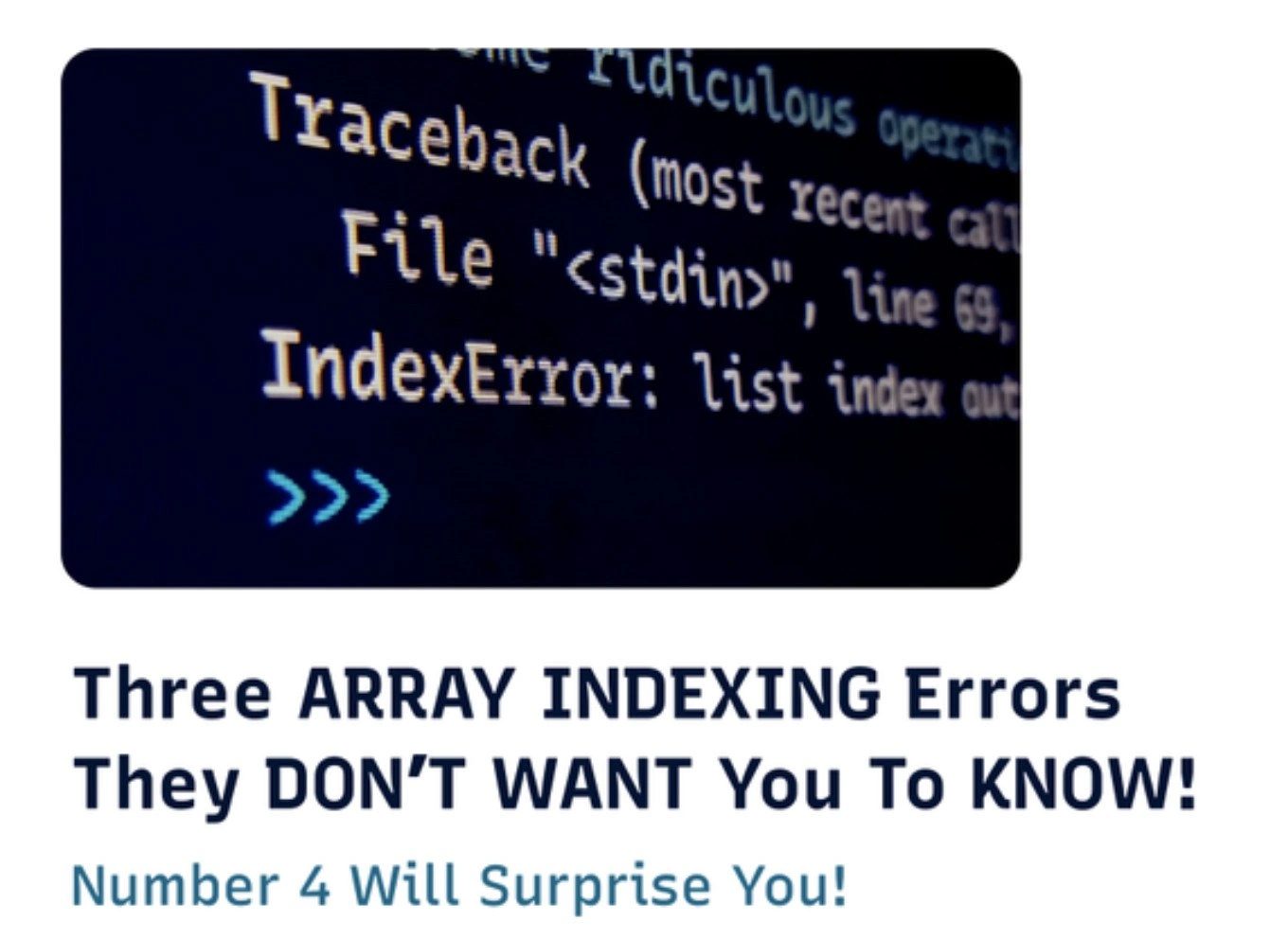
Let’s break down what’s happening in this meme. First, the image shows a Python error message – specifically a traceback from the Python interpreter. A traceback is that multi-line error dump you see when your Python code crashes. It tells you what went wrong and where. In this case, it says: IndexError: list index out of range. In Python, an IndexError is a type of exception (runtime error) that is raised when you try to access an index in a list (or array) that doesn’t exist. “List index out of range” literally means you asked for a list element beyond the range of what’s available. For example, if you have a list of 3 items, valid indices are 0, 1, and 2. Index 3 would be "out of range" (since you'd be trying to get a fourth item from a three-item list). Python immediately stops the program and throws this error to let you know you made a mistake with your indexing. This is a common bug during development – one of those classic mistakes every coder makes while learning or even later when they’re not careful. It often happens due to off-by-one errors, which are little mistakes in arithmetic or loop boundaries where you overshoot by one.
Why do these index errors happen so often? A big reason is how zero-based indexing works. Most programming languages (like Python, C, Java, JavaScript…) use zero-based indexing, meaning the first element of a list is at index 0. This is a bit counter-intuitive at first, since humans usually count starting at 1. If you’re not mindful, you might assume the first item is index 1, or that the length of the list is the last index – but actually the last index is length-1. For instance, say you have my_list = ['apple', 'banana', 'cherry']. my_list[len(my_list)] will cause an IndexError, because len(my_list) is 3, and my_list[3] is asking for a fourth item (since the three items are indexed 0,1,2). The correct last index here is 2 (len(my_list)-1). It’s an easy arithmetic slip to make! Anytime your code miscalculates an index (even by 1), you get a list_index_out_of_range error. Common scenarios include loops that iterate one time too many or using a wrong comparison in a loop (<= instead of < in some languages), or just misunderstanding a language’s indexing system.
The meme’s text plays with this concept in a humorous way. It presents a fake headline: “Three ARRAY INDEXING Errors They DON’T WANT You To KNOW!” and then right below it: “Number 4 Will Surprise You!” in a flashy sub-headline. This mimics those clickbait articles on the internet. Clickbait means using sensational or misleading titles to get people to click a link (“They don’t want you to know” implies some secret authority is hiding information, which in this context is just silly – nobody is hiding the facts of array indexing!). The headline lists "Three errors" but then immediately mentions a "Number 4". That doesn’t make sense unless the author of the headline mis-counted the items of their list. And ta-da! – that’s exactly the joke. The headline itself contains an off-by-one error (saying three but indicating a fourth) as a nod to the exact type of bug being shown in the screenshot. It’s a self-referential joke: the content about indexing errors has an indexing error.
For a newer developer, the takeaway is: array_indexing errors like this are super common and nothing to be ashamed of. You run a loop incorrectly or use a wrong index and boom – you hit an IndexError in Python (or a similar error in other languages, e.g., "Array Index Out Of Bounds"). It’s part of the learning process in debugging. The meme is just exaggerating it with a funny “Ultimate Guide” style headline for laughs. In reality, avoiding these errors just means carefully checking your indices. For instance, if you had code like:
values = [1, 2, 3]
# len(values) is 3, but valid indices are 0, 1, 2
print(values[len(values)])
# This will raise IndexError: list index out of range,
# because values[3] is asking for the 4th item when only 3 exist (indexes 0-2).
Here we explicitly tried to access values[3] even though the last index is 2. Python throws the error just like the one shown in the meme’s traceback. In a real debugging session (debugging_troubleshooting 101), seeing that IndexError message and the line number (e.g., line 69 in the meme’s case) tells you exactly where to look in your code. You’d realize, “Oops, I’m going one index too far!” and then fix your loop or index arithmetic (maybe change that <= to < or use len(values)-1 if you truly need the last index).
The clickbait_headline style “Number 4 Will Surprise You!” is just there to be goofy. Imagine an article claiming to reveal secret software bugs – it’s poking fun at how some blogs label very common knowledge as “secrets” for the sake of clicks. In truth, no shadowy figure is preventing you from learning about zero-based indexing 😅. And the “surprise” Number 4 item would likely be something obvious or anticlimactic – if it existed at all. The meme is basically saying: We programmers even find a way to mess up counting in our tech memes! So, the image resonates with developers because it’s tech humor about a scenario they’ve encountered many times – and it teaches a mini-lesson: always be careful with your index boundaries.
Level 3: Clickbait Counting Conspiracy
Every seasoned developer has encountered the dreaded IndexError: list index out of range in Python. This meme takes that universal debugging frustration and dresses it up in sensational clickbait clothing. The top half shows a classic Python traceback in a terminal: "Traceback (most recent call last): ... IndexError: list index out of range" – basically Python yelling "Hey, you're asking for an item that doesn't exist!" The bottom half then parodies those cringy tech articles with a bombastic headline: “Three ARRAY INDEXING Errors They DON’T WANT You To KNOW!” followed by “Number 4 Will Surprise You!” in flashy blue. The humor here is a multi-layered in-joke for developers: the meme is literally about an indexing bug, and the headline itself contains an indexing mistake. They promised three errors, yet tease a fourth item – a cheeky off-by-one error in the headline count. It’s like the meme author deliberately mis-counted the list of mistakes, embodying the very bug it’s joking about. Irony level 9000.
So why is this so relatable? Because array indexing bugs and off-by-one errors are incredibly common in real life programming. If you've ever written a for loop that iterates one time too many or accessed myList[len(myList)] by accident, you've seen that exact IndexError. It usually hits you at runtime, often during a rushed debugging_troubleshooting session. Maybe it was 3 AM, you were a tired on-call engineer poring over a failing script, only to realize you iterated 6 times for a 5-element list 😤. This error is basically a rite of passage in Python (and in many other languages, where it might be called "ArrayIndexOutOfBoundsException", or just cause a crash). Seasoned devs have been bitten by it countless times, so an image of that Python traceback triggers instant flashbacks of past bugs. We’ve all muttered under our breath "Ugh, index out of range... here we go again" while debugging.
The meme brilliantly combines that tech failure with the style of a clickbait headline. Phrases like “They DON’T WANT You To KNOW” and “Will Surprise You” mimic those obnoxious online ads and fake tutorials. In reality, there’s no shadowy “They” hiding the truth about array_indexing errors – nobody is conspiring to keep newbies in the dark about zero-based indexing 🤪. But framing it that way pokes fun at how even the most mundane programming mistake can be sensationalized. It’s poking at the trend of developer humor blog posts listing “Top 10 Coding Mistakes” in a pseudo-dramatic way. Coding memes love to mash up serious tech with absurd presentation, and here you have a trivial Python bug treated as if it’s a forbidden secret from Big Tech™. The veteran coder in us chuckles because we’ve seen countless listicles about “common bugs”, and none of it is secret knowledge – we all know bugs_in_software like this just come from being human (or off-by-one when counting 😂).
Another wink for the initiated is that famous line number 69 in the traceback. The code error is shown at line 69 (nice). Let's be honest, meme makers often sneak the number 69 (or 42) into examples for a little extra nerd giggle. It’s an Easter egg of irreverence—because of course the IndexError happens on line 69 of all places. A cynical, battle-worn engineer might smirk and think, "Figures… even the line number is a joke."
All in all, the meme hits home because it highlights a universal gotcha in programming (going out-of-bounds on a list) and exaggerates it with a clickbait_headline format. It’s the contrast between the mundane reality of a IndexError and the over-the-top presentation that creates the comedy. We laugh, a little self-deprecatingly, because we’ve all been the person who off-by-one’ed and crashed something. And maybe we also laugh at how the tech content world sometimes turns these basic mistakes into sensational articles for developer humor. After all, if zero_based_indexing and proper loop bounds are the “forbidden knowledge they don’t want you to have,” then every programmer is basically a rebel truth-seeker 😂. The surprise “Number 4” in a list of three? That’s just the meme twisting the knife – an extra serving of indexing irony for those of us who know exactly how it feels when a program asks for an item one step too far.
Level 4: Zero-Based Universe
Under the hood of array indexing, there's a whole philosophy of how computers count. In programming, we live in a zero-based universe – meaning we start counting from 0 instead of 1. This isn't just a random quirk: it's rooted in how memory is addressed. If an array begins at memory address M, the element at index i is at address M + i * size. So the first item is at M + 0 – index 0. This elegant simplification (no need for off-by-one arithmetic in pointer calculations) is why languages like C, Java, and Python use zero-based indexing. Legendary computer scientist Edsger Dijkstra even wrote about why counting from 0 is more natural for computing. Yet this mathematical purity sets a trap for our human brains, which are so used to counting from 1.
The result? Off-by-one errors become the eternal gremlin of coding. An off-by-one error is when a loop runs one time too many or too few, or an index is shifted by one. It's sometimes called the fencepost problem – like building a fence and miscounting the posts needed by one. This isn’t just academic trivia; it’s a real concern in program correctness. If your code goes beyond the bounds of an array, you might be reading unallocated memory or overwriting data. In low-level languages (like C/C++), accessing an array out-of-range can lead to memory corruption or security vulnerabilities. (Famously, the Heartbleed bug in OpenSSL was essentially an out-of-bounds read – reading more data than the buffer should allow, all due to a missed check on a length field!). In higher-level languages like Python, we’re lucky – the runtime stops us with an exception instead of corrupting memory. A runtime error (IndexError) is a safer failure: it loudly tells you “that index doesn't exist” rather than proceeding with dangerous nonsense.
Even with guardrails, the prevalence of index mistakes is so high that it’s a running joke in computer science. We have tongue-in-cheek maxims about it. One famous joke goes:
"There are only two hard things in Computer Science: cache invalidation, naming things, and off-by-one errors."
Notice how that quote itself has an off-by-one error in the numbering! The humour lands because anyone deep in CS theory or systems programming knows how deceptively tricky boundary conditions are. We formally prove algorithms correct and design type systems to avoid errors, yet a simple fencepost error can crash a program. This meme’s exaggerated headline — "Three errors... Number 4 will surprise you!" — is a nod to that perennial struggle. It satirically suggests that even an article about index errors might fall victim to the very same error by mis-numbering its list. In theory, we strive for programs where such bugs are impossible (through rigorous testing, formal verification, safe languages). In practice, the occasional off-by-one slips through, reminding us that software bugs often have humble origins in basic arithmetic.
Description
This meme satirizes clickbait article headlines by applying them to a common programming error. At the top, there is a screenshot of a Python traceback in a dark terminal window, showing a classic 'IndexError: list index out of range' on line 69. Below the image, a headline in a bold, sans-serif font reads: 'Three ARRAY INDEXING Errors They DON'T WANT You To KNOW!'. A smaller, blue sub-headline underneath adds the punchline: 'Number 4 Will Surprise You!'. The humor is layered for developers. First, it mocks the sensationalism of online content by treating a fundamental concept like array indexing as a hidden secret. Second, it contains a logical contradiction ('Three Errors... Number 4'), which perfectly parodies the nonsensical nature of clickbait. For any experienced programmer, an IndexError is a basic, everyday bug, making its presentation as a shocking revelation deeply ironic and relatable

Comments
8Comment deleted
The fourth type of array indexing error is when you realize the array was actually a null pointer all along, and the real error was your optimism
Clickbait promises 3 array-indexing mistakes, then immediately reaches for #4 - marketing finally nailed a live demo of off-by-one in O(1) time
After 20 years in this industry, I've learned that off-by-one errors are just the universe's way of reminding us that the real bug was choosing zero-based indexing in a species that starts counting on fingers at one
The two hardest problems in CS: cache invalidation, naming things, and off-by-one errors - number 4 will surprise you
The real IndexError here is promising three errors but delivering 'Number 4' - a meta-commentary on off-by-one bugs that would make any senior engineer simultaneously groan and appreciate the recursive irony. It's the programming equivalent of a self-referential paradox: a meme about array indexing errors that itself commits an indexing error, perfectly capturing how these bugs propagate through codebases when developers don't validate their boundary conditions. The cherry on top? Line 69 - because of course it is
“Three array indexing errors they don’t want you to know” - spoiler: #4 is out of bounds, #0 wasn’t counted, and #−1 works in Python until someone rewrites it in Java
Number 4: That 'simple' list[-1] in your sharded cache lookup, silently partitioning your cluster at scale
Marketing promised three indexing errors, then teased “Number 4” - Python politely demonstrated why zero-based arrays and business counting don’t compose, via IndexError