
The Engineer's Non-Committal Commitment
Description
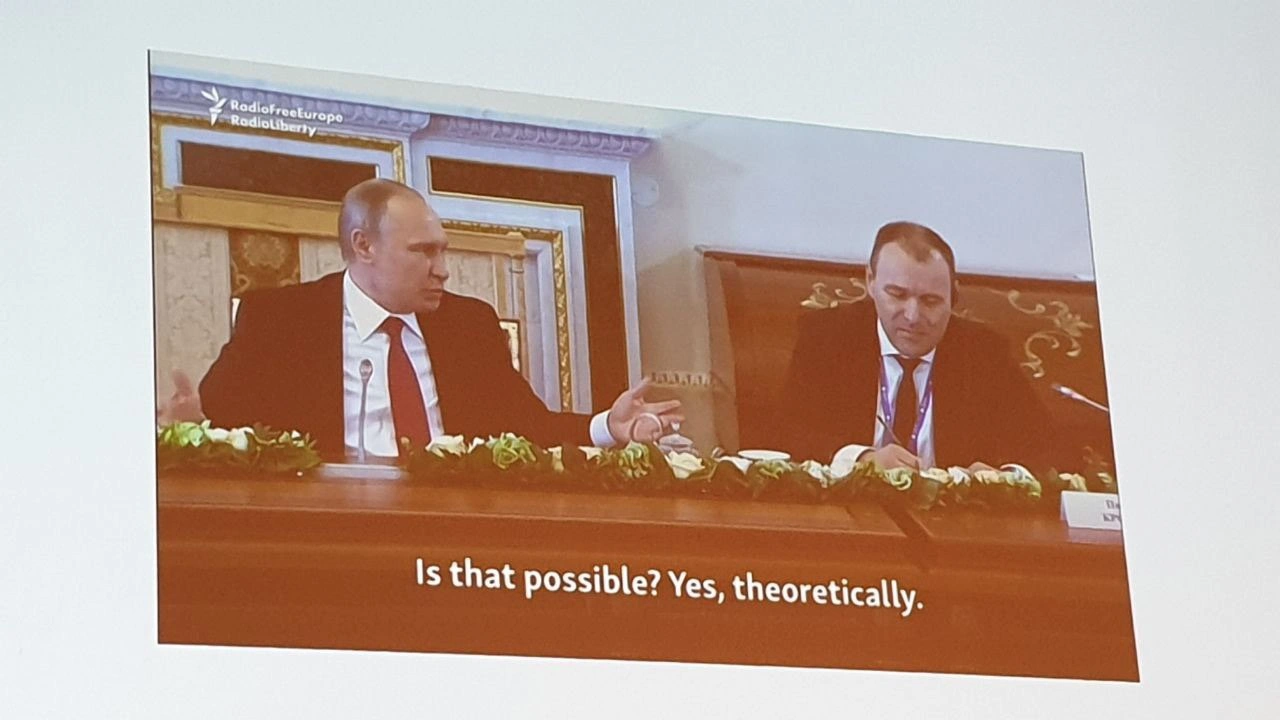
A screenshot from a news video, featuring Russian President Vladimir Putin at a formal meeting table, gesturing with his hand while speaking to a colleague. The setting is ornate with gilded wall panels. The image is captured from a screen at a slight angle. Prominent English subtitles at the bottom read, 'Is that possible? Yes, theoretically.' The 'RadioFreeEurope RadioLiberty' logo is visible in the top-left corner. The humor lies in the application of a classic developer phrase to a geopolitical context. For senior engineers, 'Yes, theoretically' is the standard, cautious response to a product manager's ambitious feature request, perfectly encapsulating the vast gap between what is possible in a perfect world and what is practical to implement given time, budget, and system constraints





Comments
7Comment deleted
That's my response when asked if the CI/CD pipeline will work on the first try. Theoretically, yes. Practically, I've already blocked off my calendar for the next three hours to debug it
The PM heard “theoretically possible” and immediately booked the release party - meanwhile the architect quietly spun up a new Jira epic titled ‘Rewrite the Universe.’
"Yes, theoretically" - the senior engineer's way of saying "it's possible if we ignore security, scalability, maintainability, the laws of physics, our entire tech stack, and the fact that Dave from infrastructure will definitely quit if we try this."
Every senior engineer knows this moment: when the whiteboard algorithm works perfectly in O(log n) time, but production has legacy systems, compliance requirements, a database that can't handle the load, three different API versions to support, and the intern who wrote the original implementation left no documentation. Sure, it's theoretically possible - right after we refactor the monolith, migrate to microservices, get budget approval, and convince the team that 'it works on my machine' isn't a deployment strategy
In distributed-systems speak, “Yes, theoretically” means “after you pick a side of CAP to sacrifice, double the SRE headcount, and triple the budget.”
Architect’s translation of “Yes, theoretically”: with eventual consistency, cross‑region replication, zero‑downtime schema changes, unlimited budget - and a time machine - absolutely
Yes, theoretically - until the legacy monolith and CAP theorem remind us why we bill by the hour