Skip to content
DevMeme
7382 of 7435
Sales Promises Three Weeks, Engineer Says Months: Work Chronicles Classic
Stakeholders Clients Post #8091, on Jun 10, 2026 in TG

Sales Promises Three Weeks, Engineer Says Months: Work Chronicles Classic

Why is this Stakeholders Clients meme funny?

Level 1: Promising Someone Else's Homework

A kid is selling lemonade, and a customer asks, "Do you have mango juice?" The kid's little brother says "no, we don't" — but the kid shouts "YES! And my brother will squeeze it fresh in five minutes! He's the best squeezer on the street!" The brother tries to explain there are no mangoes, that mangoes don't even grow here, and the kid just hisses "shut up!" while smiling at the customer. It's funny because one person gets the money for the promise, and a totally different person has to somehow find the mangoes — and everyone watching the comic has, at some point, been the brother.

Level 2: Pre-Sales Calls and the Art of the Steamroll

Decoding the workplace mechanics for those who haven't yet been invited to their first customer call:

  • Prospect: a potential customer who hasn't signed yet — which is why everything said in front of them is performance.
  • Pre-sales call: a meeting where sales brings an engineer along to "answer technical questions." The engineer's actual function, they soon discover, is to nod while features are invented in real time.
  • Vaporware: software that is sold and marketed but does not exist. The collaboration feature in this comic transitions from "no" to "three weeks away" within thirty seconds of dialogue — a development velocity only achievable in speech.
  • Estimates: an engineer's "couple of months" already includes design, testing, and edge cases. Sales' "3 weeks" includes none of those — it's reverse-engineered from whatever the customer wants to hear.
  • The phrase "for you, we'll do it in 3 weeks" is a classic closing move: it reframes an impossible deadline as a personal favor, making the customer feel special and the engineer feel expendable.

The early-career lesson: when your timeline gets contradicted in front of a customer, the argument is no longer technical. Get the real commitment in writing afterward — and start documenting why three weeks was never real, because in week four, someone will ask what you did wrong.

Level 3: The Roadmap Is Whatever Sales Said Yesterday

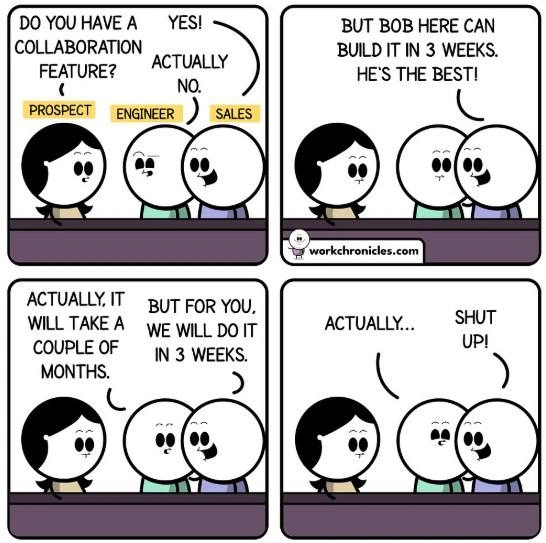
Four panels, labeled cast — PROSPECT, ENGINEER, SALES — and a complete taxonomy of how vaporware gets sold. The prospect asks "DO YOU HAVE A COLLABORATION FEATURE?" and the strip's first masterstroke is simultaneity: the engineer's "ACTUALLY NO." and the salesperson's "YES!" occupy the same panel, the same instant, the same customer-facing moment. That's not two answers to one question; that's two incompatible ontologies of truth. To engineering, "do you have X" is a question about the codebase. To sales, it's a question about the deal — and the deal-correct answer is always yes.

The escalation sequence is painfully precise. Panel 2 deploys the human sacrifice: "BUT BOB HERE CAN BUILD IT IN 3 WEEKS. HE'S THE BEST!" — note that flattery in front of a customer is load-bearing here. Bob can't dispute the timeline without also disputing being the best, a trap so elegant it should be patented. Panel 3 stages the doomed correction attempt — "ACTUALLY, IT WILL TAKE A COUPLE OF MONTHS." — steamrolled mid-sentence by "BUT FOR YOU, WE WILL DO IT IN 3 WEEKS," the for you implying a discount on the laws of physics. Panel 4 abandons all subtext: "ACTUALLY..." / "SHUT UP!" — delivered, in the drawing, through a maintained customer-facing grin.

What the comic understands about organizational incentives is why it stings. Sales is compensated on closing, on a quarterly clock. Engineering is accountable for delivery, on a reality clock. The salesperson who promises three weeks gets their commission at signature; the engineer inherits a two-month project with a three-week deadline, a customer contract as the acceptance test, and the blame when "Bob's feature" slips. This is how demo-driven development is born: the feature now must exist in some form by week three, so what ships is a hardcoded façade — a "collaboration feature" that works for exactly the demo script and two concurrent users named in the test fixtures. The estimate wasn't negotiated; it was announced, and engineering's correction was treated as a PR problem rather than a data point. Every B2B engineer has been Bob. Most of them were also told, afterward, that they "need to work on their customer presence."

Description

A four-panel Work Chronicles webcomic (workchronicles.com). Panel 1: a prospect with dark hair asks "DO YOU HAVE A COLLABORATION FEATURE?"; the engineer answers "ACTUALLY NO." while the salesperson simultaneously shouts "YES!" Panel 2: the salesperson, beaming, adds "BUT BOB HERE CAN BUILD IT IN 3 WEEKS. HE'S THE BEST!" while the engineer looks alarmed. Panel 3: the engineer clarifies "ACTUALLY, IT WILL TAKE A COUPLE OF MONTHS." but the salesperson talks over him: "BUT FOR YOU, WE WILL DO IT IN 3 WEEKS." Panel 4: the engineer starts "ACTUALLY..." and the salesperson snaps "SHUT UP!" with a forced grin. The comic captures the eternal conflict where sales commits engineering to vaporware features and impossible deadlines in front of customers, a rite of passage for anyone who has joined a pre-sales call


Comments

3
Anonymous ★ Top Pick Sales-driven development: the roadmap is whatever was said on the last customer call, and the estimate is whatever closes the deal
  1. Anonymous ★ Top Pick

    Sales-driven development: the roadmap is whatever was said on the last customer call, and the estimate is whatever closes the deal

  2. @crysknight 4w

    What is it, a normal dev meme without any necessary relation to AI? T-s-s, endangered species, everybody, don't disturb this beautiful creature

    1. Егор 4w

      It’s not even a meme, it’s just everyday life.

Use J and K for navigation