Skip to content
DevMeme
5991 of 7435
Engineer's Reality vs. PM's Promises
Management PMs Post #6560, on Feb 27, 2025 in TG

Engineer's Reality vs. PM's Promises

Why is this Management PMs meme funny?

Level 1: The Surprise Promise

Imagine you’re in class working on a group project. You haven’t finished your part yet, and you know it’s going to take at least two weeks to do a good job. But then, in a big meeting, your friend (who is kind of like the team leader) stands up and tells the teacher and the whole class, “We’ll have the entire project ready by next week!” You hear this and your eyes go wide. You’re thinking, “There’s NO way we can get it done that fast!” You feel like the floor just dropped out from under you – your hands might even go to your head in panic. Meanwhile, your friend is standing there smiling confidently, as if nothing is wrong and it’s a done deal.

This meme is poking fun at exactly that feeling. One person (the engineer, like you in the group project) is freaking out because they know the work that’s needed and the time is too short. The other person (the product manager, like your friend promising the project) is totally calm because they either don’t realize how hard it is or they just really want to look good by promising an early finish. It’s funny in the picture because the two people look like they’re on a TV news show, with one looking shocked and the other looking smug. The big idea is simple: someone promised something big would be done very soon without checking if it’s possible, and the person who actually has to do it is really worried now. It’s like your friend volunteered you to do a huge task by tomorrow and you’re finding out right in front of everyone – yikes! The humor comes from that relatable “uh-oh” moment and the totally opposite reactions: one panicking, one chill as a cucumber.

Level 2: Communication Breakdown

Let’s break down what’s happening here in more straightforward terms. We have two characters on a Zoom video call, each representing a different role in a software team. On the left is the engineer (software developer) who is alarmed, with hands on head, basically saying, “This feature can’t be delivered that soon!” On the right is the PM (Product Manager) looking relaxed and confident because he has already told everyone it will be live next week. “Live next week” means the PM promised that the new software feature will be released for users in just one week’s time.

This scenario is funny to developers because it highlights a miscommunication or misaligned expectation between the engineering team and management. The product manager (PM) is a person responsible for deciding what features should be built and when they might be delivered. PMs work with stakeholders (like customers, bosses, or other departments) and often communicate deadlines and plans. The engineer is the person who actually builds the product – writing code, fixing bugs, and estimating how long the work will take. In a healthy process, the PM should check with engineers about how long a feature might require before promising a release date. But in this meme, that clearly didn’t happen. The PM jumped ahead and announced a deadline (“next week”) without the engineer’s agreement.

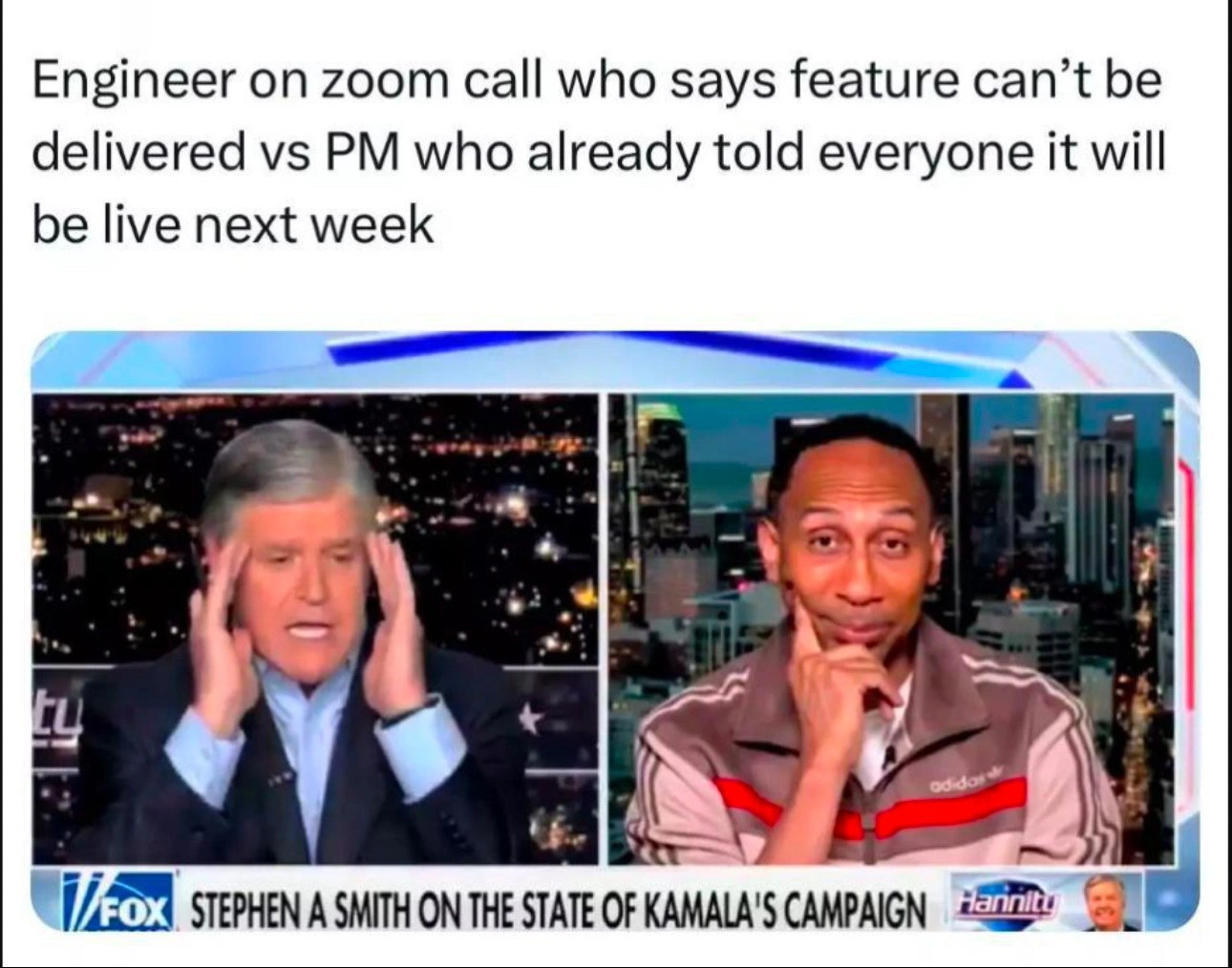
The visual joke uses a split-screen image styled like a Fox News or talk show interview, which exaggerates the confrontation. It’s as if the engineer and PM are two guests on a news program debating the “feature deadline crisis.” The left side (engineer) is visibly panicking – we see him pressing his hands to his temples, a gesture of stress or disbelief. The right side (PM) appears unfazed and calm, even a bit smug, with a hand on his chin. This contrast is exactly how it feels in meetings sometimes: the developer is freaking out internally (“There’s no way we can do this in time!”) while the manager acts like everything is under control (“Of course we’ll do it, no problem!”). That emotional mismatch is a source of MeetingHumor for anyone who’s been in that situation.

Important concepts and tags here include UnrealisticDeadlines – the idea that the due date (“next week”) is unrealistic given the amount of work. It’s common in tech that non-engineers accidentally underestimate how complicated a feature is. For example, a PM might think adding a button is simple, not realizing it requires a whole backend system change. When a deadline is set without understanding the work, it puts the dev team under intense DeadlinePressure. That pressure often leads to DeveloperFrustration – engineers feel stressed or annoyed because they want to build things well, not rush a half-baked feature out the door.

CommunicationBreakdown is another key term: it means the communication process failed. Either the engineer didn’t clearly communicate the feature’s complexity, or the PM didn’t listen (or didn’t ask in the first place). The meme caption explicitly says the engineer “says feature can’t be delivered” (engineer is voicing concerns) versus the PM “who already told everyone it will be live next week” (PM has communicated a different message to others). They are out of sync. This breakdown in understanding is often what causes such tense moments in meetings. Everyone’s now on a Zoom call hearing two conflicting stories: the engineer basically saying “It’s not feasible that fast,” and the PM essentially having promised “It will definitely happen by next week.” Cue awkward silence or arguments.

For a junior developer or someone new to the industry, this meme is a lighthearted warning about workplace dynamics. In tech companies, you’ll have meetings (often on Zoom, especially with remote work) where progress and timelines are discussed. ManagementVsEngineering humor, like this, arises because managers (or PMs) are focused on what and when, while engineers are focused on how and how long. If either side communicates poorly or has different information, you get situations like this meme: the dev is caught off-guard by a promise and has to speak up, sometimes in front of many people, to reset expectations. It can be stressful! Good practices like involving engineers in timeline planning, breaking features into smaller tasks, and honest status updates can prevent this. But of course, in real life, misunderstandings happen – which is why this meme feels so true-to-life for many. It’s essentially illustrating an expectations vs reality moment in software development using a funny news-debate picture.

Level 3: Promises vs Panic

In this meme’s high-drama split screen (a repurposed Fox News debate clip), we see a classic ManagementVsEngineering showdown: on one side the panicking engineer, on the other the serenely overconfident Product Manager (PM). The top caption nails the scenario: Engineer on Zoom call who says feature can’t be delivered vs PM who already told everyone it will be live next week. This humorous contrast resonates because it exaggerates a painfully common software reality – UnrealisticDeadlines announced before checking with those who do the actual work. The engineer's face-in-hands panic is every developer who’s been ambushed by a deliveryPressure bombshell in a meeting. Meanwhile, the PM’s calm, chin-resting smugness represents the oblivious (or optimistic) stakeholder who has MisalignedExpectations but hasn’t realized the can of worms they just opened.

This imagery cleverly mirrors a news segment debate, implying that the disagreement is as confrontational as a political talk show. The lower-third chyron text (“STEPHEN A SMITH ON THE STATE OF KAMALA'S CAMPAIGN”) is an absurd non-sequitur – a real news caption hilariously out of context – emphasizing how the conversation the engineer thought they were having (“Can we deliver this feature safely?”) has been hijacked into a public spectacle (“It WILL be delivered next week, right?!”). It’s an apt metaphor: suddenly the engineer’s careful reality-check is treated like breaking news controversy. CommunicationBreakdown is front and center: the PM has already broadcast a release date to “everyone” (maybe executives, clients, or the whole team) without engineering’s buy-in. Now the engineer is left looking like the flustered TV guest scrambling to rebut a false claim live on air.

Why is this so funny (and painful) to experienced devs? Because we’ve all been in that Zoom meeting where a higher-up cheerfully volunteers, “Sure, we can ship that by next week!” while we nearly spit out our coffee. It’s ProjectManagementHumor born from shared trauma. The humor works through contrast: the PM’s cool demeanor vs the engineer’s visible alarm. That calm PM face might as well be saying, “Everything’s fine, what are you so worried about?” – which is exactly how PMs sometimes look when dropping a schedule bombshell. The engineer’s expression screams the silent inner monologue: DeveloperFrustration mixing with “Did I just hear that right?!” disbelief. It’s a snapshot of StakeholderExpectations colliding with engineering reality in real-time.

Technically, this speaks to a failure in Agile planning and expectation-setting. Ideally, features are estimated with the dev team before any deadline is committed externally. Here the PM either ignored those estimates or never got them, jumping straight to promise a date (perhaps to appease a stakeholder or outshine competitors) – a textbook MisalignedExpectations scenario. That leaves engineering holding the bag. In practice, such premature commitments lead to frantic crunch-time coding, sloppy shortcuts, and technical debt down the line. The savvy, battle-scarred engineer knows a “one week” build for a significant new feature is a fantasy unless it was mostly done already. The meme perfectly captures that moment of dawning horror when the dev realizes the roadmap just got decoupled from reality.

This kind of deadline over-promising has a long history in software. From the days of waterfall Gantt charts to today’s “Agile” shops, if there’s poor communication, the result is the same: someone promises the moon, and developers are left figuring out how to build a rocket overnight. The meme’s TV-split format hints that this conflict can be as adversarial as a talk show debate. In fact, inside many companies the tension between product management and engineering over timelines can feel like an episode of Hannity: lots of talking past each other and a big headline promise to the audience. The seasoned engineer has seen this movie before – they know how it ends unless something changes: either a mad scramble of heroic all-nighters (with pizza-fueled coding and plenty of bugs 🐛), or a very public expectations_vs_reality lesson when the “next-week launch” slips (often followed by awkward explanations and damaged trust).

In short, the meme gets a laugh (and a groan) from senior devs because it satirizes a Communication failure that is all too real. We recognize the DeadlinePressure doom scenario: the calm PM casually swinging a wrecking ball of a promise, and the frazzled engineer mentally triaging which corners to cut to even attempt the impossible. It’s funny because it’s true – and because when you’ve endured enough of these, sometimes all you can do is laugh (albeit a bit cynically). This two-panel image is essentially the Zoom meeting edition of “expectations vs reality” in tech: one side confidently declares the outcome, the other knows the truth and is freaking out. 🔥

PM (smiling): “Of course it’ll be live next week!”
Engineer (internal screaming): “Next week?! Did we invent time travel and nobody told me?!”

Description

A two-panel meme format contrasting the reactions of an engineer and a Product Manager (PM) during a video call. The caption at the top reads, 'Engineer on zoom call who says feature can't be delivered vs PM who already told everyone it will be live next week'. The left panel, representing the engineer, shows TV host Sean Hannity looking highly stressed, with his hands on his temples and a pained expression. The right panel, representing the PM, features sports commentator Stephen A. Smith looking calm, smug, and slightly amused, with his hand on his chin. This meme captures a classic and deeply relatable conflict in software development where engineers are confronted with delivering on unrealistic promises made by non-technical managers to stakeholders. It highlights the communication gap and the pressure placed on the development team to meet deadlines that were committed to without their consultation or a realistic assessment of the work involved
Comments

12
Anonymous ★ Top Pick The PM has already factored in the story points for a miracle, but the engineer is still trying to figure out how to violate the CAP theorem on a budget
  1. Anonymous ★ Top Pick

    The PM has already factored in the story points for a miracle, but the engineer is still trying to figure out how to violate the CAP theorem on a budget

  2. Anonymous

    PM on Zoom: “We’re launching next week!” Me (muted): “Absolutely - right after the schema migration, the SOC-2 sign-off, the change-freeze waiver, and the monolith’s ritual blood sacrifice to legacy Jenkins.”

  3. Anonymous

    After 20 years in tech, you learn that 'next week' in PM-speak translates to 'whenever the engineer stops crying and figures out how to violate the laws of physics' - but by then, the sales team has already demoed the feature using PowerPoint animations

  4. Anonymous

    Ah yes, the classic distributed systems problem: achieving consensus between an engineer's O(reality) complexity estimate and a PM's O(1) 'just ship it next week' promise. Spoiler alert: CAP theorem applies here too - you can have Consistency (accurate estimates), Availability (feature shipped), or Partition tolerance (your sanity), but the PM already chose Availability and sacrificed the other two in last quarter's roadmap review

  5. Anonymous

    PM commits 'next week' faster than git push --force; engineer left resolving the prod conflicts at 3AM

  6. Anonymous

    We can ship next week - if “live” means dark-launched behind a feature flag at 0% traffic while Legal reviews the DPA and the backfill finishes sometime after the demo

  7. Anonymous

    PM: “It’ll be live next week.” Engineer runs a dependency DAG and gets NaN - security review ↔ vendor SSO ↔ contract ↔ data migration. We’ll name the feature flag next_week and leave it false

  8. @EmberFox 1y

    PM shortly to be disemployed

    1. @Valithor 1y

      If only. If my own and the experience of others I know in the field have anything to say about it, it will be the PM finding any reason to blame the devs for failing to meet productivity requirements.

      1. @EmberFox 1y

        Sadly true

    2. @Valithor 1y

      Also cute PFP, 10/10 would

  9. @realVitShadyTV 1y

    My todays morning meeting (I am proud PM).

Use J and K for navigation