
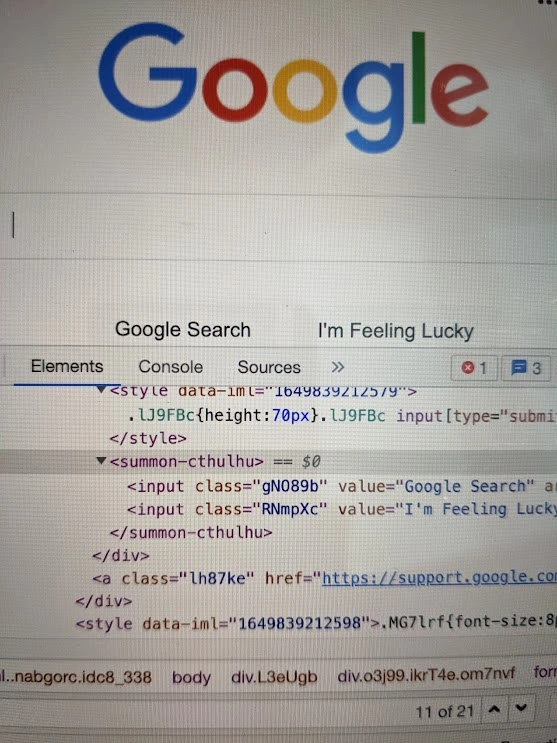
Frontend boredom: using DevTools to summon Cthulhu on Google’s homepage
Description
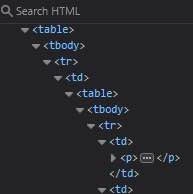
The photo shows the Google home page in a browser, with the colorful "Google" logo at the top and the familiar search bar beneath it. Chrome DevTools is open in the lower half of the screen on the "Elements" tab, revealing the live DOM tree. Inside the markup, the usual form wrapper has been cheekily replaced by a custom tag that reads <summon-cthulhu> … </summon-cthulhu>, enclosing the two input buttons whose values are "Google Search" and "I'm Feeling Lucky". All other code - classes like gNO89b and RNmpXc, style blocks specifying .LJ9FBc{height:70px}, and the “Elements / Console / Sources” tab headers - is rendered in the standard monospace font and syntax-highlighted colors of DevTools. The image captures that universal developer pastime of poking at production sites with live DOM edits, highlighting the intersection of web-component freedom and senior-level irreverence





Comments
6Comment deleted
Proof that when a senior dev says they’re just adding a custom element, you should probably check the eldritch API surface - Custom Elements v666 ships with unspeakable side effects
Opening DevTools on Google's homepage to discover they use the same unreadable class names as the rest of us, except theirs actually make it to production and handle 8 billion searches a day
Ah yes, the legendary <summon-cthulhu> element - Google's most powerful custom web component. While mere mortals struggle with semantic HTML like <button> or <input>, Google engineers have transcended to eldritch naming conventions. The button's class names 'gNO89b' and 'RNmpXc' aren't just minified - they're the result of a build process that sacrifices readability to the Old Ones in exchange for 0.3ms faster page loads. And honestly, after debugging production issues at 3 AM, summoning Cthulhu feels like a reasonable escalation path
When analytics beacons, cookie banners, and feature flags race the render thread, the only deterministic orchestration primitive left is a custom element called <summon-cthulhu>
Scraping Google? You're 'feeling lucky' only if your CSS selector survives the next deploy
Nothing says Web Components at scale like wrapping Google’s buttons in <summon-cthulhu> - meets the hyphen rule, passes the demo, and keeps SLOs safe right up until refresh