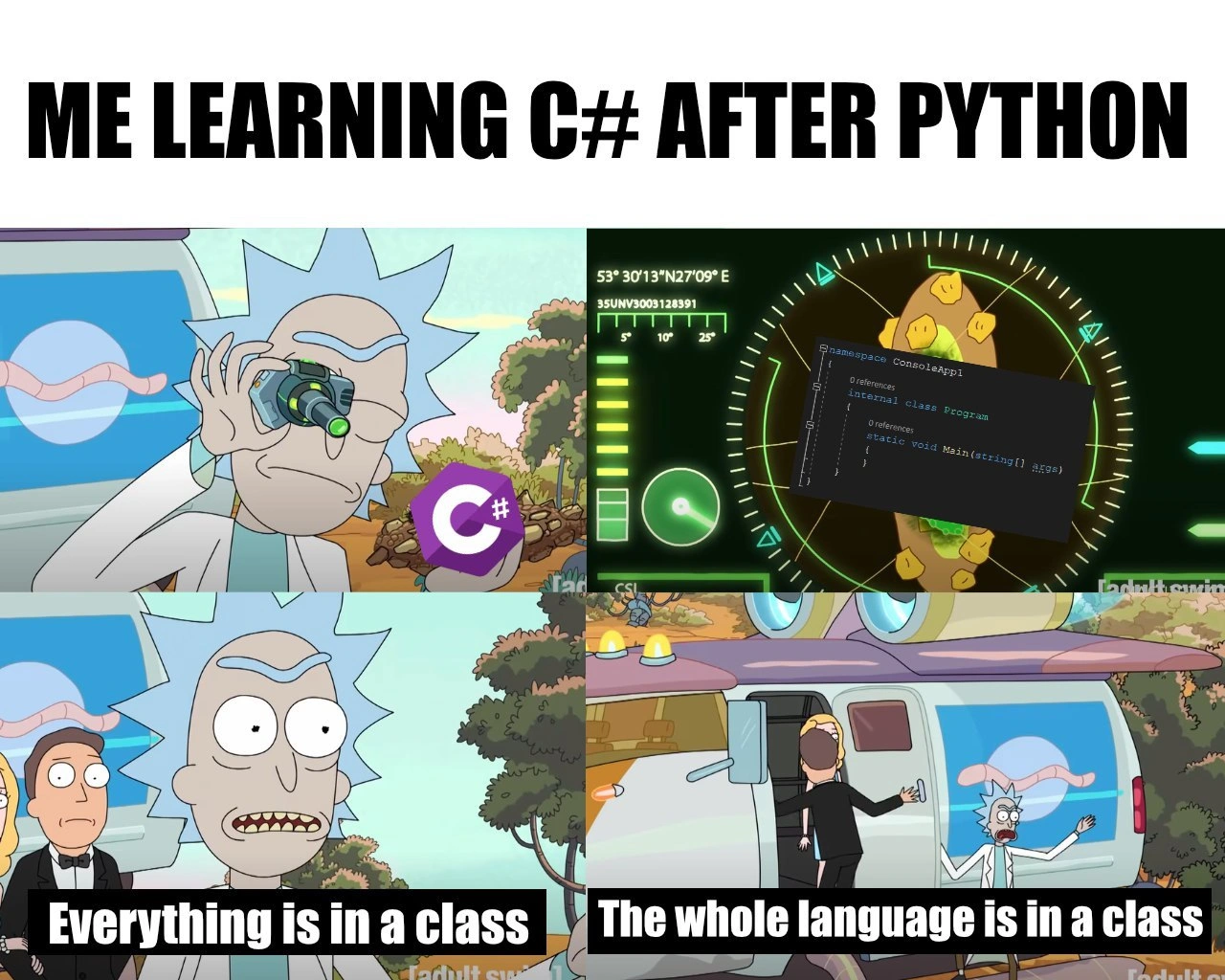
Realizing C# puts literally everything inside a class after Python freedom
Why is this Languages meme funny?
Level 1: All Toys in the Box
Imagine you have two play areas. In the first one, you can play however you like: you dump out your toys on the floor and start having fun – there are no strict rules about where things go. This was like you playing in Python-land, where you could just do stuff anywhere. Now, picture a new play area where a grown-up says: “You can play, but only if you keep all your toys inside this special box while you play.” Suddenly, you can’t just spread out on the floor; everything has to stay inside that one box. It feels a bit restrictive, right? You’re used to freedom, and now there’s a rule that contains everything you do.
That’s exactly the feeling of a Python programmer learning C# for the first time. Python was the free playroom – you could write your code freely. C# is like the tidy playroom – it insists that all your code (toys) be organized inside a class (the box). The meme is funny because the character (Rick) is reacting just like a kid who’s told about this new rule: he’s shocked and yelling “Everything has to be in the box?!” and even getting dragged back to keep playing inside the box. It’s a silly exaggeration of how it feels, but it makes the point clear: in C#, you can’t just run around with your code anywhere you want; you have to put it inside the given structure. The contrast is humorous and relatable to anyone who’s had to adjust from a no-rules environment to a more structured one.
Level 2: No Code Without Class
Dropping down to a more beginner-friendly view, let’s break down what’s going on in simpler terms. The meme shows a Python programmer (represented by Rick) learning C# and freaking out upon seeing that even the simplest C# program is wrapped in a class definition. In Python, you’re used to writing code in a very direct way: you open a file and just start writing instructions one by one. For example, to print a greeting you might simply do:
# Python: no need for class or special function for a simple script
print("Hello, world!")
When you run a Python script, the interpreter just executes each line from top to bottom. There’s no enforced structure around it beyond what you choose (you can use classes in Python, but you don’t have to for a basic script). This feels very free-form – we might call it pythonic freedom.
Now enter C#, a language from the .NET family known for being object-oriented and statically typed. In C#, you can’t simply write Console.WriteLine("Hello, world!") at the top of a file without context. The C# compiler (the tool that turns your C# code into an executable program) expects that all your code lives inside structures like classes or structs. So a minimal C# console program typically looks like this:
// C#: Code must be inside a class and within a namespace
namespace MyFirstApp {
class Program {
static void Main(string[] args) {
Console.WriteLine("Hello, world!");
}
}
}
Let’s unpack that:
namespace MyFirstApp { ... } – A namespace is like a folder or a family name for your code. It helps organize programs, especially as they grow.
ConsoleApp1in the meme’s snippet is the auto-generated namespace (often based on the project name in Visual Studio). In Python, you usually organize code by modules (files) and packages (folders), but you don’t explicitly write a namespace line – it’s handled by how you structure your files. C# makes it explicit with thenamespacekeyword.class Program { ... } – A class is a blueprint for objects and a container for code. Think of a class as a chapter in a book where you put related functions (methods) and data (fields). In C#, everything lives inside a class. Even if you just have a single method to run, you must wrap it in a class. Here,
Programis an arbitrarily named class (commonly used for the main entry point). In Python, if you don’t need to define new types or objects, you might never write aclassat all – you can just write functions or top-level code. That’s why a Python developer might be perplexed: “Why am I forced to make a class just to do something simple?”static void Main(string[] args) { ... } – This is the entry point of a C# program. Let’s break this mouthful down:
Mainis the name of the method. It’s analogous to saying “start here.” When you run the program, the C# runtime looks for aMainmethod to know where to begin execution. Python doesn’t need a special main function – it just starts at the first line of your script. (Python does have an idiomif __name__ == "__main__":to indicate “this is the main section”, but that’s optional and more about import behavior. It’s not a requirement to run a script.)staticmeans this method belongs to the class itself rather than an instance of the class. This is important because when the program starts, there are no objects created yet. By makingMainstatic, C# ensures it can call this method without having to first create an object of typeProgram. In simpler terms, static here is telling the program “you can run this without any setup.”voidmeans this function doesn’t return any value. It’s just going to do something (like print to the console) and then end. In C#, every method must declare what type of value it returns (orvoidif it returns nothing). Python doesn’t require you to declare that – a function can just send back a value withreturnor not, and there’s no declared type.(string[] args)is the parameter list for the method.string[]is a static type annotation meaning “an array of strings”.argsis the variable name. Sostring[] argsrepresents any command-line arguments passed to your program (just like Python’ssys.argvlist). Again, in Python you wouldn’t declare the type of each item insys.argv– the list can hold any strings and Python figures out types at runtime. In C#, you must specify that this function expects an array of strings. This is part of StaticTyping: the compiler needs to know exactly what types of data are coming in and out.
All these language rules might feel overwhelming to someone coming from Python. The meme’s third panel showing Rick’s face yelling “Everything is in a class” perfectly captures that overwhelmed feeling. It’s the realization: “Wait, I can’t even write a simple line of code without wrapping it in a class definition?!” For a newcomer, terms like namespace, class, static, void, and even the concept of a main function are brand new concepts to grapple with, especially if their previous experience was a language like Python where none of those were mandatory to start coding.
So, why did C# design things this way? The idea is to enforce a clear structure from the get-go. It’s like a language saying “We’re going to do things in an organized manner: all code goes inside a class, entry point is well-defined, types are explicit.” This can actually be helpful as projects grow: you know exactly where to find the start of the program (Main), and code is grouped logically in classes and namespaces. For large-scale software, these conventions make maintenance and collaboration easier (everyone puts their code in classes, so it’s consistent). Python, being more permissive, relies on the developer’s discipline and the scale of the project – for quick scripts or smaller programs, that freedom is a boon, but for very large programs, Python developers also often adopt conventions and structure (they might simulate something like a “main” by using if __name__ == "__main__": and organizing code into functions and classes as needed).
The final panel of the meme (“The whole language is in a class” with Rick being dragged to a spaceship) is a comedic exaggeration. It’s like Rick (the learner) is being unwillingly pulled into this new world where everything has to be inside a class container, much like being pulled into an alien spaceship 🚀. In reality, not every single thing in C# is literally a class (for instance, C# has things like structs, interfaces, records, etc., but those are similar constructs or still require a structured definition). However, the spirit of the joke is true: you can’t just write loose lines of code; you have to place them inside some kind of structure.
For a junior developer or someone early in their learning journey, this meme is humorously educational. It’s saying, “Heads up! If you move from a language like Python to C#, be ready for more structure.” The sudden need to understand terms like namespace ConsoleApp1 (just the default name for your project’s namespace) and to wrap your mind around why you need a class just to start the program can be surprising. But don’t worry – once you understand that C# just has this rule of organization, it starts to make sense. It’s a bit like learning that in some schools you must wear a uniform. At first, it feels unnecessary (“Why can’t I just wear my regular clothes?!”), but it’s simply a convention that environment follows.
And indeed, as of modern C# versions, there’s a bit of relief: you can now write a quick program without explicitly writing the class and Main – the compiler will infer them for you (this feature was introduced to make simple programs less intimidating, precisely to help newcomers migrating from scripting languages!). But many tutorials and workplaces still show or expect the full form, so it’s very likely our Python-to-C# convert opened up an IDE and was greeted by that wall of braces and keywords.
In short, at this intermediate level, the meme is highlighting a learning curve issue in a funny way. It contrasts Python’s simple start with C#’s structured start. The tags like LanguageComparison and LanguageQuirks are spot on: this is a classic quirk you notice when comparing languages. The DeveloperHumor comes from that relatable “Whaaat?!” reaction. The meme teaches us (with a wink) that C# insists on structure: no code without class. Once you know that, you’re on your way to understanding the CSharp_learning_curve — and you might even start to appreciate the organization after the initial shock wears off. But in the moment of discovery, as the meme shows, it’s just pure comedic disbelief 😅.
Level 3: Classes All the Way Down
At the highest technical level, this meme highlights a language paradigm clash between Python’s free-form scripting and C#’s strictly Object-Oriented structure. In the first panel, Rick (representing a Python developer) peers through a high-tech scope marked with the purple C# logo. What he “sees” in the second panel is a HUD locking onto a typical C# program scaffold:
namespace ConsoleApp1 {
internal class Program {
static void Main(string[] args) {
// ...
}
}
}
This snippet is essentially the default boilerplate for a new C# console application. To an experienced dev, it screams “everything_is_a_class here” – exactly what shocks Rick. The meme’s punchline (“Everything is in a class... The whole language is in a class”) exaggerates C#’s design where no code exists outside a class or namespace context. This contrasts sharply with Python’s philosophy, where you can write executable statements at the top level of a file without any wrapper.
Why is this funny to seasoned developers? It’s poking fun at the C# learning curve and an infamous LanguageQuirk: the ceremony required just to get a simple program running. Python, known for its minimalism and developer-friendly experience (DeveloperExperience_DX), lets you write a quick script like print("Hello, world!") without any extra structure. In C#, however, writing “Hello, world!” traditionally meant understanding namespaces, classes, a Main method, and static typing upfront. That’s a lot of overhead for someone coming from Python’s world of on-demand simplicity. This disparity often fuels lighthearted LanguageWars in which fans tease each other’s languages – here it’s the Pythonistas ribbing the C# folks about their obsession with classes and curly braces.
From a senior perspective, this contrast is rooted in language design philosophies. C# (circa early 2000s, as part of the .NET framework) was heavily influenced by Java and the 90’s push towards ObjectOrientedProgramming (OOP) as the one-size-fits-all paradigm. In pure OOP style (inspired by Smalltalk and Java), everything is an object or in a class, and code execution is organized into methods on class definitions. Python, on the other hand, descends from a scripting and multi-paradigm tradition (influenced by ABC, C, and Perl) that emphasizes quick scripting and ease of use, allowing definitions and executable code at module level. When Rick exclaims “Everything is in a class,” it captures that astonishment a Python dev feels seeing that even the entry point of a C# program (Main) must reside inside a class (Program), inside a namespace (ConsoleApp1). It’s classes all the way down, like a Matryoshka doll of code containers.
The humor and pain behind this: Many of us have experienced moving from a dynamic language to a static OOP language (or vice versa) and feeling the paradigm whiplash. The meme is very relatable developer humor: a Python programmer encountering the static_void_main ritual for the first time. The shocked expression on Rick’s face (third panel) is basically the “WTF?!” moment when you realize you can’t just write code on line 1 and have it run. Instead, you’re dragged (like Rick in panel four) into the spaceship of OOP structure. It’s as if the language itself says, “Nope, you can’t do anything until you put on these {curly braces} and enter this class.” 😂
For seasoned devs, this touches on the concept of boilerplate code – those extra lines and wrappers you write not to implement your logic, but to satisfy the language’s framework. Python famously minimizes boilerplate, whereas C# (especially pre-modern versions) had plenty. We chuckle because we’ve been there: writing a tiny script in C# felt like using a sledgehammer on a thumbtack, with all the accessor keywords (public/internal), class declarations, and using statements required. A simple comparison illustrates this difference:
// C# - Hello World requires a class and Main method
namespace Demo {
class Program {
static void Main(string[] args) {
Console.WriteLine("Hello, world!");
}
}
}
# Python - Hello World can be a single top-level statement
print("Hello, world!")
This side-by-side is almost cartoonish – precisely the point of the meme. The LanguageComparison here shines a light on LanguageQuirks: C#’s insistence on structure vs. Python’s freedom. Senior developers know there are good reasons for both approaches. C#’s structure enforces organization for large applications, making it easier to manage complex codebases as they grow (you won’t accidentally run some initialization code multiple times because it’s not tucked away in a class or Main method). The explicit static void Main(string[] args) is where the .NET runtime enters your program, which is analogous to how an operating system calls a main() function in C or C++. By requiring this entry point inside a class, C# keeps the language consistently object-oriented – even the program’s starting point lives inside an object blueprint (in this case, an object of type Program that you never actually instantiate). It’s a design choice: keep everything neatly in classes and namespaces for clarity and modularity.
However, that high-minded design can feel like overkill when you’re coming from Python’s simplicity. In Python, if you want to write a quick script to parse a file or crunch some numbers, you just write those commands at the top of a .py file. In C#, doing the same quick-and-dirty task requires setting up a new Console App project (which by default spits out that namespace ConsoleApp1 { class Program { static void Main { ... } } } structure) or using a C# interactive notebook. Rick’s dramatic “the whole language is in a class” is a playful exaggeration – of course not everything in C# is literally in a class (you have structs, records, etc., and as of C# 9 even top-level statements are allowed) – but from the perspective of a newcomer it absolutely feels that way. The meme captures that feeling perfectly. It exaggerates the truth that in classical C#, you couldn’t even write a line of code without being inside some class context.
There’s an industry story here too: Over time, language designers noticed this DeveloperExperience_DX gap. Why should a newbie have to learn about classes just to print “Hi!” on screen? Indeed, modern C# (from C# 9 in 2020 onward) introduced top-level statements which let you write a quick program without explicitly declaring class Program or static Main – essentially borrowing a page from scripting languages to improve approachability. But this meme (from mid-2022) likely mirrors the classic experience or the default in many tutorials/IDEs that still show the full boilerplate. Many C# developers will nostalgically recall writing their first static void Main and wondering why it needed to be so verbose. Meanwhile Python developers might chuckle and thank Guido van Rossum for not making them jump through those hoops.
In summary, at the senior tech level, the meme humorously underscores a well-known LanguageComparison war story: the day a Python dev meets the C# world. It points out the absurdity (through Rick’s wild reaction) of having to pack every bit of code into classes and namespaces. It’s basically highlighting an object-oriented overload. Experienced devs laugh because we know it’s true and yet it’s by design. It’s the kind of inside joke you share after surviving a multi-paradigm project: “Remember when we tried to write a quick script in C# and ended up creating three files and a class just to do it? Ha!” The meme uses Rick’s over-the-top sci-fi predicament as an allegory for that real-world programmer frustration. It’s a celebration of those “WTF” moments that ultimately make us appreciate why languages are the way they are (and give us great DeveloperHumor material in the process).
Description
The meme is a four-panel Rick and Morty cartoon with bold top text that says “ME LEARNING C# AFTER PYTHON”. In panel one, Rick looks through a hi-tech monocular bearing the purple C# logo; panel two shows his heads-up display locking onto a code snippet that reads “namespace ConsoleApp1 { internal class Program { static void Main(string[] args) { } } }”. Panel three zooms on Rick’s shocked face with the caption “Everything is in a class”, and panel four has him being dragged toward a spaceship under the caption “The whole language is in a class”. The humor contrasts Python’s free-form scripting with C#’s object-oriented mandate that even the entry point resides inside a class, poking fun at the steep mental shift for developers moving between the two languages
Comments
6Comment deleted
Python: print('hello') C#: public static void Main() lives in Program, inside a namespace, inside an assembly, inside an AppDomain, inside a worker process - Russian-Doll-Driven Development
Going from Python to C# is like being promoted from a startup to enterprise: suddenly your two-line script needs a namespace, three interfaces, dependency injection, and a solution file just to print "Hello World"
The transition from Python to C# is like moving from a minimalist studio apartment where you can just start living immediately, to a mansion where you need to declare which wing you're in, which room you're using, and fill out a static void Main form before you can even turn on the lights. Python devs discovering that 'print("Hello World")' requires a namespace, a class, and a static method signature is the exact moment they understand why C# developers have that thousand-yard stare
Coming from Python, C# hello‑world is a matryoshka - namespace → class → static Main - then StyleCop bans top‑level statements for “consistency,” so the ceremony outlives the runtime
Python: globals for days. C#: 'Public class your entire existence, peasant' - welcome to structured freedom
Switching from Python to C#: you can sneak in with top‑level statements, but five minutes later DI demands a Program class, an IService interface, and a static async Main - because even “hello world” needs an org chart