Skip to content
DevMeme
4123 of 7435
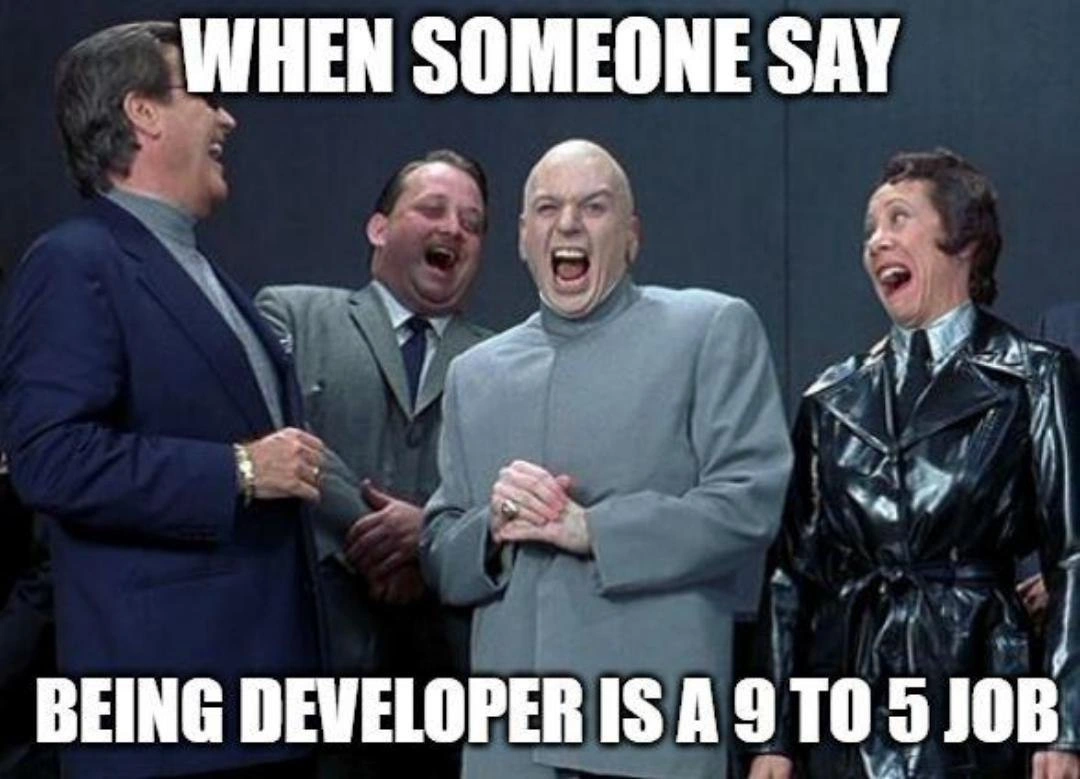
Dr. Evil laughs at the myth that developers only work 9-to-5
Deadlines Post #4501, on Jun 20, 2022 in TG

Dr. Evil laughs at the myth that developers only work 9-to-5

Why is this Deadlines meme funny?

Level 1: Chores After Bedtime

Imagine you have a set time every day when you finish your homework or chores — say 5 PM — and after that you’re free to play. Now picture this: right after you put away your books and are ready to relax, something urgent pops up. Maybe the family dog knocks over a big paint can at 5:05 PM, and you have to help clean it up for the next two hours. Or your teacher suddenly messages that there’s a mistake in the homework, and you need to redo part of it in the evening. You’d probably giggle at anyone who said, “Being a student is only a 9-to-3 job,” because you know schoolwork can spill into your free time unexpectedly. That’s exactly what this meme is saying about being a developer. It’s like thinking your day ends at a certain time, but surprise – there’s more work because something went wrong. The bad guys in the picture are laughing because the idea of a strict “done at 5 o’clock” day is as silly to them (and to developers) as expecting no surprise chores right before bedtime. They’re basically saying, “Haha, yeah right, if only it were that simple!”

Level 2: Deadlines & On-Call 101

This meme shows the character Dr. Evil (the bald villain in grey from the Austin Powers comedy films) and his three henchmen laughing hysterically. The text is split into a setup and punchline. The top caption says, “WHEN SOMEONE SAY” and the bottom caption finishes with, “BEING DEVELOPER IS A 9 TO 5 JOB.” In plain terms, someone has claimed “being a developer is a 9-to-5 job,” and the image is the developers (portrayed as Dr. Evil’s laughing crew) finding that claim ridiculous. It’s a way of saying: “Haha, if only that were true!”

Now, why would developers laugh at the idea of working only 9 AM to 5 PM, Monday through Friday? Because in developer reality, it’s common to work odd hours, late nights, or even weekends. Let’s break down some terms and concepts here:

  • "9 to 5 job": This means a normal job with fixed hours — you start at 9:00 in the morning and stop at 5:00 in the evening. Many people assume office jobs work like this every day with no extra hours. The meme jokes that being a software developer doesn’t fit neatly into that schedule.
  • Deadlines: In software projects, a deadline is the due date by which a feature or product must be finished. For example, a team might have a deadline to launch a new app version by the end of the month. If that date is close and work isn’t finished, developers often stay late to get everything done. This intense period of extended work hours is informally called “crunch time.” If you’ve ever crammed for an exam late into the night, you have an idea how crunch time feels—lots of pressure and not much sleep.
  • On-call: Some developers participate in an on-call rotation, especially those who work on live websites or services. Being “on-call” means that outside normal hours (even at night or on weekends), one team member is responsible for responding if something goes wrong in production (the live system users rely on). For instance, if a website crashes at midnight, the on-call developer will get an alert (often via phone or a loud app like PagerDuty) and must jump in to fix the issue. It’s like a doctor being on-call for emergencies, but instead of a patient emergency, it’s a server or software emergency. This is why developers can’t always fully “clock out” at 5 — if you’re on-call, your workday might suddenly start again at 2 AM due to a critical bug or outage.
  • Production issues: “Production” refers to the environment where the real users use the software (as opposed to a developer’s own computer or a test environment). A production issue means something is broken or not working correctly in the live system. These issues can be urgent — for example, if a payment system or major feature is down, the company might be losing money or users. Production issues often require immediate attention, no matter the hour. That’s why developers might get pulled back to work late at night to handle them.
  • Work-life balance: This phrase means having a healthy boundary and balance between your work responsibilities and your personal life/time. A good work-life balance would mean you can finish work around a certain time and then relax, spend time with family, hobbies, etc. The meme highlights that developers often struggle with this balance, because unexpected work pops up after hours. If you’ve ever had to cancel evening plans because homework or chores took longer than expected, you know that feeling — developers experience it with their job tasks.
  • Developer burnout: Burnout is extreme tiredness and stress caused by overwork or doing too much for too long. In the context of development, a programmer who is constantly working late nights, racing to meet deadlines, or getting woken up for on-call issues can become burned out. They feel exhausted, lose motivation, and may start to hate the work they normally enjoy. This meme touches on a cause of burnout: the assumption that you can contain the job in 8 hours, when in reality it sometimes takes over your life.

So, putting it together: the meme’s text implies someone (maybe an outsider or a new developer) casually said, “Being a developer is just a 9-to-5 job, right?” And the picture responds with big laughter, because every experienced developer knows that’s not the full story. Developers often joke about this to cope. It’s a bit of developer humor rooted in truth. They might share war stories like, “Remember that time the site crashed on Christmas Eve and we had to spend the night fixing it?” or “We thought we’d go home early, but we found a bug and stayed until 10 PM.” These stories are so common that when someone suggests the job is only 9-to-5, it’s laughable — literally meme-worthy.

For a junior developer or someone starting out, this meme is a lighthearted warning. It says: be prepared for some late nights. Not every coding job has crazy hours, but many developers will experience a crunch period or an after-hours emergency at some point. It doesn’t mean being a developer is misery — a lot of developers actually enjoy the excitement and challenge of solving a surprise problem (with plenty of coffee on hand!). But it does mean you shouldn’t expect this career to always be as routine as punching a clock exactly at 5 PM and forgetting about work entirely. The laughing villains in the image represent those of us in the industry who know this from experience.

Level 3: Evil Overlords of Overtime

In that Austin Powers movie scene, Dr. Evil and his cronies are cackling at a ridiculous statement. The meme repurposes it to mock the naive notion that software engineering is a tidy 9-to-5 gig. Seasoned developers know developer reality is far from that myth. The image of villains doubling over in laughter perfectly captures our dark developer humor when someone (usually a non-developer or an overly optimistic manager) suggests that coding is confined to office hours. It’s the kind of laugh that says, “Oh, you sweet summer child…” because every experienced dev has learned that work_hours_expectation and reality are two very different things.

Why is this combination of text and image so hilarious (and a bit painful)? It hits on a core truth of the developer lifestyle: software problems don’t care about the clock. Here are a few relatable developer experience scenarios that expose the “9 to 5” idea as a cruel joke:

  • Late-Day Bug: A critical issue pops up at 4:59 PM on a Friday. Goodbye weekend plans; hello pizza-fueled bug hunt till midnight. (Murphy’s Law for devs: if something can go wrong, it’ll go wrong right when you’re about to log off.)
  • On-Call Pager: A server crashes at 2:00 AM. The designated on-call developer’s phone erupts in alerts, dragging them out of bed because production never respects business hours. This is classic OnCall_Humor material — you can either cry or joke about being bleary-eyed in a Slack war room at 3 AM.
  • Crunch Time: A looming release date triggers crunch_hours – consecutive 12+ hour days leading up to the deadline. Management calls it a “final push”; developers call it a shortcut to burnout. You’re chugging caffeine, blasting through code while your friends think you simply left work at 5.
  • Coding Rabbit Holes: Even absent a crisis, devs often get into “the zone” and lose track of time. One moment it’s 6 PM, then you solve a tricky bug and suddenly it’s 1 AM with a string of commit timestamps to prove it. Sure, it’s voluntary sometimes, but it shows how DeveloperProductivity doesn’t always run on a schedule.

This meme lands especially well with senior engineers because it’s survival humor. We’ve all been there: deploying a hotfix after dinner, joining a war-room call in pajamas, or refactoring code on a Sunday to meet a Monday demo. Hearing someone earnestly say “being a developer is a 9-to-5 job” is like hearing someone say “Dr. Evil is just misunderstood” – it’s so off-base that laughter is the instinctive response. The truth is that project deadlines and on-call_ProductionIssues often decide when the work day ends, not the clock. So Dr. Evil’s over-the-top laugh? That’s basically every developer internally cackling at the nine_to_five_myth.

Beyond the joke, there’s a bittersweet reality: the tech industry’s overtime_culture has normalized these wild hours. Teams toss around WorkLifeBalanceTips in wellness meetings, but when the database is on fire or the CEO wants a feature “ASAP,” those tips are quickly forgotten. And while pouring extra hours into coding might temporarily boost DeveloperProductivity, it often introduces bugs and hastens developer burnout – creating a vicious cycle where yesterday’s late-night quick fix becomes tomorrow’s 3 AM outage. It’s the unspoken trade-off in many engineering shops: you can have project deadlines met or you can have a strict 9-to-5 schedule, but rarely both.

In short, this meme resonates because it’s developer humor drawn from real life. The work_hours_expectation of outsiders triggers the dark comedy we insiders share. Dr. Evil’s laugh is our collective catharsis – a way to say “Yeah, 9-to-5... good one!” to a reality that often has us working beyond 9 to 5 (and occasionally plotting world domination after hours, if only in jest). It’s funny because it’s true, and a little sobering for those of us living it.

Description

The meme uses the classic Austin Powers ‘evil team laughing’ scene: four business-clad villains stand together in a dark boardroom, heads tilted back in maniacal laughter. All faces are blurred for privacy. Across the top, bold white uppercase impact font reads, “WHEN SOMEONE SAY”, and the bottom caption completes the thought with, “BEING DEVELOPER IS A 9 TO 5 JOB.” The visual punchline highlights how developers routinely find themselves coding late nights, handling on-call pages, or grinding through crunch time despite outsiders assuming fixed hours. The humor resonates with engineering culture around deadline pressure, production incidents, and the elusive quest for work-life balance
Comments

6
Anonymous ★ Top Pick Of course it’s 9-to-5 - 9 PM when the canary blows up in prod, 5 AM when the post-mortem finally renders in Confluence
  1. Anonymous ★ Top Pick

    Of course it’s 9-to-5 - 9 PM when the canary blows up in prod, 5 AM when the post-mortem finally renders in Confluence

  2. Anonymous

    The best code I've ever written was at 2 AM during an incident, the worst architectural decisions I've made were at 5 PM on a Friday, and somehow we still pretend cognitive load follows business hours

  3. Anonymous

    Ah yes, the mythical 9-to-5 developer schedule - right up there with 'no bugs in production' and 'the migration will be seamless.' In reality, being a senior engineer means your workday is more like a distributed system: eventually consistent, with unpredictable latency spikes at 2 AM when that critical service decides to fail over. The only thing that runs on a strict schedule is the monitoring alert that wakes you up during dinner, reminding you that 'high availability' means YOU need to be highly available, not just your infrastructure

  4. Anonymous

    Being a developer is 9 - 5 - if you start counting at the 4:59pm Friday PagerDuty page and stop after Monday’s “blameless” postmortem

  5. Anonymous

    9-to-5 dev life: 9 AM standup optimism, 5 AM incident postmortem realism

  6. Anonymous

    Sure, it’s a 9-5 - if your timezone is UTC-all and the hours between sev1 pages, blue-green rollbacks, and SLO reviews count as lunch

Use J and K for navigation