When React Knowledge Outranks 18 Years of Real Engineering Experience
Why is this Interviews meme funny?
Level 1: The Magic Word
Imagine you have two people who want to help build a house. One is a master builder with 18 years of experience – he’s built big houses, knows all about construction, and has led teams of builders. The other is someone who just finished a 3-month carpentry course and has barely built a small shed. Now, the company building the house is obsessed with a new type of power drill that just came out. The experienced builder says, “I haven’t used that exact drill on a job, but I’ve used lots of drills and I’m sure I can handle it.” The boss doesn’t like that answer and literally screams at him to get out. Then the young rookie comes in and the boss asks, “Have you used the Super Drill 3000?” The rookie beams and says, “Oh, I’ve heard of that drill! In fact, I’m an expert at Super Drill 3000, hammers, wrenches, saws, screwdrivers, nail guns, forklifts, cranes, cement mixers, bricks, wood, blueprints, plumbing, electricity, everything – you name it, I can do it!” Of course, it sounds ridiculous (he even starts naming random tools and maybe a reindeer or two). But the boss only hears “Super Drill 3000” – the magic word – and immediately says “You’re hired!”
In simple terms, the joke is like a fairy tale where saying a magic word (“React” in the real comic, like the name of that drill in the story) instantly grants your wish. The company acted as if knowing that one trendy thing was more important than years of real skill. It’s funny in a sad way: the boss ignores the truly qualified person just because he didn’t say the magic word, and instead chooses the person who did say it (even though that person is clearly exaggerating and not nearly as experienced). The meme uses this silly situation to show how some hiring decisions can be pretty foolish, valuing a buzzword or trendy tool over actual proven talent.
Level 2: React or Reject
In this comic, a job interview goes off the rails because of one specific technology: React.js. React is a popular JavaScript library for building user interfaces on the web (for example, dynamic portions of websites, like buttons that update data without reloading the page). Many modern frontend developer jobs list React experience as a requirement because it’s widely used to create interactive web apps. The joke here is how extremely the interviewer prioritizes React knowledge over everything else.
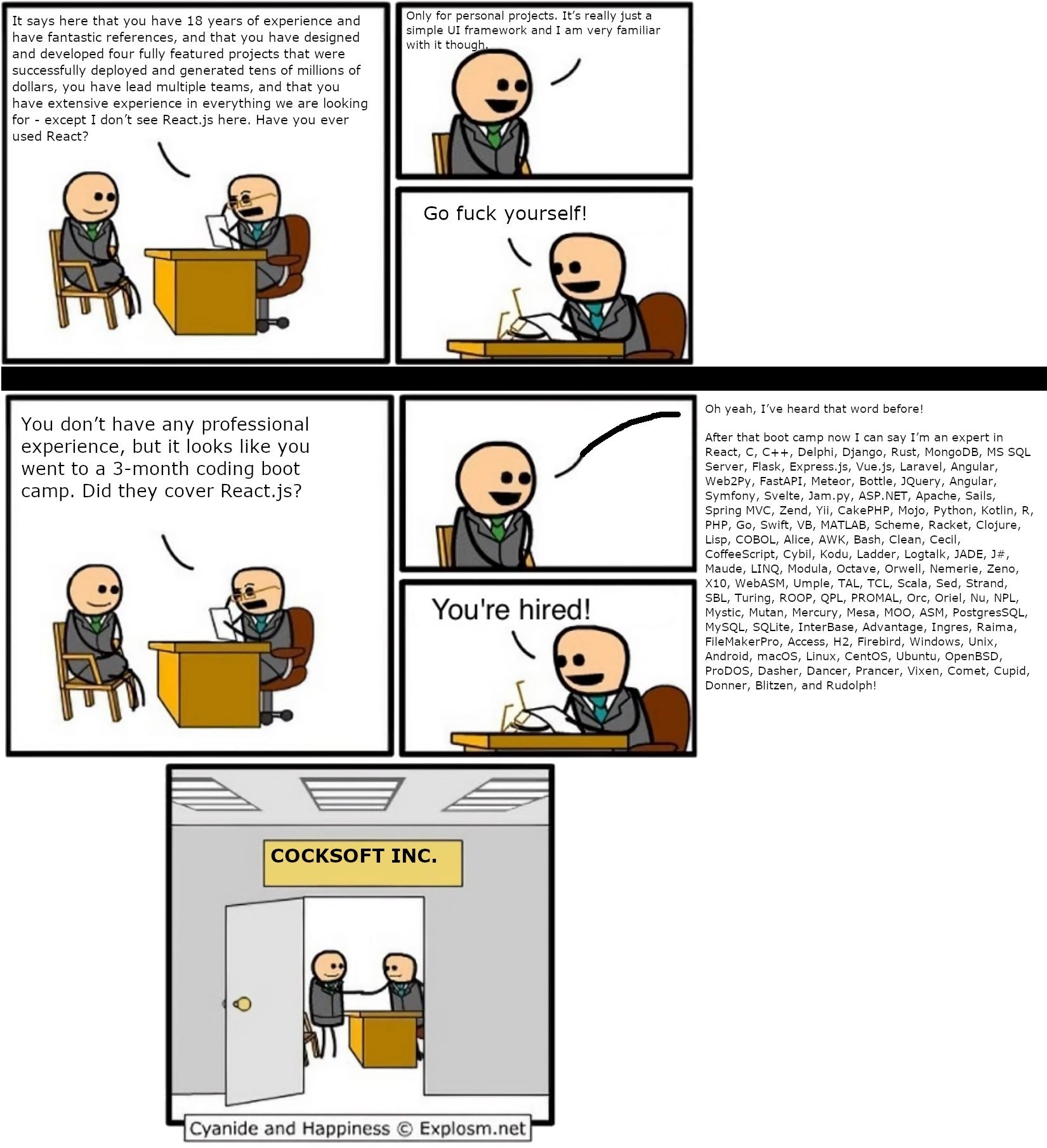
In the first panels, the interviewer reads off an incredibly strong résumé: the candidate has 18 years of software engineering experience, led teams, completed four major projects that made the company millions of dollars – basically a dream candidate. However, the interviewer notices the résumé doesn’t explicitly mention React. He asks, “Have you ever used React.js?” The senior candidate says, “Only for personal projects. It’s really just a simple UI framework, and I am very familiar with it.” In reality, that’s a reasonable answer: he’s implying “I haven’t used React at my past jobs, but I know what it is and I’ve played with it on my own – it’s not a problem.” React is just one way to build a web UI; an experienced engineer can learn a new framework quickly if they understand the fundamentals of web development. But the interviewer completely overreacts – he literally screams “Go fuck yourself!” and has a trap-door eject the candidate out of the office. This is an obviously exaggerated comic scenario showing the interviewer instantly rejecting the senior candidate purely because he didn’t have professional React experience listed. It highlights a real-world frustration: sometimes companies filter out candidates if they’re missing one keyword (like React), even if everything else is perfect.
Next, a much younger applicant sits down. The interviewer notes this guy has no professional experience, just a 3-month coding boot camp on his resume. (A coding bootcamp is a short, intensive training program that teaches people programming skills, often focusing on a specific set of trendy technologies to help them get junior developer jobs quickly.) The interviewer’s very first question to the bootcamper is, “Did they cover React.js?” Clearly, React is the interviewer’s only litmus test. The bootcamper excitedly says, “Oh yeah, I’ve heard that word before!” and immediately claims expertise in React and a ton of other technologies all at once. He rattles off a long list of programming languages, frameworks, databases, and even operating systems – far more than any person could truly learn in three months. It’s a humorous, over-the-top list meant to lampoon how some newcomers try to make themselves sound experienced.
To make sense of that list, here’s what he’s doing: he’s dropping as many keywords as possible, likely to impress the interviewer or pass résumé filters. The list includes:
- Programming languages (the actual coding languages): examples like C, C++, Rust, Python, PHP, Go, Swift, VB, MATLAB, Scheme, COBOL, etc. – from modern languages to very old ones.
- Web frameworks and libraries (tools built on languages for specific tasks): e.g. React.js, Django, Flask, Express.js, Laravel, Angular, Vue.js, Svelte, Spring MVC, ASP.NET… basically naming one or two frameworks from every major ecosystem (JavaScript, Python, PHP, Java, C# and so on).
- Databases (software for storing/retrieving data): e.g. MongoDB, MySQL, PostgreSQL, SQLite, MS SQL Server, Oracle (some of those appear in the list).
- Operating systems and platforms: Windows, macOS, Linux (Ubuntu, CentOS), Android, OpenBSD, etc. (He even says ProDOS – an old Apple operating system – for comedic effect).
- Random items and even fictional entries: As the list goes on, it becomes nonsense – he lists “Jamy, Cybil, Muddy, Ladder…” and eventually starts naming Santa’s reindeer (“Dasher, Dancer, Prancer, … and Rudolph”). These aren’t technologies a bootcamp would cover (most aren’t even real tech terms in this context – they’re thrown in as jokes).
The humor is that the interviewer seems to buy it. In the comic, after this absurd monologue, the interviewer enthusiastically shouts, “You’re hired!” The highly qualified 18-year veteran was kicked out for lacking React on paper, but this green bootcamper who only “heard of” React (and then bluffed about knowing basically everything) gets the job. It’s a classic case of “React or reject.” The company only cared whether a candidate knows the hot framework (React); they completely ignored actual experience, skill, and honesty.
For a junior developer or someone new to this humor, the comic is pointing out how some hiring processes value buzzwords over real ability. Keyword filtering is a real practice: many recruiters or HR staff will skim resumes (or use software) to see if certain words (like “React”, “Python”, “AWS”, etc.) appear. If a résumé doesn’t have the exact keywords they expect, that candidate might be discarded early, even if they are actually capable. This can lead to situations where experienced people are overlooked simply because they used a different technology stack in the past. Conversely, it encourages some candidates to stuff their résumé with as many keywords as possible (even if their exposure to those technologies is very shallow) just to get noticed. That’s what the bootcamp graduate character is doing – it’s an extreme parody, of course. In reality, no one would list that many things (especially including reindeer!), but some juniors do list an unrealistically long skill set hoping to hit the right buzzword.
The term “framework fatigue” might come up in discussions of this meme. Framework fatigue is the feeling developers get when there’s a new “must-know” framework every couple of years. For front-end development, it was jQuery, then AngularJS, then React, and others like Vue or Angular (the newer version) rising. Keeping up can be exhausting. A veteran developer may not jump on every new library immediately—they might stick with what works until a technology proves itself. But companies often want the “hot” tech right now. So if someone spent the last few years mastering one framework (say, Angular) and didn’t get a chance to use React yet, they might be viewed as behind the curve by some hiring managers. The senior candidate in the comic basically falls into that scenario (he presumably used other tools, and only played with React personally). The company, however, treats him as obsolete for not using the latest fad at work. Meanwhile, the junior who learned React in bootcamp (possibly just at a toy project level) is seen as more up-to-date and thus more hireable for a React-centric role.
The comic’s punchline panel shows the company is named “COCKSOFT INC.” – this silly, crude name signals that the company isn’t meant to be taken seriously. It’s lampooning real companies that behave this way. Tech interview humor often uses extreme examples to point out real problems. Here the problem is resume-driven hiring and checklist interviewing — when companies hire by a checklist of tech keywords rather than looking at a candidate’s true capabilities or accomplishments. The result can be absurd, as illustrated: a candidate who actually built successful projects is passed over for someone who just claims to know the trendy tool.
In summary, for a newcomer: this meme is funny because it flips common sense upside down. Normally, you’d expect a person with nearly two decades of relevant work to easily beat someone who just learned to code in a 3-month course. But because of the obsession with one skill (React), the opposite happens. It’s poking fun at how companies hire developers, suggesting that sometimes they care more about whether you know the latest tool than whether you’re a good engineer. The experienced guy could learn React quickly, and the newbie likely doesn’t truly know half the stuff he listed, but the company in the comic is too blinded by buzzwords to see that. It’s a satire of tech hiring practices, and it resonates with both senior developers (who feel unfairly judged by buzzwords) and juniors (who feel pressure to learn the “hot” tech to get a job).
Level 3: Buzzword Bingo Hiring
At first glance, this comic brutally satirizes resume-driven hiring in tech. We see an interviewer fixated on React – the trendy JavaScript library – as if it’s the single magic key to competency. The poor senior engineer in panel 1 has 18 years of experience delivering real, revenue-generating projects, leading teams, and mastering everything the company needs… except he didn’t happen to use React.js on the job. His response, “Only for personal projects. It’s really just a simple UI framework,” is the voice of a seasoned developer who knows that React is just another tool in the vast toolbox of web development. But the interviewer’s reaction – “Go fuck yourself!” as he ejects the candidate – exaggerates a real anti-pattern: framework gatekeeping. It’s a commentary on companies that treat knowledge of a specific framework as a binary requirement, effectively dismissing even stellar talent if a particular buzzword is missing from their résumé. This is the meme’s core irony: a senior engineer’s experience is undervalued because he hasn’t buzzword-bingo’d “React” on his CV.
The second half introduces a starry-eyed bootcamp grad whose résumé is basically a keyword salad. The interviewer asks if the bootcamp covered React.js – clearly the only answer he cares about. The junior candidate enthusiastically replies, “Oh yeah, I’ve heard that word before!” and then proceeds to spew an absurd list of technologies: C, C++, Delphi, Django, Rust, MongoDB, ... Angular, ... Lisp, COBOL, ... Symfony, Svelte, Jamy, ... Solaris, ... Windows, Unix, Android, macOS, Linux, CentOS, Ubuntu, OpenBSD, ProDOS, Dasher, Dancer, Prancer, Vixen, Comet, Cupid, Donner, Blitzen, and Rudolph! This ridiculously long list (even including Santa’s reindeer 🦌) parodies the practice of bootcamp exaggeration – padding one’s résumé with every imaginable keyword to beat automated filters. It’s basically buzzword bingo: throw in every programming language, framework, database, operating system, and then some mythical ones for good measure. The humor is that the interviewer is completely sold just because the candidate uttered “React” amid that avalanche of terms. He doesn’t seem to notice or care that the list is obviously BS by the end. This highlights how superficial some hiring processes can be – the comic literally has the interviewer shout “You’re hired!” without verifying any real skill, as long as the candidate checked the React box. The fictional company is even named COCKSOFT Inc., a crass parody suggesting an incompetent or cocky organization. It’s a not-so-subtle jab at tech companies with terrible hiring practices.
What’s being skewered here is a checklist interviewing mentality. Many in the industry have encountered this: a hiring manager or HR person filters candidates by a list of specific technologies. It doesn’t matter if you’ve architected complex systems for two decades; if your résumé doesn’t mention the framework-of-the-month, you get tossed aside. The meme exaggerates it to absurdity (yelling expletives at a veteran engineer), but it resonates because of the react_hype that has indeed dominated frontend hiring. In real life, there are tales of candidates being rejected for not having “enough React experience,” even if they are experts in JavaScript and other UI frameworks. It’s a form of gatekeeping: “No React on your résumé? Then you must not be qualified,” which experienced devs know is a flawed assumption. You can almost hear the cynical veteran developers groaning, “Seriously? React is just a library, not a life skill…”
The comic also mocks the junior vs senior hiring paradox. The junior from a 3-month bootcamp is basically claiming to be an expert in everything. This is a tongue-in-cheek reference to how some newcomers, eager to land a job, might overstate their abilities. A veteran engineer knows that true expertise in even one of those languages (say C++ or Rust) takes years, and that nobody can be equally proficient in 50+ technologies after a few months of training. The candidate’s line “now I can say I’m an expert in React, C, C++, Delphi, Django, Rust, … and Rudolph!” is clearly satirical – he’s just heard those words, maybe did a tutorial or two, but he’s happy to label himself an “expert.” Seasoned devs will chuckle (or cringe) at this tech humor because it’s a caricature of the Dunning-Kruger effect in juniors and the shallow evaluation by some recruiters. The interviewer’s gullible “You’re hired!” highlights a hiring humor trope: sometimes those doing the hiring can’t differentiate real depth from buzzword-fluff. It’s painfully funny because it flips meritocracy on its head.
On a technical note, the meme hints at how keyword filtering and ATS (Applicant Tracking Systems) work behind the scenes. Many companies use software or HR screeners to scan resumes for specific words like “React”. If your resume doesn’t have the right keywords, you might never even get a phone call. It’s like a dumb filter:
# Naive resume filter logic
if "React" not in resume.text:
print("Go fuck yourself!") # reject candidate
else:
print("You're hired!") # accept candidate (no further questions asked)
This snippet is essentially what COCKSOFT Inc.’s hiring process looks like in the comic. It’s obviously sarcastic – real interviews aren’t that blatant – but it captures the frustration many developers feel when job postings and recruiters reduce them to a checklist. The experienced candidate basically failed a one-item filter. In contrast, the bootcamper realized that to beat the filter, you just stuff in every keyword imaginable. It’s a sly commentary on resume-driven development of careers: people learning tools just because they’re hot keywords for hiring, rather than focusing on deeper engineering skills. The comic’s over-the-top scenario underscores a real imbalance: senior experience undervalued versus hype for the latest framework.
Historically, this kind of hype-driven hiring isn’t new. Older developers have survived multiple framework fatigue cycles – they’ve seen jQuery rise and fall, AngularJS come and go, maybe even worked with older UI toolkits before JavaScript was king. Each time, industry recruiters suddenly obsess over the new framework du jour. React.js happened to be (and still is) extremely popular around 2022, to the point that “React experience” became a line in almost every front-end job ad. The meme exaggerates that obsession to absurdity. It’s poking fun at the idea that a simple UI library (one that a solid engineer can learn in a few weeks) is valued more than nearly two decades of proven software engineering. In reality, any developer with 18 years under their belt has learned and discarded dozens of technologies. They likely could pick up React quickly – especially since React is component-based JavaScript, something any veteran web engineer is conceptually familiar with. But the interviewer (and by extension, the hiring system) doesn’t care about capacity to learn; they want the exact buzzword on paper right now. It’s a classic case of react_hype overshadowing real engineering substance.
Finally, let’s appreciate the meta-humor: the second candidate’s laundry list includes everything and the kitchen sink (Apache! Android! AWS!… and Rudolph 🦌). This is the comic’s way of saying “here’s a candidate who claims to know literally every technology ever.” Any competent interviewer would see this and laugh them out of the room. But in the cartoon, our interviewer is so hype-blinded that after hearing “React” (maybe that’s all he registered from the word avalanche), he essentially stops listening and yells “You’re hired!” The company gets a clueless newbie who happened to know the magic word, and they passed on the actually qualified engineer. It’s hilariously tragic. Every senior developer who’s lost out on a job to someone who talked the talk with buzzwords can relate. And every junior who’s been told “you need X on your resume to get noticed” can also relate. This meme exaggeration lands because it exposes the absurdity of checklist interviewing culture in tech, where sometimes filling the keyword “React” on a résumé (or LinkedIn profile) seems to matter more than the ability to actually build software. In short, it’s a savage commentary on hiring dysfunction in our industry – one that makes us laugh, then sigh and say, “Yep, seen that happen.”
Description
Four-panel Cyanide & Happiness comic strip drawn in flat pastel colors. Panel 1 shows a suited interviewer behind a desk reading a résumé: “It says here that you have 18 years of experience and have fantastic references, and that you have designed and developed four fully featured projects that were successfully deployed and generated tens of millions of dollars, you have lead multiple teams, and that you have extensive experience in everything we are looking for - except I don’t see React.js here. Have you ever used React?” The senior candidate replies: “Only for personal projects. It’s really just a simple UI framework and I am very familiar with it though.” The interviewer screams, “Go fuck yourself!” and ejects him. Panel 2: a fresh-faced applicant sits down. Interviewer says, “You don’t have any professional experience, but it looks like you went to a 3-month coding boot camp. Did they cover React.js?” Panel 3: the boot-camper beams, “Oh yeah, I’ve heard that word before! After that boot camp now I can say I’m an expert in React, C, C++, Delphi, Django, Rust, MongoDB, MS SQL Server, Flask, Express.js, Vue.js, Laravel, Angular, Web2py, FastAPI, Meteor, Bottle, JQuery, Angular, Symfony, Svelte, Jamy, ASP.NET, Apache, Sails, Spring MVC, Zend, Yii, CakePHP, Mojo, Python, Kotlin, R, PHP, Go, Swift, VB, MATLAB, Scheme, Racket, Clojure, Lisp, COBOL, Alice, AWK, Bash, Clean, Cecil, CoffeeScript, Cybil, Muddy, Ladder, Logtalk, JADE, Jae, Maude, LINC, Modula, Octave, Orwell, Nemeri, Zeno, X10, WebASM, Umplia, TAL, TCL, Scala, Snel, Strand, SBL, Turing, ROOP, GPL, PROMAL, Ore, Oriel, Nu, NPL, Mystic, Mutan, Mercury, Mesa, MOO, ASM, PostgreSQL, MySQL, SQLite, InterBase, Advantage, Ingres, Raima, FileMakerPro, Access, H2, Firebird, Windows, Unix, Android, macOS, Linux, CentOS, Ubuntu, OpenBSD, ProDOS, Dasher, Dancer, Prancer, Vixen, Comet, Cupid, Donner, Blitzen, and Rudolph!” The interviewer shouts, “You’re hired!” Panel 4: exterior of a bland office labelled “COCKSOFT INC.” where the two shake hands inside. The punchline skewers résumé keyword filters and hype around React that eclipses deep engineering experience
Comments
6Comment deleted
If ATS queries were a microservice, the regex for “React” clearly has stronger eventual consistency guarantees than 18 years of production uptime
The same recruiter who rejected you for not knowing React just hired someone who claims they wrote React... in COBOL
Ah yes, the classic bootcamp graduate who's mastered COBOL, Assembly, MATLAB, and Santa's entire reindeer team in three months - clearly ready for that senior architect role. The real tragedy here isn't the hiring decision; it's that this candidate probably listed 'Donner, Blitzen, and Rudolph' as separate entries on their LinkedIn skills section, and 47 recruiters endorsed them for it
They demand GitHub stardom from devs who've spent 15 years herding enterprise monoliths - because a weekend TODO app fixes production outages
Our hiring pipeline is a one-feature model: return resume.includes('React'); management calls it data-driven, I call it overfitting
Checkbox hiring is basically a bag-of-words classifier - 18 years of scaling production has low TF‑IDF on “react,” while the bootcamp CV clears the keyword threshold; great recall, catastrophic precision