Skip to content
DevMeme
4121 of 7435
Getting Hired for Fullstack by Simply Admitting Your Hatred of CSS
Interviews Post #4500, on Jun 20, 2022 in TG

Getting Hired for Fullstack by Simply Admitting Your Hatred of CSS

Why is this Interviews meme funny?

Level 1: Misery Loves Company

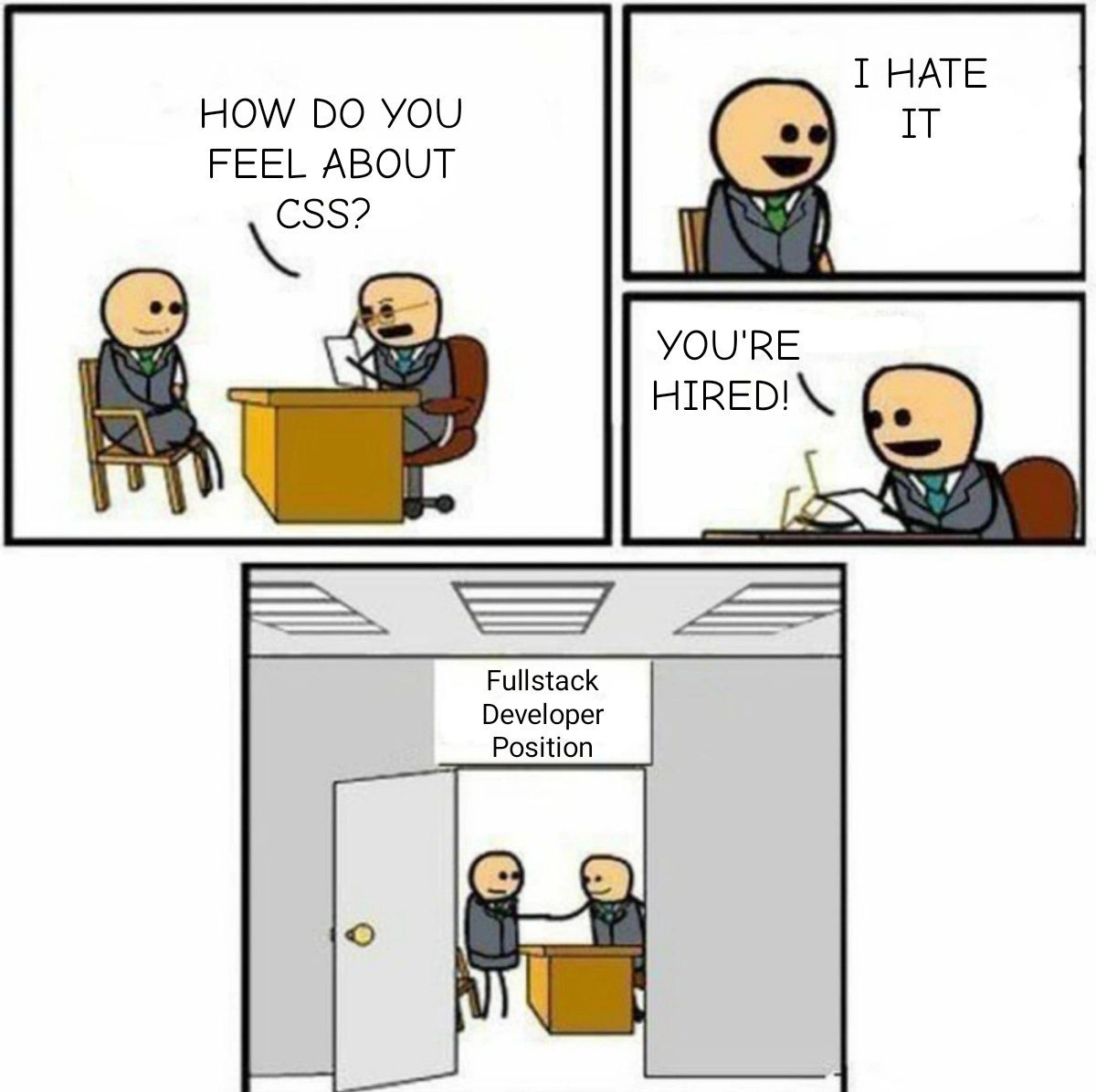
Imagine you’re in class and your teacher asks, “Be honest, who here actually likes doing homework?” Normally, you’d expect everyone to stay quiet or say something nice, because telling a teacher you hate homework sounds like a bad idea. But let’s say you raise your hand and boldly admit, “I really don’t like homework at all.” Now, picture the teacher not getting mad, but instead smiling really big and saying, “Yes! You’re my favorite student for saying that!” Sounds upside-down, right? It’s completely unexpected – usually saying you hate homework would get you in trouble, not a reward. But in this silly scenario, the teacher secretly also thinks homework is a pain, and is excited that you feel the same way. They end up bonding with you because you were honest about disliking something difficult. That’s exactly the kind of joke this meme is making. In the picture, a boss asks a developer how he feels about a tricky part of the job. The developer says, “I hate it,” expecting maybe a negative reaction. But the boss is actually happy and hires him on the spot! It’s funny because both of them feel the same frustration and weirdly become friends over it. The big idea is that people sometimes grow closer by sharing the same dislikes. In other words, misery loves company – even at a job interview, jokingly bonding over hating something hard can turn into an instant connection.

Level 2: Front-End Frustrations

Let’s break down what’s happening in this comic. We have a job interview for a Full-Stack Developer role. A full-stack developer is someone who works on both the front-end and the back-end of a website or application. The front-end is the part of software that users see and interact with – all the buttons, text, and layouts in your web browser. The back-end is the behind-the-scenes part – servers, databases, and logic that make everything run. CSS – which stands for Cascading Style Sheets – is a front-end technology. It’s the language used to style web pages, controlling things like colors, fonts, spacing, and layout. Whenever you see a webpage with a nice design or a specific arrangement of content, that’s because of CSS rules defining how elements should look. For example, if you want all the headings on your site to be blue and centered, you’d write a CSS rule for that. It might look like:

h1 {
  color: blue;        /* make the text blue */
  text-align: center; /* center the text */
}

In an interview, asking “How do you feel about CSS?” is basically checking the candidate’s comfort with front-end work. The expectation might be that the candidate says they’re fine with it or even enjoy it, since styling is part of the job. But in this meme the candidate responds bluntly with, “I hate it.” That’s a pretty strong, negative answer about something he’d likely have to do as part of the position! Normally, you would think such an answer would worry an interviewer. If you tell a company you hate an important tool or task, it might sound like you won’t do well at that part of the job. Yet, the very next panel shows the interviewer grinning and saying “You’re hired!” which is completely unexpected. This is where the humor comes from: the surprise that admitting dislike for a core skill actually wins him the job. It’s the opposite of typical interview advice (usually you try to stay positive and tactful), so it catches us off guard and makes us laugh.

To understand the joke better, it helps to know that CSS, despite being essential, has a bit of a reputation among developers for being tricky and frustrating. Many developers – especially those who don’t specialize in front-end design – groan about CSS because it can behave in ways that are not intuitive at first. Here are some common CSS quirks and pain points that cause this frustration:

  • Cross-browser headaches: A webpage might look perfect in Chrome, but then you open it in Firefox or Safari and something is off. Different web browsers sometimes interpret CSS slightly differently, which means a CSS style can work in one browser and not in another. In the past, Internet Explorer was notorious for making developers tear their hair out because it handled certain CSS rules in its own odd way.
  • The cascade & specificity: CSS is cascading, meaning that if two rules conflict, the one that comes later or is more specific usually wins. For example, imagine you wrote one rule that says p { color: blue; } to make paragraphs blue, but later in your CSS file another rule says p { color: red; }. All your paragraphs will end up red, because the later rule overrides the earlier one. This can get confusing when your stylesheets get big or when multiple CSS files are included. You might change a style and nothing happens, because some other rule (perhaps in a different file or added by a library) is taking priority. Figuring out which CSS rule is the boss is a common puzzle – developers call it dealing with CSS specificity.
  • Layout struggles: Positioning things on a page the way you want can be surprisingly hard. For a long time, simple tasks like centering an element vertically on the page were infamously difficult and required tricky solutions. Developers had to use workaround techniques (like setting an element’s parent to display: table-cell or using absolute positioning with careful math) just to center something. Modern CSS has introduced flexbox and grid systems that make this easier, but if you don’t know those, or you’re working on older code, you can run into those classic layout challenges. It’s frustrating to spend an hour tweaking things just to move a box to the middle of the screen.
  • Silent failures: Unlike a programming language (JavaScript, Python, etc.), CSS doesn’t throw obvious errors when something goes wrong. If you accidentally miss a semicolon or curly brace, or use a property incorrectly, the browser typically won’t shout at you – it will just skip that rule or ignore the broken part. This means you might stare at the screen wondering “Why isn’t this element turning the color I expect?” with no error message to guide you. Debugging CSS can feel like trying to solve a mystery with very few clues.

So, even though CSS is incredibly important (it makes the web look good instead of just plain text on a white background), it has all these little things that can irritate developers. When someone says “I hate CSS,” it’s often a sort of playful exaggeration – what they really mean is “CSS is frustrating sometimes and has driven me crazy on multiple occasions.” It’s a love-hate relationship for many. They appreciate what CSS can do, but they find the process of fine-tuning it to be tedious or maddening at times.

Now, why would an interviewer like hearing that? This comes down to the culture in some developer teams. In a casual setting, experienced programmers often joke about the tools and tasks that give them trouble. Complaining about something like CSS is a way to bond over a shared experience – kind of like friends all agreeing that a popular hard video game is “so annoying!” In this meme, the company is hiring a full-stack developer, which means the person will indeed have to write some CSS (since full-stack means doing both front-end and back-end work). But it also suggests the team doesn’t have any hardcore CSS enthusiasts; maybe everyone on the team is a primarily back-end person and they all sort of tolerate CSS rather than love it. So when the candidate says “I hate it,” the interviewer is delighted because it tells them two things: (1) this person has probably wrestled with CSS before (you usually “hate” it only after encountering its tricks and twists), and (2) the person will fit right in with the team’s vibe of jokingly griping about that part of the job. It’s a bit of interview humor poking fun at the idea of “culture fit.” In a real interview, most people wouldn’t be so blunt or negative for fear of seeming difficult, but in the world of developers, being honest (even in a grumpy way) about a known pain point can make you relatable. The meme exaggerates this to show the hiring manager valuing camaraderie over a textbook answer. The sign on the door reading “Fullstack Developer Position” sets the scene: it’s a job that involves doing it all. The punchline is that being openly averse to one of those “do-it-all” tasks (CSS work) is not a deal-breaker here – it’s practically a badge of honor. In summary, the meme highlights a common insider joke among coders: frontend work (especially CSS) can be so aggravating that admitting you dislike it is seen as a sign of experience and honesty, not a flaw. The interviewer and candidate basically bond over a shared dislike, which is funny because you’d think an interview is the last place that would happen.

Level 3: The CSS Handshake

This meme nails a bit of developer humor by flipping the usual interview script on its head. In a normal interview process, you’d expect a candidate to sugarcoat any weakness – certainly not to badmouth a core technology like CSS. Here though, the bald candidate does the unthinkable: he outright says “I hate it.” And unbelievably, that’s exactly what the suited interviewer wants to hear. For many seasoned devs, admitting a hatred for CSS is like giving a secret handshake that signals you’re a battle-tested web developer. The interviewer’s ecstatic reaction – “YOU’RE HIRED!” – suggests he’s thinking, “Finally, someone who’s suffered like us – you’re one of the tribe!” It’s a comedic inversion of expectations that rings true to anyone who’s spent late nights wrestling with front-end code.

Why would hating CSS ever be seen as a plus? It comes down to shared trauma and the bitter camaraderie of frontend pain points. CSS (Cascading Style Sheets) is supposed to be the simple language for making web pages pretty – just slap on some colors and fonts, right? But in practice, CSS can drive even senior developers up the wall. It has a notorious cascade of rules and bizarre specificity fights: one style rule might mysteriously override another, unless you sprinkle !important like a last-resort magic potion. There are no helpful error messages when things go wrong; a missing semicolon or a typo just silently breaks part of your layout. Something as seemingly simple as centering a <div> vertically was the stuff of legends (and despair) for years. Many of us have war stories about spending 3 AM debugging sessions muttering, “Why won’t this darn button align?!” only to discover an obscure CSS detail was off. In short, CSS is powerful but loaded with quirks – the kind that have caused countless developers to groan, sigh, and yes, joke that they “hate” it. That frustration is almost a rite of passage; once you’ve been burned by a CSS issue for the hundredth time, you earn the right to roll your eyes whenever someone even says “CSS”.

Now look at that office doorway sign: “Fullstack Developer Position.” A full-stack developer is expected to handle everything from fiddling with UI layouts in the browser to crunching data on the server. In reality, many full-stack devs have a stronger affinity for back-end logic and treat front-end work (like CSS styling) as a necessary evil. This comic satirizes that culture. The interviewer’s reaction implies the whole team probably shares a begrudging outlook on CSS – they consider it tedious, unpredictable, maybe even beneath “real” coding. By enthusiastically hiring the guy who hates CSS, they’re effectively saying, “Great, you’ll fit right in with us grumps!” It’s a tongue-in-cheek commentary on tech interview culture and “cultural fit”: sometimes fitting in is less about loving the craft and more about bonding over the same gripes. The humor shines a light on an industry truth: developers often bond by commiserating over annoyances like CSS, and admitting you loathe it can weirdly come off as authentic. In an environment where everyone is already avoiding or complaining about styling tasks, the best new hire is the one who instantly shares that little hate-filled hobby. The meme exaggerates this to hilarious effect – imagine a job offer basically for being honest about a common developer pain. It’s an absurd scenario that makes seasoned devs smirk because, deep down, we’ve all known the relief of hearing someone else exclaim, “Ugh, CSS drives me crazy!” and thinking yes, exactly. The candidate in the comic lands the job not in spite of his attitude, but because of it – a perfect punchline about shared suffering in the world of full-stack development.

Description

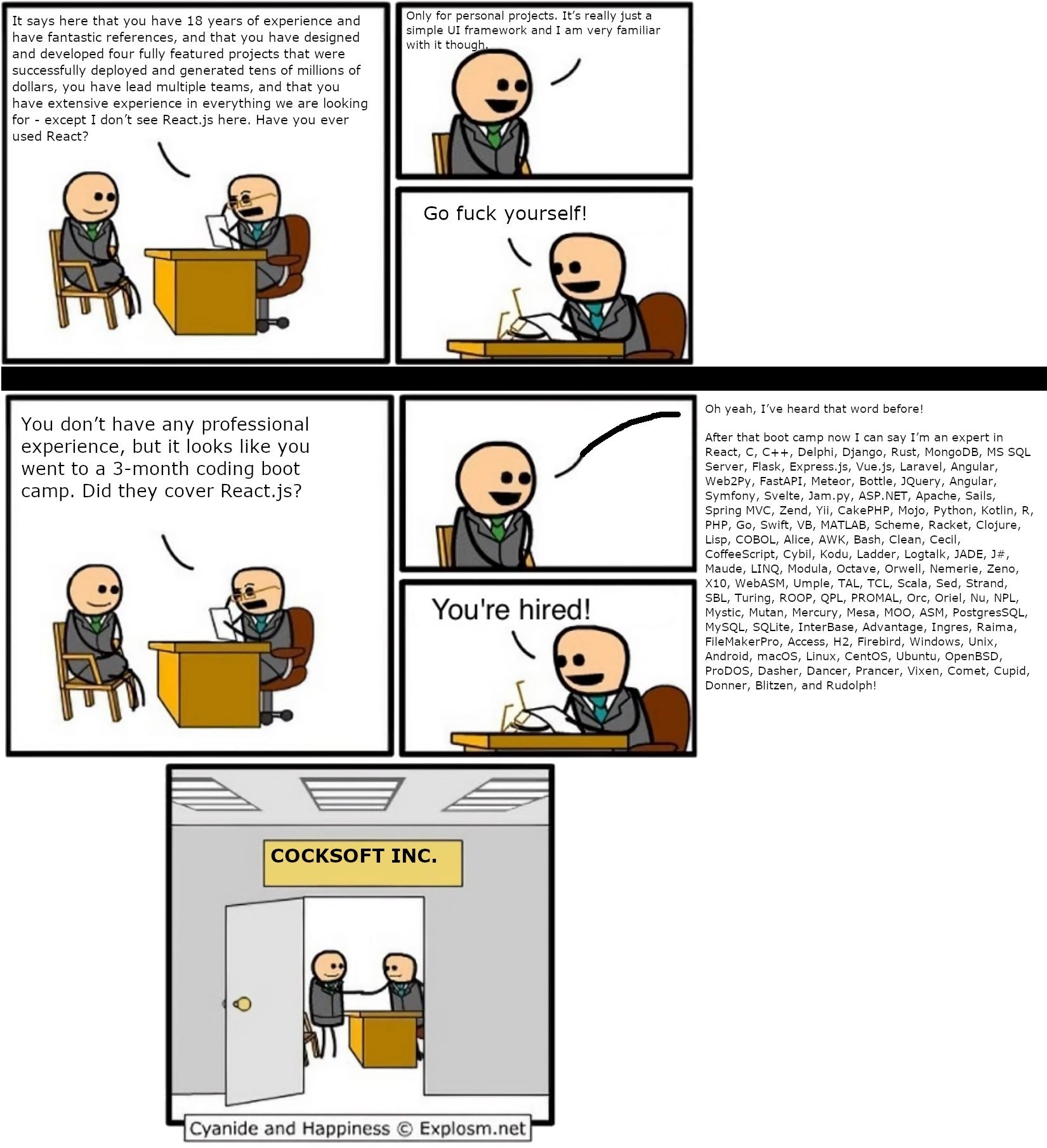
Four-panel comic in minimalist Cyanide-style art. Panel 1: a suited interviewer behind a yellow desk asks, “HOW DO YOU FEEL ABOUT CSS?” to a bald candidate seated opposite. Panel 2 shows the smiling candidate replying, “I HATE IT.” Panel 3 shows the delighted interviewer shouting, “YOU'RE HIRED!” while signing paperwork. Panel 4 zooms out through an open doorway labeled “Fullstack Developer Position,” where the two characters shake hands across the desk. The joke riffs on developer interview culture: despite CSS being core front-end tech, many full-stack engineers openly dislike its quirks, yet still land the job, highlighting common frontend pain points and hiring ironies
Comments

6
Anonymous ★ Top Pick I told the interviewer that wrestling with CSS specificity taught me all I need to know about distributed consensus - if two browsers ever render the same layout, that’s basically Paxos. Offer letter arrived before the cascade finished
  1. Anonymous ★ Top Pick

    I told the interviewer that wrestling with CSS specificity taught me all I need to know about distributed consensus - if two browsers ever render the same layout, that’s basically Paxos. Offer letter arrived before the cascade finished

  2. Anonymous

    The hiring manager knew they found someone who's actually shipped production code when the candidate didn't claim CSS was "just a matter of understanding the box model."

  3. Anonymous

    The real test isn't whether you hate CSS - it's whether you've achieved the zen-like acceptance that comes after your 47th attempt to vertically center something, only to discover that `display: flex; align-items: center;` was the answer all along, but now you're too deep into a `position: absolute; top: 50%; transform: translateY(-50%);` solution to turn back. Bonus points if you've ever shipped `margin-top: 147px;` to production because 'it just works' and the deadline was yesterday

  4. Anonymous

    Full‑stack hiring rubric: if you don’t hate CSS, you haven’t spent a Friday night triaging specificity, !important, and subpixel rounding

  5. Anonymous

    Veteran fullstackers know: True CSS hatred blooms after your nth !important forces a refactor across the monorepo

  6. Anonymous

    Show me a full‑stack who loves CSS and I’ll show you someone who’s never debugged a z-index buried under a transformed parent at 2 a.m

Use J and K for navigation