Skip to content
DevMeme
4124 of 7435
Programmer’s Bermuda Triangle: Laptop, Fridge, Bed, and a Data-Type Pun
DeveloperProductivity Post #4497, on Jun 20, 2022 in TG

Programmer’s Bermuda Triangle: Laptop, Fridge, Bed, and a Data-Type Pun

Why is this DeveloperProductivity meme funny?

Level 1: Where Did the Day Go?

Imagine you have a hobby you love so much that your whole day becomes just doing that, eating when you get hungry, and then sleeping a little before doing it all over again. For example, say you get a new video game and you play it all day, only pausing to grab a snack from the kitchen and later falling asleep on the couch. Pretty soon you might joke that you’re stuck in a little “triangle” between the TV, the fridge, and the bed. This meme is saying the same thing, but about a programmer whose life has shrunk down to just coding on a laptop, eating food from the fridge, and sleeping in a bed. It’s funny because it’s a bit true – sometimes people get so absorbed in something (like coding) that they lose track of time and almost nothing else happens in their day. The little joke about the “Double bed” is just a playful twist on words: a double bed is normally a bed for two people, but the word “double” also sounds like a fancy computer term. The commenter is goofing around, pretending to confuse the bed’s name with that programming word. In simple terms, the meme is poking fun at how a programmer’s world can get so small and nerdy that even their bed becomes part of a coding joke.

Level 2: Eat Sleep Code Repeat

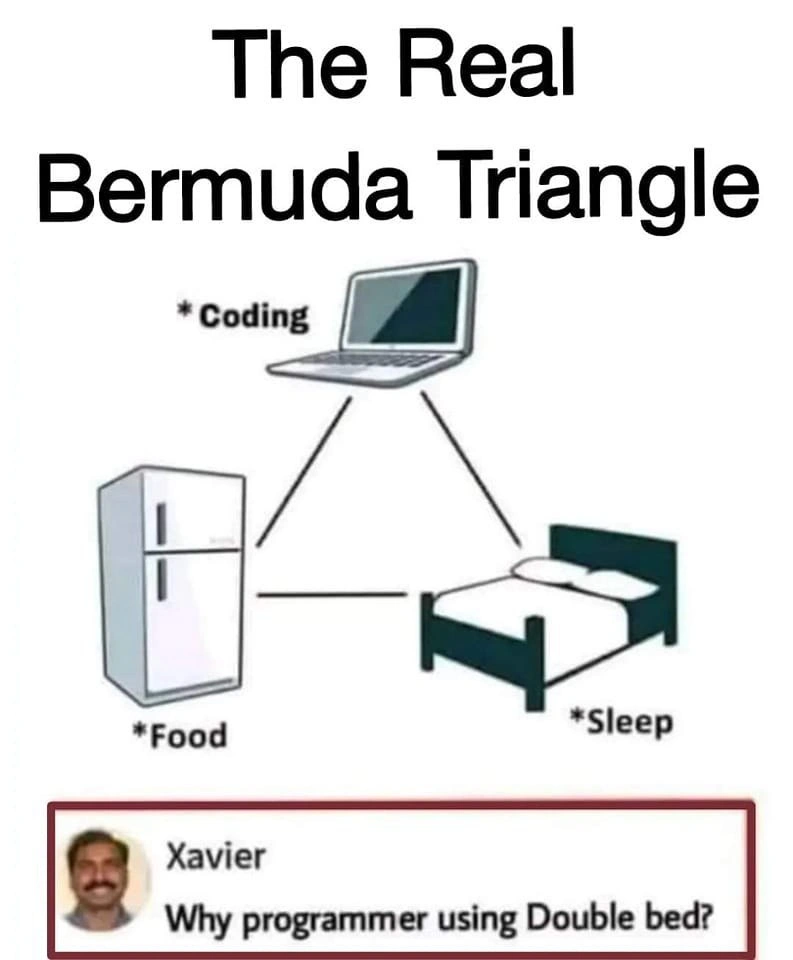
At a more straightforward level, this meme illustrates a day-in-the-life of a programmer who seems to do nothing but code, eat, and sleep. The triangle connecting the Laptop labeled "Coding", the Fridge labeled "Food", and the Bed labeled "Sleep" is jokingly called "The Real Bermuda Triangle." In legendary tales, the Bermuda Triangle is a spot in the ocean where things mysteriously disappear. Here it's a metaphor showing how a developer’s time and energy disappear into just these three activities. Essentially, the joke is that a programmer’s world can shrink down to an endless loop of writing code, grabbing food when hungry, then crashing into bed – only to wake up and start coding again.

Each corner of the triangle represents one part of this ultra-focused programmer routine:

  • Coding (Laptop): The laptop at the top stands for programming work. This is where the developer spends most of their day (and night) writing code, building projects, or debugging errors. It’s the central focus of their life in the meme.
  • Food (Fridge): The fridge on the left represents eating. When hunger strikes, the programmer just raids the refrigerator for a quick meal or snack. This implies they’re likely working from home or pulling long hours, surviving on whatever is in the fridge (leftover pizza, energy drinks, instant noodles – the classic coder diet).
  • Sleep (Bed): The bed on the right signifies the programmer finally crashing to sleep, often at odd hours. It’s notably drawn as a double bed (which is part of the joke). The idea is that they only stop coding when they’re utterly exhausted, catch a bit of sleep, and then it’s back to the laptop again.

All three points connect to show a continuous cycle: code → eat → sleep → repeat. It's a well-known concept in the tech community, often jokingly summarized by the phrase "Eat, Sleep, Code, Repeat." For many people learning to code or working on intense projects, life can start to feel like this. You get so immersed in coding that you forget to do much else. It’s portrayed as a DeveloperLifestyle quirk — funny in the short term — but it can become unhealthy if it turns into your everyday pattern. After all, if you only leave your computer to grab a sandwich and then later collapse into bed, you might be missing out on exercise, social life, and other important things.

Now, the extra punchline of this meme is the comment “Why programmer using Double bed?” shown below the triangle diagram. This is a classic example of dev humor playing with words. In normal English, a "double bed" is just a bed big enough for two people. The commenter (Xavier) is teasingly asking why our presumably single, always-coding programmer needs such a large bed. But the real joke is a nerdy pun: in programming, double is a data type (short for double-precision floating point number). In many languages like C++ or Java, a double represents a 64-bit decimal number. So when a developer hears "double bed," they can’t help but think of the keyword double. The commenter is joking as if the meme’s caption were code: why declare a double bed when probably a "single" would suffice? (There isn’t actually a data type literally called "single" in most languages, but he’s hinting at single-precision or just a smaller size.) In simpler terms, he’s poking fun at the idea that our programmer doesn’t need a bed that’s twice as big, much like you wouldn’t allocate more memory or use a bigger variable type than necessary.

For someone new to coding, this pun shows how programmers love to mix tech terms into everyday situations. Once you learn about fundamental types like int, float, and double, you start to appreciate these kinds of jokes. It’s part of DeveloperHumor culture to make light of our own habits (like never leaving the computer) and toss in a geeky pun for good measure. The whole meme is a funny exaggeration of what an intense coding streak can look like. But it also carries a small lesson: while diving deep into coding is exciting, remember to take breaks and care for yourself. Even early in your career, you’ll hear advice about maintaining work-life balance. In other words, don’t actually let your world become a Bermuda Triangle of just laptop, fridge, and bed. It’s great to be passionate, but even a programmer should step out of that loop to stay healthy and happy (that’s one of those unwritten WorkLifeBalanceTips you eventually learn in tech).

Level 3: The Infinite Loop Lifestyle

Seasoned developers immediately recognize this meme as a tongue-in-cheek depiction of the classic developer routine that many of us have fallen into at some point. Titled "The Real Bermuda Triangle," it connects Laptop (coding), Fridge (food), and Bed (sleep) as the three points where a programmer’s daily life vanishes. It's funny because it's true — hours of coding sessions make time and commitments mysteriously disappear, much like planes and ships in the legendary Bermuda Triangle. For better or worse, this closed-loop existence is the CodingLife many have experienced – an unintended triangle trap in a developer’s world.

On paper, focusing intensely on work might sound like peak DeveloperProductivity, but experienced engineers know there's a catch: this food_sleep_code_cycle can become an infinite loop that leads to burnout. It's a routine where:

  • Time disappears without a trace. You start a “quick” bug fix after dinner, and next thing you know, the clock reads 3 AM and your midnight snack is still sitting half-eaten.
  • Sleep gets deprioritized or skipped. Those LateNightCoding marathons seem heroic at first, until the SleepDeprivation kicks in and you’re pushing commits with bleary eyes and a brain full of syntax errors.
  • Life outside code vanishes. Hobbies, socializing, even basic exercise fall off the radar. The laptop-fridge-bed triangle becomes your whole universe, a wry metaphor for dangerously poor work-life balance.

This resonates with senior devs because many have endured the grind of urgent ship dates or passion-fueled all-nighters where they only shuttle between their code, the kitchen for a quick refuel, and whatever horizontal surface passes for a bed. It's an almost mythologized part of DeveloperLifestyle lore – think of startup hackathons with sleeping bags under desks and empty pizza boxes piled high by the monitor’s glow. We laugh at the meme because we've lived it, and we know it’s a double-edged sword: you feel productive in the zone, but also realize how MentalHealth and real productivity suffer if you never escape this triangle.

And then there’s the icing on this meme: the little social media comment under the image that reads, “Why programmer using Double bed?” This one-liner is a pun that makes a coder chuckle on multiple levels. In everyday terms, a "double bed" is meant for two people, but here it humorously suggests the programmer probably only ever uses one side of that bed (since they’re coding solo or barely sleeping). The kicker is the data-type pun: in programming, double is a primitive type (a double-precision floating-point number). The commenter slyly asks why a programmer is using a double bed, riffing as if the bed’s size were a variable type choice in code. It’s as if they’re suggesting, “You’re a lone developer, shouldn’t you be using a 'single' (precision) bed instead of a double?” – a playful nod to how devs can’t resist slipping tech jargon into everyday life.

For experienced devs, this joke lands perfectly. It mixes a painfully relatable scenario (being mentally and physically trapped in the code-food-sleep loop) with that nerdy reflex to see double not just as a bed size but as a data type. It’s classic TechHumor: taking a real work-life balance struggle and defusing it with a bit of geeky wordplay. Behind the laughter, there’s a knowing sigh – we chuckle because it’s true, and also as a gentle reminder to ourselves (and each other) to break out of that infinite loop once in a while.

Description

White meme panel titled "The Real Bermuda Triangle" at the top in bold black text. Below, a simple line triangle connects three clip-art items: a grey laptop at the apex labeled "*Coding", a white refrigerator at the left base corner labeled "*Food", and a dark green single bed at the right base corner labeled "*Sleep". Under the triangle, a social-media comment box shows a blurred avatar, the name "Xavier", and the text "Why programmer using Double bed?" - a joke that riffs on the programming primitive type "double" while wondering why the bed isn’t single like most devs’ sleep time. The meme humorously captures the cyclical routine of developers oscillating only between coding, eating, and sleeping, hinting at work-life balance challenges and the ever-present pun culture in software engineering

Comments

6
Anonymous ★ Top Pick Our sleep service kept getting garbage-collected, so in the latest architecture review we re-typed the bed from float to double - still not enough precision for PagerDuty latency
  1. Anonymous ★ Top Pick

    Our sleep service kept getting garbage-collected, so in the latest architecture review we re-typed the bed from float to double - still not enough precision for PagerDuty latency

  2. Anonymous

    After 20 years in tech, I've finally achieved perfect work-life balance: my laptop sleeps next to me for faster incident response, and my refrigerator runs Kubernetes to orchestrate my meal delivery containers

  3. Anonymous

    The real Bermuda Triangle isn't in the Atlantic - it's the infinite loop between your IDE, refrigerator, and bed where time mysteriously disappears and production deadlines vanish without a trace. Xavier's asking the real architectural question though: why use a Double when a Single would reduce memory overhead and you're never going to need that extra precision for sleep anyway?

  4. Anonymous

    Double bed? That’s active-active sleep - until the on-call pager does a global failover at 3 a.m

  5. Anonymous

    The only triangle where CAP theorem holds perfectly: you pick Coding consistency or Availability of sleep, but never both without Partitioning your sanity

  6. Anonymous

    It’s not a double bed - it’s an HA sleep cluster; active/standby for 3 a.m. rollbacks, yet the life CAP theorem still applies: under load you only get two of coding, food, and sleep

Use J and K for navigation