Skip to content
DevMeme
4119 of 7435
Stack Overflow experience: downvotes flood in while answers remain at zero
DevCommunities Post #4498, on Jun 20, 2022 in TG

Stack Overflow experience: downvotes flood in while answers remain at zero

Why is this DevCommunities meme funny?

Level 1: The Classroom Question

Imagine you’re a kid in a classroom who raises their hand to ask the teacher a question. You’re a bit unsure, but you really need help with your homework problem. Now picture instead of the teacher or classmates giving you an answer, one older kid in the back just yells “Boo, that’s a silly question!” and nobody else says anything. You’d feel pretty bad, right? You still don’t know the answer to your question, and now you also feel kind of embarrassed for even asking. That’s basically what’s happening in this meme. The person asking for help is like the student with their hand up. The big thumbs-down is like that rude kid shouting them down. And the other kids huddling and smirking are like classmates who only judge but don’t help. It’s showing in a simple, comic way that sometimes when we ask for help in a group (especially an expert group), we might get criticism instead of answers. Even though it’s drawn in a funny stick-figure style, it feels unfair and relatable – anyone would feel sad if they asked a question and got only negative reactions. The joke is a bit like laughing at a bad but common situation: we expect helpers to help, not just say “bad question!” So the meme is like seeing a kid ask for help and the “helping community” gives a thumbs-down. It’s funny because it’s drawn like a silly comic, but it’s also a little sad because that happens in real life sometimes. The takeaway is simple: being new at something is hard, and getting no help but a lot of discouragement is a rough (if familiar) experience – one that even grown-up programmers face on websites meant to share knowledge.

Level 2: No Answers, Only Downvotes

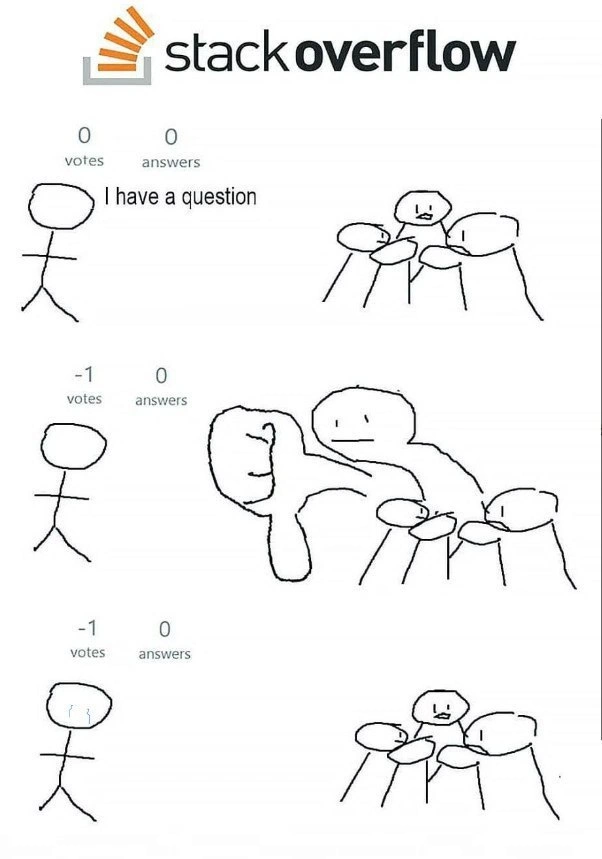
Let’s break down what’s happening in simpler terms. Stack Overflow is a popular website where programmers ask questions and other programmers provide answers. It’s like a giant help forum. Users can upvote or downvote questions and answers. An upvote means people think the question or answer is good or useful. A downvote means people think it’s not good (maybe it’s unclear, not researched, or off-topic). When you ask a question on Stack Overflow, you hope to see answers (solutions or explanations) and maybe a few upvotes if your question was well-received. In the meme’s first panel, the new asker has “0 votes, 0 answers.” That’s normal for a brand new question — no one has reacted yet. The little stick figure saying “I have a question” represents any developer (especially a newbie) bravely asking for help on a problem they couldn’t solve alone.

Now, look at panel two: the score changed to “-1 votes” but there are still “0 answers.” This means someone saw the question and clicked the down arrow (downvote) without giving an answer. The big stick figure with the giant thumbs-down is a cartoon way to show that downvote hitting the asker like a smack. Essentially, the community’s first response was negative feedback rather than help. The other three stick figures in the scene are like bystanders – other community members – watching this happen. In panel three, the score is still -1 (so only that one downvote happened, no one upvoted to counter it) and still no answers at all. The asker is drawn with a dejected posture, meaning they feel sad or embarrassed. The three bystanders are drawn huddled together, looking a bit smug or judgmental, as if they’re whispering “That was a bad question” or snickering at the newbie’s expense.

This reflects a common newbie struggle on Stack Overflow: you ask something and instead of getting help, you get criticized or downvoted. It feels like being booed on stage when you were expecting a helpful response. The meme uses a simple stick-figure style (which is common in tech humor comics) to make it clear and relatable. The Stack Overflow logo at the top establishes the context immediately – any developer seeing that logo and the format of “votes / answers” instantly knows this is about the Stack Overflow site experience. The DeveloperCommunity on Stack Overflow can be very strict. They have guidelines: for example, they expect you to search for your problem first (maybe your question was already answered elsewhere on the site), and to write a clear, detailed question with code examples if relevant. If you don’t follow these norms, your question might be labeled as “low quality.” Instead of someone kindly explaining that, often the question just gets downvoted or even closed (meaning no more answers allowed) with maybe a short comment like “duplicate of X” or “lacks details.” To a newcomer, that response feels harsh – like you’re being punished for not knowing something.

Key terms here: Gatekeeping is a word that describes what’s happening. It means experienced members of a group might be keeping the “gate,” deciding who gets let in or what is acceptable. In developer communities, gatekeeping can look like experts dismissing beginners’ questions because they’ve seen them too many times or because the question doesn’t meet certain standards. The meme is highlighting gatekeeping on Stack Overflow. The experienced folks (the three figures) essentially shut down the newbie (the lone figure) by downvoting and not engaging positively. The result? The question has a negative score (which can actually discourage others from answering it, because a negative score signals “there’s something wrong with this question”) and the asker still has no solution. The communication has broken down: the asker tried to communicate a problem, but the would-be helpers only communicated disapproval, not answers. This is why the situation is often joked about among developers as a relatable experience – many of us have a story of feeling ignored or judged on Stack Overflow.

Let’s also talk about reputation on Stack Overflow. When you participate on the site, you earn reputation points for good contributions (like asking a well-received question or writing a helpful answer). You lose points for downvotes: if your question is downvoted by someone, you might lose a couple of points. Likewise, people who answer can lose points if their answer is downvoted. However, downvoting a question typically doesn’t cost the voter much, so some people cast those downvotes freely. New users start with low reputation, and it hurts to lose points because it feels like a public score of your knowledge. In the comic, the “0 votes” going to “-1 votes” is literally the reputation score of that question dropping by 1. It’s a small drop, but symbolically it’s like a slap on the wrist. And because the score is visible to everyone, it’s a bit embarrassing – like a red mark on your contribution. That’s why the stick figure appears physically knocked back in panel 2. It dramatizes how a simple down-pointing arrow click on a website can feel like a big personal rejection to someone asking for help.

For a junior developer or someone new to these forums, this meme is a cautionary tale and a commiseration. It’s saying, “You’re not alone – Stack Overflow can be intimidating.” The tags like CommunicationBreakdown and RelatableDevExperience are pointing out exactly that: this kind of miscommunication (no actual answer given, only negative feedback) is a common experience that many developers relate to. It also subtly suggests that maybe the culture should change to be more welcoming. If you find yourself in the position of the asker, don’t take it too hard – sometimes perfectly capable developers get downvoted if they unknowingly broke a community rule. And if you’re one of the experienced folks, the meme might be nudging you to be a bit more helpful. In short, at this level of explanation, the meme is about asking for help online and getting a cold response. And that scenario is depicted in a simple, exaggerated way to make us laugh a little and think, “Yep, I’ve seen this happen!”

Level 3: Trial by Downvote

Stack Overflow is a legendary Q&A site for programmers, but this meme highlights its notoriously tough love culture. In the first panel, a stick figure earnestly says “I have a question” under the official Stack Overflow header. The site shows 0 votes and 0 answers, indicating a fresh question with no community feedback yet. The humor (or horror) comes in panel two: instead of getting help, the asker immediately gets hit with a downvote – represented by a giant thumbs-down literally knocking them over. The score flips to -1 votes while still 0 answers. By panel three, nothing has improved: the question’s score remains at -1, still no answers, and the poor stick figure stands there dejected as three other figures huddle smugly like gatekeepers. This lands because every developer who’s ventured onto Stack Overflow recognizes this relatable dev experience: sometimes when you ask a question, especially as a newcomer, the only responses are downvotes or snarky comments, not helpful answers. It’s a satirical take on communication breakdown in developer communities where expertise can sometimes manifest as elitism.

Why is this funny to seasoned developers? It’s dark humor born of shared pain. Stack Overflow is supposed to be a place to get unstuck by tapping into collective knowledge – many of us practically live by it (hence the tag StackOverflowDependence). But there’s a catch: questions that don’t meet the community’s unwritten standards can get slammed. The meme exaggerates this: a lone newbie asks for help, and the “community” responds with immediate disapproval. No answer, just an instant downvote avalanche. Experienced developers nod knowingly (perhaps with a wince) because we’ve seen it happen or felt it ourselves. The combination of zero answers and a flood of downvotes is both absurd and all too real. It pokes fun at the dev community gatekeeping that happens when seasoned users prioritize policing question quality over actually helping. The comic’s stick-figure simplicity under the official logo makes the scene unmistakable – we instantly recognize the Stack Overflow context and the déjà vu of “ask a question, get roasted.”

On a deeper level, this meme critiques the gamification and culture of Stack Overflow. The site uses a reputation system: upvotes add to your score, downvotes subtract from it. High reputation users earn moderation privileges and status in the community. In theory, this crowd-sourced moderation maintains quality. In practice, it creates an environment where some users reflexively downvote questions that seem lazy, duplicate, or poorly formatted. They might be thinking, “This question has been answered a thousand times, go search!” or “RTFM” (Read The Friendly Manual) – a classic snub to newbies. From an architectural standpoint, a downvote on a question costs the voter little (historically, no rep penalty for downvoting questions), but it deducts points from the asker’s reputation. That design choice makes downvoting an easy, low-friction reaction. Answering, on the other hand, takes effort and yields no reward if the question is going to be closed or ignored. Seasoned users often triage posts: simple or “bad” questions get downvoted/closed to protect overall content quality. This leads to the scenario depicted: newcomer asks, veterans pounce (with downvotes), and nobody actually answers. It’s like an unwritten initiation ritual on the site – “Welcome to Stack Overflow, trial by downvote!”

Importantly, the humor has an edge of truth that senior devs find both funny and frustrating. We recall real situations where a question remained stuck at -1 (or lower) with no answers, as bystanders argued about its merit instead of just helping. The three smug stick-figures in panel 3 perfectly capture that vibe of a cliquish developer community. They’re basically saying without words: “Your question isn’t worth answering; feel the shame of our downvote.” It’s a form of gatekeeping – keeping the bar high by discouraging “low-effort” questions. The result? The asker feels unwelcome (knocked back by that giant thumb), and still doesn’t have an answer. Everyone loses, but the peanut gallery feels self-satisfied. This resonates in the industry: we talk about being “Stack Overflowed” when you gather courage to ask something and get shot down. It highlights the gap between the platform’s promise (knowledge sharing) and the reality newbies often encounter (elitist snark).

From an experienced perspective, there’s also a bit of self-reflection here. Many of us senior engineers have answered tens or hundreds of questions on Stack Overflow. We justify downvoting as necessary: to filter out duplicates, off-topic queries, or poorly researched posts. After all, Stack Overflow’s treasure is its high-quality archive of Q&A; too much noise devalues it. But did you answer it? – that’s the question the meme asks pointedly. Downvoting is easy, answering thoughtfully is hard. The meme holds up a mirror to dev culture: we value helping others in theory, yet in practice we might discourage beginners by being overly harsh. It’s a commentary on how communication can fail even in a knowledge-sharing forum. Why not just kindly explain or link a solution? Often, it’s because experienced devs are burned out on repeat questions or incentivized to focus on problems that earn rep. It’s a classic trade-off: quality control vs. approachability. The human cost is that newcomers feel stupid or afraid to ask next time. The emotional core beneath the humor is the memory of that sinking feeling when your first question got a cold reception. It’s both comforting and alarming that so many relate to it.

To put it bluntly, this stick-figure strip is funny-not-funny. It satirizes the “No soup for you!” style moderation on Stack Overflow. For those of us with battle scars from the Q&A trenches, it’s a knowing chuckle with a side of guilt. We laugh, then we think: should we be doing better? The meme uses minimal art and a clear scenario to deliver a punchy message about DeveloperExperience_DX: the experience outside of writing code, where communication and community behavior directly impact how welcome developers feel. It’s a nudge to remember that behind every “stupid question” is a real person trying to learn. And maybe, just maybe, we can flood them with answers instead of downvotes next time.

# Pseudocode of the meme's scenario:
question = {"author": "NewUser", "score": 0, "answers": 0, "content": "I have a question"}
community_reaction = []
if question["author"].reputation < 50 and is_basic(question):
    question["score"] -= 1            # downvote happens
    community_reaction.append("👎")   # record a thumbs-down
# No answer is given in this scenario
print(question["score"], "votes", question["answers"], "answers", community_reaction)
# Output: -1 votes, 0 answers, ['👎']

The code above humorously models what the meme shows: a new user asks something simple, someone immediately downvotes (score goes from 0 to -1), and no answers are posted. In a real dev team, we’d call this an anti-pattern for knowledge sharing. The meme strikes a chord because we all know knowledge should flow freely (we depend on those answers!), yet the system sometimes overflows with judgment instead of help. The irony isn’t lost on us seniors: a platform literally named “Overflow” often ends up with an underflow of empathy.

Description

The image is a three-panel stick-figure comic under the official "stack overflow" logo (orange rising bars and black text). Panel 1 shows a site template reading "0 votes 0 answers" next to a lone stick figure saying "I have a question" while three other stick figures observe. Panel 2 shows the score changing to "-1 votes 0 answers" as an oversized stick figure leans in to give a huge thumbs-down, visually knocking the asker back while the onlookers watch. Panel 3 keeps the score at "-1 votes 0 answers"; the asker stands dejected and the three observers huddle smugly. The meme humorously captures the common developer complaint that novice questions on Stack Overflow are met with immediate downvotes instead of helpful answers, highlighting cultural gatekeeping and the sometimes harsh dynamics of online developer communities
Comments

6
Anonymous ★ Top Pick Stack Overflow’s hidden SLA: P99 time-to-downvote < 100 ms, answers delivered on an eventually-consistent basis - currently resolving to null
  1. Anonymous ★ Top Pick

    Stack Overflow’s hidden SLA: P99 time-to-downvote < 100 ms, answers delivered on an eventually-consistent basis - currently resolving to null

  2. Anonymous

    Stack Overflow: where your question about distributed consensus algorithms gets marked as duplicate of a 2009 jQuery thread that uses deprecated APIs, but somehow that's your fault for not searching hard enough

  3. Anonymous

    Stack Overflow: where your question gets marked as duplicate before you finish typing it, downvoted for not including a minimal reproducible example of your existential crisis, and closed as 'opinion-based' when you ask if anyone else has encountered this exact compiler error with the same stack trace you pasted

  4. Anonymous

    Stack Overflow’s consensus algorithm: without an MRE, the cluster reaches quorum on -1 in seconds - no leader election required

  5. Anonymous

    Stack Overflow initiation: Post naive question, collect -1 karma faster than a zero-day exploit

  6. Anonymous

    On Stack Overflow, “I have a question” without an MRE trips the circuit breaker to /dev/null and returns -1

Use J and K for navigation