
Big O Notation vs. Silicon Reality
Description
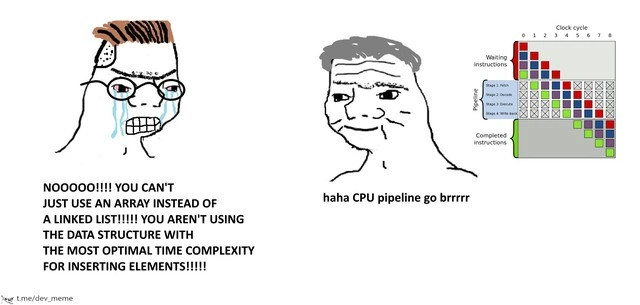
A 'Haha X go brrrr' Wojak meme contrasting theoretical computer science purity with practical hardware performance. On the left, a crying, angry Wojak character yells, 'NOOOOO!!!! YOU CAN'T JUST USE AN ARRAY INSTEAD OF A LINKED LIST!!!!! YOU AREN'T USING THE DATA STRUCTURE WITH THE MOST OPTIMAL TIME COMPLEXITY FOR INSERTING ELEMENTS!!!!!'. On the right, a calm, knowing Boomer-faced Wojak replies, 'haha CPU pipeline go brrrrr'. Next to him is a diagram of a 4-stage CPU instruction pipeline, illustrating how modern processors execute instructions concurrently. The joke is a classic senior vs. junior developer debate. The junior developer is fixated on the theoretical Big O complexity (O(1) insertion for linked lists). The senior engineer understands that the contiguous memory layout of an array is incredibly cache-friendly, leading to fewer cache misses and allowing the CPU's pipeline and prefetcher to work at maximum efficiency, which often makes arrays significantly faster in practice, despite a theoretically worse O(n) insertion time. A watermark for 't.me/dev_meme' is visible in the bottom left









Comments
7Comment deleted
The best algorithm is one that fits in the L1 cache. Everything else is just a negotiation with latency
Textbook: linked-list insert is O(1). Production: every pointer chase blows a cache line, the pipeline stalls, and that “constant” becomes the lead time for procurement to approve more cores
Twenty years of explaining Big O notation in interviews, only to spend my days optimizing for cache lines because that O(1) linked list insertion is meaningless when your prefetcher is crying in the corner
This perfectly captures the moment when a senior engineer realizes that their CS degree's emphasis on O(1) linked list insertions conveniently omitted the part where traversing pointers obliterates your L1 cache, stalls the pipeline, and makes the CPU's branch predictor cry. Meanwhile, that 'inefficient' O(n) array shift is happily prefetched, vectorized, and completes before the linked list even finishes its second cache miss. Modern hardware doesn't care about your asymptotic complexity when n < 10000 and your data fits in cache - it cares about whether your memory access patterns let it go brrrrr
Linked list: O(1) insert, O(infinity) cache misses. Array: shifts brrrr, ships first
That O(1) linked-list insert becomes O(300 cycles) when every pointer chase misses L1 - arrays let the prefetcher and pipeline go brrrrr
Big‑O says “linked list for O(1) inserts”; the perf counter says “array,” because pointer‑chasing starves the pipeline while the prefetcher makes contiguous memory go brrrr