Relationship Permission Denied: Just Use Sudo
Why is this CLI meme funny?
Level 1: The Magic Word
Imagine you ask someone for something really important, like asking your friend to share their favorite toy or asking someone to be your date to a dance. They say, “No, I can’t – I already promised it to someone else.” That’s like a door closing in your face, and it makes you sad 😞. Now, a regular person might just accept the “no.” But a super tech-savvy person tries a magic trick word from the computer world. It’s kind of like when you’re a kid and you think if you say “pretty please” (the magic word) the other person might change their mind. In this meme, the magic word is sudo – which is a nerdy computer word that usually lets you do almost anything on a computer if you know a secret password.
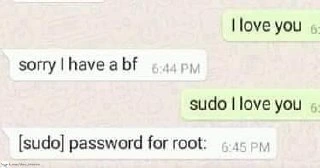
So the first person basically says, “I love you,” and the second person says, “Sorry, I already have a boyfriend” (meaning “I’m not available”). That’s our No. The first person then pretends they have a special override power and says “sudo I love you,” as if just adding this special word could make the other person suddenly say yes. It’s like them saying, “Actually, I’m a super authority, you have to love me!” It’s obviously a silly, make-believe move – nobody can force someone to reciprocate feelings by just saying a command. The funny part is the second person plays along with the make-believe. Instead of just saying “Huh? What do you mean?”, they reply with something that a computer would: “[sudo] password for root:” – which is basically, “Oh, you think you have special powers? Then you must know the secret password to use them!” It’s as if the second person is pretending to be a locked door that asks, “Fine, if you’re really the boss, prove it with the key.”
Why is this funny? Because it mixes real life and make-believe computer rules in a playful way. We know in real life there’s no magic word (no real “sudo”) that makes someone love you if they don’t. But the idea of trying it, and the other person cheekily going along with the joke, is unexpected and cute. It’s like two friends suddenly speaking in a secret code that only computer people know, turning a heartbreak moment into a nerdy pretend game. Even if you don’t get all the tech details, you can laugh at the idea that this person tried a “master override” on a love confession. It’s the same kind of laugh you’d get if a kid, told they can’t have a cookie, put on a toy crown and said, “Now I’m the Cookie King – give me all the cookies!” and the parent replied, “Alright, Cookie King, what’s the royal password?” 🤭 It’s funny because it’s a playful fantasy – in the end, the answer is still no, but at least they had a humorous exchange about it.
Level 2: Superuser to the Rescue
Let’s break down the technical references in this meme and why it’s funny even if you’re new to the command line.
What is sudo?sudo stands for “superuser do”. It’s a command used in Linux and other Unix-like operating systems (think Ubuntu, macOS Terminal, etc.) to temporarily run a command as a superuser (also called the root user). The root user is like the ultimate administrator of the system – it has permission to do anything. Regular users (like the account you normally log in with) have limited permissions for safety. For example, as a normal user you usually can’t edit system files or install software to protected directories because the OS will say, “Hey, you don’t have the rights to do that.” That’s the computer’s way of protecting itself – similar to how not just anyone can walk into a secure building area. The error you’d see is often Permission denied (meaning “you’re not allowed to do this”).
What does adding sudo do?
When you put sudo in front of a command, you’re telling the system: “I know this action is normally restricted, but I have authorization. Let me do it.” The system then typically asks you to prove it by entering your password (the one for your account that has sudo rights). Once you provide the correct password, the command runs with elevated privileges – essentially with the powers of the admin. It’s like showing your ID badge to a security guard to get into a locked room. For instance:
# Trying to write to a protected file without sudo
alice@pc:~$ echo "Hello" > /etc/important.conf
bash: /etc/important.conf: Permission denied
# Now using sudo to get permission
alice@pc:~$ sudo echo "Hello" > /etc/important.conf
[sudo] password for alice: ****** # (Alice types her password here)
# After entering the correct password, the command will execute with admin rights.
In the first attempt, Alice tried to write to a system file and got a “Permission denied” error because only root (or sudo) can do that. In the second attempt, sudo elevated Alice’s privileges, the terminal asked for her password ([sudo] password for alice:), and then it would execute the command as if Alice were an admin. This is exactly the pattern the meme humorously mimics, but in a chat about love!
Understanding the WhatsApp chat format:
In the image, the conversation is laid out like a WhatsApp chat. The green bubble on the right is Person A (usually green means messages you sent in WhatsApp), and the white/gray bubble on the left is Person B (the other person’s replies). Each message has a tiny timestamp (6:43 PM, 6:44 PM, etc.) like a real chat. It’s visually immediately recognizable as a phone messaging app conversation, which makes the scenario feel informal and relatable. But then the content of the messages takes a turn into nerdy territory!
Here’s what happens in the chat:
Person A (6:43 PM, green): “I love you” – This is a plain love confession. In tech terms, think of it like making a request. Person A is asking for something (affection or a relationship). 👩💻 In a computer analogy, it’s like running a command that tries to gain access to something (in this case, the other person’s heart).
Person B (6:44 PM, white): “sorry I have a bf” – Ouch, rejection. “I have a bf” means Person B already has a boyfriend, so she’s basically saying “No, I’m not available.” In computing parallels, that’s the error message for Person A’s request. It’s akin to a “Permission denied” or “Request refused” response. You tried to open a locked door, and the answer is “access not granted.” In other words, Person A doesn’t have the permission (or the role) to proceed because that slot (boyfriend) is taken.
Person A (6:45 PM, green): “sudo I love you” – Instead of just giving up, Person A responds with a geeky twist: prefixing the request with
sudo. 😎 This literally looks like a Terminal command now. He’s treating the previous “No” as if it were a computer telling him “Permission denied.” So his brain goes, “Alright, let’s elevate this request to superuser level.” It’s like saying, “Ignore the rules, I’m the admin now – I command you to love me.” Obviously, you can’t actually do that to a person, but that’s the joke. In text form it reads as if he typed a commandsudo I love youinto a shell. This is a play on the concept of PrivilegeEscalation – in tech, that means gaining higher access rights. Person A is humorously attempting a privilege escalation in the context of romance.Person B (6:45 PM, white): “[sudo] password for root:” – Person B one-ups the joke by replying exactly the way a Linux system would! 😂 When you run a sudo command, the system typically responds with a prompt like
"[sudo] password for <yourusername>:". Here, Person B wrotepassword for root:which is very close to the real thing (it suggests “If you’re root, enter the root password”). This response means Person B is continuing the analogy: “Oh, you think you’re the superuser who can override anything? Fine, prove it. What’s the password?” It’s basically a creative (and kind of cheeky) way of saying “No, you still don’t have permission – unless you have some godlike credentials which you don’t.” For a developer, seeing that line in a WhatsApp chat bubble is hilarious because it’s so unexpected outside of a terminal window. It instantly tells us that Person B is also tech-savvy and is shutting down Person A’s attempt with the ultimate "you shall not pass" challenge. It’s the social equivalent of the system standing its ground.
To a junior developer or someone new to Linux, the humor might not be immediately obvious without knowing these terms. But once you understand:
- CLI (Command-Line Interface) is a text-based way to interact with your computer (like the Terminal app or Windows Command Prompt). It’s where you type commands and see text output. Many developers live in the CLI for tasks like version control, running scripts, managing servers, etc.
- Linux is an operating system family (like Windows or macOS) popular among developers, especially for servers. In Linux,
sudois used constantly to do admin tasks safely. - Privilege escalation is when you go from a lower permission level to a higher one (like user to admin).
sudois a benign, authorized way to do that (as opposed to malicious ways, which hackers might try). - Root is the name of the default admin user on Unix/Linux systems. Root can do anything on the system (akin to a “super admin”). Normal users can become root temporarily via
sudoif they’re allowed. Think of root as the “boss account” on the computer.
The meme’s joke is putting computer jargon into a love chat. Person A acts like a programmer trying to solve a rejection as if it were a file permission error, and Person B responds like a computer that requires special access. It’s funny because it is a mismatch of contexts: in real life, you can’t solve personal relationships with code or admin rights. But developers find it comically relatable because we often half-joke about wanting a sudo for real life problems (“if only I could sudo my chores away!”).
Also, notice that the timestamps are one minute apart (6:43, 6:44, 6:45), implying this conversation happened in quick succession. That detail makes it even better – it’s as if Person A didn’t even pause after hearing about the boyfriend. Instead of being heartbroken, they instantly switched into nerd-solution mode: “Challenge accepted, let me just hack this situation... sudo!” And Person B was equally quick-witted to respond with the password prompt. The WhatsApp chat format itself is typically used for daily, casual conversations, which contrasts with the nerdy command-line language being used. That contrast — everyday chat app vs. hardcore terminal commands — adds to the silliness. It’s like seeing someone speak Elvish in a Starbucks line; it’s out-of-place in an amusing way.
In summary, this meme is a light-hearted take on how developers might humorously apply their technical knowledge to everyday life. It’s referencing Linux command-line behavior (specifically the sudo privilege escalation) in a dating scenario. Once you know what sudo means and what the password for root prompt is, the joke clicks: Person A got a “permission denied” in love, so they tried the one thing that always works on their computer – running the command with superuser privileges – and their crush playfully shot it down by asking for the impossible root password. For a junior developer, it’s a fun introduction to how deeply ingrained command-line thinking can be in dev culture, to the point we even make DeveloperMemes about using sudo on our love life!
Level 3: Permission Denied Romance
This meme mashes up a Linux terminal habit with a WhatsApp love confession, creating a joke only developers (especially those fluent in the command line) would cook up. In the screenshot, Person A says "I love you" and gets the classic real-life rejection: "sorry I have a bf" (translation: access denied – the “resource” is already taken by a boyfriend). Instead of accepting the rejection, Person A treats it like a computer permission problem and tries again with sudo. In Unix-like operating systems, sudo (short for “superuser do”) is the magic prefix that elevates your privileges to root, the all-powerful admin. It’s what a developer types when a normal command gives a dreaded Permission denied error. So Person A’s next message, "sudo I love you", is them essentially saying: “I’m overriding your refusal with admin authority!” This flamboyant geekiness is hilarious to developers because it echoes their daily workflow: when the system tells you “no,” you slap sudo in front and boom! – now you’re the boss.
The brilliance continues when Person B responds with "[sudo] password for root:" at 6:45 PM. If you’ve ever used a terminal, you know this exact phrase appears whenever you run a sudo command. It’s the system asking, “Okay, if you’re really a superuser, prove it by typing the root password.” By replying with that prompt, Person B is playfully role-playing as the computer, challenging the would-be “superuser of love” to produce credentials. This one line instantly levels up the joke: Person B not only recognizes the nerdy reference but volleys back a perfect in-universe response. To a developer, it’s comedy gold – both people in the chat are now pretending WhatsApp is a terminal. It implies: “Alright, you think you can override my rejection? Fine, enter the secret password that only an actual superuser would know.” Of course, in reality, there is no password that can bypass consent (consent is not a file permission!), so it’s a witty way of saying “Nope, not gonna happen,” while staying in the tech-joke character.
This humor plays on the privilege escalation trope in programming culture. There’s a long-running joke in developer circles: “Works in my dev environment? Try in prod with sudo.” We’ve all been there – running a command like mkdir /important-folder and the shell smacks us with Permission denied, so without missing a beat, we re-run it as sudo mkdir /important-folder and suddenly it works (after we enter our password). It’s practically muscle memory for anyone who’s managed servers or tinkered with OS settings. This meme takes that muscle memory and tongue-in-cheek applies it to a romantic situation. The phrase “I have a bf” is like a social version of “Permission denied – you don’t have access to this heart.” And a developer’s knee-jerk solution? Use admin privileges! It’s absurd and that’s exactly why it’s funny. It pokes fun at how programmers sometimes subconsciously see the world through a command-line lens. We joke that if something in life doesn’t work, maybe we just didn’t run it with the right privileges.
Another reason experienced devs smirk at this: it riffs on a classic piece of DeveloperHumor. You might recall the famous joke “sudo make me a sandwich” from an old XKCD comic – someone says “Make me a sandwich.” Response: “No.” Then: “sudo make me a sandwich.” Response: “Okay.” 😂. The humor is identical: the Linux sudo command is portrayed as an all-powerful spell that forces compliance. In reality, sudo only works on computers (and only if you actually know the password), but in these jokes, we imagine it working on people. Here, “sudo I love you” follows that tradition, casting a romantic twist on the gag. Seasoned developers have a chuckle because it’s a clever crossover of tech culture with real-life dating woes. It’s also a bit self-deprecating – implying the suitor is such a sysadmin at heart that even in love, they’re thinking in terms of user privileges and root access. The meme is gently mocking how we geeks can’t escape our TerminalCommands mindset, even when flirting. In short, this developer meme hits home for anyone who’s ever typed sudo and felt like a sorcerer of the system: it imagines if only we could use the same trick to magically solve OperatingSystems-in-real-life problems – like heartbreak. The joke lands because we all know life doesn’t have a root user you can log in as, but one can dream!
Description
A screenshot of a text message conversation that cleverly applies a fundamental command-line concept to a social interaction. The conversation unfolds in four messages. First, a green bubble shows the sent message 'I love you'. The reply, in a white bubble, is 'sorry I have a bf'. The original sender then tries again, this time with elevated privileges, sending 'sudo I love you'. The final, humorous response is a system-like prompt in a white bubble: '[sudo] password for root:'. This meme is a classic in tech circles, perfectly capturing the developer mindset of solving problems by escalating privileges. The humor lies in the direct and absurd mapping of the 'sudo' command, used in Unix/Linux to execute commands with root permissions, onto the complex domain of human relationships
Comments
7Comment deleted
I tried `sudo make me a sandwich` and all I got was `This incident will be reported.` Some things can't be forced, even with root
Relationship lesson: if you’re not in her sudoers, every “I love you” is just another failed privilege escalation recorded in /var/log/auth.log
When you've been debugging production issues for 20 years and still think sudo can fix your relationship problems faster than it can fix your Kubernetes cluster permissions
Classic privilege escalation attempt in the wild. Unfortunately, even with sudo, you still need to be in the sudoers file. This relationship appears to have a strict RBAC policy with no delegation configured. Should've checked /etc/sudoers before attempting unauthorized access - now you're rate-limited by fail2ban and looking at a permanent 403 Forbidden
“She said ‘I have a bf’ - that’s a 403, not a 401. Sudo won’t help; this isn’t a PAM misconfig.”
'I love you' gets permission denied? Prepend sudo - now just pray your password grants root access to her heart
Authentication != authorization; 'sudo I love you' just hits PAM - no luck until someone adds you to sudoers.d/relationships with NOPASSWD