Skip to content
DevMeme
1100 of 7435
PHP Developers Checking for Symptoms
Languages Post #1236, on Apr 3, 2020 in TG

PHP Developers Checking for Symptoms

Why is this Languages meme funny?

Level 1: Old Toy vs New Toy

Imagine you have a favorite old toy that you’ve played with for years, but now a lot of your friends have moved on to the latest new toy. One day, you hear an older kid say, “Only babies play with that old toy.” You suddenly feel a bit uncomfortable because, well, you still love that old toy. You might glance to the side, hoping no one notices that the “baby” they’re talking about could be you. That’s exactly what’s happening in this meme, but with coding. PHP is like that old toy – it’s something that’s been around a long time. Some people joke that only “old” folks use it now. So when the meme says “Old people are most vulnerable” and then points to “people who use PHP,” it’s just a funny way of saying “using that old thing kinda makes you one of the old folks, huh?” The little puppet’s sideways eyes are like the face you’d make if someone almost caught you still playing with your beloved old toy. It’s a silly, playful joke about feeling old-fashioned, even if you’re not actually old.

Level 2: Legacy Code Lives On

Let’s break down the meme in simpler terms. First, PHP is a programming language used mainly for building websites. It’s a server-side scripting language, which means the code runs on the web server to generate HTML pages that your browser then displays. PHP was extremely popular in the early 2000s for making dynamic websites – it was part of the famous LAMP stack (Linux, Apache, MySQL, PHP), a common collection of software for running web servers. If you’ve ever used WordPress for a blog or a PHP-based forum like phpBB, you’ve indirectly used PHP. It’s known for having a relatively easy learning curve and for letting developers mix code and content together (you often see PHP code embedded in HTML files using special <?php ... ?> tags). This made it super handy for quickly creating web pages that pull info from a database. Over time, huge applications and countless small sites were built with PHP, so there are a lot of legacy codebases (old, existing PHP programs) out there that still run important systems.

Now, why does the meme portray “people who use PHP” as nervous older folks? This touches on the idea of legacy technology versus newer technology. In the programming community, there’s an ongoing friendly rivalry often called language wars. Developers like to joke about which programming language is the best or worst. PHP, despite its wide use, has gotten a bit of an “uncool” reputation in recent years. One reason is that it’s been around a long time (since 1995!), so it’s considered one of the older mainstream languages for web development. Many newer developers are learning languages like JavaScript/Node.js, Python, or Ruby to build websites and APIs, and they sometimes view PHP as outdated or “what the previous generation used.” Every programming language also has design quirks and historical baggage – in PHP’s case, things like inconsistent function names and a past filled with security issues and messy “spaghetti code” implementations have made it the butt of jokes. So, within dev circles, saying someone is a “PHP developer” might stereotype them (unfairly) as someone stuck maintaining old websites or not keeping up with newer trends. It’s not really true across the board (PHP is still actively developed and modernized), but humor often plays on stereotypes.

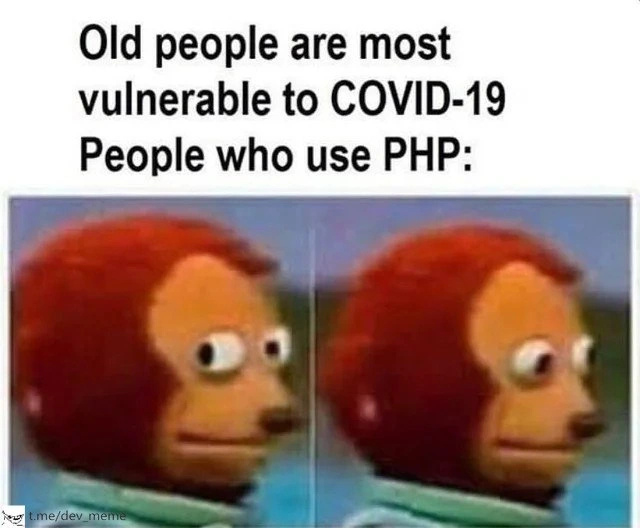
The meme specifically uses the context of COVID-19 – remember, this was posted around April 2020, right when the pandemic was a huge global concern. We all heard how older people were most vulnerable to COVID-19 in terms of health risk. The meme takes that serious news and does a playful analogy: it lists that fact, and then it says “People who use PHP:” and shows the puppet looking side-to-side uncomfortably. That puppet image is a well-known meme template (often called “awkward look monkey puppet”). It’s typically used to represent someone feeling suddenly awkward or guilty when a statement hits close to home. For example, if someone says “Only bad students cheat on tests” and you did cheat once, you might do that kind of side-eye glance. In this case, the puppet represents a PHP user who just heard that “old people are at risk”, and is internally like, “uh oh, am I considered old (because I use PHP)?”. It’s a joke on the php_user_age_joke idea – equating using an outdated language with actually being old.

So essentially, the meme is saying: “COVID-19 is dangerous for old people. PHP users, feeling ‘old’ yet?” It’s poking fun at PHP’s dated reputation in modern web dev. The two-panel puppet image drives the joke home visually: first panel puppet is neutral (listening normally), second panel puppet has eyes shifted sideways (looking uneasy). This mirrors a PHP dev’s reaction from calm to suddenly self-conscious. The humor is relatable to developers because many of us have been in a situation where someone makes a general statement that accidentally describes us in an unflattering way. Here, the unflattering implication is being behind the times in tech. A junior developer might not yet have experienced this, but they might have seen similar jokes or attitudes – like maybe seniors teasing each other that knowing only an older framework (say jQuery or COBOL) makes you a “dinosaur” in programming. And indeed, a lot of modernization conversations revolve around replacing “legacy” stuff with new shiny tools. If you’re the person who still works with the legacy tool, you might feel a bit defensive or awkward, exactly like the puppet.

To put it simply: PHP = older programming language (in the context of web dev trends), and people who use PHP = being likened to older folks. It’s a playful jibe, not a serious insult. In reality, you can be a young developer and use PHP, or an old developer using the latest tech – age and tool choices don’t always match. But jokes thrive on exaggeration. This meme falls into the category of outdated_language_memes, where a programming language with a long history is jokingly treated as antiquated. It also reflects the legacy systems and modernization theme: the industry is always somewhat pushing to move on from older technology, sometimes making those who stick with the old tools feel a bit out-of-place. The side-eye puppet perfectly captures that “I feel seen (in a bad way)” moment.

In summary, for a newer developer: the meme is saying using PHP is like being old. It’s funny because it’s such an exaggerated comparison – obviously writing PHP code isn’t an actual health risk! But it’s a quick jab at PHP’s image in the programming world. Everyone who codes has seen languages go in and out of fashion, and PHP has been around long enough to get teased as “the old-timer.” The meme uses a current event (COVID-19 concerns) in a humorous way to make that point. It’s a little edgy, because COVID-19 was a serious subject, but making absurd analogies is one way programmers joke around to keep things light. And if you do happen to know PHP and felt a tiny bit called out by this meme – well, that just means you truly understood the joke 😅.

Level 3: The Elephpant in the Room

In this meme, a serious health advisory is twisted into developer humor, targeting the proudly stubborn users of an older technology. The text starts: “Old people are most vulnerable to COVID-19.” Then it abruptly calls out: “People who use PHP:”. Below that, the famous awkward side-eye puppet image appears in two frames, looking forward then nervously sideways. The puppet’s uneasy glance is a visual punchline, conveying “wait... are they talking about me?!” without a word. This format is a classic internet way to show uncomfortable self-awareness. Here, the joke’s implication is that writing code in PHP is a habit of an older generation of programmers — so if old people are at risk from COVID-19, PHP developers jokingly feel equally “at risk” (of being seen as outdated). It’s an absurd equivalence that lands as relatable, tongue-in-cheek tech humor. The meme playfully suggests that using PHP in 2020 is like being in a high-risk group, provoking that puppet’s guilty look from anyone who still works with the language.

On a deeper level, this joke riffs on the “legacy language” stigma attached to PHP. PHP (which fittingly stands for “PHP: Hypertext Preprocessor” in a recursive acronym) is a veteran of web development. First released in 1995, it became a core part of the early web’s LAMP stack (Linux, Apache, MySQL, PHP) – essentially the Grandpa stack of modern web apps. Over 25 years later, PHP is still running a huge portion of the internet (from WordPress blogs to older corporate intranets). However, in the fast-paced world of programming, a 25-year-old language might as well be elderly. Newer generations of developers often gravitate to trendier stacks (Node.js, Python, Ruby, Go, etc.), and they sometimes poke fun at PHP as a “grandpa” technology. This meme captures that sentiment: if web development had generations, PHP would be the retired old-timer complaining about kids these days. The awkward side-eye of the puppet says what many PHP devs feel when yet another blog or colleague jokes that “only old developers use PHP.“ It’s a moment of recognition: “Oh no, I’m basically the old guy here.”

There’s an industry inside joke at work about being “vulnerable” too. In early 2020, everyone was on edge about the COVID-19 pandemic – especially about older people’s vulnerability to the virus. By equating that vulnerability to using PHP, the meme exaggerates for comic effect. It implies that working in PHP might be as dangerous (career-wise, not health-wise) as being a high-risk senior during a pandemic. Of course, writing PHP code won’t give you a virus (except maybe a computer virus if you’re running very insecure code 😜). But the comparison makes tech folks chuckle because it’s dark humor blending a real-world crisis with a LanguageWars jab. This speaks to a common feeling in tech: fear of becoming obsolete. Many seasoned programmers worry their skills in an older language make them vulnerable to being sidelined – much like how the elderly were vulnerable in the pandemic. The meme takes that anxiety and flips it into a joke: “PHP users, are you feeling okay? You’re high risk!” The absurdity works because, in truth, PHP isn’t going to kill you; at most, it might hurt your hip(ster) cred among trendy developers.

From a senior developer’s perspective, the meme is both funny and a bit painfully true. PHP has accumulated a reputation for legacy code and quirky design decisions that modern developers love to lampoon. Seasoned devs remember the wild west days of PHP 4/5: mixing SQL queries with HTML and PHP in one big spaghetti mess, $GLOBALS and magic_quotes chaos, functions named by inconsistent conventions (strip_tags() vs htmlspecialchars() – why, PHP, why?). These are the battle scars of LegacySystems maintenance. A developer who has survived a decade of PHP projects might chuckle darkly at the “vulnerable” line: they’ve endured countless vulnerabilities (SQL injections, XSS) in those old PHP apps that had to be patched. Vulnerability is a loaded term in tech – it commonly means a security flaw. And indeed, older PHP versions (like PHP 5.x, long past its end-of-life by 2020) had many known security holes. Running an unpatched legacy PHP app is a risky endeavor – not for your personal health, but for the health of your servers against malware. So the meme accidentally hits a double meaning: outdated PHP code is vulnerable (to hacks) just as old folks are vulnerable (to illness). A senior dev might appreciate this unintended cleverness while they warily maintain a PHP 5 system that’s held together by duct tape and ini_set() tweaks.

Historically, this meme also highlights the inevitable generational shift in programming. Each wave of technology eventually becomes “uncool” to the next wave. The Tech Historian in me notes that PHP itself once was the young rebel displacing older approaches (CGI scripts in C/Perl) in the late ’90s. Back then, PHP was the hot new way to build dynamic sites more easily. Fast forward two decades: now PHP is the establishment, and newcomer tools are the cool kids. It’s the circle of tech life. Today’s React or Node.js will be tomorrow’s side-eyed legacy system. In that sense, the meme’s jab at PHP users has a knowing glint: “Don’t laugh too hard, JavaScript gurus – in 15 years, someone will be meme-ing you too.” Veteran engineers have seen this before. They’ve watched LanguageWars declare winners and losers as trends come and go. (Remember when Ruby on Rails was the it framework? Now some treat it like it’s old news.) The puppet’s sideways glance could equally apply to any developer who’s heavily invested in a technology that’s no longer the shiny new thing. It’s a gentle reminder not to get too smug. Today we’re joking that PHP devs are old; tomorrow we’ll joke that about whatever supersedes our current favorite tech.

Even within organizations, there’s a perennial tension between old and new stacks. A company might have a rock-solid, aging PHP legacy system making money hand over fist, while the new hires push to rewrite everything in a modern language. The PHP veterans in the corner might feel a bit like that puppet: keeping their heads down, feeling judged as “out of touch,” yet knowing that if their PHP app goes down, the entire business might too. One could say the “elePHPant in the room” is that a huge amount of our infrastructure runs on supposedly outdated tech that everyone likes to make fun of, but nobody has fully replaced. In fact, the PHP community has been modernizing steadily (PHP 7 and 8 brought big improvements, and frameworks like Laravel prove you can teach an old elephant new tricks). But in meme culture, PHP remains the poster child of “old-school web dev.” So the humor lands instantly: every developer reading it understands that equating “PHP user” with “most vulnerable old person” is hyperbole, but it’s a comically exaggerated version of a real sentiment in tech.

Overall, the meme packs multiple layers of relatable humor. It’s a quick hit of CodingHumor during a grim global moment. By using the well-known awkward side-eye puppet format, it speaks in the universal internet language of memes, requiring no further explanation to trigger a laugh. And by targeting PHP – something of a communal punching bag in programmer culture – it ensures almost every dev gets the joke. Seasoned engineers laugh (perhaps with a touch of self-deprecation if they’ve written PHP in the past), and younger devs laugh because it reinforces the edgy in-joke that anything old is uncool. In the end, it’s a roast but a lighthearted one. The puppet’s look says, “Hey, I resemble that remark!” and we can all smirk in recognition of the ever-evolving nature of our industry. Technology moves fast, and today’s hot framework is tomorrow’s legacy system giving us side-eye from the recesses of a data center.

Description

A two-part meme that humorously links the PHP programming language to old age. The top section contains black text on a white background that reads, 'Old people are most vulnerable to COVID-19. People who use PHP:'. Below this text is the 'Monkey Puppet' meme format, featuring a puppet looking forward in the first frame and then darting its eyes nervously to the side in the second. This meme plays on the long-running joke within the developer community that PHP is an old, outdated, and dying language. By juxtaposing the statement about COVID-19 vulnerability with PHP users, the meme implies that PHP developers are the 'old people' of the tech world, and thus should be nervously looking over their shoulder. The humor appeals to developers familiar with language stereotypes and the endless debates about technology relevance. A watermark for 't.me/dev_meme' is in the bottom left
Comments

7
Anonymous ★ Top Pick PHP isn't old, it's just accumulated a lot of technical debt, much like the human body. Both have questionable global state management and a surprising number of production instances you're afraid to touch
  1. Anonymous ★ Top Pick

    PHP isn't old, it's just accumulated a lot of technical debt, much like the human body. Both have questionable global state management and a surprising number of production instances you're afraid to touch

  2. Anonymous

    After surviving register_globals, magic_quotes and the Great 5.3→5.4 migration, a “version 19” virus just sounds like another minor patch release

  3. Anonymous

    The real vulnerability is explaining to your board why half the Fortune 500 still runs on PHP 5.6 while you're pushing for a Rust rewrite that'll take three years and deliver the same features

  4. Anonymous

    PHP developers nervously checking if their Composer dependencies are older than their last health checkup, while simultaneously maintaining codebases that predate both Docker and their own existential dread about framework choices

  5. Anonymous

    PHP: where eval() is a feature, not a vulnerability - unlike boomers dodging COVID, your app won't survive the next exploit wave

  6. Anonymous

    Call it legacy, but the PHP monolith is funding your microservice rewrite and still beats your 40-service gRPC mesh on p99

  7. Anonymous

    PHP engineers hearing “older stacks are vulnerable” immediately grep for register_globals, magic_quotes, and any auth that trusts == with 0e hashes

Use J and K for navigation