Assembly Language: The Ultimate Open Source Key
Why is this LowLevelProgramming meme funny?
Level 1: X-Ray Vision
Imagine you have special X-ray glasses that let you see inside anything, no matter how locked or closed-up it is. For example, think of a closed toy box that you’re not supposed to open – but with these magical glasses, you can look right through the box and see every toy and how they’re arranged. You basically know what’s inside without opening it. This meme is joking that knowing assembly language is like having X-ray vision for computer programs. Normally, a program might be “locked up” (closed source), meaning people can’t see the secret instructions that make it work. But if you understand the computer’s basic secret language (assembly), then nothing is really secret to you. It’s like being able to read a super secret code that most people can’t. So the funny idea is that for someone who can read those hidden machine instructions, every program is an “open book”. In other words, no software can keep its secrets, because your special assembly-reading superpower lets you see through the code’s vault door. The meme makes us smile because it’s comparing a really hard skill to having a cool superpower – turning every closed toy box of code into an open one, just by looking!
Level 2: Under the Hood
Let’s break down the technical ideas for a newer developer. The meme’s humor revolves around assembly language and the concept of open source vs closed source software. Here’s what those mean:
- Open source software is when the original source code (the human-readable code written in languages like Python, Java, C, etc.) is freely available to read, use, and modify. Think of projects on GitHub where you can see all the code.
- Closed source software is the opposite: the source code is kept secret by the developers or company. You only get the compiled result – usually an executable or binary file (like an
.exeon Windows). For example, Microsoft Word’s source code isn’t published for everyone; they give you the app, not the code that created it.
Now, what happens when code is compiled? High-level code (say C++) gets translated by a compiler into machine code – the ones and zeros that the computer’s CPU can execute. Assembly language is a human-friendly representation of that machine code. It’s a low-level programming language made up of very simple instructions that correspond directly to hardware operations. Each CPU architecture (x86 for most PCs, ARM for many phones, etc.) has its own set of assembly instructions (its own “vocabulary” of commands the CPU understands).
For example, an x86 assembly instruction might look like this:
MOV EAX, 5 ; Move the number 5 into the EAX register (a CPU storage slot)
ADD EAX, 10 ; Add 10 to whatever is in EAX (so EAX was 5, now it becomes 15)
CALL 0x401000 ; Call a function located at memory address 0x401000
CMP EAX, EBX ; Compare the value in EAX with the value in EBX register
JE 0x00401030 ; If they were equal, jump to address 0x00401030 (perhaps to execute some code)
(Don’t worry about the syntax too much; the comments explain roughly what each line does.)
Reading assembly is basically reading the recipe the CPU follows, step by step. There are no high-level constructs like for loops or if (x < 5) in raw assembly – those get translated into low-level jumps and compares (JMP, CMP as seen above). There are no variables with nice names; instead you have registers (like EAX, EBX) and memory addresses. It’s very much under the hood of how software runs.
Now, how does this relate to the meme? Typically, if a program is closed source, you’re not supposed to know how it works internally. But the truth is, the program’s machine code is sitting right there in the binary file. If you have the skills (and the right tools), you can disassemble that binary – which means converting those machine code bytes back into assembly instructions. Basically, you run the program through a special tool that translates the ones and zeros into the human-readable assembly mnemonic form. This doesn’t give you the nice original source with comments and variable names, but it does give you a list of all the operations the program is performing.
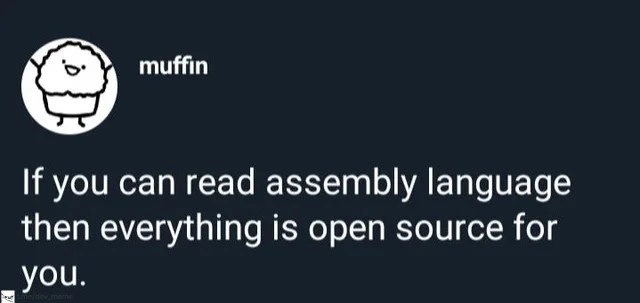
So the meme says: “If you can read assembly language then everything is open source for you.” It’s joking that a person fluent in assembly can take any program, even one without provided source code, and read the assembly to understand it. To them, there’s no real difference between an open-source program (where they’d read the original code) and a closed-source program (where they’d read the assembly) — either way, they can figure out what the program is doing. In essence, binary_disassembly_insight becomes their equivalent of reading the source.
For a junior dev, imagine it like this: Most people need the cooking recipe (source code) to know how a dish is made. But an assembly expert is like a master chef who can take a finished dish and figure out the recipe by tasting it and examining it. They see the clues in the final product and can reverse-engineer it back to the steps that created it. In programming terms, they look at the binary and reconstruct what each part of the original code must be doing. This skill is actually used a lot in ReverseEngineering — for example, to find security vulnerabilities in software, to understand how a competitor’s product works, or to restore functionality in old programs when source code is lost.
It’s worth noting, reading assembly isn’t easy! It’s a very dense, detailed view of a program. A single line of high-level code might turn into several lines of assembly. Plus, the names and structure from the original code are gone. You have to deduce what’s a loop, what’s an if-statement, or what each chunk of memory is being used for. Tools can help by guessing and by letting you label parts of the assembly, but it requires patience and expertise. That’s why the meme is funny — it’s kind of a boast. It’s saying, “I’m such a low-level programming nerd that I can treat closed software like it was OpenSource. Just hand me the binary, I’ll read that like a book!” Most developers don’t regularly do this, so it’s a comical exaggeration of the skill.
In summary, the meme is a bit of DeveloperHumor for those who know about assembly. It takes the serious concept of open vs closed source and gives it a twist: with enough knowledge, even a computer’s secret code (assembly) can be understood, effectively making nothing secret anymore. It’s both an ode to low-level wizards and a playful jab at how far you’d have to go to truly read any code in the world. After all, everything that runs on a computer ultimately boils down to assembly or machine instructions – so in theory, everything_is_open_source_meme if you’re dedicated (or crazy) enough to read it at that level!
Level 3: No Code is Closed
At a senior engineering level, this meme hits on the ultimate low-level flex: being fluent in assembly language. The joke is that if you can comfortably read raw machine instructions, then a so-called “closed source” program isn’t really closed to you at all. You don’t need the original C, C++, or Python source code – you can just dive straight into the compiled binary and reverse engineer its logic from the assembly. It’s like having a skeleton key for software: what’s opaque to others becomes transparent to you. The punchline winks at the idea that open source is relative – for an assembly guru, everything might as well be open source, since they can pop the hood on any executable and inspect its guts.
Why is this funny to experienced developers? Because reading assembly is notoriously hard-core. Most engineers treat a binary without source as a black box, but a low-level wizard sees it as a glass box. They’ll fire up a disassembler (think tools like IDA Pro, Ghidra, or the old-school objdump) and out comes a pile of cryptic mnemonics and hex addresses – which to them, might read like a fairly legible book. The meme text (“If you can read assembly language then everything is open source for you.”) humorously elevates these folks to a kind of elite status: the laws of software licensing don’t apply because they can understand the code anyway! It’s a tongue-in-cheek nod to those battle-hardened systems programmers and hackers who’ve spent years mastering ReverseEngineering techniques. They’ll talk about reading a hex dump the way others talk about reading documentation.
From a senior perspective, there’s layers of truth here. In practice, even the best assembly reader doesn’t get nicely commented, well-structured source code – they get raw instructions. All the helpful variable names and high-level structure are stripped away by the compiler. It’s more like piecing together a puzzle: you infer functions and logic by recognizing patterns (prologue/epilogue of functions, typical AssemblyLanguageX86 calling conventions like stack frames, pushes and pops, etc.). Seasoned reverse engineers develop an intuitive sense for common instruction sequences – malloc implementations, loop constructs, pointer dereferences – it all becomes recognizable with experience. It’s still painstaking work (and often requires a strong coffee or three), but the meme playfully implies that for those who can do it, the idea of software being “closed” is almost moot.
There’s industry truth in the humor: many of us have faced an undocumented third-party library or a mysterious crash in production with no source available. In those crunch moments, digging into assembly via a debugger can save the day. A senior dev might chuckle remembering the first time they stepped through optimized assembly trying to hunt a bug – it feels like reading The Matrix. In fact, that’s a common analogy: in The Matrix movie, Neo sees streaming green code and understands reality; similarly, an expert coder sees a stream of MOV, CMP, and JMP instructions and understands a program’s reality. This meme resonates because it captures that almost superhuman vibe: assembly_reader_superpower. The rest of us might joke that these people have “literal X-ray vision” for software.
And of course, there’s a lighthearted poke at open source zealotry. Open source software means you can legally read and modify the source. Here, we’re saying “Eh, who needs permission – I’ll just read the machine code.” It’s obviously not advocating piracy or ignoring licenses, but it satirizes the idea that ultimately, under the hood, code is code. A binary is just as instructive to a low-level expert as a GitHub repo might be to others. LowLevelProgramming enthusiasts wear this ability like a badge of honor, and the meme celebrates (and teases) that mindset. It’s the kind of joke you’d see shared among systems programmers, kernel developers, or security researchers, where one might respond: “Haha, yeah, source or no source, I’m gonna find out how it works!” In summary, at the senior level this meme underscores a core truth of computing – machine code is the universal language – and wraps it in humor about skill and empowerment. It’s funny because it’s almost true: to the machine whisperers, everything is open source.
Description
A screenshot of a tweet-like post from a user named 'muffin', who has a simple cartoon muffin as a profile picture. The text on the dark background reads, 'If you can read assembly language then everything is open source for you.' A small watermark is visible in the bottom-left corner. This statement is a humorous exaggeration highlighting a fundamental truth in software engineering. Since all compiled code can be disassembled into assembly language - the human-readable form of machine code - the ability to understand it effectively allows one to reverse-engineer and comprehend the inner workings of any program, regardless of whether its original high-level source code is available. For experienced developers, this is a witty nod to the power of low-level skills and the ultimate transparency of software at the machine level
Comments
7Comment deleted
The original source code is just a high-level suggestion. The real source of truth is in the disassembly, right next to the compiler's questionable life choices
Everything is open source once you read assembly - just be ready to spend the next quarter renaming sub_4015C0 to “probablyDoSomethingImportant” while Legal debates whether your eyeballs violated the EULA
"Sure, everything is open source when you can read assembly... until you spend three weeks reverse engineering a 50MB binary only to discover it's just an Electron app wrapping a website you could have inspected in DevTools."
The ultimate DRM bypass: just read the opcodes. Who needs source code when you can mentally execute MOV instructions at 3 AM? Though let's be honest, after debugging someone's hand-optimized assembly with no comments, you'll wish it stayed closed source. At least with obfuscated JavaScript you can still see variable names - assembly just gives you 'rax' and a prayer
Closed source is just open source rendered in MOV and CALL - objdump is the View Source button
Forget decompilers; assembly readers treat every binary like a verbose README
If your IP strategy is 'no source code,' remember objdump -d ships with every distro - security-through-obscurity is just a build artifact