Skip to content
DevMeme
1101 of 7435
Google's Always-On Listening Service
DataPrivacy Post #1233, on Apr 3, 2020 in TG

Google's Always-On Listening Service

Why is this DataPrivacy meme funny?

Level 1: The Google Under My Bed

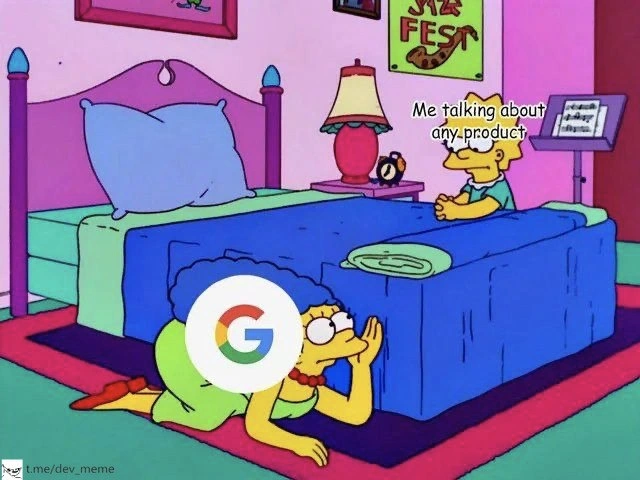
Imagine you’re talking to your friend about a cool new toy, and suddenly a salesperson pops out from under your bed saying, “Did someone say they want this toy? Here, buy it!” 😲 Pretty spooky, right? This meme is joking that Google is like that sneaky salesperson. In the picture, a kid (from a Simpsons cartoon) is on the bed saying they’re talking about any product they like. Hiding under the bed is someone with a big Google logo as a face, secretly listening.

It’s funny and a bit scary at the same time. Why? Because it feels like when we talk about something we want, we soon see ads for it on our phones or computers. It’s as if Google heard us! Of course, in real life there isn’t actually a Google person under your bed. The joke just compares Google to a monster or friend hiding in your room, always listening to what you say. It captures that feeling we get when an advertisement knows exactly what we were just talking about.

So in super simple terms: the meme is saying “I feel like whenever I say I like something, Google hears it and immediately tries to sell it to me.” It uses a funny cartoon scene to show that idea. Anyone who’s ever had an ad pop up for something right after mentioning it will giggle at this – it’s like finding out your secret wish wasn’t so secret after all!

Level 2: OK Google, Show Ads

This meme plays on the common fear that our devices might be listening in on us for advertising purposes. In the image (a twist on a classic Simpsons_meme scene), a cartoon child lies on the bed saying "Me talking about any product," and underneath the bed we see the mom character Marge Simpson with a giant Google logo for a face, secretly listening. It’s a funny exaggeration of how people feel when they mention something in conversation and soon after see ads for it online. Google is a huge tech company that makes most of its money from ads, and targeted_ads are their specialty – these are ads chosen based on your personal data, interests, or what you’ve looked at or talked about. So the meme jokingly imagines Google literally hiding under your bed, always_listening to everything you say about products, so it can immediately bombard you with related ads.

For a newer developer (or anyone new to this concept), let's break down why this is amusing and where the truth lies:

  • Google and AdTech: Google’s advertising technology (AdTech) tracks a lot of what users do online. If you search for a product on Google or browse a shopping website, Google likely knows and will show you ads for that product later. This is usually done through cookies, browsing history, and data from apps – not magic, but sometimes it feels like it.
  • “Always listening” devices: Modern gadgets (like smartphones or smart speakers) have microphones and voice assistant features. For example, many phones respond when you say "OK Google" or "Hey Google". That means the mic is technically on standby, waiting for the trigger phrase. Companies say that until the trigger is heard, the audio stays private (processed locally and not recorded). The meme is poking fun at the suspicion that maybe our phones are always listening to any product mention, not just the trigger words.
  • PrivacyConcerns and Surveillance: People care about OnlinePrivacy and DataPrivacy, and it can feel invasive to think that a company might eavesdrop on personal conversations. Surveillance capitalism is a term often used to describe how companies surveil (monitor) users’ behaviors to make money (usually through personalized marketing). In simpler terms, Google offering you free services and then using the data from those services to sell ads is their business model – some find that creepy, like someone spying on you to sell you stuff.
  • Context of the joke: Developers are aware of how apps and websites include trackers. If you've ever added Google Analytics or an ad SDK to an app, you know these tools collect user data (like what pages you visit, what products you clicked on, etc.). It’s not directly recording your speech, but if an app has permission to use the microphone, theoretically it could snoop. The meme takes that idea to an extreme visual: Google personified as a sneaky character under your bed. It's a way to say, "It feels like no moment is sacred or private, not even chatting in your bedroom, because advertising is everywhere."

In summary, Level 2 is about understanding that this comic scene reflects real tech concepts in a humorous way. Google represents big tech companies that show you ads, the kid on the bed represents any of us casually talking about something, and the joke is that Google seemingly knows and reacts instantly. There is a grain of truth (devices and ads are very connected to our lives), which is why seeing Marge with Google’s logo eavesdropping is both funny and a bit creepy. It's basically saying: Talk about a new gadget, and boom – an ad for it appears, almost like Google was hiding in the room listening. For a junior dev or an interested user, it’s a playful introduction to the idea that our technology might be doing more behind the scenes than we realize, especially when it comes to marketing and privacy.

Level 3: Spying as a Service (SaaS)

At the core of this meme is a shared developer paranoia about Google's omnipresence in our lives. The image literally puts the multicolored Google "G" under the bed, like some digital boogeyman listening to "Me talking about any product." Seasoned devs recognize this as a jab at AdTech and Surveillance Capitalism – the idea that tech giants profit from ubiquitously monitoring everything we do, say, and even hint we might want. It's funny in that uneasy chuckle way because we've all had that eerie experience: discuss a random gadget with a friend, and hours later you're served a perfectly timed targeted_ad for that exact product. Coincidence? The tin-foil hat crowd says "Google always_listening!" and frankly, many of us in tech aren’t entirely sure it’s just the tin-foil folks imagining things.

From a senior dev perspective, this scenario is a cocktail of OnlinePrivacy nightmares and brilliant backend engineering. Think about it: if Google were secretly eavesdropping, the pipeline from casual speech to tailored ad is both impressive and dystopian. Your smartphone’s mic is basically a sensor streaming data to the cloud – a potential firehose of personal chatter. The meme exaggerates it with Marge under the bed, but it's riffing on something very real in our industry: modern devices operate in always-on mode, with voice assistants waiting for wake words. Engineers know that means a buffer of audio is constantly being analyzed by an algorithm. Officially, that analysis happens locally (for triggers like "OK Google"), and the rest is thrown away. But the joke (and fear) is that under the hood, a few extra lines of code could siphon everything you mention into Google's data centers. PrivacyConcerns? Oh, absolutely – and we laugh because it's better than crying.

As experienced devs, we also recall actual incidents that make this meme too real. There have been reports of eavesdropping_algorithms gone rogue: smart TVs capturing background conversations, apps with shady SDKs abusing the mic, even ultrasonic beacons in ads trying to link our devices. Surveillance capitalism isn't just a buzzword; it's the business model of the internet. Google’s empire is built on knowing users deeply to serve them MarketingTech on steroids. In fact, the entire targeted advertising ecosystem can feel like a giant distributed system explicitly designed to track and predict our desires. We joke about the Google monster under the bed, but it's only half a joke – data engineers at Google (and Facebook, et al.) really have created a sort of all-seeing eye, piecing together information from search history, location, web browsing, and yes, potentially even ambient audio, to profile us. The humor has a dark edge: it's funny because the childlike scenario (a cartoon mom hiding under the bed) perfectly captures the creepy_google vibe of an unseen watcher in our most private spaces.

Let's not forget the technical cleverness mixed into this creepiness. Delivering an ad that matches something you just spoke about involves massive real-time data processing. It's a feat of Marketing infrastructure: your words (if captured) would need to be turned into text via speech recognition, matched against ad keywords, and then fed into an auction system where advertisers bid to show you that exact product – all in milliseconds. As jaded engineers, we acknowledge this as both a scaling triumph and a privacy travesty. The meme nails the absurdity: Google has effectively become the nosy neighbor with infinite memory. And in true Cynical Veteran fashion, we can't help but smirk at the caption "Google magically appears..." – because from what we've seen in countless codebases and product requirement docs, there's very little magic about it: just a whole lot of sophisticated code quietly doing the dirty work.

# Pseudo-code for our worst nightmare: voice-triggered ads
while phone.mic.is_open():
    audio_chunk = phone.mic.listen(duration=5)        # capture recent speech
    transcript = cloud.speech_to_text(audio_chunk)    # Google transcribes audio
    if any(product in transcript for product in PRODUCTS_DB):
        AdServer.trigger_ad(product)  # cue creepy targeted ad

In reality, Google claims they don’t do this without consent, and as devs we know constant audio upload would be battery/data intensive. But the allure of that data is so strong! It's easy to imagine some engineer joking “what if we just peeked under the bed?” Most of us have seen enough questionable analytics requirements in our careers that this Simpsons scene feels painfully plausible. Google, the company whose name became a verb for searching, is depicted here as a sneaky listener because we inherently understand their business: DataPrivacy often takes a backseat when MarketingTech wants more targeting precision. The meme resonates with senior developers because it highlights an open secret: our industry’s most lucrative products often border on surveillance. The joke works because it’s a wink and a nudge to those in the know – we laugh, then nervously double-check our phone’s permissions.

Description

This is a two-panel meme using a scene from 'The Simpsons' to comment on data privacy. In the top part of the image, Lisa Simpson sits on her bed with a worried expression, hands clasped. A text label above her reads, 'Me talking about any product'. Below, her mother Marge Simpson is seen on the floor by the bed, in a praying or hiding posture. Her face is covered by the circular, multicolored Google 'G' logo. The scene humorously depicts the pervasive feeling that Google is always listening to conversations to serve targeted ads. For a developer, this hits on the reality of building and using systems that rely on massive data collection, highlighting the often-unsettling effectiveness of ad-tech and the erosion of user privacy. A watermark for 't.me/dev_meme' is visible in the bottom left corner

Comments

7
Anonymous ★ Top Pick We've built such effective event-driven architectures that you can whisper 'buy a standing desk' in your kitchen and three different microservices will have an ad in your feed before you reach the living room
  1. Anonymous ★ Top Pick

    We've built such effective event-driven architectures that you can whisper 'buy a standing desk' in your kitchen and three different microservices will have an ad in your feed before you reach the living room

  2. Anonymous

    Turns out the “on-device hotword detector” the PM kept bragging about is just a gRPC proxy to AdSense - congrats team, we shipped Marge-as-a-Service under every user’s bed

  3. Anonymous

    The only migration strategy more complex than moving off Google's deprecated services is explaining to stakeholders why you built critical infrastructure on a product that didn't even survive its own internal 20% time

  4. Anonymous

    Every architect's nightmare: You're designing a greenfield microservices stack, carefully evaluating Kubernetes alternatives, and suddenly Google Cloud Run appears under your bed whispering 'But have you considered our managed solution?' The real horror isn't vendor lock-in - it's realizing you've already been using Firebase, Google Analytics, and reCAPTCHA for the past three years, and your entire auth flow depends on OAuth with Google. At this point, you're not choosing Google products; they're choosing you

  5. Anonymous

    Me pitching GCP for a hello-world app: intense stare, zero regrets - until the sunsetting blog post drops

  6. Anonymous

    Not a hot mic - just GAID + email receipts + Topics API stitching your shadow profile so a second‑price RTB auction serves a toaster ad before you finish the sentence

  7. Anonymous

    Any product discussion eventually lands on the third option: gamble on the Google version - perpetual beta, renamed mid‑migration, and deprecated the quarter we hit GA

Use J and K for navigation