NPM Audit Reports: A Sea of Red Flags
Why is this Security meme funny?
Level 1: This Is Fine
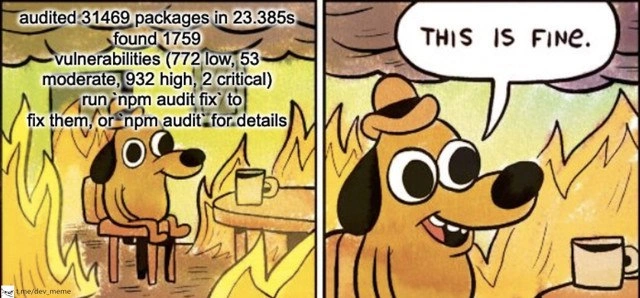
Imagine you're sitting in a room that’s starting to catch on fire 🔥. The table, the curtains, and the walls are burning, but instead of doing something about it, you just sit there calmly sipping your drink and saying, "Everything is okay!" Obviously, in real life you wouldn’t do that — you'd try to put out the fire or run outside. That’s why this scene is so silly and funny: the character (a little dog in a famous cartoon) is ignoring a huge problem and pretending nothing’s wrong. In this meme, the burning room is like a software project with a lot of things going wrong (lots of problems), and the developer is the dog who says "this is fine." It’s humorous because it shows someone staying chill and optimistic in a situation where things are clearly not fine at all. The meme makes us laugh, and at the same time it reminds us that sometimes people act like everything’s okay even when they feel overwhelmed by problems.
Level 2: Dependency Overload
Now let's break down what's happening here in simpler terms. The image is showing text from a command-line output, specifically from running npm audit in a Node.js project. npm stands for Node Package Manager – it's the tool Node.js developers use to download and manage libraries (packages) that they want to include in their projects. In modern web development, developers rely on lots of pre-made code packages (called dependencies) to add features or save time. For example, instead of writing your own web server from scratch, you might install a dependency like Express (a popular web framework) that does a lot of the heavy lifting for you. Each dependency can in turn have its own dependencies (called sub-dependencies or transitive dependencies). Think of this like a big Lego structure: you decide to use a piece (a library), but that piece might be built out of many smaller Lego pieces (its internal libraries). It’s not uncommon for a project to pull in dozens or even hundreds of packages this way. In extreme cases (especially with large projects or when you include a lot of tooling), you can end up with thousands of packages without even realizing it. This kind of situation is often jokingly called dependency overload (or dependency hell): you have so many libraries tangled together that it's tough to manage or even understand them all. In our meme’s case, the audit checked 31,469 packages! That number is basically the project’s entire collection of direct and indirect dependencies.
The command npm audit is a tool that checks all these installed packages to see if any of them have known security vulnerabilities. A vulnerability is basically a weakness or bug in the code that could let a bad person (a hacker) do something harmful to your app or its users. For example, a vulnerability might allow an attacker to steal data, take control of your server, or crash the application. When npm audit runs, it compares the versions of your packages against a database of reported issues. In the meme’s output, it says it found 1,759 vulnerabilities in total. These are further categorized by severity: 772 low, 53 moderate, 932 high, and 2 critical. The severity levels (low, moderate, high, critical) indicate how serious or dangerous each found vulnerability is. Low might be something minor or hard to exploit (not a big threat), while critical means a very serious problem (for instance, an issue that lets someone break into your system easily). The command also gives a tip at the end: “run npm audit fix to fix them, or npm audit for details.” In other words, npm is saying "I found problems. I can try to automatically fix these if you want, or I can give you more info on each one if you prefer to handle it manually."
Now, the funny part of the meme is that despite this scary report, the developer (represented by the cartoon dog in the burning room) says, “THIS IS FINE.” Why would they say that? There are a couple of reasons, and understanding them can be a lesson in real-world software development. First, seeing some vulnerabilities pop up is very common, especially in big projects. It can be overwhelming. Often, not all of those 1,759 issues are actual threats to the specific project. For example, many might be in libraries that are only used during development (like testing tools or build tools that never end up in the final app that users interact with). Other vulnerabilities might be in parts of the code your application isn’t actually using. So a developer might look at this huge list and know that, in context, a lot of it is noise or low-priority stuff. It’s like getting a medical report with a list of 1759 very mild issues — it looks terrifying, but maybe 1700 of them are like tiny scratches and only a few are real injuries that need treatment.
Second, fixing all these issues is not always simple. If you run npm audit fix, it will attempt to update some of the packages to safer versions. But those updates can sometimes break your project if the new package versions aren’t compatible with your code. So a developer might not hit “fix” right away, especially on a working project. They might plan to fix the 2 critical issues immediately (because those are really dangerous), and then schedule time to gradually resolve the others. In the meantime, the project is still running, and they have deadlines to meet and features to build. In short, the sheer amount of warnings creates a sort of paralysis where you just choose to keep going and hope for the best, at least until you can properly deal with it.
This meme uses the famous "This is fine" cartoon as a metaphor. In the original comic, a little dog is sitting calmly at a table while the room around him is engulfed in flames, and he says, “This is fine.” People on the internet use that image to joke about situations where someone is ignoring a problem or staying optimistic in a hopeless scenario. Here, the burning room represents the project’s dependency problems (all those security issues), and the developer is portrayed as the dog, calmly saying it’s okay. It captures a common developer attitude: sometimes we cope with overwhelming problems by downplaying them. It’s a mix of denial and humor. The developer isn’t literally fine with having vulnerabilities; rather, they’re making a tongue-in-cheek statement – basically, "Yeah, this looks bad, but I'm just going to pretend it's fine because freaking out won't help and I’ve got other work to do."
To put it simply, the meme is highlighting dependency overload in a comical way. The project has so many dependencies that the number of vulnerabilities is huge, and that’s the "fire" around the developer. And the developer’s "This is fine" reaction is a comedic way to show how people sometimes respond to an overwhelming problem: by acting like everything is normal, at least on the surface.
Let’s clarify a few key terms from that audit output in plain language:
- Package/Dependency: A reusable piece of code someone else wrote that you include in your project so you don’t have to write it yourself. (E.g., a package for handling dates, so you avoid coding all the date logic from scratch.)
- Packages audited: The number of packages that were checked. In our case,
31469 packagesmeans the audit looked at 31,469 modules in the project (which includes all direct dependencies and the dependencies of those dependencies). - Vulnerability: A problem or weakness in code that could let bad things happen. It’s like an open window or an unlocked door in a software system that intruders could use to get in or do damage.
- Low / Moderate / High / Critical: These are ratings of how severe each vulnerability is. Low means a minor issue (hard to exploit or limited impact), Moderate is a bit more concerning, High is serious, and Critical is very serious (could allow major breaches or damage if not fixed).
npm audit fix: A command that tells npm to automatically try fixing the vulnerabilities it found by updating the packages to newer, safer versions. This can solve some problems automatically, but it might not catch everything (and sometimes it can’t fix an issue if there's no safe version available, or it might upgrade to a version that requires you to change your code).- “This is fine”: A catchphrase from a popular meme. It’s used to joke about ignoring a big problem. When someone says "this is fine" while everything is clearly NOT fine, they’re being humorously ironic.
In short, the two-panel meme juxtaposes a terrifyingly long security report with the developer’s deadpan reaction. The developer is basically saying, “I see that everything is on fire, but I’m going to act like it’s okay.” It highlights the sometimes absurd reality of software development: dealing with so many moving parts (dependencies) that problems are inevitable, and yet we often carry on regardless, with a bit of dark humor to keep us sane.
Level 3: Vulnerability Inferno
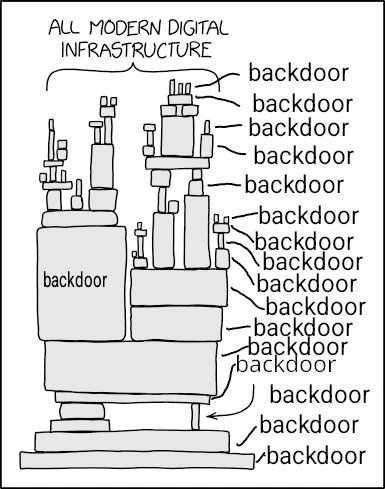
From a senior developer’s perspective, this meme hits right in the gut with relatability. It depicts the scenario known colloquially as dependency hell – and in this case, it's literally on fire. Seeing output like “audited 31469 packages... found 1759 vulnerabilities (772 low, 53 moderate, 932 high, 2 critical)” flash by in a project audit is almost a rite of passage in modern Node.js development. It's the kind of moment where an experienced engineer will either chuckle or facepalm (probably both), because we've all been that dog, surrounded by the flames of our own making (or rather, the flames coming from our myriad third-party packages). The humor here comes from the developer’s reaction – a serene “THIS IS FINE” – which is hilariously at odds with the dire security report scrolling past their terminal. JavaScript projects are infamous for pulling in countless small dependencies; a simple npm install of a popular library can drag in a whole raft of sub-dependencies. Over time, as features pile on and packages get added, you end up with your application sitting atop a Jenga tower of open-source modules. And each block in that tower might be harboring a bug or security flaw. In this meme, the audit has basically lit that tower on fire, yet the developer remains unfazed.
Why would any sane developer be so calm in the face of a flaming audit report? The answer is an uncomfortable mix of familiarity, resignation, and cold pragmatism. In many real-world projects, an npm audit revealing hundreds or thousands of vulnerabilities has unfortunately become normal. It's almost expected that any large Node application will have a laundry list of known issues at any given time. This causes a sort of alert fatigue – when you see a wall of warnings every day, you start tuning them out. The breakdown in the meme shows a couple of critical flaws, but often those are buried in some deep dependency you hardly use, or perhaps it's a build-tool dependency that never touches production. Seasoned devs learn to triage these things. They might quip, "Oh, 932 high? I'll bet 930 of those are false alarms or irrelevant to how we use the code." It’s dark humor, but rooted in experience – often many vulnerabilities are in code paths you never actually exercise, or in dependencies used only during development (like test frameworks or tooling).
There’s also the pragmatic fear that fixing everything could break the build. Running npm audit fix might sound like a no-brainer, but in practice, automatically bumping dozens of packages can lead to chaos. Picture spending a week untangling version conflicts and new bugs because an "easy" fix updated a core library to an incompatible version. A veteran developer might joke, "One does not simply npm audit fix a 3-year-old project." In other words, blindly applying fixes can be like pulling a thread in a sweater – you don’t know what unwinds. The little code snippet below captures this sentiment:
npm audit fix --force
# => Upgrading many packages to newer major versions...
# ...half the app stops working, but hey, at least `npm audit` is quiet now.
In a perfect world, we'd address every one of those 1,759 vulnerabilities immediately. And indeed, truly critical issues (like the 2 critical ones listed) do deserve urgent attention – no one wants to be the developer who ignored a known hole that let hackers in. But the reality in large projects is that you often have to pick your battles. Teams will focus on the truly dangerous vulnerabilities first – for example, those 2 critical issues – and perhaps a few of the high-severity ones that are most relevant (say, a high that affects an important feature or can be exploited on a user-facing path). The rest often end up in a backlog or get postponed indefinitely. It's a bit of a running joke that "we'll get to those low-severity issues eventually" – and "eventually" tends to stretch into never, unless a security audit or an incident forces the team’s hand. The result? Developers exist in a state of learned complacency; we know things are on fire, but as long as the flames aren't directly burning customers or bringing down production, we carry on as if everything’s fine.
Historically, this state of affairs grew out of the very nature of Node’s ecosystem. Back in the day, a software project might have had a dozen external libraries at most, which you often managed manually. But Node.js, with npm, embraced the philosophy of tiny, single-purpose packages and easy sharing. This led to explosive dependency sprawl – why write something yourself when a package already exists to do it? Need a string padding function? There's a package for that (literally left-pad, which is just 11 lines of code but was reused by tons of projects). In fact, the infamous left-pad incident of 2016 is a cautionary tale every senior dev knows: when that trivial utility was unpublished from the npm registry by its author, it broke thousands of builds, because so many projects (directly or indirectly) relied on it. That was a wake-up call about both the fragility and the interdependence in our ecosystem. Now translate that to security: if even one widely-used package has a serious vulnerability, it can potentially compromise thousands of applications unless it's quickly fixed everywhere. The industry’s response was to create tools like npm audit, GitHub’s Dependabot, and other automated scanners to at least inform us of these risks. But as this meme wryly points out, being informed is one thing – actually resolving every issue is another.
In the end, the meme strikes a chord because it's poking fun at a truth every experienced developer knows: we often ship software that has known flaws under the hood. The dog saying "This is fine" is basically us deploying an app while hundreds of low-priority fires smolder in the dependency tree. We laugh (perhaps a bit nervously) because it's true — a lot of software is held together by countless components maintained by strangers, and often we’re grateful if it even runs. It’s a collective understanding born of experience: yes, the room is on fire with minor bugs and security issues, but if we stopped to extinguish every single flame, we'd never get anything done. So we do our best, fix what we can, and jokingly pretend that the remaining fires are "fine" (until they aren’t).
Level 4: The Dependency Singularity
From a broad systems perspective, this meme exposes a fundamental software supply chain dilemma: modern applications, especially in the Node.js and JavaScript ecosystem, often depend on an astronomically large graph of packages. Here we have 31,469 packages audited – an almost unfathomable number of building blocks for one project. This sprawling dependency graph is essentially a complex network, a directed acyclic graph of modules where each node is a package and edges represent "requires" relationships. In such a vast web, transitive dependencies (packages that your direct dependencies pull in, and so on) accumulate exponentially. We’ve reached a point of dependency singularity – an irreversible state where no single developer (or even an entire team) can fully grasp or vet every line of code their software relies on. The meme’s absurd audit output (found 1759 vulnerabilities) is a direct consequence: statistically, with tens of thousands of components, the probability that none have known flaws approaches zero. In other words, the attack surface has become as expansive as the dependency list itself.
This brings us to a core theoretical issue in security and systems design: the weakest link problem at massive scale. Each dependency is an implicit trust in some external code maintainer. The more dependencies you chain together, the more you extend this transitive trust – you’re not just trusting one library author, but thousands of them (along with all of their code, competence, and goodwill). The This is Fine dog calmly sipping coffee amid flames perfectly embodies the resigned acceptance of this reality. It’s a darkly comical reflection of complexity and chaos in software. We know that within those 1759 flagged vulnerabilities, many are likely inconsequential, but a few could be ticking time bombs. Yet addressing them all verges on intractable. The nature of npm audit is reactive – it queries a database of known flaws (public CVEs) and flags what’s known to be bad. But it can't catch the unknown zero-day issues lurking in that sea of code. Completely securing a system of this complexity borders on the impossible (akin to the halting problem of software security – you can never fully prove the absence of bugs or backdoors in a program of non-trivial size). Advanced organizations try strategies like SCA (Software Composition Analysis), automated patching tools, or even formal verification for critical components, but at 31k packages none of these methods scale perfectly.
One can draw parallels to other complex systems and emergent risks: it's reminiscent of a chaotic network where tiny perturbations can have outsized effects. In fact, the community has witnessed real-world cascades from this fragility. A notorious example was the event-stream incident in 2018, where a widely trusted npm package was handed over to a new maintainer who then injected malicious code into it. That single node in the dependency graph turned into a breach point affecting thousands of projects downstream – a supply-chain attack in action. Similarly, if a popular library like lodash or express suffers a severe vulnerability, it sends shockwaves through the entire Node.js ecosystem, forcing frantic updates in countless dependent projects. These incidents underline a sobering truth: the modern software supply chain, especially with Node’s penchant for micro-packages, behaves like a tightly-coupled ecosystem. It has interdependencies that border on the chaotic, making it essentially impossible to eliminate all risk. Thus, when faced with an npm audit report screaming about hundreds of flaws, seasoned developers often respond with a kind of wry, fatalistic calm – much like that cartoon dog in a burning room – because they recognize the gap between theoretical total security and the practical reality of shipping software before the heat death of the universe.
Description
A classic two-panel 'This is Fine' meme adapted for the woes of modern web development. In the first panel, the iconic cartoon dog sits smiling in a room engulfed in flames, a coffee cup on the table. Overlaid on this scene is the text output from a terminal command: 'audited 31469 packages in 23.385s found 1759 vulnerabilities (772 low, 53 moderate, 932 high, 2 critical) run `npm audit fix` to fix them, or `npm audit` for details'. The second panel is a close-up of the dog, still smiling, with a speech bubble saying 'THIS IS FINE.' The meme perfectly captures the feeling of helplessness and denial many developers experience when confronted with an overwhelming number of security vulnerabilities in their project's dependency tree, a common occurrence in the Node.js ecosystem. A watermark for 't.me/dev_meme' is visible in the bottom left corner

Comments
7Comment deleted
`npm audit fix` is the Schrödinger's cat of development; it both fixes your vulnerabilities and breaks your build until you check the pipeline
npm audit has become my burndown chart - if the vulnerability count drops, it just means someone deleted package-lock again
The real vulnerability is explaining to the security team why fixing these would break production, not the 1759 unpatched CVEs from a left-pad dependency's dependency's dependency
When npm audit reports 1759 vulnerabilities but 1700 of them are in packages you've never heard of, buried 47 levels deep in your dependency tree, and the 'fix' would require rewriting half your application because some abandoned package from 2016 depends on a specific version of lodash. So you sip your coffee, add `--force` to the command, and tell yourself you'll circle back to it after the sprint. This is fine
779 vulns in 31k deps? That's not a bug, it's the architecture - Swiss cheese security, enterprise-grade
npm audit: 31,469 packages, 1,759 vulns. Comforting - only two critical, and they’re in our logging library, so when it burns the postmortem will be beautifully colored
With 31,469 transitive packages, 'npm audit fix' is basically semver roulette - odds are a critical hits prod before CI turns green