
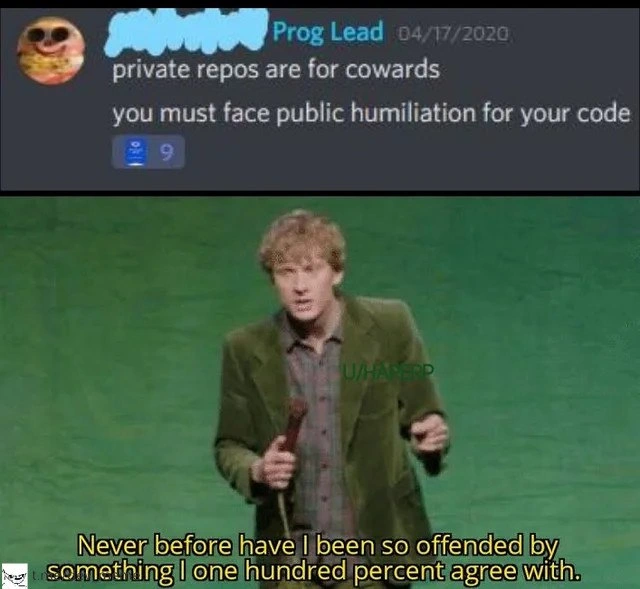
The Painful Truth About Open-Sourcing Your Code
Description
A two-panel meme. The top panel shows a screenshot of a chat message, likely from Discord, from a user named 'Prog Lead' dated 04/17/2020. The message reads, 'private repos are for cowards' and 'you must face public humiliation for your code'. The message has been reacted to with a thumbs-up emoji and a count of 9. The bottom panel features a still image of British comedian James Acaster from a stand-up special, looking perturbed. The caption below him reads, 'Never before have I been so offended by something I one hundred percent agree with.' The meme humorously captures the internal conflict many developers experience regarding open-source development. While the 'Prog Lead's' statement is an aggressive and gatekeeping take, the sentiment that making code public forces a higher standard of quality due to fear of scrutiny is a feeling many senior engineers reluctantly share. It's a joke about imposter syndrome and the harsh-but-true reality that public accountability can be a powerful, albeit terrifying, motivator for writing better code



Comments
7Comment deleted
The difference between a private and a public repo is the commit message history. One is a detailed log of thoughtful development, the other is just 'fix', 'lol', and 'PLEASE WORK'
CI/CD is nice, but the real pipeline is pushing to public GitHub and letting the entire internet run `git blame` on your 2013 “temp_fix” commit - continuous humiliation as a service
The same lead who makes everything public also keeps the database passwords in a private Slack channel because "that's different."
The real reason we keep repos private isn't fear of code theft - it's that our commit history reads like a psychological thriller: 'fix bug', 'actually fix bug', 'revert last 3 commits', 'why did I become a developer', 'IT WORKS DON'T TOUCH IT'. Public repos demand we either squash our existential crises or embrace the performance art of watching senior engineers discover we've been cargo-culting Stack Overflow answers for the past six sprints
ShameOps: keep the repo public, let git blame and Hacker News run QA, and suddenly your 3 a.m. hotfixes read like RFCs
Public repos: where your 'clever' monolith refactor becomes a fork farm of 'just use microservices' PRs from strangers
Flip the repo public and suddenly everyone discovers SemVer, CI, and the magical linter called ‘Hacker News’