Skip to content
DevMeme
1256 of 7435
When You Don't Understand Your Own Working Code
Debugging Troubleshooting Post #1409, on Apr 27, 2020 in TG

When You Don't Understand Your Own Working Code

Why is this Debugging Troubleshooting meme funny?

Level 1: Works Like Magic

Imagine you built a tall tower out of blocks by randomly stacking pieces together. Somehow, the tower stands upright and doesn’t fall. 🎉 It works! But then your friend asks, “How is your tower standing up like that? How does it work?” You shrug and say, “I don’t know, it just works like magic.” In this meme, the developer is basically doing the same thing with computer code. He wrote the program and it runs, but when someone asks why it works or how it does what it does, the only answer he has is, “I don’t know, it just does!” That surprise and honesty is what makes it funny – we expect the builder to know their creation, but sometimes even the builder is amazed that it’s working at all, just like a magic trick.

Level 2: Lost in Your Code

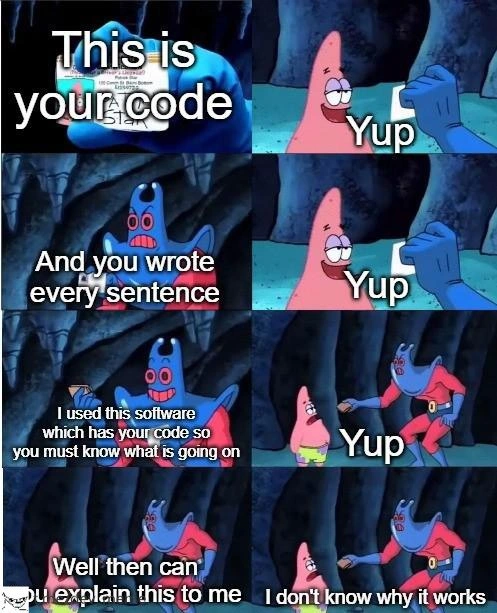
If you’re a newer developer, you might still recognize the SpongeBob characters, but let’s break down what’s happening in programming terms. The meme shows a developer (Patrick) who is confronted with their own code and asked to explain how it works. Despite having written every line, the developer admits, “I don’t know why it works.” This is funny to developers because it’s a situation we dread and joke about at the same time. It highlights issues of code maintainability and documentation woes in a very colorful way.

Let’s clarify some terms and ideas here:

  • Code Quality: This refers to how well-written and reliable code is. High-quality code isn’t just about working correctly; it’s also easy to read, understand, and modify. In the meme scenario, the code might run fine (it “works”), but the quality is questionable if the author themselves can’t understand it. That’s a big red flag for code quality – code should ideally be written clearly enough that you (and others) can follow its logic later on.
  • Documentation: Documentation means any written explanations about the code – this can be comments in the source code, or external docs like a README or design notes. Good documentation tells you how the code works and why certain decisions were made. In our meme, it seems there was no documentation or clues left in the code. Patrick has essentially forgotten his own thought process. Without docs or comments, he’s lost. This is why developers often say, “Document your code for your future self,” because six months down the line you might feel like a stranger reading it.
  • Debugging & Troubleshooting: Debugging is the process of finding out why code isn’t working as expected (or understanding a weird behavior). Now imagine trying to debug something when you don’t even know how it’s supposed to work. That’s a nightmare! In the meme, Man Ray is basically asking Patrick to debug or explain a piece of software. Patrick’s “I have no idea” response means any troubleshooting will be like wandering in the dark. It’s both funny and scary – funny as a cartoon, scary in real life when you’re the one on the hook to fix a bug.
  • Technical Debt: This is a metaphor engineers use. Think of writing messy, quick-fix code as borrowing time – you “take on debt” to solve a problem now, but you’ll pay for it later with extra work. Code written in a hurry or without clarity is technical debt. Eventually, when you (or someone else) have to modify that code, you pay back the debt with interest – it takes much longer to figure out and safely change. In our meme case, Patrick’s unexplained code is tech debt he accumulated. Now the “interest” is coming due: someone asked him a question about it, and he’s spending time struggling to recall or reverse-engineer his own work.

Now, why would a programmer not be able to explain code they personally wrote? A few common real-world reasons even junior devs encounter:

  • They wrote it a while ago and didn’t revisit it until now. Without continuous familiarity, code can become like an unsolved puzzle, even if you created it.
  • They were under pressure (a tight deadline or a production bug) and just hacked together something that seemed to work. When you’re in “firefighting” mode, you might not fully understand why the fix works; you’re just happy that it does. Only later do you realize you’re not sure what you did.
  • They copied a snippet from the internet (Stack Overflow, for example) and integrated it without fully grasping it. It solved the immediate problem, so they moved on. But if asked to explain the logic inside that snippet, they’d be stuck.
  • The code is overly complex or “clever.” Sometimes newbies (and even experienced devs) try to get fancy with one-liners, tricky recursion, or smart shortcuts. It might work, but clever code can be hard to follow. Without clear comments, the reasoning is easy to forget.
  • No documentation or comments were written. The developer assumed they’d remember their own logic, which is a classic mistake. As we see, even the person who wrote it can forget the why behind the code.

Think of a time you might have written a solution that fixed a bug or passed a test, but you weren’t entirely sure why it fixed things. It’s like when you’re learning and you tweak a few lines until the program finally does what you want – it works, but if someone asked you to explain step-by-step why it works, you’d struggle. That’s exactly what’s happening to Patrick in this meme. He’s basically saying, “I wrote this code, and it functions, but please don’t ask me for the theory behind it.” It’s funny because we expect programmers to be like math students who can show their work. But in reality, sometimes we just have an answer that we know is correct without a neat proof to show.

The SpongeBob scene used here originally had Patrick denying knowledge of his own wallet, a famously silly exchange. In this remix, the wallet is “your code,” and Patrick’s cluelessness about his own wallet is now a programmer’s cluelessness about his own code. For a junior developer (or any dev), the moral is: try to write code you can explain later. If you ever catch yourself saying “I have no idea why it works, but it works,” that’s a sign to pause and learn more about your code. Write a comment, add some documentation, or refactor the code to make it clearer. Future you (and your teammates) will be very grateful! It’s normal to sometimes be surprised by your code, but you should strive to minimize those surprises by coding with clarity. Remember, code isn’t just for computers – it’s for humans (you and others) to read as well.

Level 3: Post-Commit Amnesia

Every seasoned developer has experienced the horror of post-commit amnesia: that moment when you revisit code you wrote and it's like deciphering an alien language. In this SpongeBob-themed meme, that scenario plays out as a ridiculous Q&A in a dark cave:

Man Ray (Code Reviewer): This is your code, right?
Patrick (Developer): Yup.
Man Ray: And you wrote every sentence of it?
Patrick: Yup.
Man Ray: I’m using the software which has your code, so you must know what is going on.
Patrick: Yup.
Man Ray: Well, then can you explain it to me?
Patrick: I don’t know why it works.

Patrick (the developer) basically admits he has no clue how his own code functions. 🤦‍♂️ It’s a comedic gut-punch because senior devs know this feeling all too well. We’ve all had that "I wrote this, and even I can’t explain it" moment. The meme uses the classic “yup, yup, yup… I have no idea” format (the famous Patrick’s wallet scene) to highlight a knowledge transfer failure: logically, the author should understand their code, but reality says otherwise. The bright cartoon characters underscore the absurdity, while the dark cave background feels like diving into a black-box codebase where you’re in the dark about how things work.

This humor lands because it’s painfully real. It’s a perfect depiction of poor CodeQuality and missing documentation creating a nightmare for debugging and maintenance. The code works by some miracle, but even the developer treats it like a mysterious black box. In project post-mortems and code reviews, this scenario is the ultimate facepalm: if the original coder is this confused, what hope do the rest of us have? It’s a prime example of technical debt coming back to bite. The code probably “solved” a problem under deadline pressure or during a 3 AM hotfix, and nobody went back to refactor or document it. Now it’s an indecipherable tangle. As a result, debugging it or modifying it is incredibly risky — you touch one line and who knows what fragile magic makes it all hold together.

Seasoned developers chuckle grimly at this because it triggers flashbacks:

  • On-call PTSD: That time you got paged at 2 AM, patched a production bug with a quick fix that somehow stopped the crashes. Six months later, you’re staring at that fix thinking, “How on earth does this even work?!”
  • Git Blame Surprise: You dig through version control (git blame) to find out which genius wrote this confusing code... and discover it was you, just last year. Oops. Yup.
  • Clever ≠ Clear: Maybe you wrote a super “clever” one-liner or an optimized bit-twiddling hack. It felt brilliant then, but now it looks like gibberish. Without comments or clear structure, even the author doesn’t understand the logic anymore.
  • Bypass Surgery: Perhaps the code relies on a side-effect or an undefined behavior quirk. It works by accident – two wrongs made a right. Try to explain that coherently! It’s basically coding by superstition at that point.
  • Forgotten Context: Human memory is volatile. You thought you’d remember why you did X = X * 42 to fix the bug (42 felt important at the time), but without a note or comment, Future You is scratching their head. The context fell into a black hole.

In short, this meme hits on the dirty little secret of software development: working code isn’t necessarily well-understood code. It’s both hilarious and horrifying when even the creator of a program throws their hands up and says, “I dunno, it just works.” For experienced devs, it’s a cautionary tale: write code as if you’ll be the one maintaining it in a year (because you probably will be, and you’ll have the memory of Patrick). If you don’t, you end up with codebase archaeology, digging through layers of confusion. The laughter this meme generates is a knowing laugh – we’ve met the enemy, and unfortunately, the enemy was us and our own past code.

Description

An eight-panel meme using the 'Patrick Star's Wallet' format from SpongeBob SquarePants. The character Man Ray is interrogating Patrick. In the first panel pair, Man Ray holds up a card and says, 'This is your code,' and Patrick replies, 'Yup.' In the second, Man Ray states, 'And you wrote every sentence,' and Patrick again says, 'Yup.' In the third, Man Ray says, 'I used this software which has your code so you must know what is going on,' and Patrick agrees, 'Yup.' In the final panels, Man Ray asks, 'Well then can you explain this to me,' and Patrick, looking clueless, admits, 'I don't know why it works.' This meme perfectly captures a common developer experience: forgetting the logic behind one's own code, or encountering a situation where a complex system works for reasons that are no longer obvious. It highlights the phenomenon of 'it just works' code, which can be a symptom of accumulated technical debt or emergent behavior in a system so complex that no single person understands it fully. It’s a humorous take on developer amnesia and the fear of touching fragile, yet functional, legacy code
Comments

7
Anonymous ★ Top Pick I call that feature 'Schrödinger's code.' It's simultaneously perfectly functional and horribly broken until you try to refactor it, at which point the waveform collapses into just 'broken'
  1. Anonymous ★ Top Pick

    I call that feature 'Schrödinger's code.' It's simultaneously perfectly functional and horribly broken until you try to refactor it, at which point the waveform collapses into just 'broken'

  2. Anonymous

    2013-me somehow achieved eventual consistency with a random Thread.sleep; 2024-me has no idea how it works - just knows deleting it turns the cluster into a distributed shrug

  3. Anonymous

    The code review where you confidently defend your implementation's elegance until someone asks about the regex on line 47 that somehow handles authentication, logging, and inexplicably makes the coffee machine work

  4. Anonymous

    This perfectly encapsulates the senior engineer's paradox: you've architected systems handling millions of requests, mentored dozens of developers, and shipped production code for years - yet when asked to explain why that one critical function works, you're reduced to 'well, the integration tests pass and it hasn't broken in production yet.' The real wisdom isn't knowing why every line works; it's knowing which mysteries are safe to leave unsolved and which require a three-day deep dive into git blame, Stack Overflow archaeology, and questioning your past self's sanity

  5. Anonymous

    Senior dev litmus test: Can you refactor it without breaking prod? No? Congrats, it's battle-tested arcana

  6. Anonymous

    Yes, I wrote it; it works only because cache warm-up, a “business logic” retry loop, and a lucky race condition accidentally act like a distributed lock

  7. Anonymous

    Yes I wrote it; after six rewrites, three feature flags, an ORM cascade, and a prod-only race condition, I’m just the curator of my own git blame

Use J and K for navigation