Skip to content
DevMeme
1260 of 7435
A Visual Metaphor for a Common Logical Operator Bug
Bugs Post #1407, on Apr 27, 2020 in TG

A Visual Metaphor for a Common Logical Operator Bug

Why is this Bugs meme funny?

Level 1: Tiny Mistake, Huge Mess

Imagine you have a rule for yourself: you can have dessert if you finish your homework or clean your room. That means doing just one of those chores is enough to earn a treat. Now, what if you accidentally change the rule to say you only get dessert if you finish your homework and clean your room? Suddenly, you have to do everything to get anything. If you only did one task, no dessert for you! Such a tiny change in wording — swapping “or” for “and” — completely flips the outcome. You’d probably end up pretty upset, thinking “That’s not what I meant!”

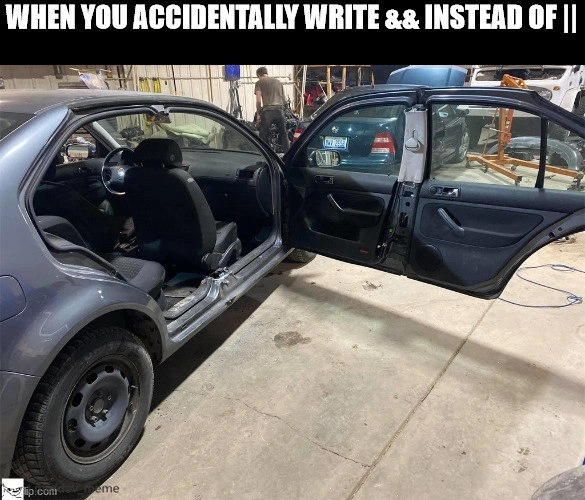
This meme takes that simple idea and makes it visual and funny. The top text says you wrote && instead of || by accident – in plain words, you used “and” when you meant “or” in a computer program. The picture below shows a car that’s literally missing one entire side, as if someone said “the car will only work if both sides are perfect” and then removed half of it when that condition wasn’t met. Of course, a car that’s cut in half won’t drive at all! In the same way, one tiny typo in the code can break the whole program. The reason this is funny is because it’s extreme: a small slip-up (using the wrong word/operator) turned a fully functioning car (or program) into a wreck. It makes us laugh and groan because we know a little mistake shouldn’t cause such chaos, but in programming it sometimes does. The meme is basically saying: “Whoops! I used the wrong logic, and now my project is as messed up as this poor half-a-car.” Even if you’re not a coder, you can relate to how one small error or misunderstanding can lead to a big, absurd mess – and that’s the joke here.

Level 2: AND vs OR Mix-Up

Let’s break down the technical joke for a newer developer. In programming, logical operators like && (AND) and || (OR) are used in conditional statements to decide if certain blocks of code run. The meme’s caption “WHEN YOU ACCIDENTALLY WRITE && INSTEAD OF ||” describes a common boolean logic mix-up. Here’s what these operators mean:

  • conditionA && conditionB is true only if both conditionA and conditionB are true. (AND = “all conditions must pass”).
  • conditionA || conditionB is true if at least one of conditionA or conditionB is true. (OR = “any one condition can pass”).

Accidentally using && when you meant || makes your code too strict. You’re telling the program “do this thing only when every requirement is satisfied” when you intended “do it when any one is satisfied.” This logical error can cause parts of your code to never execute when you expect them to, or features to stay turned off, because the combined condition is almost never met. It’s a fundamental CS_Fundamentals concept: AND and OR have very different truth requirements. To visualize the difference, consider their truth tables:

| Condition A | Condition B | A && B (AND) | A || B (OR) | |-------------|-------------|----------------|---------------| | true | true | true | true | | true | false | false | true | | false | true | false | true | | false | false | false | false |

See how AND (&&) only yields true in the top-left case (both conditions true), whereas OR (||) yields true in three cases (any true in either or both). A simple conditional logic slip — using && — means your if statement might not run when you expect it to. It’s the logical equivalent of a gate that only opens if all keys turn at once.

For example, imagine you intended to grant access if a user is an admin or if the system is in debug mode. The code should use || so that either condition is enough. If you mistakenly use && instead, you’ve told the program that both conditions must be true simultaneously:

// Intention: allow access if user is admin OR if we're in debug mode.
if (user.isAdmin && debugMode) {
    grantAccess();
} else {
    denyAccess();
}

In this buggy code, an admin user in normal mode gets denied, and a non-admin in debug mode also gets denied. Only someone who is an admin and running in debug mode would pass, which is likely nobody in production! The outcome: the feature stays disabled for all the cases where it should have been enabled. This is exactly what the meme is joking about — the program’s logic is so strict that it “removes” half the possibilities. In the photo, the car’s left side (representing one half of the conditions) is completely gone, and the poor vehicle can’t run. It’s a literal image of a program with half its requirements gutted because the code’s if statement was too demanding.

From a Debugging_Troubleshooting standpoint, these bugs can be tricky for a newcomer to identify. The code compiles and runs, but the behavior is wrong. There’s no crash or obvious error message – it’s just that nothing happens when something should happen. As a junior developer, you might stare at your screen wondering, “Why is this feature not turning on?” You’d inspect each part of the code and eventually find the culprit: && instead of ||. It’s an “aha!” moment that teaches you to double-check your boolean conditions. The meme captures that scenario in a humorous way. BooleanLogic might seem straightforward, but when you’re in a hurry or not paying close attention, it’s easy to swap AND vs OR and introduce a subtle bug. The end result of this boolean_operator_misuse is a program state that’s broken in a comically severe way — just like a car with only the right-side doors attached and the entire left side missing. No wonder it’s impossible to drive!

The photo reinforces the lesson: if you require everything when you only needed anything, you might strip away vital parts of your program. In real coding, this could mean a whole feature never executes or data that should be kept gets thrown out. It’s a BugFixing rite of passage to hunt down a bug like this. Once you fix the typo (swapping && to ||), your program’s “doors” are back on, and it can run properly again. The meme is a lighthearted reminder to be careful with those logical operators — even a single & or | character out of place can leave your codebase looking like a chopped-up car chassis.

Level 3: Conjunction Catastrophe

At the expert level, this meme hilariously highlights a classic bug born from a single-character mistake in conditional logic. Writing && (logical AND) instead of || (logical OR) in code is a tiny slip that can wreak outsized havoc on your program’s behavior. In boolean logic terms, you’ve accidentally demanded all conditions be true when you only needed any one condition to pass. The result? A strict logical conjunction that prematurely chops off functionality – much like the car in the image missing its entire left half. For seasoned developers, the humor cuts deep (pun intended): we’ve all debugged a mysteriously broken feature only to facepalm upon discovering a boolean operator typo. It’s a CodingMistakes hall-of-famer that can send you straight to Debugging Hell. One moment you have a fully formed plan (a working car/program), and the next, a misused && leaves you with half an application limping along. This contrast between intent and outcome delivers that “so true it hurts” laugh.

From a senior engineering perspective, the meme is riffing on how uncompromising boolean logic can be when misused. In code, using && is like requiring every door of the car to be intact before it’ll drive; if any one condition fails, nothing proceeds. Meant to write a more lenient || (where just one true condition is enough), the developer instead introduced an overly strict gate. The photo of a bisected sedan perfectly visualizes this — the program’s logic lops off critical parts (just as half the car is cut away) because the overly strict && condition wasn’t met. The Debugging_Troubleshooting humor is that something as innocuous as an extra ampersand can mangle your output this badly. It resonates with every developer who’s spent hours chasing a bizarre bug: the conditional was technically correct syntax, but functionally it was a catastrophe. The meme captures that frustrating revelation moment: “It was the && all along!” It underscores an important CS_Fundamentals lesson too — OR and AND are fundamentally different operations (inclusive disjunction vs. conjunction), not interchangeable at all. Misusing them can trigger completely unexpected code paths, or no path at all, leaving your program as broken as a car missing one entire side.

This kind of logical operator mix-up might sound trivial, but it speaks to deeper software truths. In large codebases, a stray && can silently cause logic bugs that unit tests miss, resulting in a feature that’s present in code but never activates unless all conditions align perfectly. It’s the sort of subtle bug that can slip past code reviews as well, since && and || are easy to overlook at a glance – the code looks reasonable, yet the behavior is dead wrong. Veteran developers chuckle (and maybe cringe) because we’ve been burned by this and similar gotchas (like using = instead of == in C, or a <= instead of < in a loop). These are the scars of BugFixing wars: one-character typos that lead to hours of troubleshooting. The meme’s exaggeration – a car literally cut in half – pokes fun at how code quality and program integrity can be utterly demolished by a seemingly tiny mistake. In practice, chasing such a bug often means painstakingly rebuilding your mental model of the code (much like welding a car back together) only to discover a simple boolean operator was to blame. It’s equal parts catharsis and cautionary tale, a nod to every DeveloperHumor thread about “I can’t believe it was just that one symbol!”

Description

A meme with a top banner of white text on a black background that reads, 'WHEN YOU ACCIDENTALLY WRITE && INSTEAD OF ||'. The image below shows a grey four-door sedan inside a mechanic's garage. The car is bizarrely missing its B-pillar, the vertical support between the front and rear doors. The rear door is swung open, but it appears to be attached to the front door rather than the car's frame, creating a large, structurally unsound opening. This serves as a hilarious and effective visual metaphor for a common programming error. The logical AND operator (&&) requires all conditions to be true, while the logical OR operator (||) requires only one to be true. Accidentally using AND instead of OR can create conditions that are impossible or nonsensical to meet, leading to catastrophic bugs. For experienced developers, this is a relatable 'fat-finger' error that can cause hours of frustrating debugging, perfectly captured by the absurdity of the structurally-compromised car

Comments

7
Anonymous ★ Top Pick This is what happens when your code's cohesion is high but its coupling is... unconventional. The doors are a great microservice, they just forgot the message bus to the chassis
  1. Anonymous ★ Top Pick

    This is what happens when your code's cohesion is high but its coupling is... unconventional. The doors are a great microservice, they just forgot the message bus to the chassis

  2. Anonymous

    Swapped || for && in the HA health check - now failover only triggers when every node is already a smoking crater, the software equivalent of shipping a sedan that’s missing its entire left side and calling it “operational redundancy.”

  3. Anonymous

    The senior dev who approved the PR with "LGTM, just a minor boolean change" is now explaining to the board why half our users can't log in and the other half have admin access

  4. Anonymous

    This is the physical manifestation of that production bug where your authentication check required users to be both logged_in && logged_out simultaneously. Turns out 'impossible conditions' aren't just a theoretical concept - they're a parking violation waiting to happen. The real question is: which door gets garbage collected first?

  5. Anonymous

    Pipe dreams backgrounded: now your grep's an orphan process haunting prod logs

  6. Anonymous

    Swap || for && in an auth guard and your system becomes a short‑circuiting two‑key launch console - nobody gets in unless both doors open at once

  7. Anonymous

    Accidentally used && instead of || on the door interlock - unlock now requires leftDoorOpen && rightDoorOpen, so Ops shipped a split-brain deployment: two halves of a car just to satisfy the boolean

Use J and K for navigation