Skip to content
DevMeme
1255 of 7435
Unauthorized Access to Server Room May Result in Termination
DevOps SRE Post #1403, on Apr 27, 2020 in TG

Unauthorized Access to Server Room May Result in Termination

Why is this DevOps SRE meme funny?

Level 1: Keep Out of My Room!

Imagine your friend has a super elaborate LEGO castle on the floor – they spent days building it. Now they’re so worried someone might step on it or knock it over that they put up a big “KEEP OUT” sign on their bedroom door. Maybe they even joke, “Enter and face doom!” in a silly, exaggerated way. They wouldn’t really hurt anyone, but that warning makes it clear how protective they feel. In this meme, the server room is like that treasured LEGO creation, and the sysadmin (the person who takes care of the servers) is like the kid who built it. They’re basically saying, “This place is very important to me – if you mess it up, I’ll be extremely upset (to the point of pretending it’s life-or-death).” It’s funny because grown-ups usually don’t put up signs with stick figures and threats, but the joke shows just how serious the computer guy is about nobody touching those fancy machines without permission. Just like you know not to barge into your friend’s room and kick apart their LEGO castle, everyone in an office knows not to barge into the server room and mess with the computers. The over-the-top threat on the sign is a humorous way to say, “I mean it – keep out!

Level 2: Authorized Personnel Only

Let’s break down what’s going on here. The server room is a special, restricted area where a company’s critical computers (servers) live. It’s often climate-controlled (to keep those machines cool), packed with racks of blinking equipment and tangled cables, plus backup power units (the heavy UPS batteries you see on the floor). Not just anyone can stroll in there – usually only the IT staff (the Systems Administrators, aka sysadmins, and infrastructure engineers) have access. Why? Because those servers are essentially the heart of a company’s technology. They run websites, databases, internal applications – all the business-critical stuff. If a server goes down because someone tripped over a cable or pressed a wrong button, the entire company could feel it. Picture your office’s internet suddenly dying or a popular app going offline; that’s the kind of disaster a stray hand in the server room can cause. Infrastructure folks implement strict physical_datacenter_security to prevent exactly that. Commonly, there’s a sign on the door that says “Authorized Personnel Only” – meaning “hey, if you’re not one of the people trained to be in here, stay out.” You might need a special keycard or code to even unlock the door. In higher security data centers, there are camera monitors and even two-phase entry systems (like a mantrap, a little entry chamber that only lets one person in at a time after identity verification). It’s all to make sure random employees, visitors, or contractors don’t unintentionally (or intentionally) mess with the equipment.

This meme’s sign takes that physical security warning to comical extremes. Instead of a normal caution like “High Voltage” or “No Unauthorized Entry”, it literally shows a stick figure with a gun enforcing the rule! Of course, real sysadmins don’t actually threaten violence – this is tongue-in-cheek. But it emphasizes how important that rule is. The text “SERIOUS INJURY OR DEATH MAY OCCUR” parodies the language on dangerous equipment or hazardous areas. In a real server room, what’s the worst that could happen physically? You might get a shock if you open a live power supply, or hurt your back lifting a 50-pound server, or create a fire risk by mishandling something. But the true risk is to the systems: an untrained person could cause serious damage to servers or data. That’s professional death for a sysadmin’s uptime record. So, sysadmin_gatekeeping isn’t about being mean – it’s about protecting the company’s infrastructure (and yes, also the sysadmin’s job). By “gatekeeping,” we mean the sysadmin controls exactly who can access the servers or make changes. It might feel a bit territorial, but it’s a key part of Security best practices. Remember, a server isn’t like a regular PC; it might be serving thousands of users or transactions. One wrong move (like unplugging the wrong network cable or accidentally hitting the power button on a critical server) can cause an outage that costs a ton of money and panic. That’s why new IT folks learn quickly: Never enter the server room without permission. If you do go in, you follow protocol – maybe an ESD strap on your wrist (to avoid static shocks to components), definitely careful footing around cables, and absolutely no “experiments” unless you’ve cleared it. The sign in the meme is a humorous way of saying “Seriously, don’t even think about coming in here unless you know what you’re doing or have approval.” It echoes countless real signs and policies – just with a much more aggressive twist for laughs.

Level 3: Gatekeeping at Gunpoint

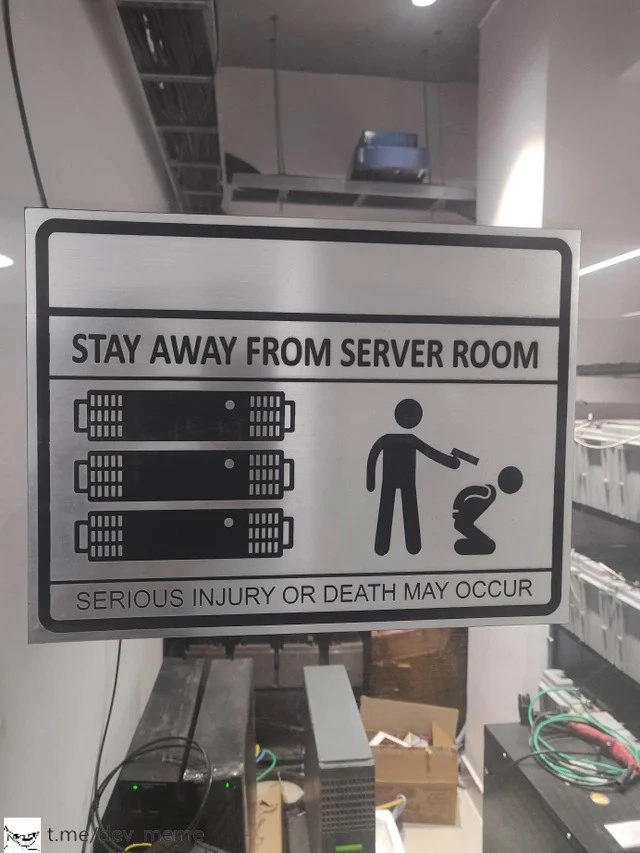
The brushed-metal sign in this server room isn’t your typical polite “Authorized Personnel Only” notice – it’s a full-blown BOFH-style warning. BOFH (short for "Bastard Operator From Hell") is the legendary sysadmin archetype known for torturing scaring clueless users. And here we have exactly that vibe: a stick-figure sysadmin holding a pistol to a kneeling intruder’s head under the bold command “STAY AWAY FROM SERVER ROOM.” It’s hilariously over-the-top, yet every grizzled infrastructure engineer who’s been on 3 AM outage calls can’t help but smirk. This absurdly violent pictogram is a dark SysadminHumor exaggeration of a very real sentiment: Keep your hands off my servers, or you’ll face dire consequences.

Why is this so relatable to senior engineers? Because we’ve all experienced the ServerRoomStories where one innocent “I’ll just peek in here” turned into a catastrophe. Maybe it was the well-meaning developer who wandered in to trace a cable and accidentally yanked the power on a production database. Or the over-curious manager who hit the big red Emergency Power Off switch thinking it was the light. Or the cleaning crew plugging a vacuum into the wrong outlet and tripping a circuit. Serious injury or death may occur is hyperbole – but serious outage or career death is no joke. A single misstep in a data center can knock out critical systems and send the on-call admin into cardiac arrest (figuratively… we hope). The meme resonates because it captures that territorial ferocity a veteran sysadmin feels about their hardware: “Touch anything in this rack and you’re signing your own resignation letter.” It’s Infrastructure 101 that physical access is sacred – the last line of defense.

From an infrastructure security perspective, this sign is just gallows humor for a truth every senior tech knows: if an unauthorized person can get inside the server room, all bets are off. You can have the strongest firewalls and encrypted disks in the world, but none of that matters when someone can literally open a server chassis and root it with a boot USB or yank out a drive. In security circles there’s an axiom: “If you have physical access, it’s Game Over.” This meme cranks that fact up to 11 by implying the sysadmin will personally intervene before letting it happen. It lampoons the sysadmin_gatekeeping we’ve seen in real life – those admins who guard the server racks like a dragon hoarding treasure. And honestly, after you’ve spent years maintaining near-100% uptime, swapping dead drives at 2 AM, and fending off corporate blame for any blip, you might get a little territorial too. The server room is your domain, your DataCenter dojo, and uninvited guests are a threat to both stability and your sanity. In a perfect world, robust policies and keycard locks would handle this. In reality, sometimes it feels like the only thing standing between a stable production environment and total chaos is a strongly worded sign and a glaring sysadmin ready to do whatever it takes.

Description

A photo of a silver, metallic-looking sign on a glass wall, likely the entrance to a server room. The sign has a black border and black text. At the top, it reads 'STAY AWAY FROM SERVER ROOM' in all caps. Below this, on the left, are three stylized icons representing rack-mounted servers. To the right of the server icons is a pictogram depicting a stick figure standing and pointing a gun at the head of a second stick figure kneeling before them. Along the bottom, the sign warns, 'SERIOUS INJURY OR DEATH MAY OCCUR'. The background is a slightly out-of-focus server room with racks, wiring, and other equipment visible. A small watermark for 't.me/dev_meme' is in the bottom left corner of the photo. The meme uses dark, hyperbolic humor to represent the extreme protectiveness that system administrators, SREs, and DevOps engineers feel towards their critical production environments. Any unauthorized change can cause a catastrophic outage, so the sign humorously equates meddling with the servers to a life-threatening situation, a sentiment deeply understood by any senior engineer who has guarded a fragile production system

Comments

7
Anonymous ★ Top Pick The sign is just the first layer of security. The second is the RAID array configured to format the drives and the intruder's credit history simultaneously
  1. Anonymous ★ Top Pick

    The sign is just the first layer of security. The second is the RAID array configured to format the drives and the intruder's credit history simultaneously

  2. Anonymous

    Our zero-trust policy just reached layer 0: physical access now encrypted with 9 mm TLS - Touch Leads to Shooting

  3. Anonymous

    The sign says "death may occur" but we all know the real fatality happens when someone touches production without updating the runbook that nobody reads anyway

  4. Anonymous

    The sign's brilliance lies in its deliberate ambiguity: is the 'serious injury or death' from touching production servers without a change ticket, or from the battle-hardened sysadmin who's been on-call for 72 hours straight? In enterprise environments, both scenarios are equally plausible. This perfectly captures the unwritten rule that the server room is sacred ground - violate it at your peril, whether from electrical hazards, cooling system failures, or the wrath of someone who's spent years cable-managing that rack and will defend it with their life

  5. Anonymous

    Ops RBAC in one sign: if you think the big red EPO is “deploy,” congrats - you’ve just scheduled an unplanned DR test

  6. Anonymous

    Server rooms: where the real prod protection is a sign scarier than SELinux enforcing mode

  7. Anonymous

    Strongest consistency model we’ve shipped: a locked server room with a very opinionated retry policy

Use J and K for navigation