The Universal Threat of a Desperate Merge
Why is this VersionControl meme funny?
Level 1: Merge or Crash
Imagine you and your friend are building a big LEGO castle together. You made a really cool new tower for the castle on your own, and now you want to add it to the main castle structure. But your friend (who is kind of like the “leader” of the project) says, “Hold on, I need to check it first to make sure it fits.” You wait and wait, but your friend is busy checking other parts of the castle, and you’re getting really impatient. You worked hard on your tower and you just want it to be part of the castle already!
Eventually, you get so frustrated that you blurt out jokingly, “Let me put my piece in or I’ll smash this whole castle for both of us!” You don’t actually mean you’ll destroy the castle; you’re just super upset that you’re being blocked from joining in. It’s an over-the-top, silly threat born out of impatience. Now, everyone else on the playground hearing that is like the boy in the picture with wide eyes, holding his drink, thinking, “Whoa, calm down… did you really just say that?!” They find it a bit scary but also kind of funny because it’s such an extreme reaction.
In the coding world, adding your tower to the castle is like merging your code into the main project. The friend who wants to check it first is like a code reviewer who must approve the change. The meme jokes that the developer waiting for approval is so fed up, he’s acting like a kid ready to wreck the whole project if he doesn’t get his way. It’s funny because it’s a huge exaggeration – a playful way to show just how impatient and desperate we can feel when we’re blocked from finishing something we started.
Level 2: Review Purgatory
Let’s break down the scenario for newer developers. In a typical Git workflow, you don’t directly commit changes to the main codebase; you create a separate branch for your work. Once your code is ready, you open a Pull Request (PR) on GitHub (a popular platform for hosting Git repositories). A pull request is basically asking: “Please merge my branch into the main branch.” But merging isn’t automatic – usually it’s gated behind a code review. That means one or more teammates need to look at your code changes, give feedback, and finally approve it. Only after approval (and all automated tests passing) can you hit the merge button. This process is a cornerstone of modern VersionControl collaboration, intended to maintain quality and catch bugs. For a junior dev, waiting for a review can be nerve-wracking – you might constantly refresh the PR page looking for that green checkmark or an approving comment.
Now, imagine your PR has been sitting there for days. You’ve addressed review comments, maybe fixed a bug or two, and you’re still stuck in limbo because your senior is busy or on vacation. All the while other changes are being merged into main. Your branch is getting stale compared to main – this is where MergeConflicts become a worry. A merge conflict happens when your changes overlap with someone else’s changes in the same parts of the code. Git then can’t automatically figure out whose code to keep, so it throws a conflict that you have to resolve manually. It’s like two people editing the same line in a document – the system needs you to decide which edit wins or how to combine them. The more time passes, the higher the chance that something in main will conflict with your work. So you feel pressure to get merged ASAP (that’s the git_merge_pressure the meme hints at – the longer a merge is delayed, the more stressful it becomes).
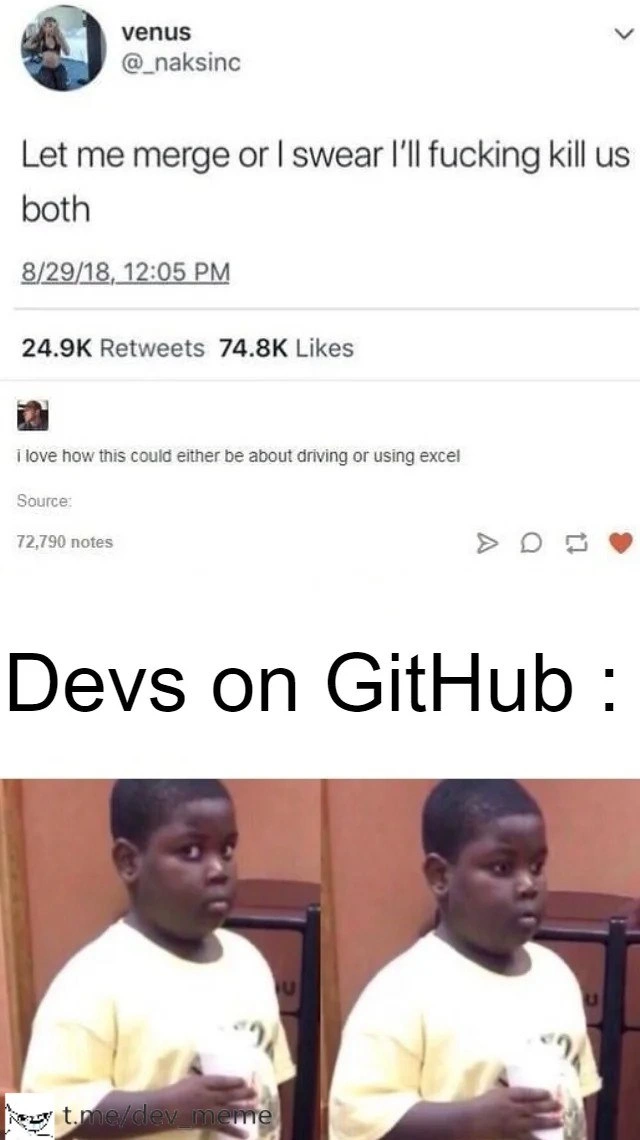
The tweet in the meme says: “Let me merge or I swear I’ll… kill us both.” Of course, in reality no one is getting harmed physically – this is humor via exaggeration. It’s basically a dev joking that if their code doesn’t get merged, they’ll do something so drastic it will ruin everything for everyone. It’s an all-or-nothing tantrum. This might mean, for example, threatening to deploy unreviewed code or take down the development environment out of sheer frustration. It’s joking about the idea of “If I can’t have it my way, I’ll wreck it for both of us.” Developers often vent like this in private chats or memes when a process (like a blocking review) gets on their nerves.
Why do we find it funny? Because it’s relatable in the tech community. We’ve all had that anxious feeling when a PullRequest is stuck and the deadline is near: you start fantasizing ridiculous scenarios like “What if I just merge it without approval… what are they gonna do, fire me?” You wouldn’t actually do it (hopefully!), but joking about it releases some stress. The meme adds a layer of humor by using that kid’s reaction image at the bottom. The text “Devs on GitHub:” followed by the startled boy holding a cup is saying: This is how developers on GitHub react or feel in that situation. The boy looks wide-eyed and nervous, as if he just witnessed someone say something insane. It’s the face of “Did he really just say that?!” In other words, every other dev on the team is that kid, hearing their colleague half-jokingly threaten to bring down the whole repository if their code isn’t merged. It perfectly captures the mix of fear and awkwardness: we know that one unhinged teammate or that inner voice that goes “Merge it now or I swear…”.
Also, notice the little Tumblr comment in the tweet about driving or Excel. The phrase “let me merge” could mean merging lanes while driving a car, or merging cells in an Excel spreadsheet – both are everyday contexts where you might get frustrated (road rage or Excel fiddling). The commenter wrote, “i love how this could either be about driving or using excel.” That was the original joke’s twist. But in the developer meme universe, “merge” immediately makes us think of Git. So the meme creator basically hijacked that tweet for a programming joke. This is super common in DeveloperMemes: we take a funny meme from pop culture or other contexts and re-label it to fit a developer scenario. Here, “Devs on GitHub” reframes the tweet entirely. Suddenly it’s not about cars or spreadsheets, it’s about a Git Pull Request merge. And indeed, merging code can feel just as contentious as merging lanes in traffic!
In summary, the meme is making a joke about how a developer waiting on a code review might dramatically overreact out of frustration. It uses a bold threat (purely joking) to highlight the feeling of being blocked. The humor lands because if you write code, you’ve likely been in a similar spot – stuck waiting with your cup of coffee (or Styrofoam cup, like the kid) and feeling both anxious and a little crazy. It’s a lighthearted way to commiserate over the code_review_bottleneck that every coder encounters.
Level 3: The Merge Ultimatum
This meme hits a nerve for anyone who’s survived a code review standoff. It portrays a developer’s ultimate pull request meltdown – an exaggeration, sure, but one that seasoned devs recognize all too well. We have a tweet at the top shouting: “Let me merge or I swear I’ll f*ing kill us both.” In the real world of Version Control, this is the programmer equivalent of a hostage situation: “Approve my PR or the codebase gets it!” It’s darkly funny because it satirizes that pent-up pull_request_anxiety when a merge is blocked. After all, on GitHub many teams protect the main branch with required reviews, so a dev can’t just merge their code without someone’s thumbs-up. When deadlines loom or a hotfix is urgent, being stuck in code_review_bottleneck feels like life or death (for the project, at least). The meme hyperbolically captures that merge or mayhem desperation.
The format itself is a combo of a viral tweet and a reaction image, a common pattern in DeveloperHumor. The original tweet wasn’t even about coding – a commenter joked it could refer to “driving or using Excel” (since merge could mean merging lanes on a highway or merging cells in Excel). But developers saw the word “merge” and immediately thought Git. It’s a running joke that any general meme about MergeConflicts or blocked merges will get repurposed for our world. So someone slapped on the caption “Devs on GitHub:” and added that two-panel image of a startled kid with a Styrofoam cup. Now it perfectly conveys a programmer’s look of alarm when a teammate basically says “Merge my code now, or I’m hitting the big red destruct button.”
Why is this so funny (and painful) to experienced devs? Because we’ve all had that feature branch that languishes while reviews trickle in. You push your changes, request a PullRequest merge, and then… nothing. Maybe your tech lead is busy, or a CI test is flaky. Hours turn to days, your branch drifts from main, and each new commit on main is like a ticking time bomb for MergeConflicts. The longer it drags on, the higher the git_merge_pressure. In backend teams, we joke about “merge windows” and code freeze periods – if you miss the window, you’re stuck waiting, watching other code go in first. That’s when the “Let me merge or we all go down” energy surfaces. It’s tongue-in-cheek, but it underscores real frustration with process and bureaucracy in software teams. This is the developer’s road rage: if you don’t let me merge into the traffic of the codebase, I’m ready to crash this whole party.
From a senior perspective, there’s also an implicit critique here: if a merge getting blocked can elicit such drama, maybe the team’s process has issues. Maybe code reviews are under-resourced, or branch protections are too rigid without fallback for urgent changes. The meme’s dark humor hints at the absurd lengths a dev might consider when the system doesn’t accommodate real-world pressures. We’ve seen incidents where someone, in a rush, does a git push --force to bypass approvals – the nuclear option of Git. It’s the kind of move a cynical veteran might joke about: “Deploying on Friday 5 PM with failing tests? Sure, let’s all go down together.” Of course, in reality blowing up production helps no one, but in that heated moment of a blocked merge, it feels like you’re ready to hit the big red button out of spite. The shared laughter comes from that recognition: we’d never actually cut the brake lines, but wow, do we sometimes feel the urge when the CodeReviews keep nitpicking or stalling.
Description
A three-part meme about the term 'merge'. The top part is a screenshot of a tweet from user @\_naksinc (venus) that reads, 'Let me merge or I swear I'll fucking kill us both'. The tweet has 24.9K retweets and 74.8K likes. Below it, a Tumblr comment says, 'i love how this could either be about driving or using excel'. The final part of the meme, added below, has the text 'Devs on GitHub:' followed by the 'Awkward Look Monkey Puppet' meme, showing a young boy glancing sideways with a nervous expression. This addition humorously implies that developers performing a 'git merge' can relate to the same high-stakes, potentially disastrous feeling, adding a third context to the original joke. The developer's nervous look suggests they know exactly how a bad merge can 'kill' a project
Comments
7Comment deleted
The difference between a git merge and a traffic merge is that in traffic, you don't have to resolve a conflict by manually stitching two cars together
After the fourth “LGTM, but…” comment, I’m one `git push --force origin HEAD:main` away from letting the uptime monitor settle the code-review debate
The scariest part isn't the merge conflict - it's explaining to the PM why the "simple rebase" just invalidated six months of commit signatures and broke three CI pipelines that nobody remembered depended on that branch's exact SHA history
The real tragedy is that after 6 years of CI/CD maturity, we've automated everything except the one thing that still makes us threaten mutual assured destruction: waiting for that one senior engineer to approve your PR while your feature branch accumulates 47 conflicts and your standup excuse evolves from 'waiting on review' to 'archaeological excavation of git history.'
PRs in monorepos: where rebase hell meets maintainer radio silence, birthing legends in commit history
GitHub’s undocumented merge strategy: admin override - Byzantine consensus solved by one very impatient general
Friday 4:59 pm: “merge” stops being a strategy and becomes a threat model - flaky e2e red, CODEOWNERS asleep, someone finds “Merge anyway.”