
Stakeholders Clients Post #4468 · source on Telegram
Stakeholder's 'Simple' Request vs. Engineering Reality
Description
This meme uses the 'Woman Yelling at a Cat' format. The yelling woman, labeled 'Product Manager,' is screaming: 'It's a simple feature, just add a button!' The confused cat, labeled 'The dev team,' is sitting at a table in front of a plate of salad, representing the innocent engineering team that knows this 'simple' request will require refactoring the entire legacy authentication module. This meme brilliantly captures the disconnect between non-technical stakeholders and the engineering team, where the perceived simplicity of a request masks a mountain of underlying technical complexity. For senior engineers, it is a painful and hilarious depiction of scope creep and the daily struggle of managing expectations
More like this
More like this in Stakeholders Clients →
Use J and K for navigation
Comments
7Comment deleted
The fastest way to give a principal engineer an aneurysm is to preface a feature request with the phrase, 'It should be a quick one...'
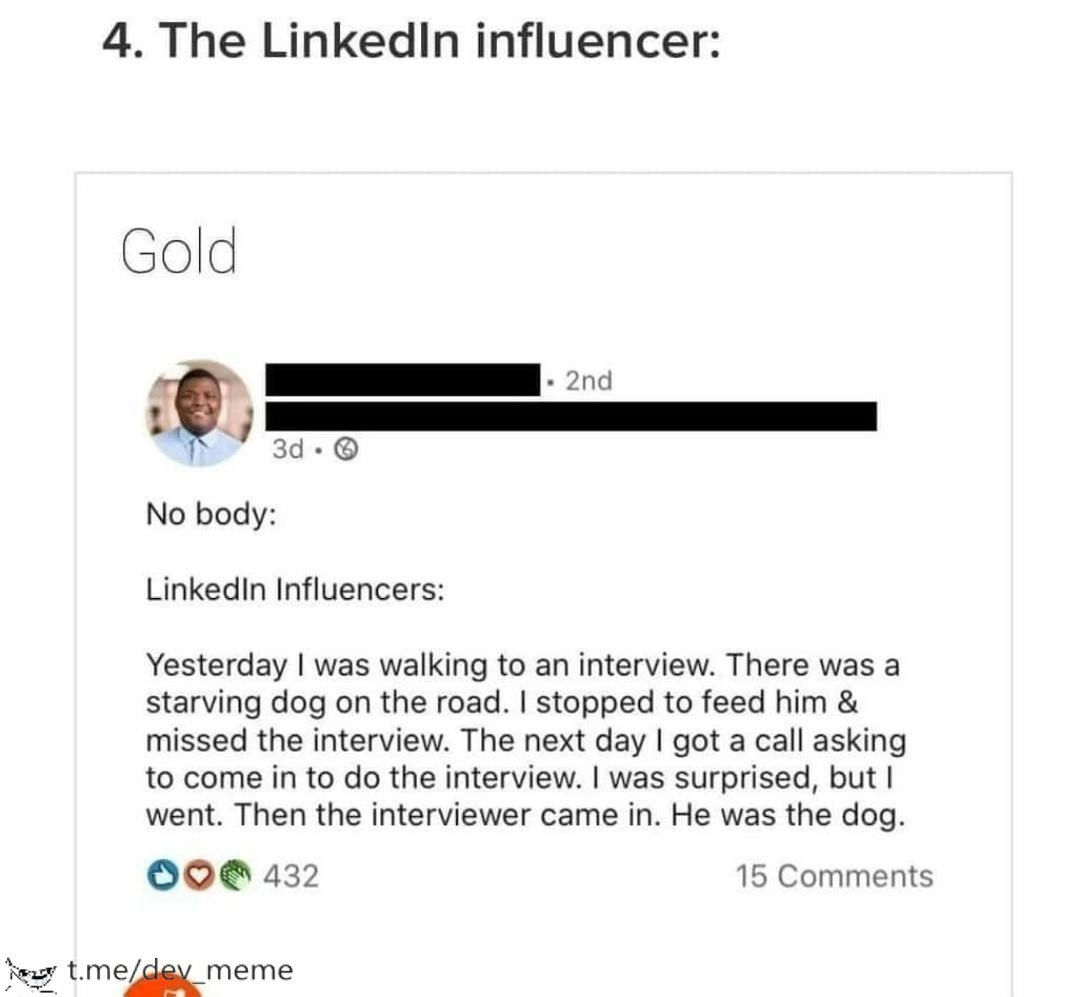
If the dog actually *was* the hiring manager, odds are the next sprint review will be nothing but chew-toys and everyone still afraid to ask for a salary bump larger than a Milk-Bone
The same people who write "Agree? Thoughts?" under their LinkedIn posts are the ones who'd mark their own code reviews as approved if GitHub let them
LinkedIn influencers have mastered the art of schema-less storytelling - no foreign key constraints to reality, no referential integrity checks, just pure NoSQL fiction optimized for engagement metrics. Their posts follow a well-documented anti-pattern: fabricate an improbable scenario, inject a moral lesson with the subtlety of a SQL injection attack, and watch the engagement counters increment. It's content-as-a-service, but the service level agreement explicitly excludes truthfulness
Finally, a hiring pipeline where empathy for strays outranks system design - beats any 5-round FAANG gauntlet
LinkedIn fables are BASE-compliant: Basically Available, Soft-emotion state, Eventually the interviewer is the dog
LinkedIn optimizes for engagement, not signal - if your interviewer turns out to be the dog, your content pipeline is A/B-tested for reactions while the hiring pipeline starves for evidence