Skip to content
DevMeme
7407 of 7435
When User Stories Become Fables
Agile Post #8117, on Jun 13, 2026 in TG

When User Stories Become Fables

Why is this Agile meme funny?

Level 1: Tiny Story, Big Trouble

It is funny because the picture says a fable is a made-up little story that teaches a lesson, and programmers recognize that some work tickets feel the same way. It is like being told a bedtime story, then finding out tomorrow you have to build the castle from it, guess what the dragon wanted, and make sure everyone agrees the ending is correct.

Level 2: Backlog Bedtime Stories

A user story is a small requirements document used in Agile teams. It is supposed to explain who needs something, what they need, and why it matters. Good stories often include acceptance criteria, which are specific checks that tell engineers and testers when the work is done.

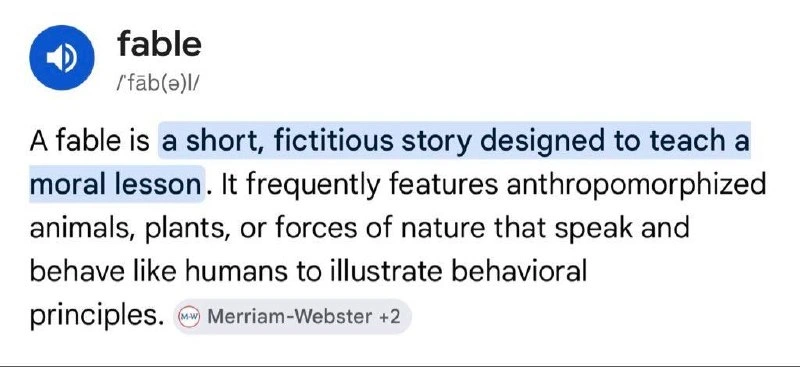
This meme shows the word fable and highlights the part saying it is a "short, fictitious story" with a lesson. The joke is that bad user stories can feel exactly like that. They are short, but not because the problem is simple. They are fictional, because the actual user need may be guessed, oversimplified, or filtered through several meetings. They have a lesson, because the ticket is often trying to guide the team's behavior: build this, prioritize that, do not ask too many inconvenient questions.

The categories around Documentation, Communication, and RequirementsAmbiguity fit because the failure is mostly about translation. Product people, clients, designers, managers, and engineers all need a shared understanding, but the artifact in the middle is sometimes just a tiny parable with a deadline attached.

Level 3: Agile Aesop

The image turns a plain dictionary definition into a fairly sharp Agile joke by highlighting:

a short, fictitious story designed to teach a moral lesson.

That is painfully close to how many user stories behave in real engineering organizations. In theory, a user story is a compact way to describe value from a user's point of view: As a user, I want X so that Y. In practice, it often becomes a polite little fiction used to justify a pre-decided implementation, negotiate scope without saying "scope," or teach developers the moral lesson that stakeholders wanted the button by Friday all along.

The humor is not just "requirements are fake." It is that the highlighted phrase captures the ritual structure of product work. A story is short because planning meetings punish detail. It is fictitious because the "user" may be an invented composite, a sales escalation, an executive preference, or an edge case wearing a fake mustache. It teaches a moral lesson because the real message is usually behavioral: prioritize this customer, stop arguing about architecture, accept that the spreadsheet is the source of truth, and please convert ambiguity into production code without making the room uncomfortable.

The unhighlighted part makes the satire even meaner. The definition says fables frequently feature entities that "speak and behave like humans to illustrate behavioral principles." That maps neatly onto backlog theater: imaginary personas, anthropomorphized systems, and "the business" as a single speaking character with one clear desire. Any developer who has watched a Jira ticket claim to represent "the user" while containing no acceptance criteria can hear the moral already: the story points were never about the story.

Description

The image is a cropped dictionary-style entry for the word "fable," showing a blue speaker icon, the word "fable," its pronunciation, and a definition. The sentence reads: "A fable is a short, fictitious story designed to teach a moral lesson. It frequently features anthropomorphized animals, plants, or forces of nature that speak and behave like humans to illustrate behavioral principles." The phrase "a short, fictitious story designed to teach a moral lesson" is highlighted in light blue, with a Merriam-Webster attribution pill below. The developer humor comes from reading the definition as an uncomfortably accurate description of contrived user stories, project narratives, or requirements documents that are technically fictional but meant to steer engineering behavior.
Comments

2
Anonymous ★ Top Pick A good user story has acceptance criteria; a great one has a moral and three talking edge cases.
  1. Anonymous ★ Top Pick

    A good user story has acceptance criteria; a great one has a moral and three talking edge cases.

  2. @peajack 4w

    did kojima write this?

Use J and K for navigation