The Perils of a Friday Afternoon Deployment
Why is this Deployment meme funny?
Level 1: Bad Players Become Coaches
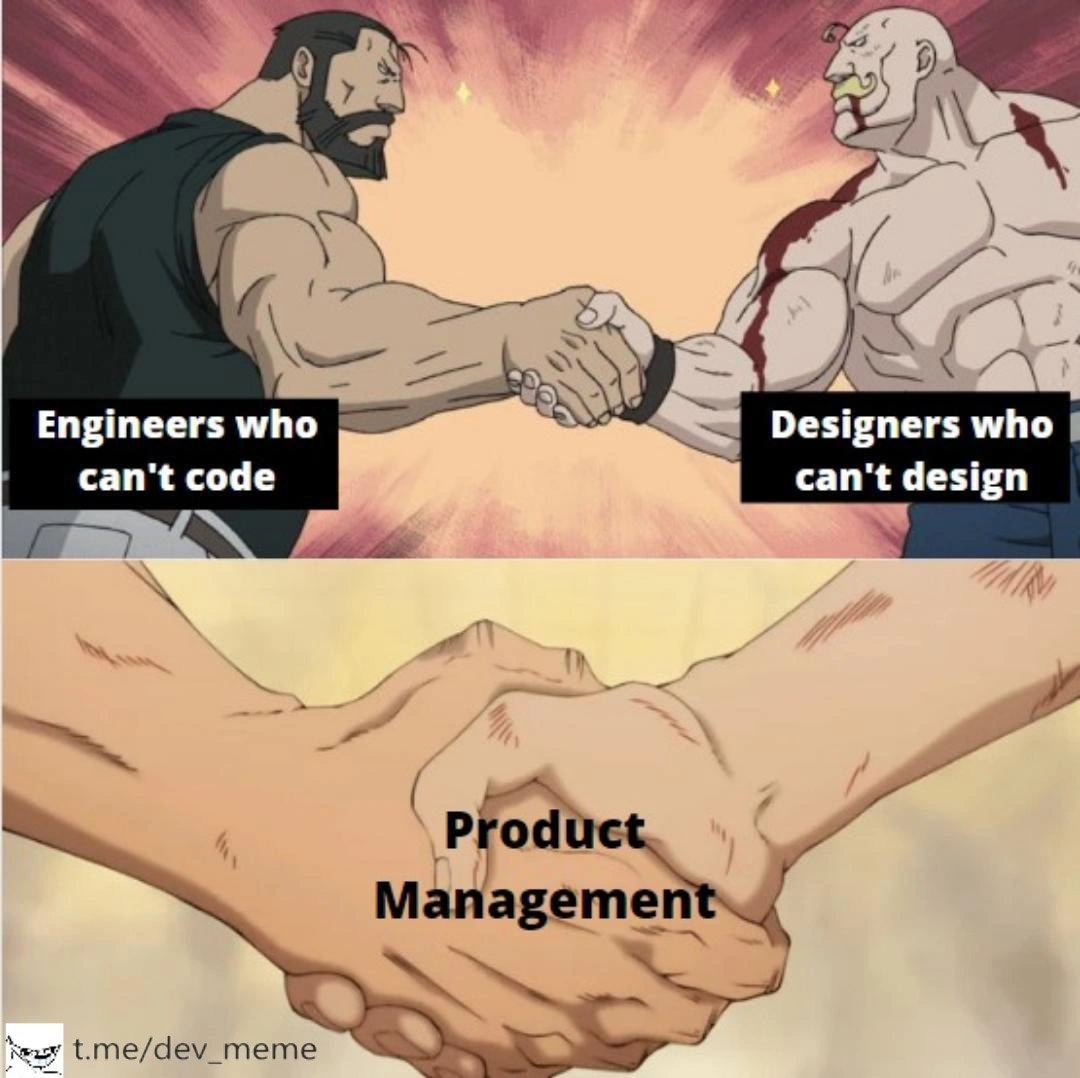
Imagine you’re on a kids’ soccer team. There’s one kid who can’t kick the ball straight and another kid who can’t stop any goals. They’re not good players, right? Now picture those two kids suddenly deciding to team up and become the coaches of the soccer team. They walk around with whistles, telling all the other kids how to play, even though they themselves weren’t good at playing! Sounds silly, doesn’t it? Usually, you’d want the coach to understand the game really well. This scenario is funny for the same reason: in the meme, the “engineer” is like the kid who can’t kick and the “designer” is like the kid who can’t block goals. But together they’re acting as the leader (the coach) for the team. It’s a goofy way to say sometimes the people in charge are the ones who weren’t good at doing the actual work. The picture with two strong cartoon guys shaking hands is just there to make it look super dramatic and over-the-top, which makes the joke even funnier. It’s like two clueless players doing a fancy handshake and declaring, “Don’t worry, we’ll lead everyone to victory!” – even though everybody knows they were bad at the game. The humor comes from that pretend confidence and the big contrast between how important they look and how little they can actually do.
Level 2: Two Wrongs Make a Manager
Let’s break down why this is funny for someone newer to the industry. In a tech company, you usually have software engineers, designers, and product managers working together to build a product. Each role has a specialty: engineers write the code, designers craft the user experience, and product managers coordinate the effort, making sure the product features make sense for users and the business. The meme jokes that when you have an engineer who isn’t good at coding and a designer who isn’t good at designing, they essentially shake hands and turn into a Product Manager. It’s saying, tongue-in-cheek, that a product manager might just be someone who failed at the other two jobs.
Why would people find that relatable? Because in some organizations, it feels true. For example, imagine an “engineer” who can’t code: maybe they struggle with writing even simple programs or understanding the tech, but they’re great at talking in meetings. Or a “designer” who can’t design: their user interfaces might be ugly or confusing, but they can churn out polished slideshows about “vision” and “branding.” What do you do with folks like that? Often, companies don’t fire them outright – instead, these people may end up in roles where they don’t have to do the actual coding or designing. Product management can become that landing spot. It’s a role that’s about planning, talking, and translating ideas between teams. So the joke is effectively “take two misfits, put them together, and voila, you get one manager.” This echoes a bitter office joke: two wrongs don’t make a right, but apparently they make a manager!
The image uses an anime handshake template to exaggerate this. The two muscular characters clasping hands come from a famously enthusiastic friendship scene in anime. By labeling these beefy guys “Engineers who can’t code” and “Designers who can’t design,” the meme is being ironic – these dudes look epic and competent, but their titles say they’re bad at their jobs. The bottom caption “Product Management” on the close-up of the handshake implies this is how a Product Manager is born. It’s a comedic simplification, of course. Real product managers often have tough jobs coordinating between feuding engineers and designers, especially if those teammates are bad at communicating (enter the CommunicationGap). But the meme jabs at a common CorporateCulture gripe: sometimes the PM doesn’t seem to have deep technical or design skill, yet they’re in charge of defining the product. This can happen if, say, a coder realizes coding isn’t their strength and pivots to a planning role, or a designer does the same. There’s also a bit of schadenfreude here: developers and designers (especially juniors) might share a laugh because they’ve felt frustrated by managers who talk a lot but don’t seem to actually do anything tangible. The categories like ManagementVsEngineering and TeamDynamics hint at this tension: engineers often joke about clueless managers, and managers joke about engineers not seeing the big picture. This meme firmly takes the engineers’ perspective, poking fun at product managers as people who might have gotten there by not being very good at the other things.
A quick definition: Product Management is supposed to be the art of deciding what to build next, making sure the product is useful and fits the market. A good PM translates what customers want to what engineers need to build, and ensures the designers’ work fits the vision. But when a PM lacks technical skill or design sense, you get miscommunication and MisalignedExpectations. For instance, a non-coding PM might promise a feature to a client without realizing how hard it is to implement. Or a PM with no design taste might okay a terrible UI layout. In the meme, the handshake alliance is basically saying: if neither the engineer nor the designer knows what they’re doing, the product manager role ends up being this weird in-between job where you just hope for the best. It’s like the meme is teasing, “here lies the intersection of clueless engineering and clueless design – and we call that intersection product.” For a junior dev, it’s a cautionary chuckle: you’ll meet all kinds in the tech world, including managers who may not have the skills you expected. And yes, it’s okay to laugh, as long as you learn the underlying lesson: good products need competence in all roles, and when that’s missing, no fancy “handshake” title can truly cover it up.
Level 3: Synergy of Incompetence
This meme paints a darkly humorous picture of cross-functional dysfunction in tech teams. The top panel shows two battered, musclebound characters in a dramatic handshake (a nod to that epic handshake scene in Fullmetal Alchemist). Their arm veins pop and scars gleam as if they've survived outrageous battles. The labels reveal the joke: one is “Engineers who can’t code”, the other “Designers who can’t design.” In a burst of anime intensity, these unlikely anti-heroes clasp hands. The bottom panel dubs their alliance “Product Management.” It’s a cynical punchline suggesting that the Product Manager role emerges from the unholy union of an engineer with no coding chops and a designer with zero design sense. This synergy of incompetence is portrayed as something almost mythical – “the myth of seamless product management” – as if by combining two negatives you magically get a positive.
For senior engineers and architects, the humor cuts deep. We’ve all encountered the Peter Principle in action: individuals rise to their level of incompetence. Here it’s implied that an engineer who can’t code and a designer who can’t design get “promoted” (or shuffled) into product management, where their lack of tangible skills is hidden behind meeting schedules and JIRA tickets. It’s a well-worn trope in CorporateCulture: those who can’t do, manage. The handshake is hilariously over-the-top, as if forming this role is an earth-shattering alliance. In reality, it satirizes those painful projects where the engineering lead couldn’t program a “Hello World” without five frameworks, and the UX lead churned out confusing mockups – yet they’re calling the shots. The scars and blood in the image? Think of them as the wounds inflicted on the project timeline and team morale by their mistakes. MisalignedExpectations and CommunicationGap are the real battle scars here.
The meme resonates because it captures an uncomfortable truth in ManagementHumor: sometimes the people driving the product vision are the ones least capable of creating it. Senior devs smirk (or groan) at this because they’ve survived releases where a clueless PM (born from such an incompetence handshake) promised stakeholders a miraculous product “just around the corner.” Meanwhile, the devs are rewriting spaghetti code at 2 AM and designers are scrambling to fix hideous UIs – all because the Product Management was as solid as a castle made of sand. It’s a form of shared trauma: we've seen that smooth-talking ex-engineer or ex-designer who schedules endless “alignment meetings” to mask the fact they don't actually know how to fix the mess. This meme nails that scenario with one image and a biting caption. The joke lands not just on individual ineptitude, but on the team dynamics failure: when neither engineering nor design is competent, the management layer tends to become a glorified junk drawer for responsibility. The result? A “seamless” product process that’s totally fictional – held together by buzzwords and handshakes instead of solid code or great design. It’s a cynical take on stakeholderAlignment: if you can’t contribute real work, you can at least shake hands and pretend everything’s under control. The experienced folks laugh (and wince) because it’s absurd yet eerily familiar. We’ve watched two weak links form a chain of command, and we know that chain is only as strong as its weakest links – in this case, incredibly weak.
Description
This meme features the 'Domino Effect' meme format. A small domino, labeled 'A tiny CSS change on Friday at 4:59 PM,' is shown tipping over. This sets off a chain reaction of progressively larger dominoes, culminating in a massive domino labeled 'The entire production database gets wiped.' This meme is a classic cautionary tale about the dangers of deploying changes, no matter how small, at the end of the day or week. For senior engineers, it’s a humorous but all-too-real reminder of the potential for unintended, catastrophic consequences, and the golden rule of never deploying on a Friday
Comments
7Comment deleted
Deploying on a Friday is like playing Russian roulette with a fully loaded Glock. You might get lucky, but you're probably going to spend your weekend in a war room
Product management is the join table auto-generated when your org’s ER diagram has two NULL columns - 'engineering skill' and 'design skill'
Product management: where we've perfected the art of drawing boxes and arrows between things we'll never actually build, while confidently explaining why the technical debt from our last pivot is actually a feature
The brutal truth about product management: it's where engineers who can't debug their way out of a nested callback and designers who think 'accessibility' is a nice-to-have finally find common ground - writing JIRA tickets that neither group will be happy with. At least now they can blame each other's original disciplines for why the roadmap is six quarters behind
The ultimate three-way Git merge: all branches broken, but PM force-pushes to main anyway
Product Management: the org’s Adapter layer translating designer vibes and engineering estimates into Jira epics, OKRs, and a roadmap no one follows after the quarterly reorg
Product management: the distributed transaction coordinator providing “alignment” when both services return 501 Not Implemented