Blaming the Compiler for My Own Obvious Mistake
Why is this Bugs meme funny?
Level 1: From Microwave to Master Chef
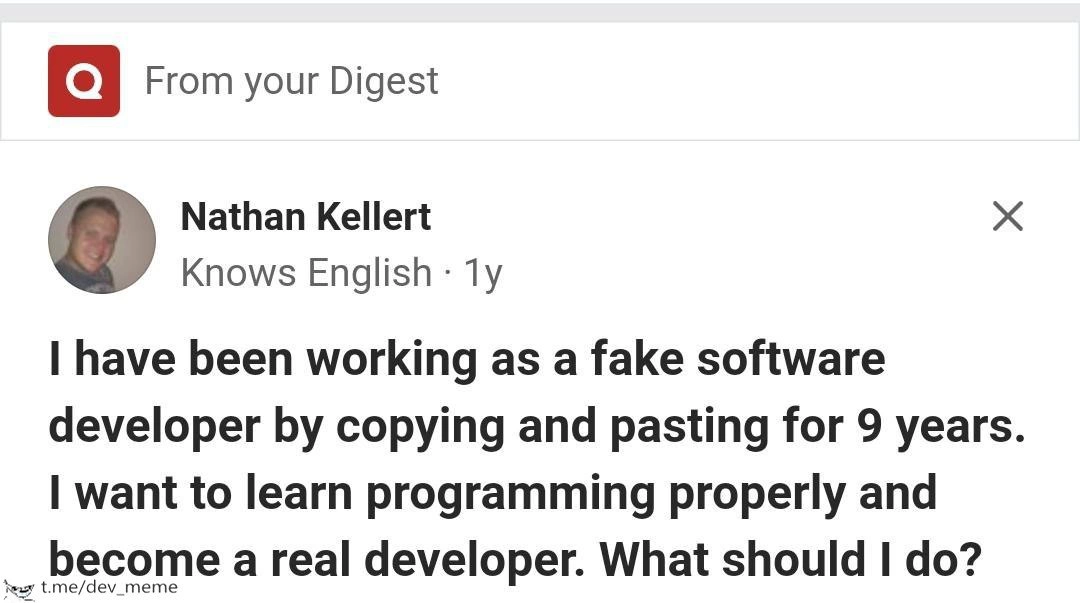
Think of it like cooking. For nine years, this person didn’t really know how to cook; they just microwaved ready-made meals or followed recipes to the letter without knowing what the ingredients do. Every time they were hungry (i.e. had a coding task), they’d grab a frozen dinner (find some code online) and heat it up (paste it into their project). It fills the stomach and fixes the immediate hunger, sure – dinner is served in 5 minutes! But after nine years of this, our "chef" realizes they never actually learned to cook. They don’t know why adding eggs makes a cake fluffy or how to fix a soup that’s too salty (in coding terms, they don't know why the code works or how to troubleshoot it when it doesn't). Now they earnestly want to be a real cook (a real developer).
The meme is funny because it’s as if a chef proudly announced, “I’ve been faking cooking for almost a decade by just using a microwave. I want to cook a proper meal now – what should I do?” The obvious answer is: well, you’ll have to start from the basics – get a cookbook, learn about ingredients, maybe attend a cooking class. It’s both silly and sweet, because on one hand you think, “Wow, nine years and you never tried using the stove?” and on the other hand, you kind of root for them, “Hey, at least now you’re motivated to learn for real!”
So in everyday terms, this meme jokes about someone taking a shortcut for a very long time and finally deciding to do things the proper way. It’s funny to seasoned developers like finding out a supposed "expert" chef has been serving takeout food as their own cooking for years. But it also has a feel-good angle: it’s never too late to learn. Just expect a few burnt meals (or buggy programs) in the kitchen as you start doing it yourself! The core humor is the exaggerated time it took for the realization. Most people would try to learn the craft much sooner, so we laugh at the absurdity. But if a friend said this about cooking, you’d smile and say, “Alright, let’s start with boiling an egg.” In the same way, the programming community’s response to this would be a mix of laughter and giving helpful advice. After all, everyone has to start somewhere – though preferably not nine years late!
Level 2: Beyond Copy-Paste
Let's break down what's happening for a newer developer or someone early in their LearningCurve. The person in the meme is basically saying: "I've been coding by copying other people's answers and code snippets for 9 years. I never truly learned how to program on my own. How can I actually learn and become a real developer now?" This scenario touches on a few key ideas in software development:
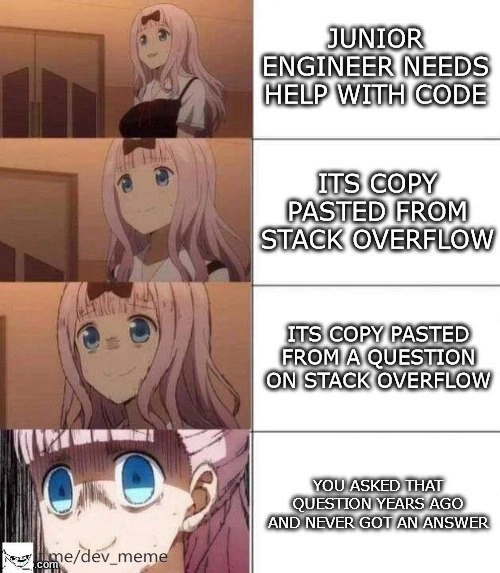
Stack Overflow-driven development: Stack Overflow is a Q&A website where developers post solutions to programming problems. Many juniors (and even seniors) visit it daily. StackOverflow-driven development is a tongue-in-cheek term for when a developer constantly relies on finding answers or code online and plugging them into their project without fully understanding them. It's like assembling a puzzle using pieces found in different boxes – the pieces might fit, but you didn't craft them yourself. In moderation, using Stack Overflow is absolutely normal (why reinvent the wheel for common problems?), but it becomes an issue if you rely on it exclusively for every task over years. In the meme, the developer admits this has been their primary mode of work, which is extreme and therefore humorous (and a bit alarming!).
Copy-PasteProgramming / Cargo Cult Programming: These tags refer to writing code by literally copying it from somewhere and pasting it into your project, without understanding it. The term "cargo cult programming" comes from an analogy: during WWII, some isolated Pacific islanders saw armies build airstrips and then cargo planes landed with supplies. After the war, the islanders built fake airstrips and wooden control towers hoping to attract planes with cargo, not understanding the real cause-and-effect. In coding, it means you're imitating code patterns or rituals (like using a snippet of code or a particular framework) because you saw it work for someone else, but you don't know why it works. So you might include code that you don't need, or use it incorrectly, simply because it was in the copied example. Over 9 years, you can imagine this developer has a whole codebase built out of such cargo cult code – things that seem to work but feel almost magical (to them) because they never learned the underlying principles.
CodeQuality and maintainability: When code is assembled from random copied pieces, its quality usually suffers. Code quality means how well-written, clear, and maintainable the code is. High-quality code is easy for others (and future you) to read, has fewer bugs, and usually comes from someone understanding what they're writing. A copy-paste approach often leads to spaghetti code – a tangled mess that's hard to follow. Why? Because if you don't fully understand a piece of code, you also won't anticipate how it might fail or interact with other parts of your system. Errors might be handled poorly, security issues could creep in (imagine copying code from a 10-year-old forum post that uses outdated cryptography), and performance might be suboptimal. Many senior engineers have encountered legacy projects where half the challenge is just deciphering why something was coded a certain way, only to realize the original developer copied it from an unrelated context. This meme gets a laugh because it's a fellow dev openly admitting, "Yeah, I have no idea what I'm doing under the hood, and I've been getting by with duct tape and Stack Overflow snippets."
Imposter Syndrome: This term is about feeling like you’re not as competent as others think you are, like you’re a "fraud" in your role. Even experienced developers sometimes feel this way, especially if they often resort to quick fixes they found online. The meme's author calling himself a "fake software developer" is basically describing imposter syndrome. Many new developers worry that because they Google for solutions or use other people's code, they’re not "real coders." The truth is, seeking help and using existing solutions is a normal part of development. However, outright copying for nine years without learning why those solutions work will certainly leave someone feeling like they missed out on actually growing their skills. So the question "What should I do?" comes from a place of regret and a desire to finally overcome that imposter feeling by filling the gaps in knowledge.
Now, for someone early in their career, the takeaway here is not that using Stack Overflow or copying a snippet is evil – it's that you should try to understand whatever code you borrow. If you copy a piece of code, take a moment to ask: "How does this work? Could I write it myself next time? Does it exactly fit my problem or do I need to tweak it?" Over years, those who always copy without learning end up with shallow skills. They might be able to patch things up in the moment, but they struggle when faced with a new problem or when something breaks, because they never built a foundation.
Imagine a junior developer's first big task: say you're asked to implement a feature that involves sorting some data. You might quickly Google "how to sort a list in my programming language" and copy a function that sorts. That solves the immediate problem. But later, your project needs a custom sort (maybe by a complex rule), or the data is huge and performance matters. If you only ever copied code, you might not know about different sorting algorithms (like quicksort vs mergesort), or how to optimize. This is why eventually one realizes they need to truly learn programming – the principles, not just the snippets.
The funny part of the meme is the time scale and the earnest plea. After 9 years in the industry (that’s a long time – someone like that might even be in a senior position on paper!), to suddenly say "I want to learn properly... what should I do?" is ironic. The obvious answer any experienced person would give is: start from the basics. Learn a programming language systematically, practice by building small projects from scratch without copying code, maybe read books or take courses on algorithms, data structures, and software design. Basically, do all the learning that most people do in their first couple of years, which this person skipped. It's never too late, but it will indeed be a humbling experience.
To put it simply, the meme is a humorous exaggeration of a real issue: relying on shortcuts vs. investing in real skills. Here's a quick comparison that illustrates the trade-off this developer made:
| Approach | Short-Term Result | Long-Term Result |
|---|---|---|
| Copy-Paste Coding | Instant solution, code works now (why reinvent the wheel?) | Accumulated tech debt and fragile code; limited personal skill growth. |
| Learning & Understanding | Slower start (you have to read, experiment, maybe fail a few times) | Strong foundation, cleaner code, ability to solve new problems (being a "real developer"). |
In a junior-friendly analogy: copying code is like using training wheels on a bike. It helps you get going initially, and that's okay! But if you never take the training wheels off, you’ll never learn to balance on your own. This developer left the training wheels on for 9 years. Now they're finally realizing they want to ride the bike properly. The community finds it funny because 9 years is an overly long time to keep copy-paste training wheels on, but it's also encouraging because the first step to improvement is admitting there's a problem.
Lastly, let's clarify CodeQuality (one of the categories). Code quality refers to how good your code is in terms of readability, reliability, and maintainability. Copy-pasting without learning often leads to low code quality: imagine a book where each chapter was written by a different author and none of them talked to each other – the plot would be messy. Similarly, code written by copy-paste ends up inconsistent and hard to maintain. A "real developer," as the meme puts it, is someone who strives to write high-quality code that they understand and can debug or extend.
So, if you're a junior dev chuckling at this meme, remember: it's poking fun at the extreme end of a habit that nearly everyone has when starting out. The goal is to gradually rely less on blind copying and more on understanding. Use Stack Overflow as a learning tool, not a crutch. When you paste a solution, take the time to study it. Over time, you'll need to copy less and can even contribute answers back for others. That’s the journey from feeling like a "fake" to feeling confident and real in your skills.
Level 3: Cargo Cult Code
This meme hits senior developers right in the tech debt. The Quora-style question is both hilarious and horrifying: a developer admits they've spent nine years essentially programming by copy-paste (Ctrl+C / Ctrl+V) without truly understanding the code. The screenshot even highlights the user's only listed skill as "Knows English" – a cheeky detail implying they have no actual programming credentials. For experienced engineers, this is a perfect storm of DeveloperHumor and PTSD from maintaining codebases built on shaky foundations. We chuckle, but we also cringe because we've encountered that exact "Stack Overflow-driven development" in the wild. It's the classic case of cargo cult programming: imitating solutions without grasping why they work, hoping magic incantations from the internet will keep the system running.
In real projects, if someone has coasted for 9 years by copying random snippets, the code they leave behind is often a Frankenstein monster of mismatched styles and mysterious bugs. Senior devs know the pattern too well: functions pasted in with comments in languages the team doesn't even use, variable names like leftover from tutorials, and half-implemented "fixes" that create new problems down the line. The humor cuts deep because we've been the ones diffusing these time bombs. That "fake software developer" likely introduced legacy code that blows up at 3 AM on a weekend, and guess who gets the on-call alert? The cynical veteran in us can practically hear the error logs screaming with stack traces from code nobody truly grokked. As the meme tag suggests, this is stackoverflow_driven_development taken to the extreme, and many of us have fought that fire in production. foo and bar
Why is this combo of elements so funny? There's an industry inside-joke here: lots of us half-joke that we spend all day copy-pasting from Stack Overflow, but we usually mean the occasional snippet or reference. Here someone admits to doing only that for nearly a decade! It's absurd, yet it underscores a real problem in tech: ImposterSyndrome and the LearningCurve. After years of faking it, the developer has a moment of clarity – they want to become a "real developer" and learn properly. Seasoned engineers reading this might smirk, thinking, "Buddy, after nine years, now you want to learn? Well, better late than never!" The question "What should I do?" is both comically naive and endearingly earnest. The shared experience is that many of us have seen colleagues (or even past versions of ourselves) who advanced through the ranks by memorizing Stack Overflow answers rather than building true understanding. The meme is poking fun at that late realization. It's the kind of confession that would get knowing nods and a few facepalms in any senior dev meeting.
This scenario also hints at systemic issues in our field. How does one remain a "fake dev" for 9 whole years? Perhaps they worked in an environment with low code review, or on projects where delivering something that works was valued more than writing good code. It's a quiet jab at certain corporate cultures: cutting corners becomes habit. Only when things start to break or career growth stalls does reality hit. At that point, DeveloperRegret sinks in—realizing all those quick copy-paste fixes have piled up into a personal skills debt. As experienced devs, we find humor in the dramatic way it's phrased, but we also recognize the underlying truth. It's funny because it's true: eventually, CopyPasteCoding comes back to bite you. The meme uses self-deprecation (the dev calling themselves "fake") which is something our community relates to; many senior engineers have had to unlearn bad habits from earlier in their careers. In essence, this is a comedic take on the journey from being a copy_paste_warrior to becoming a competent programmer, highlighting the absurdity of realizing after nine years that perhaps one should’ve actually learned to code instead of just patching things together.
Even the format of the meme adds to the humor. The fact that this appears in a Quora digest email — a place where people often ask naive or soulful questions — makes it feel like a public confession. It's as if this developer said, "I've been doing it wrong for almost a decade. Internet, please save me!" To a seasoned dev, that mixture of desperation and innocence is darkly funny. We can imagine the flood of advice (and snark) that question would get from the programming community. The whole scene is a perfect satire of DeveloperSelfDeprecation: exposing one’s own inadequate practices that, truthfully, many others also slip into. In summary, the humor works on multiple levels: the extreme case of a copy_paste career, the shared industry pain of untangling such code, and the earnest yet almost absurd plea for help after so long. It's a mirror held up to all of us, exaggerating a flaw to the point of comedy. As cynical veterans, we laugh, then sigh and think, "There but for the grace of good mentors (or sheer curiosity) go any of us."
Telltale signs of a copy-paste codebase that senior devs know all too well:
- Inconsistent coding styles: One file has Java-style
camelCasefunction names, the next uses Pythonicsnake_case– a patchwork of whatever style the copied snippet used. - Leftover comments and code: Comments like "// Found this on StackOverflow, hope it works" or dead code that was never removed because the copier didn't fully understand it.
- Magic numbers and unknown constants: Weird constants or regex patterns appear with no explanation (
42?/[A-Za-z0-9_$]+/?) – they were copied to fix something and no one knows why they work. - Functions that do too much or too little: Copied solutions often carry extra baggage. That utility function you pasted might also be opening network connections or assuming a global variable exists, leading to bizarre side effects.
- Error handling (or lack thereof): The code might swallow errors with a generic
try/exceptortry { ... } catch(Exception e) { }because the snippet did, making debugging a nightmare later.
A veteran engineer looks at this meme and mentally connects it to all those late-night debugging sessions caused by code that was clearly duct-taped together. It's funny in the way that painful memories can be, especially when someone finally says out loud what everyone quietly fears: "Have I been faking it all along?" The meme exaggerates it to nine years of faking, which is an overshoot for comedic effect, but it rings true enough to make us laugh (or cry). In the end, it’s a senior-engineer cautionary tale wrapped in a joke: learn the fundamentals, or be prepared for some truly awkward realizations down the road. This time the "fake developer" caught it themselves—usually it's the next maintainer who discovers the house of cards, but here the builder is finally asking how to build a proper house. And that, ironically, gives hope along with the laughter.
Description
This meme uses the 'Bike Fall' or 'Man Puts Stick in Own Bicycle Wheel' format. In the first panel, a person sticks a pole into the front wheel of their own bicycle, with the text 'Me writing an obvious off-by-one error.' In the second panel, the person flips over the handlebars and crashes violently. The final panel shows the person on the ground, angrily blaming the bicycle with the text, 'Why would the compiler even allow this?' This meme perfectly captures the absurdity of a developer blaming their tools for a simple, self-inflicted mistake. For senior engineers, it’s a humorous jab at the lack of personal accountability and the tendency to deflect blame onto the compiler, the language, or the framework, rather than admitting a simple lapse in logic
Comments
7Comment deleted
Of course my code is perfect. The bug is in the CPU's microcode, obviously. I've already filed a ticket with Intel
Senior rule of thumb: if you’ve been shipping prod code via Ctrl-C/Ctrl-V for nine years, congratulations - you’re already qualified to maintain half the industry’s legacy micro-monoliths
Nine years in and he's discovered what the rest of us won't admit: we're all just senior copy-paste engineers with better git blame alibis and more convincing architectural justifications for why we chose that Stack Overflow solution
After nine years of copy-paste, this developer has finally achieved what most senior engineers only dream of: the self-awareness to admit they've been running 'git clone stackoverflow' as their primary development workflow. The real question isn't 'what should I do?' but rather 'how did the code reviews not catch this for nine years?' - a testament to either exceptional comment-writing skills or a team that was equally committed to the ctrl+c, ctrl+v methodology
9 years copy-pasting? That's not fake dev - it's senior-level 'leverage OSS giants before they deprecate.'
Nine years of copy - paste isn’t fraud - you’re an enterprise clipboard orchestrator; ship tests and a mental model, then deprecate stackoverflow_import v1
Nine years of SODD - impressive uptime; now refactor the architecture: deprecate Clipboard as your package manager and add tests, docs, and “why” as first‑class dependencies