Debugging: Sophisticated Tools vs. Print Statements
Why is this Debugging Troubleshooting meme funny?
Level 1: Full Circle Surprise
Imagine you once had a really hard puzzle that you couldn’t solve, so you wrote it down on a public message board hoping someone would help you. But nobody ever answered it. Years later, a friend of yours is working on a puzzle and shows you the solution they found in an old post online. To your shock, that “solution” is actually the half-finished idea you wrote down years ago when you were stuck. No wonder it doesn’t actually solve the puzzle – it was your own unsolved attempt! You both suddenly realize what happened and can’t help but feel stunned (and maybe laugh a little). In simple terms, something you did in the past, when you didn’t know the answer, has come back around to cause trouble now. The funny part is that you inadvertently set a trap for yourself: your old unsolved problem became someone else’s quick fix, and now it’s your job to fix the mess. It’s like making a mistake, forgetting about it, and then years later being surprised by your own mistake coming back to bite you.
Level 2: Copy-Paste Conundrum
Let’s break down what’s happening here in simpler terms. This meme is all about a young developer and a more experienced developer dealing with a troublesome piece of code that wound up in their project. The source of that code? Stack Overflow, which is a popular Q&A website where programmers ask questions and get answers from the community. It’s basically the go-to place when you’re stuck on a coding problem. You’ll often hear developers joke about “StackOverflow-driven development”, meaning they frequently copy solutions from the site to get their code working.
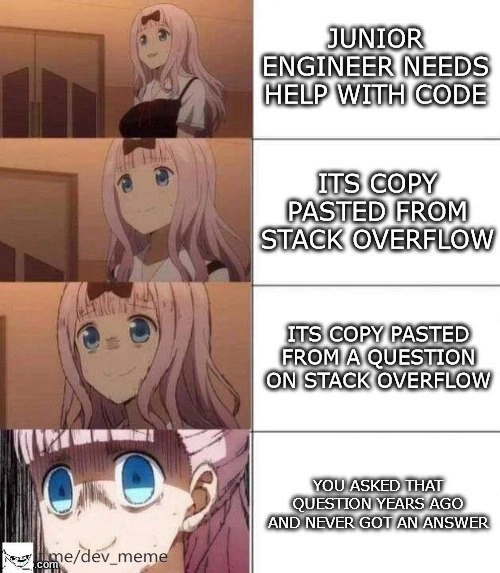
What went wrong? In the scenario, a junior (newbie) engineer needed help with some code. They admit they copied it from Stack Overflow. That’s pretty common – when you’re new and facing an error, you Google it, find a Stack Overflow post, and often there’s a code snippet that looks like it fixes the issue. Copy, paste, done. But here’s the twist: the code was copied from a Stack Overflow question, not from an answer. On Stack Overflow, when someone asks a question, they often include code showing what they tried or where they’re stuck. That code isn’t a proven solution – it’s usually incomplete or outright broken (after all, they’re asking for help with it!). An unanswered question means nobody ever replied with a fix or confirmation. So the junior basically took code that was known to be problematic enough that someone was asking for help with it.
Now enter the senior engineer. The junior’s code isn’t working (no surprise, since it came from an unresolved problem), so they ask the senior for help debugging. The senior starts investigating: they might recognize something odd about the code or perhaps even search for a particular error message or comment in it. Imagine their surprise when they discover the truth: that Stack Overflow question the code came from was posted years ago by the senior themselves! It’s a real facepalm moment. The senior had run into this same problem in the past (likely when they were a more junior developer), got stuck, and posted on Stack Overflow hoping someone would help. No one ever answered with a good solution, so that question just sat there unresolved on the internet. Fast forward to now – a new developer found that very post and assumed the code inside it was a valid answer. It’s a bit like finding notes from someone else’s failed experiment and thinking it’s the instructions for success.
Let’s clarify some terms and why this is a big deal:
- Production (Prod): This refers to the live environment where the software/application is running for real users or the company’s purposes. If something “bites you in prod,” it means a bug or problem has made it into the live product, which is the worst place for things to go wrong. Developers try hard to catch issues in testing, because a prod bug can affect customers or critical operations.
- Dev Communities & Stack Overflow: The meme highlights a dependency on community help. Stack Overflow is an amazing resource, but it’s not foolproof. Not every question gets answered, and not every answer is correct. There’s even a running joke among programmers that the true test of skill is eventually answering your own Stack Overflow question from years ago. In this case, that never happened – the senior never got an answer back then – and life came full circle in an unexpected way.
- Copy-Paste Programming: This phrase refers to the practice of grabbing code from the internet (Stack Overflow, blogs, forums) and inserting it into your own project without fully understanding it. Early-career developers do this a lot to solve problems quickly. It can save time if the code is good and relevant. But it’s risky because you might bring in hidden bugs or make the codebase confusing. Here the junior copied code blindly, not realizing the source was unreliable. It’s a lesson: always make sure the solution you copy is verified. Check if the Stack Overflow question has an accepted answer (green check mark) or a lot of upvotes on an answer. If you take code from a question with no answers, you’re basically taking code that someone else already said “I need help with this; it doesn’t work.” That’s asking for trouble.
- Debugging: When the code broke in production, the senior had to troubleshoot (find the cause of the problem). Part of debugging often involves understanding where the code came from. In teams, it’s common to ask “Who wrote this code?” or “Where did we get this from?” If the answer is “Stack Overflow,” eyebrows go up. In our meme’s story, the answer turned out to be “Stack Overflow, and funny enough, you were the one who put it there.” That realization is both embarrassing and oddly satisfying to solve, like closing a very long-open loop.
For a junior developer, this meme is a lighthearted warning. It tells you: be careful with the quick fixes you find online. Also, it’s a nod to the fact that senior developers were once juniors too, struggling with the same issues. The senior’s horror isn’t anger at the junior; it’s more “I can’t believe I’m haunted by my own old bug!”. It’s relatable for a lot of experienced devs and a quirky insight for new devs about how the industry shares knowledge. In a healthy scenario, the senior might chuckle and then finally solve the problem properly (maybe even go back to that old Stack Overflow question and post the answer after all these years!). It highlights the importance of mentorship and thorough understanding: if the junior had someone to ask or better documentation, they might not have resorted to random code from the web. And if the senior had gotten an answer years ago or documented the solution internally, this might have been avoided. Communication and knowledge-sharing in development teams (and communities) are key – otherwise, you get these unfortunate (if funny) full-circle moments.
Level 3: The Ghost of Code Past
At first glance, this meme sets up a scenario that is every seasoned developer’s nightmare and dark comedy rolled into one. A junior engineer comes asking for help with a piece of code that’s misbehaving. The senior’s curiosity turns to alarm as they learn the code was copy-pasted from Stack Overflow. Alarm becomes dread when it turns out the snippet came not from a vetted answer, but from a Stack Overflow question itself. And then the final gut-punch: the senior realizes they were the one who posted that very question years ago – and it never got answered. It’s a plot twist worthy of an anime reaction shot (hence Chika Fujiwara’s progressively horrified face in each panel), and it hits so hard with developers because it’s a perfect storm of common industry themes:
- StackOverflow-Driven Development: Relying on snippets from Q&A sites is practically a rite of passage in coding. We’ve all done the quick Google -> copy-paste fix in a pinch. This meme dials it up a notch: the code wasn’t from a highly upvoted solution but from an unresolved question. That’s like grabbing a half-baked remedy from someone’s unresolved bug report. It’s the epitome of CopyPasteProgramming gone wrong.
- Knowledge Debt Comes Due: The senior engineer likely asked that question in their own junior days, got no answer, and moved on. In doing so, they inadvertently created a little knowledge black hole. Years later, a new dev fell right into it. This is knowledge debt in action – similar to technical debt, but for know-how. Unanswered problems don’t just evaporate; they lurk until someone else stumbles upon them. The meme humorously illustrates how an unanswered_so_question can boomerang back as a production bug. It’s the software equivalent of a past-you leaving a trap for future-you.
- Self-Referential Bug: The irony is mouthwatering: the senior is effectively debugging their own old code, which they had forgotten about. It’s a self_referential_bug in the story of their career. There’s a famous horror trope, “the call is coming from inside the house!” – here, the bug is coming from inside your own history. The senior’s wide-eyed horror in the last panel says it all: “I am the author of my own misfortune.” It’s a humbling moment of reckoning that many experienced devs find both terrifying and darkly funny.
- Stack Overflow Dependence & Blind Trust: On a broader level, the meme pokes fun at how dependent dev teams can become on community Q&A sites. This StackOverflowDependence can create a circular dependency of knowledge. Developers trust content from the internet sometimes a bit too much. In healthy cases, we copy code from answers that have been tried and tested by dozens of upvotes. In worst cases, like here, someone copies code with no validation. The junior probably thought, “It’s on Stack Overflow, it must be right.” – not realizing they were pulling code from a question description, basically someone’s “I have a problem” snippet. It’s the blind leading the blind: one developer’s confused attempt becomes another developer’s sanctioned solution. No wonder production is on fire! 🔥
- Why This Is Hilariously Relatable: Every senior engineer has a cringe-worthy memory of code they wrote or fixes they attempted when they were less experienced. Running into that code years later – especially in prod (production) where it can do real damage – is both mortifying and comical. It’s like meeting your younger self via a bug. The humor also comes from the extreme unlikelihood yet plausibility of the situation. Sure, the odds of hitting your own Stack Overflow question are slim, but the underlying issues (copied code of dubious origin, unsolved problems resurfacing) happen all the time. This meme just ties it together in the most dramatic, anime-plot-twist way possible.
In essence, the meme is a cautionary tale wrapped in comedy. It underscores why blindly copying code without understanding context is dangerous. It also highlights a softer truth about developer culture: we heavily rely on communal knowledge (dev communities like Stack Overflow) and sometimes that knowledge has holes. When those holes line up just wrong, you get this nightmare-fuel scenario. The senior’s final expression says what every dev feels in that moment: a mix of “How could this happen?!” and “Of course this would happen to me…”.
The next time you’re debugging a weird issue and get the urge to blame that mysterious snippet, remember this meme. The culprit might just be an older version of you who was stuck on the same problem. Talk about deploying your demons! It’s a reminder that in the world of software, code karma is real – and sometimes our past coding sins find a way to bite us in production.
Description
This meme uses the 'Virgin vs. Chad' format. The 'Virgin Debugger' is depicted with text highlighting its perceived weaknesses: 'needs complex setup,' 'disrupts application flow,' 'requires learning a tool.' In contrast, the 'Chad Console.log' is shown as a confident, strong figure with text praising its strengths: 'works everywhere,' 'simple and direct,' 'shows the raw, unfiltered truth.' This meme humorously champions the simplicity and ubiquity of using print statements for debugging over more complex, integrated debuggers. For senior engineers, it’s a relatable joke about choosing the right tool for the job, and how sometimes the simplest solution is the most effective, despite its lack of sophistication
Comments
7Comment deleted
A debugger shows you what you think your code is doing. A print statement shows you what your code is *actually* doing. The difference is usually a pointer to null
When git blame, Stack Overflow, and the space-time continuum all point back to you, congratulations - you’ve achieved 100% self-inflicted technical debt coverage
The worst part isn't finding your own unanswered question from 2019 - it's realizing the accepted answer from 2021 is just someone saying "nvm, fixed it" with no explanation, and you upvoted it
The real horror isn't finding your own unanswered Stack Overflow question from years ago - it's realizing you've since become senior enough to answer it, but you still have no idea how to solve it. This is the technical debt equivalent of meeting your past self in a time loop, except instead of preventing disasters, you're both just staring at the same compiler error with equal confusion. At least now you understand why that question had 47 views but zero answers: everyone who could solve it was too busy copy-pasting from other Stack Overflow questions
Juniors treating unanswered SO questions as quantum superposition: code that's both genius and garbage until it hits prod
Relying on Stack Overflow as your org's knowledge base has CAP tradeoffs: high availability, shaky consistency, and the eventual realization the missing answer was your own post
SO-driven development is fine until the junior copy-pastes my 2013 unanswered question; at least the blame is version-controlled