The Sisyphean Task of Fixing One Bug, Creating Another
Why is this Bugs meme funny?
Level 1: Overdoing It
Imagine your mom asks you to clean a small spot on the kitchen floor. It’s just a quick chore, right? But while you’re cleaning that spot, you notice the whole floor could use mopping. So you mop the floor. Then you figure, why not wipe the counters too? Next thing you know, you’re rearranging the furniture and scrubbing the walls. What was meant to be a 5-minute quick fix turned into a month-long spring cleaning! 😅 It’s funny because the programmer in the meme did the same thing: he took a tiny job and kept adding more and more to it, making it a huge project. We laugh because we’ve all gotten carried away like that – doing way too much when we were only asked to do a little. The meme just jokes that programmers are especially known for overdoing it, turning a little fix into a big adventure, just for the love of tinkering.
Level 2: Scope Creep Spiral
So, what’s happening here? The meme is poking fun at a common developer pitfall: turning a quick fix into a massive project. A “five hour task” means something that should be done in an afternoon. But instead, it took “one and a half months” – basically around 6 weeks, which in software development could be 3 or 4 full sprints (in Agile, a sprint is a 1-2 week chunk of focused work). In other words, a tiny task ate up a quarter of the year! 😱
Why would this happen? A mix of over-engineering, scope creep, and dealing with technical debt. Let’s break those terms down:
- Over-engineering: This is when a solution is far more complicated than it needs to be. Imagine using a bulldozer to plant a flower seed. In coding, over-engineering might mean writing a whole new module or framework for something that could’ve been a single simple function. Developers sometimes do this because they want a “clean” or future-proof solution, or maybe just to try out a cool new technology – even if it’s overkill for the problem at hand.
- Scope creep: This refers to the tendency of a project’s scope (the planned work) to keep expanding. It “creeps” beyond the original goals. In our case, maybe the original fix was just to patch a small bug. But then the programmer decided to also add a minor feature, then clean up some code, then update the UI, and so on. Each little addition might seem harmless, but together they turn a short task into a long one. It’s like if you were asked to patch a hole in one wall, and you ended up renovating the entire room.
- Technical debt: This is the accumulated “debt” of quick-and-dirty code or outdated systems that haven’t been cleaned up. It’s called debt because it’s like borrowing time – you saved time earlier by not fixing things properly, but you pay interest in the form of extra work later. In the meme scenario, maybe the codebase was messy (lots of tech debt). A small change wasn’t straightforward because everything was tangled. The programmer then had to rewrite messy parts just to make that fix, uncovering more hidden problems along the way. The five-hour task ballooned because they were essentially paying off years of neglected clean-up (the debt came due!).
Let’s illustrate how a “quick fix” spirals out of control:
- Initial task: “Just fix that one bug in the user login – it’s causing a minor error.” This sounds straightforward. Maybe a couple of lines of code?
- Discover hidden complexity: While fixing it, the developer finds that the bug is deep in a function that’s poorly written. The code is confusing and has no tests. “Ugh, this code is a nightmare. Let’s refactor it a bit while I’m here,” they think.
- Refactor cascade: They start cleaning up that function. But that function is used in 5 different places. Now those 5 places need updating to work with the improved function. While updating those, they notice some inefficient logic and decide to optimize it (hello, premature optimization!).
- Update dependencies: Perhaps the bug was partly due to an outdated library. “Might as well update the library to the latest version.” But the new version has a different API, so the developer must change a bunch of code across the project to accommodate the update. And of course, the library update breaks something else…
- Testing and fixes: With so many changes, lots of tests (if they existed) fail. Now it’s a hunt to fix new bugs introduced by the refactor. The developer is essentially rewriting and retesting a significant chunk of the application.
- Feature creep: Along the way, the developer has an idea: “As long as I’m modifying the login, I should add multi-factor auth – that would make it more secure.” It wasn’t in the original plan, but it feels like a good improvement. That leads to even more work (and another library, which means more integration… you see the pattern).
By the end, our poor programmer is knee-deep in a full system overhaul. A task that was supposed to be one bug fix turned into a chain reaction of updates and improvements. This whole process is what we dub a scope creep spiral – once it starts, it keeps spiraling bigger and bigger. The meme’s second line “Because I’m a programmer, and that’s what we do” is said in a tongue-in-cheek way. It’s the coder acknowledging, “Yeah, I know I went overboard. We programmers tend to do that.” It’s a bit of self-deprecating engineering humor. We joke about it because it happens a lot: a mix of passion for doing things correctly and the reality of messy systems means even a “quick fix” can turn into an unplanned project. Junior devs learn fast that estimating tasks is hard – something that “should take 5 hours” might hide complications that only surface once you dig in. And sometimes, we create the extra work ourselves by aiming for a perfect solution when a simple one would do. The result? A frustrated developer, a surprised manager (“Weren’t you done with that weeks ago?!”), and a lesson learned about keeping an eye on scope.
Level 3: Refactor Rabbit Hole
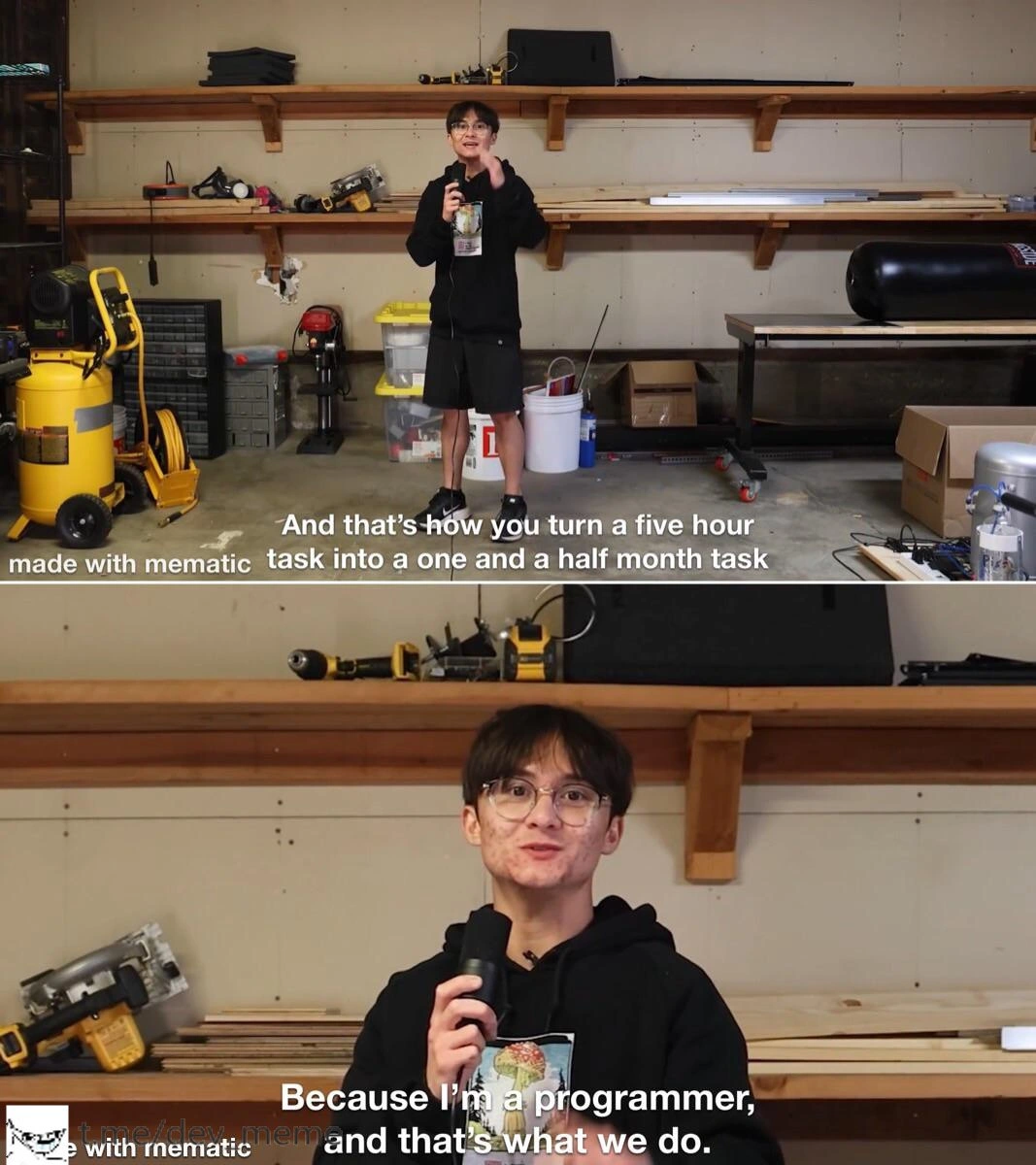
And that’s how you turn a five hour task into a one and a half month task
Because I’m a programmer, and that’s what we do.
This meme hits senior developers right in the gut. The speaker, mic in hand, stands in a cluttered garage full of heavy-duty tools – a perfect metaphor for a dev armed with too many frameworks and gadgets. He’s basically giving a stand-up comedy routine about over-engineering. The punchline? Turning a simple five-hour fix into a quarter’s worth of sprint work. Seasoned engineers laugh (and groan) because we’ve all lived this nightmare.
Why is it funny? Because it’s painfully true. You start with a tiny bug fix or a “quick feature,” but then you peel back the layers of the codebase and discover a swamp of technical debt. Instead of just slapping on a duct-tape solution, the programmer decides to do it “right.” Cue the epic refactor: rewriting modules, updating dependencies, improving the design, and accidentally breaking half the system in the process. One thing leads to another, and suddenly that “small” task has ballooned into an epic overhaul spanning multiple sprints. In Agile terms, a minor story morphed into a full-blown epic with a dozen subtasks. Deadlines? Blown to smithereens. 🚀
This is the classic developer habit of making mountains out of molehills in code. It’s fueled by a mix of pride, curiosity, and a dash of perfectionism:
- Scope creep: Initially, you just needed to fix one thing. But then you think, “As long as I’m here, I should also address this other issue… and that one… oh, and add this improvement too!” The project’s scope keeps expanding secretly like kudzu.
- Premature optimization: Maybe the original 5-hour fix worked okay, but the dev thinks, “What if we get 10x more users? I better optimize this now.” As Donald Knuth warned, “premature optimization is the root of all evil” – you end up engineering a super-efficient solution for problems you don’t even have yet.
- Perfectionism and architecture astronauting: The coder might decide the whole component design is flawed. Why not redesign it entirely? They chase the “perfect” architecture (microservices! design patterns! new library!). It’s fun... until you’re neck-deep in a rewrite that takes weeks.
Underneath the humor, there’s a hint of war-weariness: experienced devs have seen “quick fixes” turn into marathon refactors way too often. You poke one part of a brittle system, and five other parts fall apart – a sign of accumulated technical debt. So you feel compelled to fix those too, like pulling a thread on a sweater and unraveling the whole thing. By 3 AM a month later, you’re cursing past-you for not just leaving it alone. This meme is basically a self-deprecating confession: “Yep, I overcomplicated it – because I’m a programmer, and that’s what we do.” It’s darkly funny because in the back of our minds we know that sometimes the simpler, “lazy” fix would have been more productive, but our engineering instinct (or ego) just couldn’t resist the refactor rabbit hole.
Description
This meme depicts the Greek mythological figure Sisyphus, doomed to forever roll a boulder up a hill, only to have it roll back down. In this version, Sisyphus is labeled 'Me,' and the boulder is labeled 'fixing a bug.' As he pushes the boulder up the hill, another, identical boulder, labeled 'a new bug,' rolls down and knocks him over. This meme is a perfect visual metaphor for the frustrating experience of fixing one bug, only to have the fix introduce a new, often unrelated, bug. For senior engineers, it’s a dark but humorous take on the interconnectedness of complex systems, and the humbling reality that sometimes, 'fixing' things can make them worse
Comments
7Comment deleted
In software, we call this 'bug-driven development.' It's like TDD, but with more crying
Somewhere between yak-shaving and polymorphic refactors, the 'quick script' became a platform rewrite
Started with a simple CSV export, ended up building a distributed event-sourcing system with CQRS, three microservices, and a Kubernetes operator - because what if we need to scale to millions of users who will never exist?
This perfectly captures the senior engineer's dilemma: spend 5 hours doing the task manually, or spend 6 weeks building a generalized, scalable, cloud-native solution with proper observability, comprehensive test coverage, and CI/CD pipelines - for a task that will run exactly once. We call it 'investment in infrastructure,' but deep down we know we're just avoiding the boring work by doing the interesting work. The real kicker? Three years later, that over-engineered solution becomes the critical path dependency that nobody dares touch because the original author left and the documentation is 'self-explanatory code.'
Normals hammer a nail; we orchestrate a K8s cluster for the shelf - with Helm charts for versioning
Senior move: spend six weeks building a reusable, observable, idempotent CLI with a plugin architecture to avoid a five‑hour manual step - then export the ROI to Prometheus as exactly 0
We automated a one-off chore by shipping a microservice, Terraform module, feature flag, and two RFCs - six weeks later the chore is still pending, but the platform looks great