The Infinite Recursion of 'Just One More' Refactor
Why is this Refactoring meme funny?
Level 1: Still in the Empire
Imagine you really don’t like a big powerful king who rules your land, so you decide to run away from his kingdom. You travel far and settle in a new place where you can do your own thing. You build a house, use local tools, and feel free. But then, to your surprise, you find out the same king secretly owns the new village you moved to, and even the tools you’ve been using were provided by his people! In other words, you tried to escape the king’s influence, but you ended up still living under his rule without realizing it. This is exactly what’s happening in the meme, but with Microsoft as the “king.” It’s funny (and a bit frustrating) because the character thought he escaped to freedom, only to discover he was still in the empire all along.
Level 2: Open-Source Owned
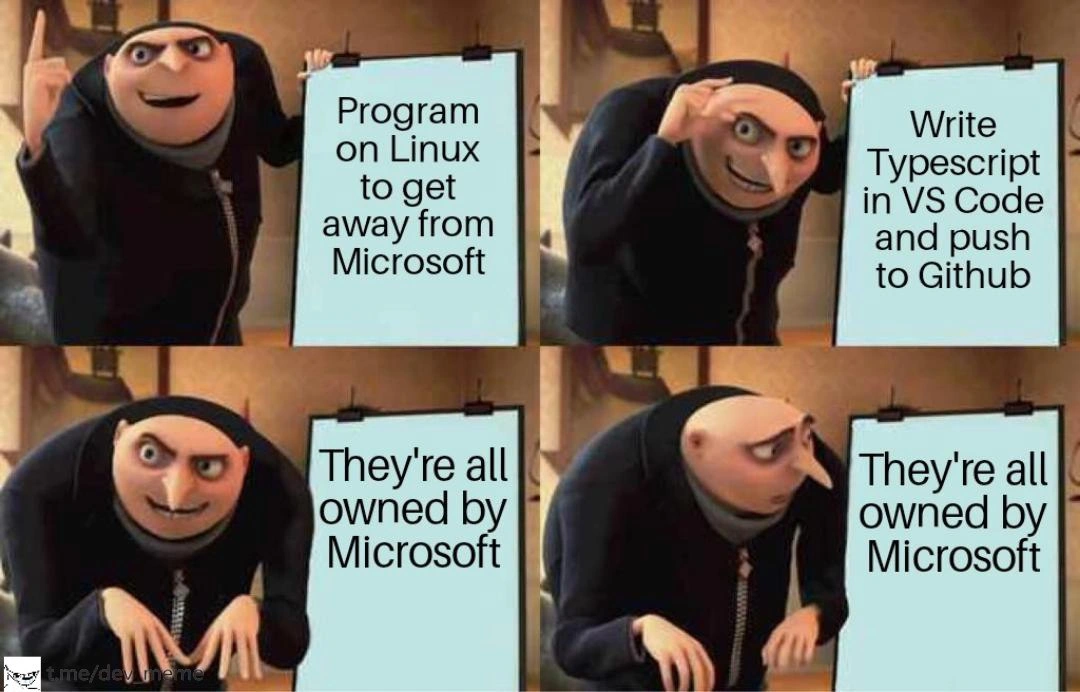
Let’s break down the meme in simpler terms. The meme uses the character Gru (from Despicable Me) presenting a plan on a flip-chart in four panels. The joke is in the text on Gru’s chart and his changing expression. The scenario goes like this:
Plan Part 1 – “Program on Linux to get away from Microsoft.”
What this means: The person (Gru) plans to use Linux as their operating system instead of Windows. Linux is an open-source OS known for being free and community-developed. People often choose Linux to be independent from companies like Microsoft (which makes Windows). So Gru’s thinking, “I won’t use Windows, that way I won’t be using any Microsoft product. Hooray, I’m free!” This reflects a lot of developers’ mindset who prefer open-source everything to avoid big corporations’ influence.Plan Part 2 – “Write TypeScript in VS Code and push to GitHub.”
Here Gru lists the tools he’ll use on Linux:- TypeScript – This is a programming language. Specifically, it’s a version of JavaScript (the language that runs in web browsers) that adds static types to it. Static types help catch errors in your code early. Many developers love TypeScript because it makes coding large applications easier and less error-prone. It’s become extremely popular for web development. Important detail: TypeScript was created by Microsoft. It’s open-source (anyone can use and contribute to it freely), but the original maker and main maintainer is Microsoft.
- VS Code (Visual Studio Code) – This is a code editor, basically the application where you write your code. Think of it like Microsoft Word, but for coding. VS Code is very popular because it’s free, fast, and has a huge library of extensions (plugins) that make a programmer’s life easier (like auto-completion, debugging tools, etc.). Developers on Linux, Mac, and Windows all use VS Code – it’s cross-platform. Important detail: VS Code is developed by Microsoft. Even though it’s free to download and its source code is publicly available (open-source), it’s a Microsoft product from the ground up (it even has “Visual Studio” in its name, referencing Microsoft’s family of developer tools).
- GitHub – This is a website/service for version control and code sharing. When developers “push to GitHub,” it means they upload their code to the GitHub platform using Git (a version control system) so that it’s backed up online and can be shared with others or collaborated on. GitHub is hugely popular in the developer world – it’s like the hub for open-source projects and also used by companies to host code. Important detail: GitHub was an independent company originally, but Microsoft acquired (bought) GitHub in 2018. Now GitHub is a subsidiary of Microsoft.
So, Gru’s plan in panel 2 is essentially: use TypeScript (Microsoft-made language) to code, in VS Code (Microsoft-made editor), and store the code on GitHub (now a Microsoft-owned platform). At a glance, these tools are just common choices for a modern developer. Many people might not even associate them with Microsoft because they are so common and not Windows-specific. But Microsoft is the common thread behind all three.
Plan Part 3 – “They’re all owned by Microsoft.”
This is where the punchline starts. In the third panel, Gru’s eyes are wide and he has that shocked/realization face. The text on the board is the outcome he didn’t intend. He’s realized a flaw in his plan: all the tools he just listed belong to the very company he was trying to avoid. Microsoft owns or created every piece of his Linux-based workflow! This moment is the “uh-oh” or facepalm moment. For someone who wanted to get away from Microsoft, discovering that Microsoft is still in the picture (just less obviously) is ironic and funny.Plan Part 4 – (Repeating) “They’re all owned by Microsoft.”
In the final panel, Gru is slumped and defeated, and the text is the same realization repeated. This emphasizes the joke: there’s no escaping it – “They’re ALL Microsoft!” He tried to be clever and independent, but ended up relying on Microsoft’s ecosystem even more in some ways. The repetition drives home that sense of “Doh! I really didn’t get away at all.” It’s the meme’s way of underlining the irony and making us laugh.
Why is this funny to developers?
It highlights a real-world situation in a lighthearted way. Many developers who prefer open-source software have traditionally avoided Microsoft. (In the past, Microsoft was seen as very proprietary and not friendly to the open-source community. Using Linux was a statement of breaking free from that.) Now, in modern times, Microsoft has changed its approach: it actually supports a lot of open-source projects and even owns some of the most-used open-source-friendly tools. The meme is joking that even if you run away from Microsoft’s obvious products (like Windows), you might unknowingly run toward other Microsoft products because Microsoft’s reach in the developer world is so broad now.
For a newer developer or someone not aware of these ownership details, it’s an educational irony:
- You might use VS Code because it’s an excellent editor, not realizing it’s from Microsoft since it runs on Linux and doesn’t scream “Microsoft” in your face.
- You might learn TypeScript because many modern web projects recommend it, not necessarily aware that Microsoft invented it (since it’s open-source and has a large community).
- You probably use GitHub because everyone does for git repositories – and while you might know Microsoft bought it (it was big news), on a day-to-day basis it’s easy to forget. GitHub still feels like its own thing, but ultimately, it’s part of Microsoft now.
The meme basically says: “Ha! You thought you left Microsoft behind, but actually you’re using Microsoft-owned tech even more now.” The humor comes from that reversal and the shared experience – a lot of developers have that moment of realization at some point. It’s a gentle poke at the idea of trying to be completely independent of Big Tech. In reality, big companies like Microsoft, Google, etc., have their hands in so many tools and services that using something totally “independent” is harder than it looks.
And to be clear, this isn’t necessarily a terrible thing – Microsoft’s stewardship of VS Code, GitHub, and TypeScript has generally been positive for developers. Those tools are popular because they’re good. But it’s funny in an almost gotcha way. It’s like discovering the cool indie band you loved is actually on a major record label — you still like the music, but you chuckle at your assumption of its indie cred. Here, our developer Gru thought his workflow was free of the “Microsoft label,” but it turns out the label was just hidden.
In summary, panel by panel, the meme uses Gru’s plan-and-failure gag to illustrate a point about developer tools consolidation:
- Using Linux = avoiding Microsoft’s operating system.
- But using TypeScript, VS Code, GitHub = inadvertently using Microsoft’s programming language, code editor, and code hosting service.
- Realization = “Oops, my entire development workflow is under Microsoft after all.”
It’s a tech inside-joke that many in programming find both funny and a little eye-opening. It reminds us how much one company can be behind the scenes of technologies we use every day, even when we think we’re “free” of them. This is why the meme falls under DeveloperHumor: it’s poking fun at a common scenario in the developer experience with a big wink.
Level 3: All Roads Lead to Redmond
At the highest level, this meme plays on the delicious irony of modern software development: even when you think you’re escaping Microsoft, you end up using its tools. In the first panel, Gru (the hapless planner) proclaims his scheme: “Program on Linux to get away from Microsoft.” Many senior engineers smirk at this because we’ve seen it before – the classic escape_big_tech_fail. Sure, you ditch Windows for Linux (the open-source OS haven), but then what do you inevitably use for coding? In panel two, Gru’s very next steps are: writing code in TypeScript, using VS Code as the editor, and pushing the project to GitHub. The punchline (panels three and four) is Gru realizing with horror that “They’re all owned by Microsoft.” 😅
Let’s unpack why this hits home for experienced devs. It’s highlighting a kind of devtools monopoly cleverly orchestrated by Microsoft in recent years. We have a developer determined to flee the “Microsoft empire,” but inadvertently embraces Microsoft’s empire even harder through the back door of open-source tools. This is the open_source_ownership_irony: a stack that feels independent and free (Linux + VS Code + TypeScript + GitHub) but is actually under one giant corporate umbrella. It’s like a plot twist where the hero discovers the villain was funding the operation all along.
Consider each element of Gru’s plan:
- Linux – the open-source operating system that historically symbolized freedom from Microsoft’s Windows. For decades, running Linux has been the rebel move, a way to avoid vendor lock-in and the corporate heft of Windows.
- TypeScript – a hugely popular programming language for web development. It’s basically JavaScript with static types for better reliability. Many devs adopt it thinking they’re just using a superior tool for coding, often not realizing Microsoft designed TypeScript (it was created by Anders Hejlsberg at Microsoft, the same legendary engineer behind C#). Using TypeScript means you’re literally writing code in a Microsoft-invented language – albeit an open-source one.
- VS Code (Visual Studio Code) – the code editor that took the developer world by storm. It’s lightweight, highly extensible, and runs on Linux, Mac, Windows – everywhere. It feels like a community-driven, plugin-rich editor, not some corporate locked-in product. But VS Code is indeed developed and maintained by Microsoft. It’s open-source (the code is available on GitHub) which made it even more popular among open-source enthusiasts. Microsoft basically achieved VS_Code_supremacy by creating an editor so good that even Linux fans say “Yes please.”
- GitHub – the de facto platform for hosting code, especially open-source projects. It started as an independent startup beloved by developers worldwide. But in 2018, Microsoft swooped in and acquired GitHub for $7.5 billion. This was huge news: the home of open-source projects joining the Microsoft family. By 2022 (when this meme was posted), developers have mostly accepted it, but that ironic sting remains – your open-source code is now hosted on servers owned by the company many tried to escape.
So, by step 2 of Gru’s plan, he’s using three major technologies – VS Code, TypeScript, GitHub – all under Microsoft’s control (or ownership). The senior engineer perspective here is a knowing chuckle: “Ah yes, one does not simply escape the Empire.” We’ve watched Microsoft reinvent itself and quietly infiltrate the open-source ecosystem over the past decade. The meme humorously exposes that Microsoft is everywhere in a modern dev’s workflow, even if you’ve sworn off Windows. It’s a bit of a gotcha: the developer thought they’d achieved technological independence, but unknowingly fell right into Microsoft’s extended realm.
There’s industry history behind why this is so poignant. In the late 90s and early 2000s, Microsoft was often viewed as the “Evil Empire” by Linux and open-source advocates. There was intense rivalry – think of Steve Ballmer’s infamous “Linux is a cancer” remark, or the general mistrust of Microsoft’s motives. But under Satya Nadella’s leadership (mid-2010s onward), Microsoft executed a pivot: “If you can’t beat them, join them (and buy them)”. They embraced open source, started contributing to Linux, open-sourced .NET, and released VS Code for free. And importantly, they acquired key developer platforms (like GitHub) and kept supporting popular open technologies (like TypeScript, which they give away open-source to make web development better, and thus draw developers into their ecosystem).
This strategy has been so effective that many developers using these tools don’t even think “Microsoft” day-to-day – VS Code just feels like a great editor, GitHub feels like a neutral platform, TypeScript feels like a community staple. Microsoft’s influence is almost invisible until you step back and connect the dots – exactly as Gru does in panel 3. It’s a “Wait… who owns all this?!” moment. That realization can be both funny and a tad unsettling. It’s funny because of the dev humor aspect – the plan backfired spectacularly in a cartoonish way. It’s unsettling (in a lighthearted way) because it reminds us how consolidated our tools are under big players.
To a seasoned dev, the meme also pokes at the futility of trying to avoid Big Tech entirely. It’s practically a rite of passage to go through a “I’ll use only open-source, avoid the mega-corps” phase, only to find out that those open solutions are often backed by one of the same mega-corps. The line “They’re all owned by Microsoft” hits like the punchline of a dark joke about modern software development. Microsoft has become the quiet landlord of the developer ecosystem: you might not see the Microsoft logo on your rent check to VS Code or GitHub, but you’re paying into their ecosystem with every push and every package download.
In short, the meme resonates with senior devs because it’s a truth wrapped in humor. It highlights the consolidation in DeveloperExperience (DX) tooling – how one corporation’s influence pervades even the open-source landscape. As cynical veterans might say, “All roads in tech lead to Redmond eventually.” Gru’s defeated face in the last panel is basically every developer when they finally read the fine print. 😂 We laugh, perhaps a bit ruefully, because we’ve all been that Gru at one point – proudly independent on the surface, but still dancing to the tune of the same old Pied Piper of Redmond.
# The ironic "escaping Microsoft" workflow:
$ install linux-distro # Step 1: Ditch Windows, embrace Linux
$ code . # Step 2: Open Visual Studio Code (Oops, that's Microsoft!)
$ tsc app.ts # Step 3: Compile TypeScript (Microsoft-created language!)
$ git push origin main # Step 4: Push to GitHub (Owned by Microsoft since 2018!)
# ...and realize the entire toolchain traces back to Microsoft.
Description
This meme shows a picture of two mirrors facing each other, creating an infinite reflection. The first mirror is labeled 'My code,' and the second mirror is labeled 'My urge to refactor my code.' The infinite reflection between them represents the endless, recursive loop of refactoring that developers can fall into, where the act of improving code creates new opportunities for further improvement, ad infinitum. For senior engineers, it’s a humorous take on the law of diminishing returns in code quality, the dangers of gold-plating, and the importance of knowing when to stop refactoring and just ship the damn thing
Comments
7Comment deleted
The difference between a junior and a senior is that a junior doesn't know when to start refactoring, and a senior doesn't know when to stop
We switched to Linux for freedom, but our entire toolchain still resolves to `*.microsoft.com` - guess the only truly independent repo left is that TODO on the whiteboard
Successfully migrated our entire infrastructure away from vendor lock-in, except for Active Directory, Azure DevOps, Teams, Office 365, and that one critical .NET Framework app nobody wants to touch
The modern developer's journey: flee Windows for Linux freedom, only to realize you've just switched from Microsoft's OS to Microsoft's entire development stack. It's like leaving your hometown to escape your family, then discovering they bought the city you moved to, your apartment building, and the coffee shop where you work remotely. At least with WSL2, Microsoft saved us the trouble of pretending we had a choice
We brag about multi-cloud, then run a single-vendor toolchain: Linux kernel, Microsoft userspace
We moved to Linux for freedom and accidentally implemented vendor lock-in as a microservice: TypeScript, VS Code, and GitHub forming one Microsoft
Linux escape pod? More like Microsoft's open-source onboarding funnel