
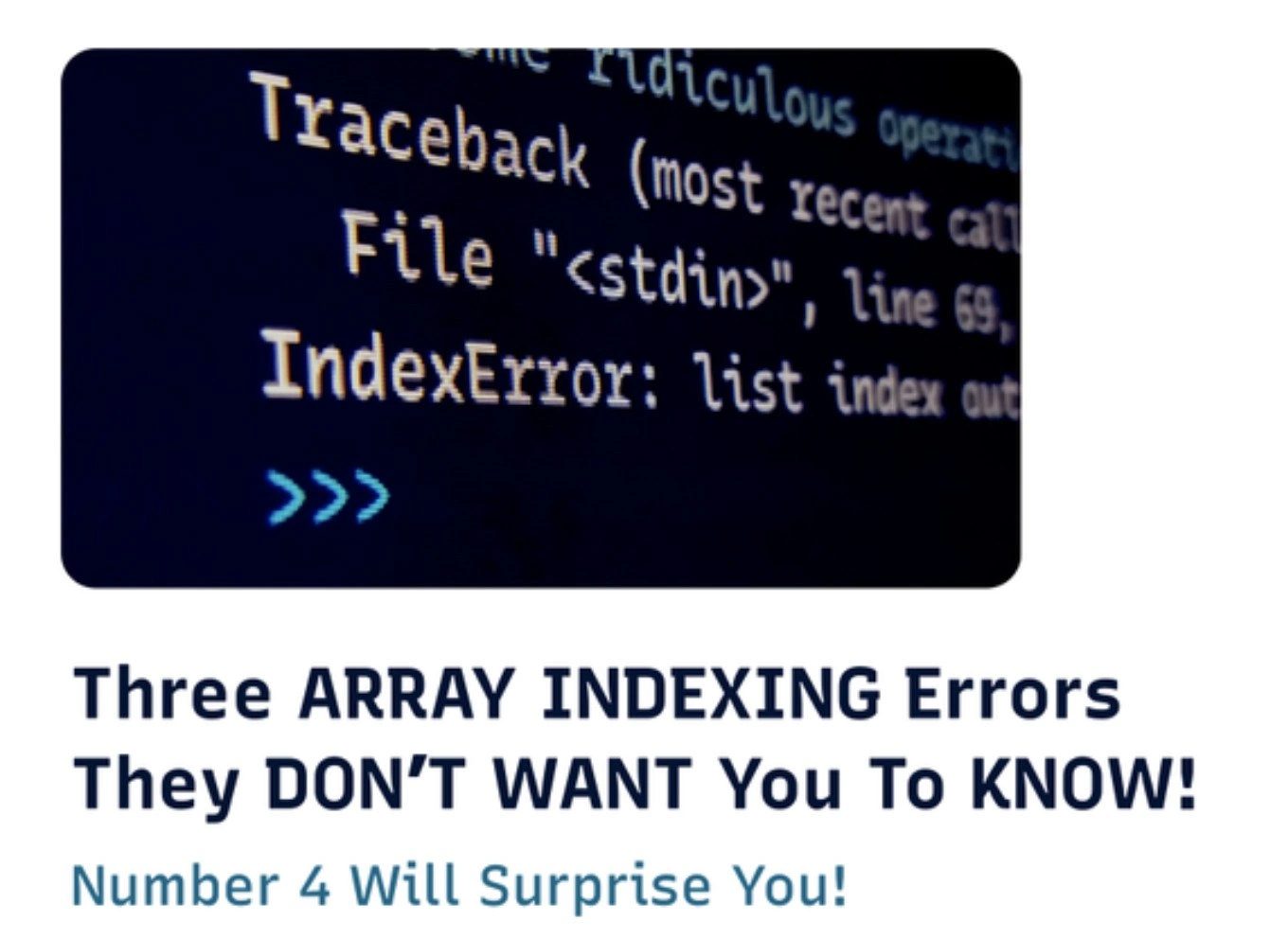
Clickbait Journalism Discovers Off-By-One Errors
Description
This meme satirizes clickbait article headlines by applying them to a common programming error. At the top, there is a screenshot of a Python traceback in a dark terminal window, showing a classic 'IndexError: list index out of range' on line 69. Below the image, a headline in a bold, sans-serif font reads: 'Three ARRAY INDEXING Errors They DON'T WANT You To KNOW!'. A smaller, blue sub-headline underneath adds the punchline: 'Number 4 Will Surprise You!'. The humor is layered for developers. First, it mocks the sensationalism of online content by treating a fundamental concept like array indexing as a hidden secret. Second, it contains a logical contradiction ('Three Errors... Number 4'), which perfectly parodies the nonsensical nature of clickbait. For any experienced programmer, an IndexError is a basic, everyday bug, making its presentation as a shocking revelation deeply ironic and relatable







Comments
8Comment deleted
The fourth type of array indexing error is when you realize the array was actually a null pointer all along, and the real error was your optimism
Clickbait promises 3 array-indexing mistakes, then immediately reaches for #4 - marketing finally nailed a live demo of off-by-one in O(1) time
After 20 years in this industry, I've learned that off-by-one errors are just the universe's way of reminding us that the real bug was choosing zero-based indexing in a species that starts counting on fingers at one
The two hardest problems in CS: cache invalidation, naming things, and off-by-one errors - number 4 will surprise you
The real IndexError here is promising three errors but delivering 'Number 4' - a meta-commentary on off-by-one bugs that would make any senior engineer simultaneously groan and appreciate the recursive irony. It's the programming equivalent of a self-referential paradox: a meme about array indexing errors that itself commits an indexing error, perfectly capturing how these bugs propagate through codebases when developers don't validate their boundary conditions. The cherry on top? Line 69 - because of course it is
“Three array indexing errors they don’t want you to know” - spoiler: #4 is out of bounds, #0 wasn’t counted, and #−1 works in Python until someone rewrites it in Java
Number 4: That 'simple' list[-1] in your sharded cache lookup, silently partitioning your cluster at scale
Marketing promised three indexing errors, then teased “Number 4” - Python politely demonstrated why zero-based arrays and business counting don’t compose, via IndexError