Game Dev Pragmatism vs. Web Dev Over-Engineering
Why is this WebDev meme funny?
Level 1: Just Flip the Switch
Imagine you have two friends who want to turn on a lamp. The first friend walks up and flips the switch on the lamp – the light turns on, simple as that. This is like the game developer’s approach: just do the straightforward thing to reach the goal. The second friend, however, decides that’s too simple. They bring out a bunch of gadgets and start setting up a whole contraption: they connect the lamp to a smart plug, connect that to their phone, write a special app, and maybe even include a motion sensor so the lights can turn on automatically when someone enters the room. In the end, the lamp does turn on, but only after this friend built a mini high-tech system for it. This is like the web developer’s approach in the joke: they use a lot of fancy, complex ideas to do something pretty basic (like creating a sign-up form). It’s funny because both friends just wanted the same thing – a lit lamp – but one took the simple route and the other took a very complicated route. The joke exaggerates to make us laugh, but it’s really about how different people (or developers) sometimes tackle problems in wildly different ways, even when they’re aiming for the same result. In real life, the art is knowing when you need the fancy solution and when you can just, well, flip the switch!
Level 2: Loops vs Frameworks 101
Let’s break down the technical bits of this joke in simpler terms. First, game developers and web developers often work in different domains of programming. A game developer typically writes software for video games. Games are often written in languages like C++ or C#, and they need to be extremely efficient because they’re doing a lot (graphics, physics, input) in real-time. A very common pattern in games is the game loop – essentially a while loop that runs continuously (for example, 60 times a second) to update the game world and draw it on screen. Inside this loop, game devs often use plenty of if statements. An if statement is the basic “decision” in code – “if condition is true, do this, otherwise do that.” Combined with loops, which repeat sections of code, these are fundamental building blocks. The joke implies that game devs rely on these basics so much that they feel they can solve any problem with them. It’s a bit like saying, “give me duct tape and a Swiss army knife, and I can fix anything!” It humorously glorifies a do-it-yourself, no-frills approach to coding. Indeed, if you peek at some game code (especially in small or older projects), you might literally see a long list of conditions handling different scenarios. It’s straightforward, though it can get a bit chaotic as the game grows – yet game devs often prefer this to adding too many layers of abstraction that might slow things down.
Now, web developers (particularly front-end developers) build applications that run in your browser, like websites and web apps. Front-end code is typically written in JavaScript (or languages that compile to it), and these days, web devs have a lot of libraries and frameworks available to help structure their apps. A framework is essentially a pre-made structure or toolkit for building software – it’s like a template with rules to make development easier and more organized. State management frameworks are a specific kind: they help manage the “state” of an application, which means the current data and UI at any given time. For example, in a sign-up form, the state might include “what the user has typed so far” and “whether an error message is showing.” Managing state can get tricky as an app becomes interactive and complex, because changes in one thing can affect something else. Frameworks like Redux, MobX, or the architecture of React/Vue are designed to handle these changes in a predictable way.
The tweet jokingly says the web dev will use graph theory and a custom functional state framework for the form. Graph theory is an advanced topic from math and computer science that studies graphs – a way to represent relationships and connections (think of a network of cities connected by roads as a simple graph). In programming, graph theory comes into play for things like routing algorithms, social networks, or dependency graphs. It’s not something you’d typically need to make a basic form work! That’s why it’s funny – it’s an obvious exaggeration. The web dev in the joke is basically saying, “I’m going to apply really advanced, academic concepts to a very simple problem.” It pokes fun at the tendency of some developers (especially in the front-end world) to perhaps over-complicate solutions.
When they mention a hand-crafted functional state management framework, they’re implying the web developer isn’t even using an off-the-shelf solution like Redux – they might be inventing their own. Functional programming is a style where you avoid changing things directly (no modifying a variable willy-nilly). Instead, you create new values from old ones with pure functions (functions that for the same input always give the same output and have no side effects). So a functional state management library might, for instance, have you keep the form data in an object, and whenever the user types or clicks, you call a function that takes the old object and copies it with the new changes, returning a fresh object that represents the new state. This can make reasoning about changes easier (since you’re not mutating the original data, just creating new versions). It’s a solid technique, taught in computer science classes and used in big applications to avoid bugs. But doing all this by hand for a simple sign-up form can seem like using a sledgehammer to crack a nut.
To visualize the difference, imagine you’re implementing a sign-up form’s logic:
The simple approach (game dev style) might be: use an
ifstatement to check “if the user hasn’t filled all fields, show an error message; else, send the form data.” It might literally look like:if (!name || !email) { showError("Please fill in all the fields."); } else { submitForm(name, email); }This is straightforward: directly check the condition and act.
The framework approach (web dev style) might involve setting up a structure where the form’s state is an object and writing functions to handle transitions. For example, you might define a function that updates the state when an input changes, and another to handle submissions. Perhaps you even model the form as a mini state machine:
// Pseudo-code for a more abstract approach const formStates = { EMPTY: "empty", ERROR: "error", COMPLETE: "complete" }; let state = formStates.EMPTY; function onInputChange(nameValue, emailValue) { // if both fields have text, consider form filled if (nameValue && emailValue) { state = formStates.COMPLETE; } else { state = formStates.EMPTY; } } function onSubmit() { if (state !== formStates.COMPLETE) { state = formStates.ERROR; showError("Please fill in all fields."); } else { submitForm(name, email); } }In this pseudo-code, we’re managing
stateexplicitly as one of several labeled states and changing it based on events – that’s a simple kind of state machine. In a real “graph theory” heavy approach, you might actually draw this out or use a library to ensure you’ve covered every transition (from EMPTY to ERROR, EMPTY to COMPLETE, etc.). It’s more structured and makes it clear what the possible states are, but you can see it’s also more to set up for such a basic validation.
For a newcomer, the key takeaway is that different programming fields have different norms. Game devs often value direct control and performance – so they’re fine writing lots of if/while code by hand if it runs fast. Web devs value maintainability and predictability – so they might introduce frameworks and patterns to manage complexity, even if the initial problem is small, because they’re thinking ahead (what if this form grows into a whole checkout flow? What if we need to reuse it?). The joke is funny because it exaggerates these tendencies: the game dev’s solution sounds almost absurdly blunt (“just code it till it works!”) and the web dev’s solution sounds absurdly over-thought (“break out the advanced computer science for this trivial thing”). Real life is usually a balance, but if you’ve dabbled in both games and web, you’ve probably noticed the contrast. And if you’re new: don’t worry, you don’t actually need to know graph theory to make a form! The tweet is just poking fun at how sometimes developers (especially us front-end folks) complicate our own lives with all these tools and theories.
Level 3: Loops Wizardry vs Framework Frenzy
At the core of the humor, we have a contrast in developer mindset and culture. Game developers are portrayed as the ultimate pragmatists – give them a problem and they’ll hack at it directly with code until it works. The joke “with enough if statements and while loops I can do literally anything” resonates with anyone who’s seen a game dev tackle a tough bug at 3 AM by adding one more conditional check or a quick loop. It’s imperative wizardry: straightforward, sometimes messy, but often astonishingly effective. Game development often has to squeeze out performance and meet tight deadlines; there’s not always time to introduce fancy new architectures for every little feature. Many seasoned game programmers stick to proven simple constructs. They’ll write one giant loop to update the game state every frame, and inside it, a litany of if/else clauses handles input, collisions, AI decisions – basically a big procedural update cycle. This approach can lead to code that outsiders might call spaghetti code (tangled and hard to follow), but in the game world it’s sometimes the only way to meet performance targets and ship on time. Veterans in game dev have war stories of monstrous update() functions that run the entire game logic. It’s both terrifying and impressive – a kind of raw power coding where the motto is “just get it done.”
Now enter the web developers, particularly front-end engineers, who often operate in a wildly different ecosystem. The tweet jokes that a web dev will “use graph theory and a handcrafted functional state management framework” just to create a sign-up form. This playfully skewers the tendency in modern front-end development toward over-engineering even simple tasks. If you’ve worked on a front-end team, you might smile (or cringe) at how a basic login form can end up involving half a dozen libraries and patterns: a state management library (Redux or a homemade variant), a form validation library, perhaps a UI component framework, and maybe even something like RxJS or state machines for handling transitions. There’s a grain of truth here – web development has a culture of constant new frameworks and framework churn. Today it’s React with Redux, yesterday it was Angular, tomorrow it might be Svelte with signals – the landscape changes quickly. Developers sometimes joke about “framework fatigue”, feeling exhausted by the need to learn a new approach every year. This meme taps into that sentiment: why do we need an entire graph-theoretic, functional architecture for something as straightforward as a sign-up form?
There’s also an undercurrent of the academic vs pragmatic dichotomy. Modern front-end practices are heavily influenced by academic computer science concepts. For example, React’s core idea that the UI is a pure function of state, and libraries that enforce immutability, all come from academic ideals (like making UIs easier to reason about by eliminating side effects). We’ve seen frontend devs proudly implement things like finite-state machines for UI flows or use formal type systems and even dabble in concepts from category theory – all in pursuit of more robust, maintainable code. The tweet exaggerates this: picturing a web dev bringing out full-blown graph algorithms and custom functional patterns for something as mundane as a registration form. It’s funny because it rings true in an exaggerated way – many of us have opened a simple web project only to find a labyrinth of abstractions that feel like using a rocket thruster to push a kid’s bicycle.
This humor is relatable in team settings. The game dev might poke fun at the front-end dev, “Why are you dragging in a whole math library for a form?” and the front-end dev might retort, “Well, at least my code is organized and won’t turn into a bowl of spaghetti!” Each side has scars: the game dev has probably inherited a gnarly codebase with endless conditions (where a single change risked breaking something far away). The web dev has likely spent days debugging inscrutable framework behavior or chasing a state bug through layers of abstraction. The meme is basically a good-natured roast of developer stereotypes: the hardcore low-level coder vs the architectural astronaut. It highlights a real tension in software engineering between simplicity and structure. Too little structure (just throw if statements at it) and you might get a mess that’s hard to maintain. Too much structure (designing a mini-framework for everything) and you get over-engineering, with needless complexity and possibly performance overhead. Experienced devs have seen both extremes. That’s why this tweet gets knowing chuckles – it’s lampooning our industry’s tendency to sometimes go way beyond the necessary, versus sometimes not bothering with any structure at all. And of course, the context (a sign-up form – the most basic of web features) makes it extra absurd that someone would invoke “graph theory” for it. It’s a tongue-in-cheek reminder that, perhaps, not every problem requires a new framework or a PhD in computer science; sometimes an if statement will do, and sometimes a little more planning is wise. The art (and comedy) is in choosing the right balance.
Level 4: The Game Loop vs State Graph
Deep in the computer science underpinnings, this meme pits two fundamental problem-solving paradigms against each other. On one side, game developers lean on the raw essentials of computation: with enough if statements and while loops, you can theoretically implement anything. This isn’t just bravado – it’s backed by theory. In computer science, a system of conditional branches and loops is Turing-complete, meaning it can compute any algorithm given enough time and memory. The game dev’s quip “with enough if statements and while loops I can do literally anything” tongue-in-cheek echoes this fact. It’s a nod to the idea that you don’t strictly need fancy abstractions – just the basic building blocks of logic are powerful enough to create entire worlds. Game engines themselves often run on a game loop (an infinite while loop ticking away frames) and within that, countless if checks drive everything from physics to AI. It’s brute-force imperative programming at its finest, a bit like a pianist using just a few notes to compose an entire symphony.
On the other side, we have the web developer reaching into the academic toolbox, talking about graph theory and a hand-crafted functional state management framework to build something as simple as a sign-up form. Graph theory is a branch of mathematics that studies networks of nodes and edges – it’s quite heavy stuff for a basic UI. So what does it mean here? The front-end engineer might be modeling the form’s possible states and transitions as a graph: imagine each stage of the form (empty fields, partially filled, submitted successfully, error shown, etc.) as nodes, and the user’s actions (typing input, clicking submit) as edges that move the form from one state to another. In computer science terms, this is essentially a finite state machine, a concept from automata theory where you formally map out every state and transition. It’s a rigorous way to ensure the form logic handles all cases – mathematically elegant, but arguably overkill for a couple of text fields! The mention of a functional framework implies the developer is using principles of functional programming (like pure functions and immutable state) to manage those transitions. For example, instead of directly changing a variable when a user types, they might have a pure function updateState(oldState, action) -> newState that returns a brand-new state object. This approach has roots in lambda calculus and formal methods – the kind of stuff you’d find in academic papers or advanced CS courses, not necessarily in a simple login form tutorial.
What’s humorous is that both approaches ultimately can achieve the same goal – they’re both “Turing complete” ways to solve the problem – but the level of abstraction is worlds apart. The game dev’s approach is like constructing a machine using raw gears and levers (the basic control flow), whereas the web dev’s approach is akin to designing a high-level blueprint with graph nodes, edges, and pure functions describing behavior. It’s as if to validate an email input, the game dev writes a couple of if checks, while the web dev defines a mini graph of states like { emailValid -> canSubmit, emailInvalid -> showError } and uses a derived algorithm to navigate it. In theoretical terms, the game dev is coding in the trenches of the Turing tar pit (where everything is possible but done manually), and the web dev is flying high in the realm of declarative models and state graphs. Both are powerful – one is raw power, the other is power wearing an academic gown. The meme cleverly exaggerates this dichotomy to poke fun at how far removed modern web engineering can feel from the simple roots of code.
Description
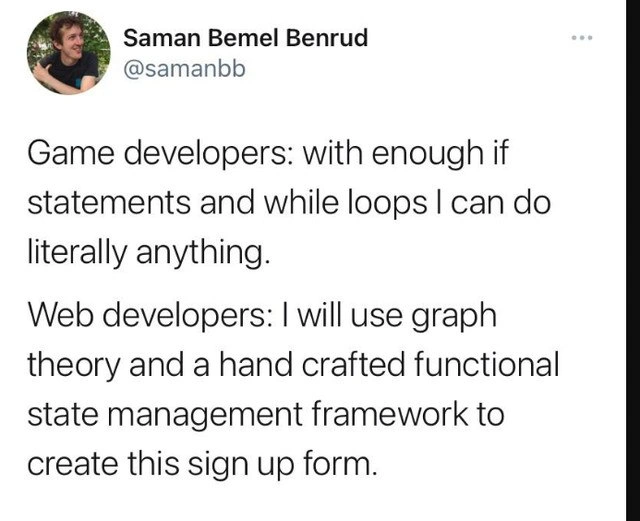
This image is a screenshot of a tweet from user Saman Bemel Benrud (@samanbb). The tweet presents a satirical comparison between the coding philosophies of game developers and web developers. The text reads: 'Game developers: with enough if statements and while loops I can do literally anything.' followed by 'Web developers: I will use graph theory and a hand crafted functional state management framework to create this sign up form.' The humor arises from contrasting the perceived brute-force, pragmatic approach of game developers, who focus on core logic to solve complex problems, with the stereotype of web developers over-engineering simple tasks. The sign-up form, a relatively trivial component, is ironically subjected to complex academic concepts like graph theory and bespoke, high-paradigm frameworks. This resonates with experienced engineers who have seen the tendency in web development, particularly the frontend ecosystem, to embrace excessive abstraction and complexity for mundane problems, often driven by trends rather than necessity

Comments
8Comment deleted
Game devs are fighting the hardware to squeeze out another frame per second. Web devs are fighting their own abstractions to render a button
Game dev lead: “We squeezed an ECS, physics, and AI into 4 ms of frame time by deleting abstractions.” Frontend architect: “Nice - now watch me spin up a DAG-based event-sourcing layer and eight custom hooks so this ‘Agree to TOS’ checkbox persists across micro-frontends.”
Game devs ship AAA titles with 10,000 nested if statements running at 60fps while web devs are debating whether useState violates the principles of functional purity in their email validation component
Game devs ship a physics engine in a nested if; web devs need a monadic effect system before the email field can be marked 'touched'
Game devs will ship a AAA title with nested if-statements 47 levels deep and 60fps, while web devs are still debating whether their sign-up form needs Redux, MobX, Zustand, or a custom finite state machine with time-travel debugging. Both approaches work, but only one requires a PhD thesis to explain why the email validation exists in a separate microservice
Game devs: “deltaTime + if/while.” Web devs: “topologically sort the effects graph, orchestrate a saga, and use CRDTs so the Sign Up button reaches consensus.”
Game devs: loops conquer universes. Web devs: cycle detection for email fields, because trees weren't recursive enough
If your signup form doesn’t need a statechart, optimistic updates, and a saga, is it even enterprise - asks the team that added six transitive dependencies to toggle password visibility