Architect discovers revolutionary fix: just break the Python import loop
Why is this Dependencies meme funny?
Level 1: Don’t Chase Your Tail
Imagine you have a little problem in everyday life: whenever you spin around in circles really fast, you get super dizzy and fall down. Now picture someone giving you this advice: “Hey, I have a great idea – just don’t spin around in circles so you won’t get dizzy!” 🤦 It’s so obvious that you’d probably giggle or groan. I mean, they’re not wrong – if you avoid doing the thing that causes the trouble, the trouble goes away. But that advice doesn’t really help you do what you wanted to do (which was to play and spin without feeling sick).
This meme is funny for the same reason. The programmers had a problem where two parts of their code were stuck depending on each other in a loop (imagine two friends each waiting for the other to start a game – and so the game never starts). The “brilliant” solution presented is basically, “Just don’t get stuck in that loop.” It’s like telling someone who locked their keys in the car, “Next time, don’t lock your keys in the car.” Yeah... thanks, Captain Obvious!
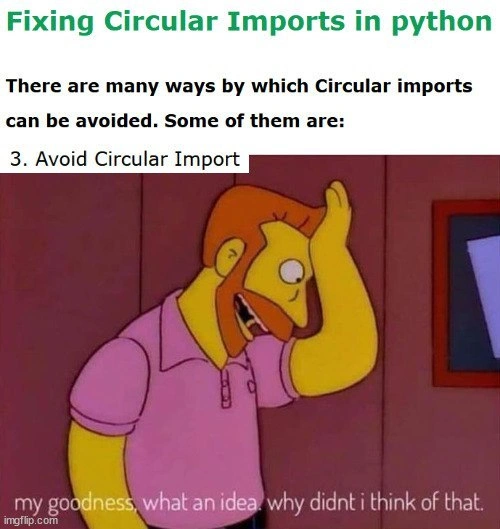
We laugh at the meme because it’s a total facepalm moment. The character in the picture is literally smacking his forehead and saying, “What an idea, why didn’t I think of that!” We’ve all been there: sometimes the “solution” to a tough problem is just not to have that problem in the first place. It’s technically true, but it’s totally unhelpful after you’re already in trouble. The humor comes from how ridiculously straightforward the advice is — it’s basically saying the best way to fix a mess is to not make the mess. That’s a pretty funny (and true) little lesson, and it’s why even non-programmers can chuckle at this joke.
Level 2: Codependent Modules
Let’s break down what circular imports are in Python and why they’re a problem. Imagine you have two Python files (modules) that need to use each other’s code:
# a.py and b.py depend on each other - this will cause a circular import error
# a.py
from b import greet # tries to use function greet from b
def welcome():
print("Welcome!")
# b.py
from a import welcome # tries to use function welcome from a
def greet():
print("Hello!")
If you try to run a.py, Python will start loading a and execute its import of b. But to load b, it then tries to import welcome from a. Uh-oh – a hasn’t finished defining welcome yet (it got interrupted mid-load to go get b). Python is basically caught in a loop: A is waiting on B, and B is waiting on A. The result is an error complaining that it can’t import something from a partially initialized module. In plain terms, each module is only half-loaded and each is waiting for the other to finish – a classic standoff.
This is what we call a circular dependency (or circular import): two (or more) modules that depend on each other to work. It’s like two friends who each refuse to start eating dinner until the other one takes a bite – neither gets to eat! In programming, Module A needs something from Module B, while Module B simultaneously needs something from Module A. Neither can be fully set up because they’re each waiting on the other’s stuff. Python’s import mechanism isn’t designed to resolve that kind of back-and-forth requirement.
For a junior developer, encountering this the first time can be perplexing. You might see an ImportError or notice a function isn’t found and think, “But I did define that function – why can’t module B see it in module A?” The answer lies in how Python imports work: Python executes the code in a module file sequentially when you import it. So if two modules are importing each other at the top level, they effectively halt each other in their tracks. It’s a known quirk of the Python language that modules execute on import, which is why circular imports blow up at runtime rather than being caught earlier (Python doesn’t have a separate compile step like Java or C++ where such issues might be detected).
How do you avoid such headaches? The real solutions usually involve changing how your code is organized. Some common strategies:
- Merge or reorganize modules: Perhaps A and B shouldn’t be separate files if they’re so interdependent. Sometimes putting all the related code in one module, or splitting out the shared pieces into a new module C that both import, will solve the issue by removing the cycle.
- Adjust import timing: If reorganization is too drastic, a quick workaround is to import one of the modules later, not at the top. For example, you might move an import statement inside a function or under an
if __name__ == "__main__":block so that it only happens when needed. This can break the initial circularity (by the time you call that function, the other module is already loaded). It’s not the prettiest fix, but it can get you past the error in a pinch. - Refactor dependencies: Sometimes module A doesn’t truly need to import B fully – maybe it just needs one function or a small piece of data. You could redesign so that A and B don’t depend directly on each other. For instance, have A call B through an interface, or pass objects around so that B can use A’s functionality without importing A. The idea is to untangle the two so they no longer form a loop.
The key term to remember is “acyclic” – meaning “no cycle.” A healthy dependency graph of modules is like a one-way street: it flows in one direction without looping back. When you’re just starting out, it’s easy to accidentally create a cycle, especially if you split code into multiple files without a clear plan of who should import whom. If you hit a circular import error, don’t feel bad – it’s a rite of passage in learning Python. The fix is straightforward in concept: rearrange things so the loop is gone. In practice, that might mean rethinking your code structure a bit, which is not always fun, but it pays off.
That’s why the meme cheekily advises "Avoid Circular Import" as if it were just one method among many – it’s tongue-in-cheek, because all the little tips essentially boil down to that anyway. For a newcomer, hearing “just avoid it” might cause an eye-roll, like, “Great, avoid it… but how?” As you gain experience, you start to recognize designs that could cause circular imports and you structure your dependencies more carefully. But even pros get caught by them sometimes, especially in large projects with tons of modules. When it happens, you’ll often hear a teammate sigh and quip, “Well, guess we shouldn’t have made a circular import!” – which is basically what this meme is joking about.
Level 3: Circular Reasoning
At a senior developer’s vantage point, this meme elicits a knowing groan and a laugh in equal measure. The top portion mimics a technical guide’s advice with the heading "Fixing Circular Imports in Python" and lists supposed solutions. After some buildup, it delivers a hilariously tautological punchline: "3. Avoid Circular Import." It’s basically telling us the way to fix circular imports is to not have circular imports. Circular reasoning at its finest. Every experienced Pythonista who’s wrestled with tangled modules can relate – it’s like those moments in code reviews or design discussions where someone airily suggests, “Well, just don't create a dependency cycle,” as if it were a profound insight.
The bottom image (a scene from The Simpsons) seals the joke. We see a red-headed character face-palming in a moment of mock epiphany, captioned with “my goodness, what an idea, why didn’t I think of that.” The sarcasm is palpable. This is exactly how it feels when an architect or a well-meaning blog post triumphantly proclaims the "solution" to your DependencyHell: just don’t do the thing that causes the problem. It’s not wrong – avoiding the problem entirely does prevent it – but it’s hilariously unhelpful when you’re already in the thick of it.
The humor works on multiple levels for seasoned devs. First, there’s the self-referential absurdity: of course the ultimate fix for circular imports is to remove the circular imports. We knew that! It’s akin to a medical joke: “Doctor, it hurts when I poke my eye.” – “Then don’t poke your eye.” Technically sound advice that offers zero new information. In software terms, it’s like being stuck with a production bug and someone saying, “Well, don’t write buggy code.” Gee, thanks!
Secondly, it hints at a real-world dynamic in engineering teams. Often the people writing the code (who are firefighting a nasty bug caused by circular imports) are well aware that the design is flawed. But untangling a tightly-coupled mess isn’t trivial – it might require significant refactoring, new abstractions, or changes across many modules. Then along comes a higher-up who blithely states the obvious: “Many ways to avoid circular imports… number 3: Avoid them.” It triggers that collective facepalm. We’ve all sat through a meeting where a tech lead says something like, “We should ensure modules don’t reference each other; that will solve these issues,” and we’re thinking, “No kidding! If only it were that easy, now that the code’s already written.”
This meme also pokes fun at how Python specifically can make a big deal of circular imports. In some languages, you might get a compile-time error or have formal ways to forward-declare or invert dependencies to break cycles. But in Python, because imports execute code immediately, a circular import often bombs out at runtime in a confusing way. Every Python dev eventually learns the hard way to structure modules carefully to avoid these headaches. So when a piece of advice just says "Avoid Circular Import" as if it’s an item on a to-do list, it resonates as dark humor. It reminds us of those overly simplistic CodeQuality mantras – easy to agree with in principle, eye-roll inducing when stated without any acknowledgement of the real effort involved.
In essence, the meme is riffing on obvious solution gags and tautological advice within programming. The punchline is that the long-sought remedy was trivial all along: just don’t make that mistake. It’s funny because it’s a truth we can’t disagree with, served with a heavy dose of irony. Every developer who has untangled a gnarly import cycle wishes they could “just avoid it” from the start – but hearing it phrased that way (especially as the third item in a list of tips) is just too on-the-nose. It’s the perfect blend of DeveloperHumor and reality: we laugh because we’ve felt that mix of “gee, thanks” frustration and “I guess they have a point” hindsight before.
Level 4: Dependency Graph Dilemma
In Python (and really, any language with module dependencies), the problem of circular imports boils down to graph theory. Each module can be seen as a node in a directed graph, and an import is an edge pointing from the importer to the imported module. For an application to load correctly, this graph of module dependencies must remain a directed acyclic graph (DAG). Why a DAG? Because loading modules is essentially performing a topological sort of the dependency graph: the runtime needs to find some order to initialize modules such that each module’s requirements are satisfied before it runs. If your modules form a cycle (A → B → ... → A), you’ve introduced a circular dependency. In theoretical terms, a cycle means there is no valid linear ordering of those modules – there’s no "foundation stone" to start with, because every piece depends on another. The result? The interpreter gets stuck trying to satisfy dependencies that can never be fully resolved in isolation.
Python’s import system is dynamic, which accentuates the issue. When Python executes an import statement, it loads and runs the target module’s code immediately (initializing functions, classes, etc. at import time). Consider what happens in a circular import: Module A begins importing module B, but B’s top-level code in turn tries to import A. Python will detect this loop – it won’t infinitely recurse, but it will hand over a partially initialized version of A to module B. Now B might try to access something from A that hasn’t finished initializing yet. This typically leads to a runtime exception like an ImportError or an AttributeError complaining that some attribute is missing. (In modern Python, the error message might even explicitly hint at a circular import.) Under the hood, you’ve created a situation akin to two people stuck holding doors open for each other: neither side can fully proceed because each is waiting for the other to finish opening.
From a computer science standpoint, this is a classic dependency-graph dilemma. A cycle in the module graph precludes a well-defined start point or hierarchy. It’s impossible to satisfy “A needs B and B needs A” without breaking the loop somehow. In compiler terms, you can’t complete a topological sort on a graph that isn’t a DAG. This is why build systems and linkers historically forbid true cyclic dependencies – you might recall errors in C/C++ linking or package managers complaining about dependency cycles. They’re telling you the same thing: there is no ordering that makes everyone happy. You either have to merge things or add a new piece that cuts the cycle.
In large-scale software architecture, avoiding cyclic dependencies is more than just an OCD tendency – it’s often formalized as an acyclic dependency principle. Systems are designed in layers or components such that lower-level modules never depend back on higher-level ones. If a design inadvertently introduces a cycle, architects will refactor by, say, extracting the shared functionality into a separate module that both can use (thus linearizing the graph), or by defining clear interfaces so one module doesn’t need to import the other directly. Essentially, some form of cycle breaking must occur.
So at this deepest level, the meme’s “revolutionary fix” – just break the Python import loop – is poking fun at a fundamental truth: the only surefire cure for a circular dependency is to eliminate the cycle. No fancy runtime trick exists that can magically untangle that logical knot; one of the links in the loop has to be severed. That might mean redesigning part of your code (painful but effective) or employing a workaround like delaying an import (less ideal but sometimes pragmatic). It’s a bit like a mathematical axiom in software design: a cycle in dependencies is unsolvable without intervention, so the grand solution is, indeed, “don’t have a cycle.” The humor, of course, comes from how obvious and self-evident that advice is – it’s technically correct (the best kind of correct), but it doesn’t make the actual untangling work any easier.
Description
The meme is split into a white text block on top and a screenshot from The Simpsons below. The green headline states: "Fixing Circular Imports in python"; black bold text follows: "There are many ways by which Circular imports can be avoided. Some of them are:" and a single bullet reads "3. Avoid Circular Import". In the lower pane, a red-haired, bearded character face-palms in sudden enlightenment while the subtitle says "my goodness, what an idea, why didnt i think of that." The humor lies in the self-referential, tautological advice - telling seasoned Python engineers struggling with tangled module graphs that the ultimate solution is simply to stop creating cycles, a wink at anyone who has enforced acyclic dependency rules in large codebases

Comments
15Comment deleted
Sure, you *could* introduce a lazy loader, topological sort, and importlib hacks… or, hear me out, remove the arrow that points back to itself and call it ‘design-driven debugging.’
After 15 years of architecting Python systems, I've discovered the secret to avoiding circular imports: just rewrite everything in one 50,000-line file. No modules, no imports, no problems - just pure, unadulterated technical debt that future-you can refactor 'when there's time.'
Ah yes, the classic Python circular import problem - where your module structure becomes a dependency graph that would make a graph theorist weep. The solution? Just don't have circular imports! It's like telling someone with a memory leak to 'just free your memory' or advising against race conditions by saying 'don't access shared state concurrently.' Technically correct, architecturally useless, and about as helpful as that Stack Overflow answer with 2 upvotes that just links to the documentation you've already read three times while your import chain looks like a Möbius strip
Our architect’s remediation plan for the Tarjan-identified SCC in the Python module graph was a new guideline - ‘avoid cycles’ - while the rest of us hide imports under TYPE_CHECKING and invert dependencies
Turning a circular import into a local import merely replaces a strongly connected component with a runtime grenade - the DAG is the fix, not the delay
'Avoid circular imports' - profound counsel akin to fixing monolith coupling by suggesting smaller modules, right before the 3AM pager fires
Circular imports are really some of the frustrating errors in python. Getting a linter that automatically wraps imports in if TYPE_CHECKING: is a tedious must Comment deleted
Sounds like something I would do in C/C++ Comment deleted
Can't wait for python to add pointers Comment deleted
And then you can go back to real programming languages Comment deleted
I found a good resource on how to avoid circular imports here (look inside the group if it says "message not found" - it is there, I promise) Comment deleted
I like this guy Comment deleted
Me too Comment deleted
And I like his hatred for python even more Comment deleted
Pre-commit linter hook? Comment deleted