The Time-Warping Nature of a Really Good Bug
Why is this Debugging Troubleshooting meme funny?
Level 1: Losing Track of Time
Have you ever been doing something so intensely that you completely forget what time it is? This meme is making a joke about exactly that. Imagine you start working on a tricky puzzle after school. You feel like you’ve been at it forever, and you tell your friend, “I’ve been doing this since 5 o’clock!” But then your friend looks at their watch and says, “Uh… it’s only 4 o’clock right now.” Oops! That means you were so wrapped up in the puzzle that you even got the time wrong – you thought it was an hour later than it really was. The picture of D.W. (from the Arthur cartoon) with big tired eyes and a shocked face is like how you’d feel in that moment: a bit dazed, mind blown, maybe a little embarrassed or just out of it.
In simple terms, the meme is funny because it exaggerates the feeling of losing track of time. Anyone can relate to that: for example, you start playing a video game, get super involved, and when you stop you’re surprised to find out hardly any time passed (or sometimes a lot of time passed and you had no idea!). Here, a programmer was so focused on fixing a bug (a mistake in a computer program) that time got all mixed up in their head. They jokingly say they started at 5pm even though it isn’t 5pm yet. Of course, they didn’t really defy time – it’s just a playful way to show how completely absorbed or frustrated they were. The heart of the joke is a feeling: “I’ve been stuck on this problem so long, I can’t even tell what time it is anymore!” Even if you’re not a coder, you know that feeling when you’re super focused or struggling with something tough. This meme takes that feeling to a silly extreme, and that’s why it makes people chuckle.
Level 2: Bug Fix Marathon
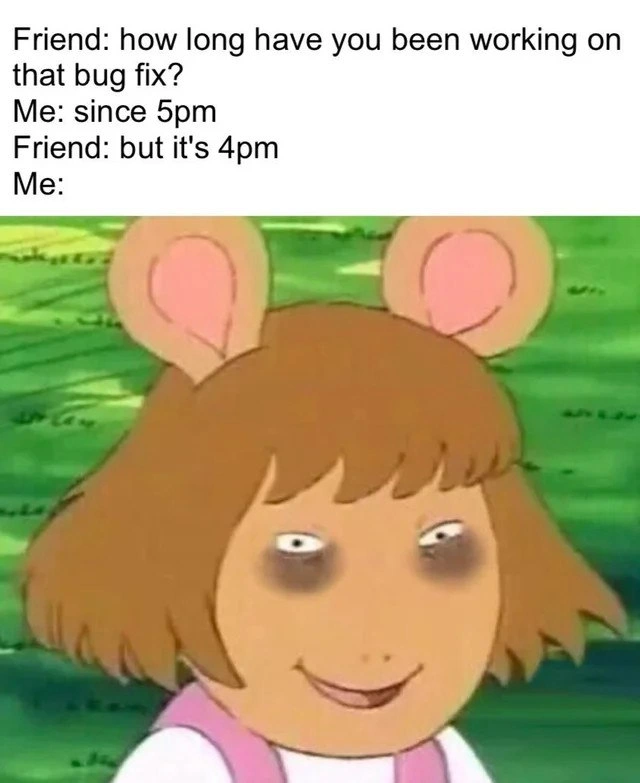
So, what’s going on here? This meme shows a conversation between two friends (or coworkers) about a programmer’s bug fix marathon. The friend asks how long the coder has been working on that bug. The coder says, “since 5pm.” But the twist is: the friend replies, “but it’s 4pm.” In other words, the poor developer is so mixed up that they claim to have started debugging at a time that hasn’t happened yet! The image below the text is from the children’s cartoon Arthur, showing the character D.W. with a spaced-out, stunned face. She has big mouse-like ears and a blank, tired expression (imagine someone who hasn’t slept, eyes all glazed over). That face is basically the developer’s reaction – kind of speechless and mind-blown – when they realize how badly they’ve lost track of time while debugging.
Let’s break down the key terms and why this is funny for developers:
- Bug: In software, a “bug” is a mistake or problem in the code that makes the program act wrong. It could be a typo in the code, a logical error, or something not handled (like what happens if a user enters a negative number where only positives make sense). Bugs cause software to behave unexpectedly or even crash.
- Debugging: Debugging means finding and fixing these bugs. It’s like detective work: you notice something is wrong, then you investigate the code to figure out why. This can involve running the program with test data, printing out values (
print("value:", x)is a very common newbie approach!), or using special tools called debuggers that let you pause and inspect the program state (like setting breakpoints – markers where the program will halt so you can peek at variables). Debugging is a core part of troubleshooting in development. - Debugging Frustration & Fatigue: These terms from the tags are all about how tiring and frustrating long debugging sessions can become. If you’ve ever tried to solve a tough puzzle for hours, you know it can make your brain feel like mush. Developers experience this a lot: chasing one bug for a long time can be really draining. You might get fatigued (tired) and frustrated (irritated or annoyed) especially when the solution is elusive. This meme exaggerates that feeling – the developer looks so done with everything that they don’t even know what hour it is.
- Lost Track of Time: This is a common phrase meaning you stopped noticing time passing. A developer “in the zone” (super focused on coding) or spiraling in debugging can easily lose track. Maybe you start in the afternoon, and next thing you know, the cleaning crew is turning off the office lights because it’s night! Or conversely, you feel like you spent ages on it but only an hour passed because it was so tedious it felt longer. In the meme, the coder lost track so completely they’re essentially one hour out of sync with reality. It’s a goofy way to say their brain’s clock is broken.
The conversation in the meme is a playful jab at how time estimation in programming can be notoriously unreliable. Pretty much every junior developer (and senior ones too!) learns that saying “I’ll fix this bug in 5 minutes” is dangerous – it often turns into an hour or more. In fact, there’s a joke rule among programmers: the two hardest things in development are naming things, cache invalidation, and off-by-one errors (yes, there are three items – that’s the joke!). Here the “off-by-one” error is applied to time itself: the developer’s estimate of how long they’ve worked is off by one hour 😅. It’s humor, but it also teaches a little lesson: DeveloperProductivity can suffer when we don’t keep an eye on the clock or take breaks. We sometimes grind away at a bug far longer than we realize.
The Arthur cartoon image of D.W. adds to the humor because it’s an ironic contrast: Arthur is a kids’ show, a happy and simple world, but D.W.’s face looks disturbingly relatable to any programmer who has pulled a late-night debugging session. The background shows a bright green lawn and a sunny vibe, but D.W. (the developer stand-in) looks like a zombie with shock and exhaustion. It’s as if the world is fine, time is normal (it’s only 4pm in the outside world), but in the programmer’s mind, it’s later than late. That blank stare is the “Me:” in the conversation – the coder has no good comeback, just a shell-shocked look, because the friend is right: they’ve been at the bug so long they got totally confused.
For a new developer or someone just learning to code, this meme is a funny cautionary tale. Why is it so common to lose track of time when coding? A few reasons:
- Immersion: Writing code or fixing bugs often requires intense concentration. You can get so absorbed in reading the code, trying different fixes, and testing, that you stop looking at the clock. It’s like getting sucked into a video game or a book – you might start in daylight and be surprised when it’s dark out.
- Unpredictable Problems: Some bugs are tricky. What seems like a simple error can lead you on a wild goose chase through many files or functions. New developers often underestimate this. You think, “I just need to adjust this one thing,” but that one thing is connected to something else, and then another, and so on. An hour later, you’re deep in layers of code trying to pinpoint the root cause. Time flies (or crawls) without you noticing.
- Lack of Breaks: Beginners (and honestly, everyone) sometimes forget to take breaks when debugging. You keep telling yourself “I’m almost there, just another test, just another tweak.” Without stepping away for a moment, you lose perspective on how long you’ve been grinding. It’s a good habit to occasionally stand up, stretch, check the time, maybe drink water – this can actually help you solve the bug faster and avoid feeling like D.W. in the meme!
In short, the meme is DeveloperHumor that says: “Been debugging so long, I think I’ve transcended time.” It’s an exaggeration, of course. The coder didn’t literally time-travel, but it feels like it. It’s a super relatable joke in the tech community because almost everyone who writes software has had a day where a single stubborn bug just annihilated their schedule. You start in the morning aiming to finish by lunch, and suddenly it’s evening and you’re not done. Or as shown here, you think an hour’s gone by and your friend has to gently point out that it’s barely been 15 minutes beyond when you started. The humor has a bit of “ugh, I’ve been there” pain to it, but we laugh because it’s true. Debugging can mess with your mind — even your sense of time!
Level 3: Breakpoints in Time
When a developer enters a deep debugging session, it's almost like stepping into a private time warp. The meme’s joke is that the programmer has been wrestling a bug for so long that they’ve apparently bent reality – claiming to have started at 5pm when the clock says it’s only 4pm. This absurd little exchange (Friend: “how long…?” Me: “since 5pm”; Friend: “but it's 4pm”) exaggerates a time dilation effect many coders know too well. It’s a comical way to say “I’ve been at this forever” – so long that my sense of time is completely shot. The developer’s blank stare (courtesy of Arthur’s D.W. with those glazed, exhausted eyes) is basically the 1000-yard stare of a programmer who’s been debugging so intensely that they’ve lost touch with the outside world. DebuggingFrustration can do that: minutes feel like hours, and you emerge from code at 4pm feeling like it should be 8pm already. In other words, this meme captures the “lost track of time” vibe of a bug_fix_marathon.
From a seasoned developer’s perspective, it's painfully relatable humor. We joke about “debugging bending the space-time continuum” because long bug hunts truly distort perception. If you’ve ever said “I’ll be done in 5 minutes” and then debugged for 5 hours, you know the RelatablePain behind the laugh. There’s even a classic industry tongue-in-cheek rule about this: Hofstadter’s Law, which states that everything takes longer than you expect, even when you take into account Hofstadter’s Law. Debugging is the poster child for that law. You start at what you think is 5pm, then suddenly find out reality disagrees. The code’s logic might as well be warping time. In fact, the meme’s scenario is like an off-by-one error in real life: the developer’s internal clock is off by one hour. (Off-by-one errors are a classic bug where you accidentally iterate one time too many or too few – here our poor dev iterated one hour too far into the future 😆.) It’s a clever way to illustrate how a stubborn bug can scramble your brain.
Let’s break down why this happens in real developer life:
- Hyperfocus and Flow: When you zero in on a tricky bug, you can enter a mental zone where the outside world fades away. Psychologists call it flow state. It's great for productivity, but it means you stop noticing the passing of time. You might look up thinking “surely it's late evening” and find it's not even dinnertime. The meme cranks this up to 11 by having the dev overshoot so much they think they started an hour in the future.
- Frustration and Time Drag: Conversely, when you’re troubleshooting something infuriating (like a
NullPointerExceptionthat won’t log any useful info), each minute can feel interminable. Ever watch a pot that won’t boil? Debugging a vexing problem is similar – you swear you’ve been at it half the day, but nope, it’s only been 30 minutes. The meme captures that dissonance perfectly. - No Clear End in Sight: Unlike adding a known feature (where you can gauge progress), bug fixing is open-ended. You don’t know if resolution is 5 minutes away or 5 days away. That uncertainty messes with your time perception. One moment you’re confident the fix is just around the corner, next thing you know you’re deep in a rabbit hole of stack traces and you’ve forgotten to eat lunch. Time? What is time?
The Arthur D.W. image is a popular meme template (the arthur_dw_meme_template tag clues us in). Here, D.W.’s dazed expression – eyes dark with fatigue – says “I have seen things… and I’m not okay.” It’s exactly how a developer feels after staring at the screen, combing through the same 200 lines of code for hours. Those big cartoon ears might even represent how, during intense debugging, you become hyper-sensitive to any hint of a clue, much like D.W. perking up for any sound. The bright green background of the scene ironically contrasts with the dev’s mental state: the world outside is sunny and normal, but the coder’s brain is in a dark tunnel hunting a bug. RelatableHumor indeed – many of us have emerged from the cave of a bug fix only to blink at the late-afternoon sun, surprised that the world is still turning out there.
There’s also an inside joke about “fixing bugs before they occur.” Of course you can’t literally do that (unless you have a time machine or you’re implementing some predictive QA magic), but when you’re so deep into debugging that time goes loopy, it feels like you’re altering causality. The meme’s dialogue plays with a paradox: starting a fix in the future implies this coder might have looped back in time. It's a humorous nod to how disoriented you can get. In reality, developers sometimes do preempt bugs (writing tests, doing code reviews, or refactoring code before it breaks), but here it’s just a playful exaggeration of being so tired, your timeline of events is glitching. We might chuckle that the DeveloperProductivity is so low at this point that even time travel seems plausible if it would help squash that bug.
To top it off, let's imagine how the code might flag this temporal anomaly. If we treated the debugging start and end times like variables, we'd get a scenario that logically should never happen – unless debugging truly warped time:
start_time = 17 # 5 PM in 24-hour format (the time I *thought* I started)
current_time = 16 # 4 PM, the actual current time
if current_time < start_time:
print("↯ Time warp detected: debugging bent the clock! ↯")
In a normal universe, current_time is never less than start_time unless clocks moved backwards (hello, daylight savings) or our dev’s brain is totally fried. The printed message here – “debugging bent the clock” – is exactly the meme’s punchline. Every senior dev reading this meme has likely felt this surreal moment at least once. It’s a lighthearted reminder that in the realm of DebuggingTroubleshooting, our human perception of time can get seriously skewed. And when that happens, you know it’s probably a good moment to push back from the keyboard, take a breather, maybe grab a coffee – before you accidentally commit a fix from the future.
Description
A two-part meme featuring a dialogue at the top and an image of the character D.W. from the children's show 'Arthur' below. The text reads: 'Friend: how long have you been working on that bug fix? Me: since 5pm Friend: but it’s 4pm Me:'. Below the text is a close-up of D.W. looking utterly exhausted, with large, dark circles under her eyes and a slightly unsettling, weary smile. The background is a blurry green, suggesting an outdoor setting. The humor comes from the developer's nonsensical response, implying they are so sleep-deprived from a marathon debugging session that they have lost all track of time, suggesting they've worked through the night and into the next day. It's a relatable depiction of the burnout and temporal distortion that can occur when tackling a particularly difficult technical problem
Comments
7Comment deleted
That's not a bug, it's a feature that introduces temporal paradoxes. The fix is due yesterday, which, according to my git log, is in about three hours
I’ve been chasing a timestamp drift in our Kafka pipeline so long that the wall clock swears it’s 4 PM, Git blame insists it’s 5 PM, and I now trust Lamport clocks more than my own circadian rhythm
The only thing more broken than the code is the developer's perception of linear time - a phenomenon well-documented in production incident post-mortems where '5 minutes' mysteriously becomes '3 hours' and yesterday's hotfix somehow predates the bug it was meant to fix
When you've been chasing a race condition so long that you've created one in your own timeline - turns out the real concurrency bug was the friends we confused along the way. At this point, you're not just debugging code; you're debugging causality itself, and the stack trace leads straight through the space-time continuum
Fixing a timezone bug “since 5pm” at 4pm - wall clocks are eventual consistency; use a monotonic clock before your SLA starts traveling backwards
Classic distributed-time: NTP says it’s 4pm, Lamport says I started after I finished, and git blame pins it on tomorrow‑me
Senior debugging: where one Heisenbug warps spacetime, collapsing 11 hours into -1 via infinite log-scroll relativity