Deterministic Randomness Exposed
Why is this CS Fundamentals meme funny?
Level 1: The Magic Hat Has A List
This is like thinking someone is pulling surprise numbers out of a magic hat, then looking inside and finding a very long list they are following in order. It still feels surprising if you have not seen the list, but it is not magic anymore.
Level 2: Fake Random, Useful Random
A random number generator in software often produces pseudorandom numbers. That means the numbers appear random, but they come from an algorithm. If you start the algorithm with the same seed, it will produce the same sequence again.
That repeatability is helpful. Developers use seeded randomness for tests, games, simulations, and debugging because they can replay the same behavior. If a random test fails, the seed can help reproduce the failure.
For security, the rules are stricter. If you are generating passwords, tokens, encryption keys, or anything an attacker might guess, you need randomness from a secure source. The difference is simple: normal pseudorandomness is good for variety; secure randomness is needed for secrecy.
Level 3: Seeded And Exposed
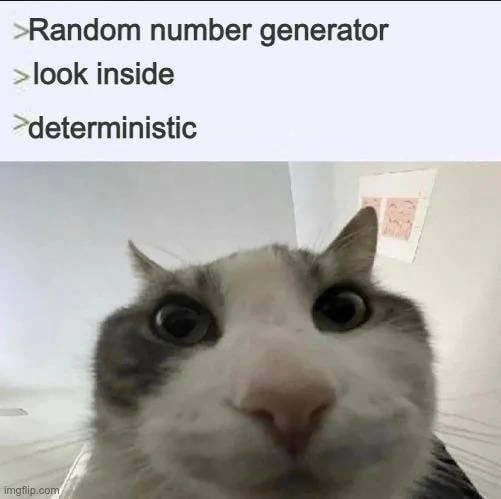
For experienced developers, the joke is not that deterministic PRNGs exist. The joke is that the abstraction leaks at exactly the moment someone asks too much of it. The top line says ">Random number generator", which sounds like a box that produces uncertainty. Then ">look inside" reveals ">deterministic", and the image supplies the wide-eyed reaction.
In testing, determinism is a feature. A seeded generator lets a failing randomized test be replayed. In simulations, reproducibility matters because you need to compare runs without wondering whether the universe shuffled the deck differently. In fuzzing, recording the seed can turn "it crashed once" into "here is the exact path back to the crash." Deterministic randomness is one of those contradictions that makes software engineering possible.
The problem starts when the same mental model wanders into security-sensitive code. A predictable password reset token, session ID, API key, or cryptographic nonce is not "random enough" just because the values look noisy in a log. Attackers do not care whether the sequence feels irregular; they care whether they can narrow the state space and guess the next value before your system does. This is where Math.random() energy in production code ages poorly.
The meme also pokes at CSFundamentals education. Students are often introduced to randomness through library calls, then later discover seeds, periods, distributions, and entropy. The cat reaction is the moment the magic trick becomes a finite automaton in a trench coat. Useful, fast, and deterministic. Truly random? Only if you were careful about where the seed came from.
Level 4: Entropy Is Expensive
The visible terminal-style exchange is short and merciless:
Random number generator look inside deterministic
The close-up startled face underneath is the correct reaction the first time someone learns that most everyday random number generators are deterministic state machines. A typical pseudorandom number generator has internal state, a transition function, and an output function:
state_next = F(state_current)
output = G(state_next)
If the initial seed is known, the entire future sequence is knowable. That is not a bug; it is the design. A PRNG is built to produce values that look random enough for simulation, testing, games, randomized algorithms, and sampling, while remaining fast and reproducible. The apparent chaos is an API boundary. Inside, it is math with a memory.
The cryptographic wrinkle is that "statistically random-looking" and "unpredictable to an attacker" are different requirements. A generator can pass many surface-level distribution checks and still be a disaster for Security if an attacker can infer its state, predict the next output, or recover past outputs. A cryptographically secure PRNG still becomes deterministic after seeding, but it is designed so that without the secret state, predicting outputs is computationally infeasible. It also needs careful seeding from real entropy sources, state protection, and resistance to backtracking or state compromise. There is the boring engineering sentence that prevents the incident report.
This is why the meme deserves its little horror reveal. In CryptographyAlgorithms, randomness is not decorative. It underpins keys, nonces, salts, session tokens, IVs, challenges, and protocol safety. Reusing or predicting supposedly random values can collapse an otherwise sound system. The punchline is that the word "random" on an API can hide a deterministic machine, and whether that is brilliant or catastrophic depends entirely on the use case.
Description
A simple meme shows terminal-style prompt text at the top: ">Random number generator", ">look inside", and ">deterministic". Below the text is a close-up wide-angle photo of a startled-looking cat staring into the camera, with a small "imgflip.com" watermark in the lower-left corner. The joke is that most everyday random number generators are deterministic pseudorandom algorithms once you inspect the implementation, even though their output appears random at the API boundary. For experienced developers, it points at the important distinction between reproducible PRNGs used for simulations or tests and entropy-backed randomness needed for security-sensitive code.
Comments
8Comment deleted
The randomness was deterministic all along; only the bug reports were truly nondeterministic.
because you forgot the word pseudo- Comment deleted
Last case for me was Dice100 in DaggerfallUnity (but one could say it was deliberately done to prevent excessive savescumming) Comment deleted
Deterministic rngs are the best. If the game is too random TAS won't be possible. Comment deleted
Just like human brain is. 🙈 Comment deleted
ok Comment deleted
No such thing as random even IRL. Randomness is entirely a thing of perspective. The less predictable something is the more "random" it appears. Comment deleted
Quantum collapse is fully unpredictable. Otherwise I agree, but still call things random when they're unpredicatble enough Comment deleted