A Fair Negotiation on Pre-Release Quality
Why is this Deadlines meme funny?
Level 1: Haste Makes Waste
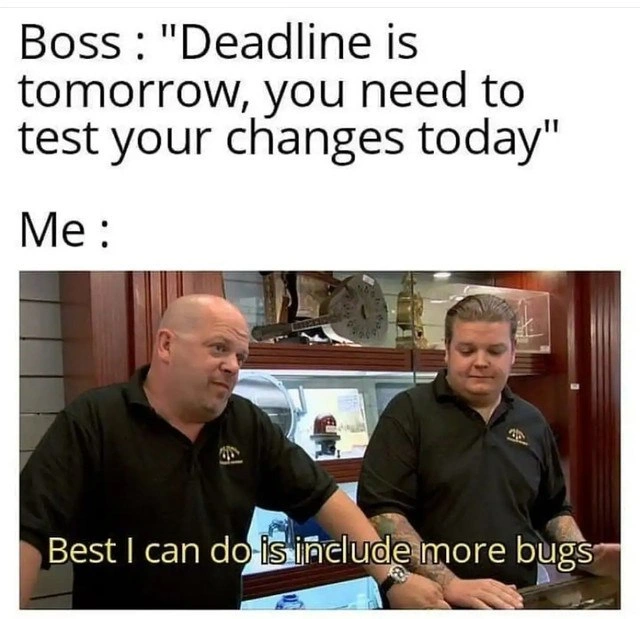
Imagine your teacher says, “Tomorrow is the big school play, and you need to sew a whole fancy costume tonight.” That’s a pretty scary last-minute request! You’d probably laugh nervously and say, “The best I can do is cut some holes in a bedsheet.” In other words, if you rush something that should take a lot longer, you’ll end up doing a sloppy job or even making things worse. That’s exactly what this meme is joking about. The boss wants the programmer to check all their work in just one day (so that the program has no mistakes by tomorrow). The programmer knows this is way too little time and jokes, “Sure, I’ll check it… I’ll just end up adding more mistakes!” It’s funny in the same way it’s funny when someone tries to hurry and clean their room in five minutes – they usually just shove things in the closet and accidentally break stuff. In plain terms: when you rush, you mess up. The picture with the men behind the counter is from a TV show where people bargain. The programmer is bargaining back, saying the only thing he can deliver on such short notice is a messy result. We laugh because we know he’s right: if you ask for something impossible, you’re going to get a goofy outcome. It’s a silly way to tell the boss, “slow down, or we’re going to have a big mess on our hands!”
Level 2: Testing Crunch Explained
Let’s break down why developers find this meme funny. The boss in the text says the deadline is tomorrow and insists you test all your changes today. In software, “testing your changes” means checking that new code works correctly and doesn’t break anything. Testing can involve running the program to see if it behaves as expected, writing unit tests (small programs to automatically verify each part of the code), doing integration tests (making sure different pieces work together), or having a QA (Quality Assurance) person manually use the app to find issues. Full testing usually takes a significant amount of time — sometimes days or weeks for a big project — because you want to catch as many bugs (software errors or flaws) as possible. A bug in software is like a mistake that makes the program act in strange or wrong ways. Bug fixing means identifying what’s causing the error and correcting it in the code. It’s a normal part of coding, but it takes time and careful work.
Now, think about the boss’s demand: finish all that testing in one day. That’s a ton of work in a very short period – an unrealistic deadline in any serious project. If a developer hasn’t already been testing along the way (which is the ideal scenario), trying to cram it in at the last minute is risky. It’s like studying an entire textbook the night before an exam – you’re likely to miss details. Here the developer responds with a well-known meme line: “Best I can do is include more bugs.” This line is a direct reference to the Pawn Stars TV show (the scene in the image is from that show). On Pawn Stars, people bring in items to sell, and the shop owner often haggles by saying “Best I can do is $X,” often much lower than what the seller asked. Internet memes took that format and now people use “Best I can do is X” as a joke when someone asks for something unreasonable. It’s a way to say “I can’t give you what you want, but here’s a much worse alternative.”
So in the meme, the pawn_stars_reference is the boss as the customer asking for high quality (full testing = fewer bugs) and the developer as the pawn shop guy offering a lowball outcome (“more bugs”). The phrase “include more bugs” is the punchline. The dev is basically saying, if you force me to rush through testing, I’m not going to find and fix bugs – I’ll probably introduce new bugs instead. This is common CodingReality humor: rushing often backfires. When developers are under intense boss_pressure and have to do last_minute_testing, they might only have time for a quick glance over the code or very cursory tests. In doing so, they could overlook major problems or even accidentally break something while trying to fix another issue. The end result? The software delivered tomorrow will have even more bugs than before testing. That’s obviously the opposite of what the boss wants!
This meme falls under DeveloperHumor and specifically TestingHumor. It pokes fun at the situation many programmers have experienced: a manager or client demands an unrealistic turnaround (“sure, just fully test it in one day!”) and the programmer knows this request is almost impossible to fulfill properly. The humor comes from shared frustration. Newer developers (and even computer science students) quickly learn that thorough testing is essential but also time-consuming. You can’t rush it without consequences. The meme exaggerates those consequences in a witty one-liner. It also highlights the absurdity: no one actually wants to add bugs, but that’s effectively what happens when you force a rushed job. Even if you’re not familiar with the Pawn Stars show, the meaning is clear from context: the developer can’t meet the demand and is responding with sarcasm. In sum, it’s explaining a common coding reality: rush your work, and you’ll do a poor job. Or as another saying in software goes, “Works on my machine, but who knows what happens in production when we skip proper QA!”
Level 3: The Bug Bargain
In this scenario, unrealistic deadline pressure meets the cold reality of software development. The boss expects full testing in a single day before a big release tomorrow – an almost comically unrealistic deadline. Any senior engineer knows that attempting "complete" testing in such a short window is a recipe for chaos. The meme cleverly uses the format of the TV show Pawn Stars to lampoon this. On the show, a seller might demand a high price for an item, and the pawn shop owner, Rick, famously replies "Best I can do is..." with a much lower offer. Here, the developer responds to the boss’s grand ask with “Best I can do is include more bugs.” It’s a darkly humorous negotiation: instead of delivering quality, the dev lowballs the outcome to more bugs – exactly what everyone was trying to avoid!
This punchline hits home because experienced devs have lived this. When cornered by a last-minute testing under pressure scenario, rushing often creates new defects instead of uncovering them. If a codebase hasn’t been thoroughly tested incrementally, you can’t just sprinkle magic QA dust in one afternoon and call it good. More likely, any hasty fixes or "quick tests" will miss edge cases or introduce fresh issues. Coding reality is cruel: every rushed bug-fix runs the risk of breaking something else. We’ve all seen a bug fix at 5 PM that spawns two new bugs by 5:30. This is how you end up debugging a production failure at 3 AM, muttering “we should’ve tested more” while remembering the boss’s demand. The meme’s TestingHumor rings true – it’s essentially saying, “Sure, I’ll test it… and in the process I’ll probably ship even more bugs for you. Happy now?”
To engineers, this scenario also screams technical debt being ignored. Proper testing isn’t just a checkbox – it requires time for unit tests, integration tests, maybe a round of QA. Squeezing that into a single day at the end of a timeline is like asking a construction crew to inspect every inch of a skyscraper in an afternoon. Corners get cut. Important bugs in software hide in the parts you didn’t have time to check. The result? The deadline might be met on paper, but the software delivered is a ticking time bomb of defects. This short-sighted trade-off is painfully common in troubled projects: features get prioritized over quality, and everyone crosses their fingers that nothing critical breaks. The veteran chuckle comes from hard experience – we know that when a manager prioritizes speed over quality, inevitably coding reality bites back with a production bug frenzy.
Even the imagery of the meme – those two Pawn Star guys behind the shop counter – reinforces the negotiation vibe. The developer (like Rick in the show) is effectively saying, “You want thorough testing and zero bugs? Given these conditions, the best I can offer is a bug-riddled release.” It’s sardonic. It’s also a bit of a protest: the dev can’t openly tell the boss “this schedule is insane,” so instead they joke that fulfilling the request will achieve the opposite of its intent. It’s a coping mechanism many of us use when facing boss pressure for a last-minute miracle. The humor dilutes the frustration. Internally, every seasoned dev knows the translation: If you force me to rush, we’re just going to ship trash. Reality isn’t an 8-hour TV edit where everything magically gets done; reality is more like:
if deadline.is_tomorrow():
try:
run_full_test_suite()
except TimeAllocationError:
# Not enough time to test properly
include_more_bugs() # the inevitable outcome of rushing
deploy_to_production() # fingers crossed
In short, the meme captures a coding reality and an age-old industry joke: “You want it fast and perfect? Choose one. Actually, in this case, you get neither – just a bug-fest delivered on time.” The bitter laugh it elicits from developers is one of recognition. We laugh so we don’t cry, knowing that testing under pressure like this means playing Quality Assurance roulette – and the house (or in this case, the bug) usually wins.
Description
A two-part meme that captures the conflict between deadlines and code quality. The top text sets the scene with a manager's request: 'Boss: "Deadline is tomorrow, you need to test your changes today"'. Below this, under the label 'Me:', is a screenshot from the reality TV show 'Pawn Stars'. Rick Harrison, the shop owner, is shown with a negotiating posture and a slight smirk. The superimposed caption, in the show's signature style, reads, 'Best I can do is include more bugs'. This meme uses the popular 'Pawn Stars' format to humorously depict a developer's cynical response to unrealistic expectations. For senior developers, it's a deeply relatable scenario. The joke isn't just about being lazy; it reflects the reality that rushing code and skimping on testing under pressure doesn't just fail to fix existing issues - it actively makes the software worse by introducing new, unforeseen bugs
Comments
7Comment deleted
I'll have you know my code passed the most critical test: it compiled. Once. On my machine. That's my final offer
Sure, ship it - prod can be the canary, crash metrics become “customer-driven test cases,” and we’ll claim the blown error budget was a business requirement
The real negotiation isn't about bugs versus features - it's about which regression we're willing to call a "known issue" in tomorrow's release notes
When your boss asks for comprehensive test coverage before tomorrow's deployment, but you know the real MVP is production monitoring and a well-rehearsed rollback strategy. At least the bugs will be consistently reproducible - in prod
Deadlines turn test suites into vestigial code - prod becomes the real integration environment, complete with customer-reported edge cases
Deadline tomorrow, test today? Perfect - QA becomes a canary release and PagerDuty runs the integration tests
We'll hit the deadline by reclassifying QA as 'post-release monitoring' - MTTR is just our integration test