Skip to content
DevMeme
3467 of 7435
AI's True Calling: From Coder to Commenter
AI ML Post #3802, on Oct 11, 2021 in TG

AI's True Calling: From Coder to Commenter

Why is this AI ML meme funny?

Level 1: Robot Helper vs. Robot Chef

Imagine you love building with LEGO blocks. Writing code is like building your own awesome LEGO castle – it’s the fun part you enjoy and want to do yourself. Now, after you build, you’re supposed to write down instructions or labels for your castle so others know how you made it (that’s like writing comments or documentation for your code – a bit less fun, more like homework). The meme is saying developers would rather have a helpful robot that watches you build the LEGO castle and then writes the instruction manual for you (so you don’t have to do the boring explanation part) instead of a robot that you tell “build a castle like this” and it does all the building. We don’t really trust the robot to build the castle exactly how we imagine it – that’s the fun creative job we want to control. But we’d love the robot to handle the dull stuff, like writing down what the castle is and how it was built after we’re done. In simple terms, it’s funny because it shows that programmers want help with the chores (writing comments) more than the actual playing/building (writing code), just like you might want a robot to clean your room but not to play with your toys for you!

Level 2: AI Tools & Code Comments

Let’s break down the basics of what’s being contrasted in this meme. On one side, we have “AI that writes code from comments.” This means a tool (often powered by Machine Learning and specifically a Large Language Model, or LLM) where you can write a human-friendly description – for example, a comment like # sort a list of numbers – and the AI will try to generate the actual code to do that. This is a bit like telling a junior developer, “Hey, I need a function that sorts a list,” and the AI writes the Python (or Java, C#, etc.) function for you. A real-world example of such a tool is GitHub Copilot (which was new around 2021): you start typing a comment or the name of a function, and it suggests code to complete it. It uses patterns learned from millions of code examples to guess what you might want. Cool, right? But developers aren’t super excited about this in the meme, because while it can save time on simple boilerplate, it also can produce wrong or weird code that you then need to check. The phrase “writes code from comments” implies you have to first know what you want (write it in a comment) – often the hardest part – and then you still have to trust and verify the AI’s output. It might miss edge cases or use a different approach than you intended. Essentially, this kind of AI is acting like an auto-complete for code. It’s helpful, but not infallible.

On the other side, we have “AI that writes comments from code.” This is the reverse: you’ve already written some code, and now the AI looks at your code and generates helpful comments or documentation explaining it. For instance, say you wrote a function:

def find_max(numbers):
    max_val = float('-inf')
    for n in numbers:
        if n > max_val:
            max_val = n
    return max_val

This function finds the largest number in a list. An AI comment generator could look at that code and produce a comment like:

# Returns the maximum value in the list `numbers`

So instead of you, the developer, having to write that explanatory line, the AI does it for you. Developers love this idea because writing those explanations is important (it helps others understand your code, and helps future you remember what you did), but it’s sometimes tedious. If the code is complex, summarizing it accurately can take effort. And when you change the code, you’re supposed to update the comment… but under deadlines or forgetfulness, that doesn’t always happen. Tools that write comments from code use techniques like code analysis and language models to basically document the code’s behavior. This can also extend to generating larger documentation, like README content or even diagrams, from the code – all forms of Documentation automation.

Why is this about CodeQuality? Because well-documented code is easier to maintain. Clean, quality code isn’t just about how clever or efficient your algorithms are – it’s also about how understandable the code is. Comments and docs are a big part of that. In developer humor, there’s a running joke that “my code is self-documenting” (meaning the code is written so clearly you supposedly don’t need comments). In reality, even clear code benefits from some comments, especially to explain why something is done, or to give an overview of a complicated function. This meme resonates with developers who know they should write those comments but often don’t enjoy doing it. So an AI tool that can automatically add or update comments is like a dream assistant.

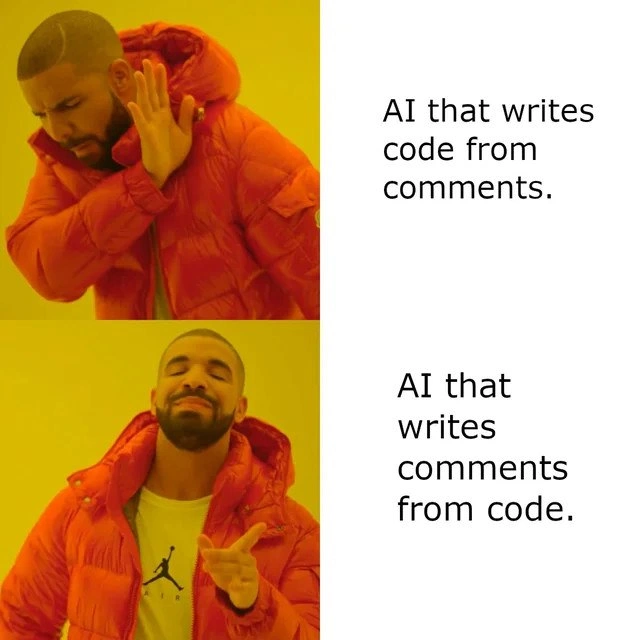
And the meme format itself – the two-panel image with the rapper Drake (from his “Hotline Bling” music video) – is a popular way to show a preference. In the top image, Drake is turning away with his hand up as if to say “no, thanks.” The caption next to that image is “AI that writes code from comments,” meaning developers are saying “nah, not so interested” to that idea. In the bottom image, Drake is pointing and smiling, clearly saying “yes, that’s the thing I like!” next to “AI that writes comments from code.” So, it’s using a very recognizable meme template to communicate: developers would rather have AI help with writing comments/documentation than have AI try to write the code for them. This ties into current AI_ML trends: we have fancy LLM-based assistants now, and devs are deciding what they actually find useful. The consensus, jokingly presented here, is that the real win is in automatically generating documentation (which addresses the hard work of keeping comments in sync), instead of generating code (which can be hit-or-miss and possibly risky if you don’t verify it). In summary, for a less-experienced developer: the meme is saying we prefer a tool that explains our code for us over a tool that writes the code for us, because we trust our own coding but wouldn’t mind offloading the explaining part!

Level 3: Inverting the Workflow

At a senior engineer level, this meme hits home because it flips our usual workflow and nails which half we actually dread. Typically, we write code first and then write comments or documentation – and let’s be honest, the latter often falls by the wayside. The top panel (Drake rejecting) says “AI that writes code from comments.” That’s calling out tools like GitHub Copilot or other AI code generators where you write a description (a comment or docstring) and the AI produces code. Experienced devs have mixed feelings about that: sure, it’s cool when an AI can stub out a function from a one-line comment, but we’ve all seen the pitfalls. The generated code might compile or run, but is it correct? Is it idiomatic to our codebase? Does it handle edge cases or just the happy path we described? Senior devs know that writing code isn’t the bottleneck – understanding the problem and the requirements is. An AI that naively turns a comment into code can churn out something syntactically right but logically wrong or inefficient. We’ve been promised “write specs in English, get working code” since the era of CASE tools and 4GLs (4th generation languages) – it always sounds great, but in practice you spend almost as much time debugging the AI’s output as you would writing it manually. It’s like those WYSIWYG interface designers or ORM code generators: they get you 80% there, then you hit a wall of weird bugs or needed tweaks in the last 20%. Documentation, on the other hand, is the eternal thorn. The code we trust – it’s the source of truth. But comments? They rot. We’ve all encountered the infamous scenario: the code was updated in a refactor, but the comment above it wasn’t. Now you have a comment lying about what the code does, which is worse than no comment at all! Maintaining those inline docs is a known pain point in CodeQuality. So the bottom panel (Drake happy) – “AI that writes comments from code” – speaks to a senior dev’s heart. Imagine a tool that scans your function and updates the docstring or comments to accurately reflect what the code currently does. That’s basically an always-updated documentation generator. We already use simpler versions of this, like running /** ... */ Javadoc stubs or using tools that infer types and generate API docs. But an AI could go further – writing natural language explanations of complex logic, ensuring the documentation isn’t just present but actually descriptive and in sync. There’s also an implied joke about our priorities: give us a bot that handles the boring part (documentation) over one that tries to do the fun part (coding) for us. Senior devs have a bit of pride in writing code – we’re not so eager to hand that creative control to an AI. But writing comments? By all means, automate that drudgery! It’s a humorous take on the attitude that real programmers would rather write the code themselves and let a tool handle the wordy explanations. After all, we often quip that “good code is self-documenting,” but reality shows we still need comments and they still go stale. This meme captures an almost guilty relief: “Please, AI, you deal with the documentation while I wrestle with the code.” And since it uses the famous Drake Hotline Bling meme template (Drake looking displeased then pleased), it visually drives home the contrast in our enthusiasm: AI as coder? Nah, seen as gimmicky. AI as documentation assistant? Oh yes, sign me up! It reflects a very real trend in developer tools preferences circa 2021: we were intrigued by AI code assistants, but absolutely ‑thrilled by anything that could automate keeping our comments, docs, and even unit test descriptions up to date.

Level 4: Spec-to-Code Paradox

In theoretical computer science, program synthesis (turning a high-level description or spec into actual code) is notoriously challenging – almost a holy grail of AI. It’s an ill-defined, open-ended problem: a single vague comment (spec) might correspond to infinitely many possible programs, and choosing the “right” one requires understanding nuances that aren’t explicitly written. This is akin to solving an inverse problem under ambiguity. Natural language (like a comment) lacks the formal rigidity of code, so an AI has to guess the intent and fill in all the missing details. In contrast, generating documentation from code is closer to a direct analysis problem: the code is a complete, formal artifact that can, at least in principle, be analyzed or executed to determine its behavior. It’s like the difference between synthesizing a puzzle solution from clues versus reading off the solution from a finished puzzle. The meme humorously highlights this asymmetry: “AI that writes code from comments” tackles the harder direction (spec -> implementation), bumping against fundamental complexities (think of the halting problem or the vast search space of possible programs). Meanwhile, “AI that writes comments from code” deals with the easier inverse (implementation -> spec), essentially a summarization task. That’s still complex (there’s no single correct summary of a program, and understanding code intent can verge on AI-complete reasoning), but at least the input (the code) is a fully-specified truth. Deep learning models like OpenAI Codex (an LLM specialized for code) have made strides in both tasks, but developers instinctively trust the latter direction more. It aligns with decades of compiler theory and formal methods: we have reliable ways to parse and analyze code (ASTs, data-flow analysis) but only speculative ways to automatically generate correct, production-ready code from a plain English wish. In short, there’s a fundamental information imbalance between code and comments – and this meme jokes that devs prefer AI tackling the direction where the info is abundant (the code) rather than sparse (the comment). It’s a wink to the AI_ML research folk: we appreciate the breakthrough of code-writing bots, but we’re even more excited by a tool that could handle the “comment upkeep” problem that theory tells us is comparatively less intractable.

Description

This meme uses the popular two-panel 'Drake Hotline Bling' format to comment on the utility of AI in software development. In the top panel, Drake, wearing an orange puffer jacket, holds up a hand in a gesture of rejection. The text next to him reads, 'AI that writes code from comments.' In the bottom panel, Drake points approvingly, with a satisfied smile. The corresponding text is, 'AI that writes comments from code.' The joke highlights a common sentiment among experienced developers: while AI generating entire code blocks from simple comments is often met with skepticism due to potential quality and accuracy issues, an AI that can accurately generate documentation and comments from existing complex code is seen as a highly valuable and practical tool. It's a preference for AI as a smart assistant that handles tedious tasks, rather than an autonomous agent that replaces the core logic and problem-solving work of a developer

Comments

23
Anonymous ★ Top Pick The Turing test for a dev tool AI is not whether it can write code from comments, but whether it can write a comment for a 10-year-old legacy function without just saying '// TODO: refactor this mess'
  1. Anonymous ★ Top Pick

    The Turing test for a dev tool AI is not whether it can write code from comments, but whether it can write a comment for a 10-year-old legacy function without just saying '// TODO: refactor this mess'

  2. Anonymous

    AI that writes code from comments? Cute. I’ll take the model that reads our 17-year-old monolith and finally explains why line 8,437 is “// DO NOT DELETE - breaks everything.”

  3. Anonymous

    After 20 years in the industry, I've finally found the holy grail: an AI that can reverse-engineer the business logic from that 10,000-line legacy method and explain why Dave from 2008 thought a triple-nested ternary operator inside a switch statement was 'elegant.' Now if only it could explain why we're still maintaining his 'temporary' workaround

  4. Anonymous

    Senior engineers know the real value proposition: AI that writes code from comments is just expensive rubber duck debugging with extra steps, but AI that generates documentation from your uncommented 3AM refactoring spree? That's the hero we actually need - because let's be honest, that TODO comment from 2019 isn't getting expanded into proper docs on its own, and your future self (or the poor soul inheriting your codebase) will thank you when the AI explains why you chose that particular O(n²) algorithm at 4AM

  5. Anonymous

    Give me the LLM that updates comments after every refactor - if the AST diff and the comment diff disagree, block the merge

  6. Anonymous

    AI nails docstrings on your tech debt so the next architect doesn't audit your sins - instead of hallucinating the debt itself

  7. Anonymous

    Skip the model that writes code from comments - give me the one that reads 200k lines of legacy and produces the missing ADR: “We rebuilt RPC on Kafka to avoid 2PC.”

  8. @Nsky24 4y

    😅😅💯💯💯

    1. @RiedleroD 4y

      there's so little women who show their faces around here that I thought for a second you were another thot bot 😅 In any case, welcome to dev_meme with this not at all weird message.

      1. @ZgGPuo8dZef58K6hxxGVj3Z2 4y

        Stalker /s

      2. @anyarchy 4y

        I thought the same at the beginning...

      3. @Nsky24 4y

        Hah😅😅 thanx:)

      4. @the_lonely_astronaut 4y

        simp moment

  9. @RiedleroD 4y

    👈😀👈

    1. @pavloalpha 4y

      Ah, ya ya, sieg heil der untermensch

      1. @RiedleroD 4y

        translation: Sieg Heil (hitler's greeting) the subhuman

        1. @pavloalpha 4y

          Yeah I knew it

  10. @QutePoet 4y

    Tell me more about AI that writes code from comments please. I know about one that's still in dev — Codex GAN.

    1. @slnt_opp 4y

      GitHub Copilot

      1. @mxkrsv 4y

        It's AI that helps to wash off copyleft licenses from code

      2. @QutePoet 4y

        Thanks!

    2. @a_desant 4y

      Kite

      1. @QutePoet 4y

        Thank you!

Use J and K for navigation