
TechDebt Post #8125 · source on Telegram
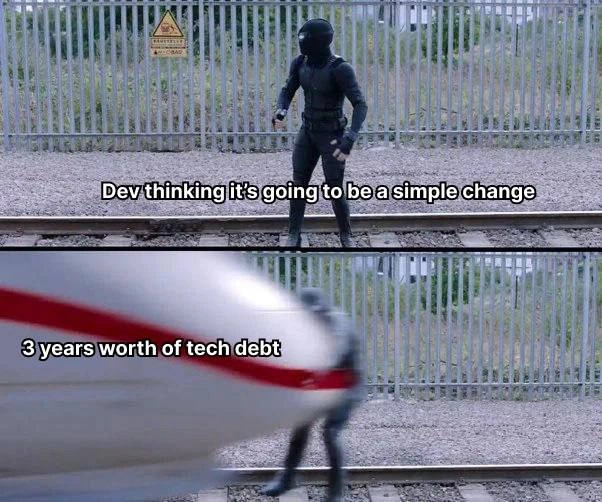
Simple Change Meets Tech Debt
Description
The image is a two-panel action meme set beside train tracks. In the top panel, a black-suited figure stands near the rails with the caption "Dev thinking it's going to be a simple change." In the bottom panel, a fast-moving train blurs across the frame and slams into the figure, with the caption "3 years worth of tech debt." The technical joke is the familiar engineering trap where a tiny-looking change exposes years of hidden coupling, undocumented behavior, brittle tests, and deferred cleanup. It frames technical debt as the high-speed consequence of past shortcuts, not an abstract backlog item.
More like this
More like this in TechDebt →
Use J and K for navigation
Comments
37Comment deleted
The change was one line; the blast radius was apparently stored in a monorepo nobody had indexed since 2021.
The ticket was one line; the dependency graph was an oncoming train.
Why the limited reaction emojis? Comment deleted
because ai told it will be better this way Comment deleted
Say no to AI say yes to junior developers in critical infrastructure Comment deleted
the juniors will learn a lesson at least Comment deleted
Tbf I have no real preference if I would choose AI code or junior code in critical infrastructure Comment deleted
or your code Comment deleted
I have been coding since I am 7 Comment deleted
AI makes a bunch of mistakes and its not even funny. I especially know because I am lazy and I just want some shitty wrapper class or some redundant implementation I am lazy to write myself but ever singe time it does such beginner mistakes and unless the one looking at the code actually knows these they can slip into prod very easily... Comment deleted
Like its not the first time it gave me "better" code that relied on user fields for size in C Comment deleted
claude has memories too ☝️ Comment deleted
yes. that's why I need to recall him about missing solution details every couple of prompts. especially funny when you look at the "thinking process" and he like the user requested the result to be formatted as X, so I need to format it as X and then immediately misses that point. and then you "you forgot to do the X" "you are absolutely right" and misses another point of the task, which already has been done correctly Comment deleted
Didn't know ai can be on crack and opium Comment deleted
Trueee Comment deleted
which model Comment deleted
doesn't matter. happens to every model from time to time Comment deleted
Skill issue 🌚🌚🌚 Jokes aside, opus 4.8 is shit I’m back to gpt-5.5 It remembers what I said in initial requirements after 5 compacts, you couldn’t make it up Comment deleted
Chatgpt uses memory despite being off to seem smarter Comment deleted
Doesn’t matter? Opus uses memory too Comment deleted
It does. I turn it off they keep using it sneakily Comment deleted
To impress the average user Comment deleted
You are changing topic tho, that’s a separate issue Comment deleted
how does that disprove anything? Comment deleted
I just wanted to share an observation To me all Ants models went downwards since January, only degrading from release to release Comment deleted
Opus 4.5 for a week or so was a real imba tho I spend entire NY holidays prompting with it. Literally 16 hours a day on some days. I felt how it’s intelligence was bonked Never experienced the same addiction to work with model again since then, till release of Fable Comment deleted
yes. they are capable of long term memory. it wasn't my point. when combining unusual requirements, they often tend to slip to one subset or another, struggling to keep them in 1 solution together. Comment deleted
then you have like 3 outputs you need to cherry pick from, to construct the final result, because it is already easier and quicker, than burning tokens until it manages to keep all constraints together Comment deleted
btw, don't your agents do regression testing? Comment deleted
Or at least smoke On key user stories Comment deleted
do you connect iqos so the agent has his smoking break? Comment deleted
This was great meme tho Comment deleted
Wanna invite to private beta of devme.me? Comment deleted
Should be deployed once codex will finish regression on staging btw Comment deleted
thanks, no need to. Comment deleted
👆 Comment deleted
can I participate? Comment deleted