First Deadlock Beats Wedding Day
Why is this Databases meme funny?
Level 1: The Hallway Jam
Imagine two people in a narrow hallway. Each is holding a door open and waiting for the other person to move first, so nobody can go anywhere. Fixing a database deadlock feels amazing because you finally figure out how to make both people move without crashing into each other. The meme is funny because that invisible hallway problem feels more thrilling than huge life milestones.
Level 2: Two Transactions Stuck
A database deadlock happens when two or more transactions block each other in a cycle. A transaction is a group of database operations that should succeed or fail together. A lock is how the database protects data while a transaction is changing it.
Imagine transaction A locks row 1 and needs row 2. At the same time, transaction B locks row 2 and needs row 1. Neither can continue, because each is waiting for the other. The database detects the cycle and cancels one transaction so the system can keep moving.
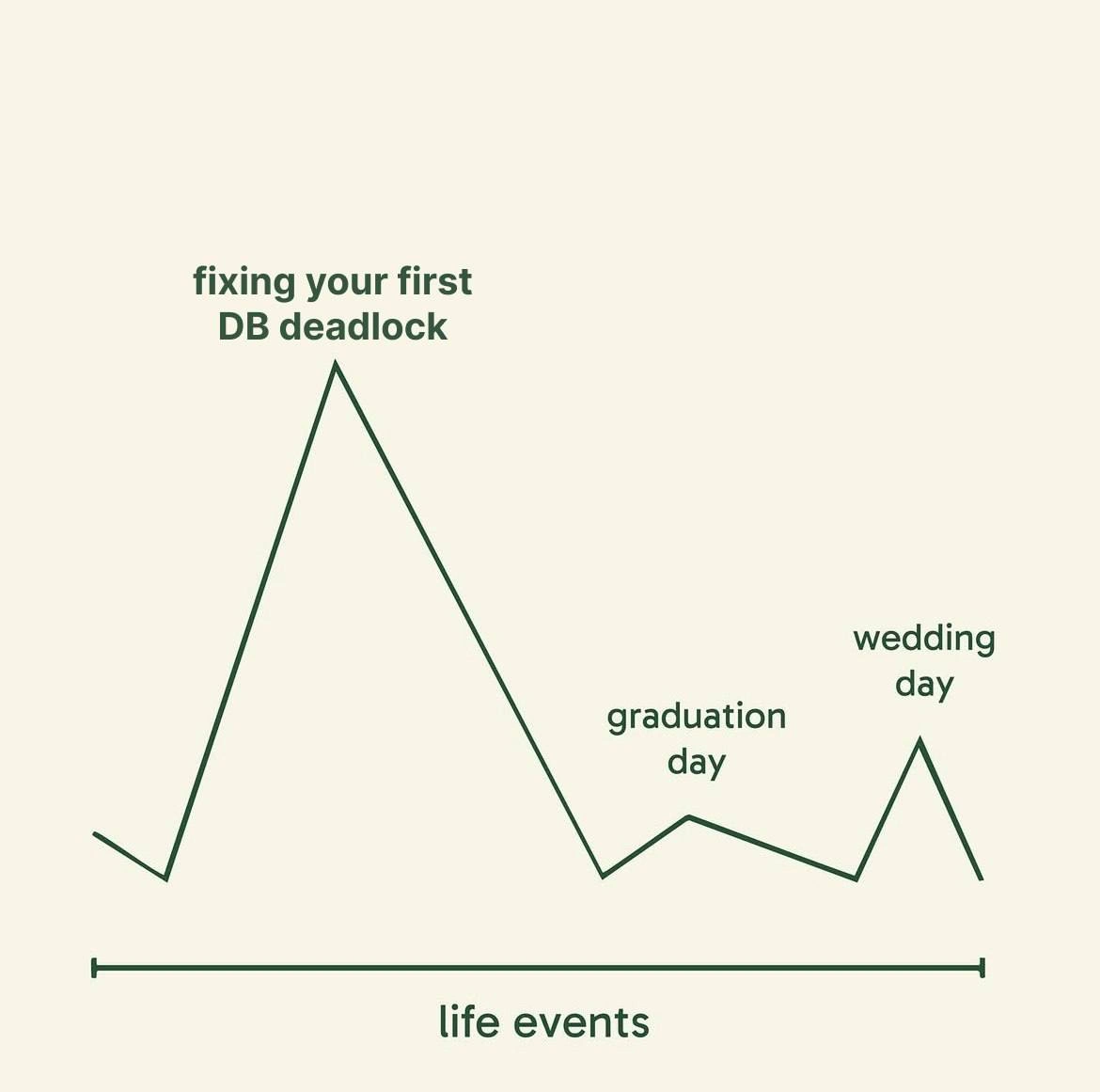
This is why the meme belongs with databases, debugging, SQL, and concurrency control. The visual chart makes the first deadlock fix look like a life achievement because it often teaches a developer that production bugs are not always in one line of code. Sometimes the bug lives in timing, load, and the order of operations.
For a newer developer, the fix usually means learning habits like keeping transactions short, touching shared tables in the same order, indexing queries so locks are held for less time, and handling retryable database errors instead of assuming every failure is permanent.
Level 3: Lock Order Euphoria
fixing your first
DB deadlock
The chart's tallest emotional spike is not graduation day or wedding day. It is fixing your first DB deadlock, which is absurd only until you have actually chased one. A database deadlock is one of those bugs that refuses to be understood from a single stack trace. Two transactions can each be perfectly reasonable in isolation, then combine into a circular standoff where each holds a lock the other needs. The database eventually chooses a victim, rolls one transaction back, and leaves the developer staring at a production error that says, with great institutional calm, "try again."
The senior-developer joy comes from how much hidden system behavior suddenly becomes visible. To fix a deadlock, you often need to understand transaction boundaries, isolation levels, row locks, index access paths, foreign key checks, and the exact order in which application code touches tables. It is rarely just "query A is bad." It is more like: this service updates orders then inventory, that worker updates inventory then orders, and under enough concurrency they politely strangle each other.
-- Transaction 1
UPDATE orders SET status = 'paid' WHERE id = 42;
UPDATE inventory SET reserved = reserved + 1 WHERE sku = 'abc';
-- Transaction 2
UPDATE inventory SET reserved = reserved - 1 WHERE sku = 'abc';
UPDATE orders SET status = 'rechecked' WHERE id = 42;
Neither transaction looks dramatic. The drama appears in the timing. Once you solve it by enforcing a consistent lock order, narrowing transaction scope, adding the right index, retrying safely, or moving side effects out of the transaction, you feel like you have briefly seen the machinery under the floorboards. Graduation proves you survived school. Fixing a deadlock proves the database has stopped personally whispering riddles at you.
The joke also lands because deadlocks are a rite of passage in backend work. They are not beginner syntax errors. They sit at the intersection of application design and database internals, which means the fix often requires cooperation between developers, DBAs, SREs, and whoever wrote the "quick" batch job three years ago. The graph in the image exaggerates the emotional value because the real high is not just closing a ticket; it is escaping a concurrency problem without adding sleep(500) and calling it architecture.
Description
The image is a minimalist green line chart on an off-white background, with the horizontal axis labeled "life events". The tallest spike is labeled "fixing your first DB deadlock", while smaller later bumps are labeled "graduation day" and "wedding day". The visual humor ranks a hard database debugging milestone as more emotionally significant than major personal achievements. For experienced engineers, the joke lands because a real deadlock fix often requires understanding transactions, lock ordering, timing, and production behavior all at once.
Comments
5Comment deleted
Marriage is a commitment, but resolving a deadlock is the first time two commitments actually stop blocking each other.
I guess excitement Comment deleted
erection Comment deleted
Looks like the first sexual intercourse is negligible to be depicted on this chart. 🤓 Because there has been none. Comment deleted
in Germany we can't fix Deutsche Bahn deadlocks for decades, that's why our marriage rate is so low. Comment deleted