The Heart Rate of a Developer on Release Day
Why is this Debugging Troubleshooting meme funny?
Level 1: Racing Heart
Think of it like this: walking is easy and calm, so your heart beats normally. Running is harder and exciting, so your heart beats faster. Now imagine you have a big school project due today and right before you hand it in, you realize there’s a huge mistake – that feeling is represented by “debugging on release day.” It’s like when a teacher announces a surprise test and you haven’t studied – your heart would start pounding really, really fast from sudden panic. In the meme, a developer finding a bug right when they’re about to show their work to everyone (on release day) feels a giant rush of fear and urgency. Their heart races even more than when running. So the last picture shows a super blurry heart, meaning boom-boom-boom, a heart beating out of your chest! The meme is funny because it compares a coding emergency to something as intense as sprinting or a big scare. Even though writing code is done sitting at a computer, a surprise problem at the worst time can make a programmer feel as anxious and adrenaline-filled as if they were running full speed or getting a scary surprise. It’s a way of saying: “This job can be really stressful sometimes!” in a silly, relatable way that even non-tech folks can understand – we’ve all had moments where we got so scared or nervous that we could feel our heart thumping hard.
Level 2: Release Day Jitters
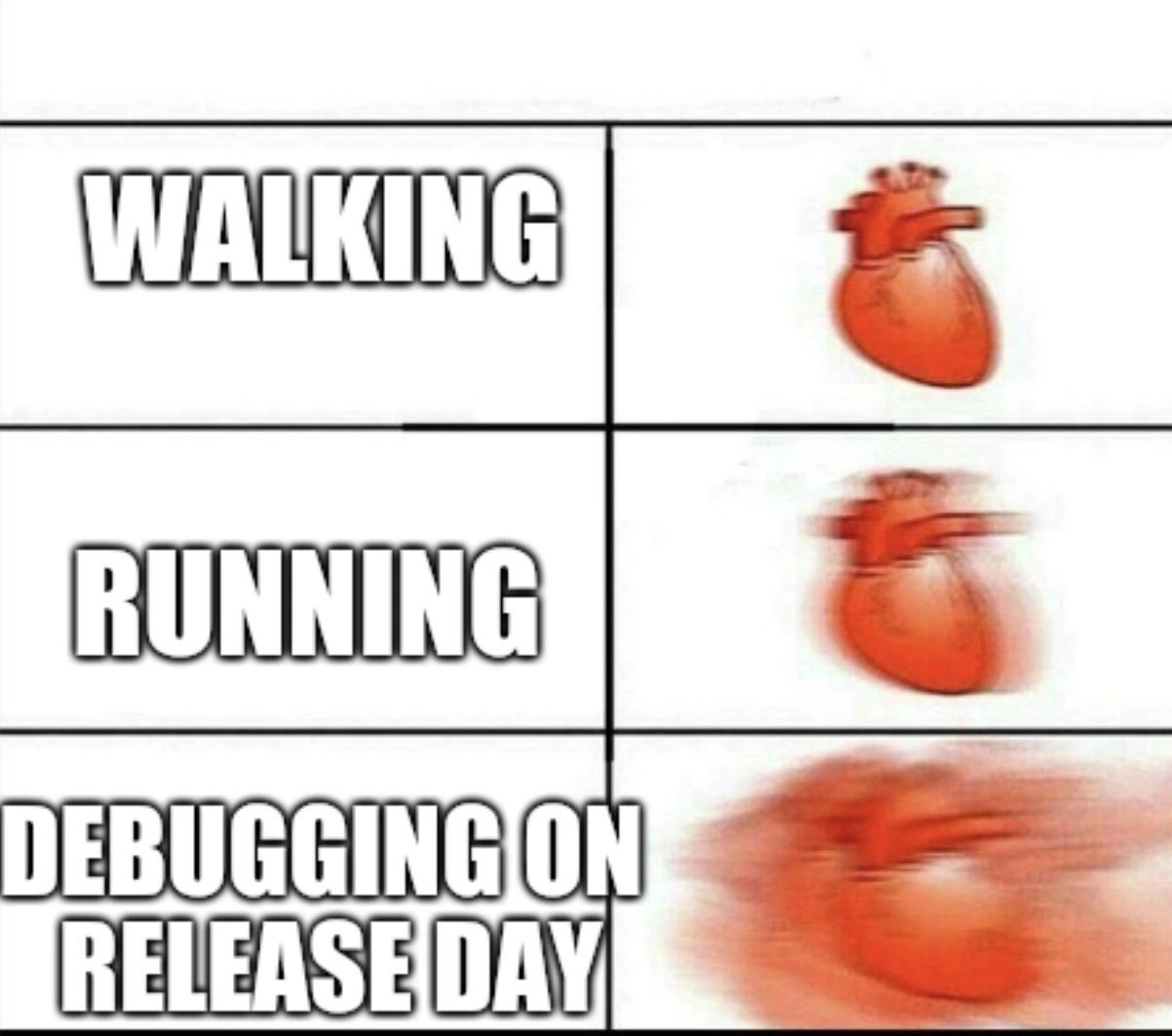
Let’s break down what’s happening in this meme in simpler terms. The meme shows three stages – walking, running, and debugging on release day – each next to a picture of a heart. The heart image starts normal (for walking), then a bit blurry (for running), and finally extremely blurry for “debugging on release day.” This represents a heart beating faster and faster at each stage. In real life, when you walk, your heart rate is normal, when you run it gets faster, and if you suddenly have a big scare or stress, it can race like crazy. The joke here is that programming can cause that last extreme level of stress. Specifically, “debugging on release day” is when a programmer is trying to find and fix a software bug right when they are about to release the software to users (or worse, on the day it’s already supposed to go live). It’s comparing that situation to a huge adrenaline rush – basically saying it makes a developer’s heart beat as fast as someone who’s sprinting flat out.
Now, why would “release day” cause such a freak-out? In software teams, release day is the big day when a new version of the application or product is launched or deployed. Often there’s a planned schedule, marketing events, or client expectations tied to that date. By that day, everything is supposed to be tested and ready. Teams usually institute a code freeze shortly before, meaning developers stop adding new changes so they can stabilize and ensure no last-minute bugs. But sometimes a serious problem is discovered at the last minute – right on release day. Debugging means finding the cause of a bug (error) in code and fixing it. So if you’re debugging on release day, it means something went wrong at the worst possible time, and now you have to scramble to fix it under intense time pressure. That is why the developer’s heart is pounding. It’s like all your careful planning is on fire and you’re racing to put it out so the launch isn’t delayed or broken. This kind of situation creates a ton of stress: you might be thinking “Oh no, if I don’t fix this in the next hour, we’ll miss our deadline or users will see a broken app!”
Let’s connect some of the technical terms to understand the context:
- Deployment is the process of rolling out new code to the production environment (the live system that real users use). When we say “release day,” we’re talking about the day of deployment.
- Production (prod) is the live environment where the software actually runs for users, as opposed to a test or development environment. A production bug is a problem that appears in that live environment.
- On-call refers to a rotation of developers or engineers who are available to respond if something goes wrong, especially outside normal hours. If you’re “on call” and a bug appears in production, it’s your job to jump in and debug/fix it, even if it’s 2 AM.
- Deadline is the latest date or time by which something must be done. Release day is essentially a big deadline for the whole team. When a bug pops up at that point, it’s a high-pressure deadline situation to fix it immediately.
- Troubleshooting is another word for debugging – investigating and solving problems in tech systems.
For a newer developer, imagine the anxiety of your first big deployment. You might have tested your code many times in a development or staging environment (a safe testing space), and everything seems fine. But when you hit the “go live” button on release day, suddenly an error shows up that you’ve never seen before. Maybe it’s due to a slightly different configuration in production, or a missing environment variable, or an interaction between components that wasn’t evident in testing. Your calm day just turned into a frantic emergency. Everyone is looking to you (and your team) to fix it ASAP. Your heart would definitely start beating faster in that scenario. This is often how developers learn about ReleaseAnxiety – that nervous feeling when pushing code out to the world, especially when something unexpected happens.
This meme is poking fun at that feeling. It’s common in developer humor to exaggerate experiences we find stressful or ridiculous. The reason developers chuckle at this is because it’s a “it’s funny because it’s true” moment. We’ve all had times when a bug in our code caused a surge of adrenaline. Maybe it was during a live demo when something broke in front of an audience, or during an app launch when an unknown issue cropped up and you had to dive into logs to diagnose it on the fly. Even if you’re relatively new, you might relate if you’ve ever had something go wrong right when you least want it to – like your program crashing during a class presentation or a critical feature failing during a client meeting. That feeling of “oh no, I have to fix this RIGHT NOW” sends your heart racing. The meme just amplifies it by saying debugging during a release is the ultimate heart-rate accelerator – more than physical exercise!
So, to put it simply: the meme is showing that a computer programmer trying to fix a mistake in their code on the day of a big software release is so stressed that their heart beats insanely fast – faster than when walking or even running. It humorously highlights the intense stress and pressure developers feel during last-minute problem solving in high stakes moments. Anyone who has worked with tight deadlines or been responsible for an important deployment can attest that it can be as nerve-wracking as anything, often causing sweaty palms and a pounding heartbeat. The phrase “debugging on release day” has almost become shorthand for a nightmare scenario in development, which is why this meme resonates. It turns that nightmare into a visual joke we can all shake our heads and laugh at, because we’ve survived it and know how absurdly stressful (and sometimes absurd in hindsight) it can be.
Level 3: Deployment Palpitations
This meme nails the fight-or-flight adrenaline rush of a production bug discovered at the worst possible time. The left column lists WALKING, RUNNING, and DEBUGGING ON RELEASE DAY, while the right column shows a red cartoon heart increasingly blurred – from calm to racing so fast it’s just a red smear. It’s implying that pushing code on release day sends a developer’s heart rate off the charts, even more than actual cardio. Seasoned devs know this exact pulse-pounding feeling: that moment when a critical bug pops up right as you’re about to deploy to production. Suddenly you’re in panic mode. Your calm, methodical troubleshooting turns into a frantic scramble as if the project’s life (and maybe your job) were on the line.
Why is this so funny and painfully true? Because it satirizes our industry’s recurring nightmare: discovering a showstopper bug under deadline pressure. The humor comes from contrast – walking vs running are physical activities that obviously elevate your heart rate, but here coding at a desk triggers the highest heart rate. It’s an exaggerated truth many of us recognize. In those final minutes before a big release, debugging a nasty issue can make your heart pound like you’ve sprinted a marathon. The meme’s third panel heart is extremely motion-blurred, as if it’s about to burst. That’s basically an engineer’s heartbeat when production is on fire or the release build is failing and the whole team’s waiting. It’s a classic case of release day panic, something every dev team desperately tries to avoid but inevitably experiences at some point.
From a senior developer’s perspective, this scenario is a perfect storm of DeploymentAnxiety and DebuggingNightmares. You’ve probably been through “code freeze” where no new changes are allowed right before release – yet here you are, breaking that rule with a desperate last-minute hotfix. Commit after code freeze? Oh, it’s happening. Maybe QA or a user just found a critical bug that somehow all tests missed. Murphy’s Law rules this territory: anything that can go wrong will go wrong, and it will do so 10 minutes before the deadline. The whole team’s in a war room (or a frantic Slack call) watching logs scroll by, while project managers hover asking “Is it fixed yet? Can we still launch today?” It’s the ultimate ReleaseAnxiety cocktail, and your sympathetic nervous system responds accordingly – cue the heart palpitations.
This is funny because it’s too real. Developers joke about “getting your cardio by deploying to prod” precisely because of how common and visceral this stress is. The meme visually exaggerates the heart’s motion, but honestly not by much – I’ve had my smartwatch ask me if I’m running while I was just sitting at my desk chasing a production bug. It’s a shared trauma humor: anyone who’s been on-call or pushed a hotfix at 4:59 PM on Friday can relate. The tags like DebuggingFrustration and DeploymentAnxiety exist because we’ve all been there, hands trembling on the keyboard, pulse thumping in our ears, trying to keep a cool head. Under the hood, it’s your body dumping adrenaline – the same hormone as when you nearly get in a car accident – because in that moment of debugging under pressure your brain perceives a threat (the system is failing, people are angry, fix it now!). Evolution didn’t exactly differentiate a charging tiger from an angry ops manager yelling about downtime.
Technically speaking, why is fixing a bug on release day so much harder and scarier? For one, the stakes are real: the code is about to (or already did) hit production, meaning real users, real money, or real data are at risk. Mistakes can have immediate impact, so there’s no luxury of “we’ll fix it later.” You’re likely dealing with a live system or a final build – no sandbox to play safely. Time is brutally short. Often you’re debugging with limited info: maybe an ambiguous error log or a vague bug report, and you have to deduce the cause like a detective racing against the clock. Meanwhile, every passing minute of delay might breach the deadline or service-level agreement, which only amplifies the stress. It’s a perfect recipe for DebuggingNightmares: complex, high-pressure problem-solving while everyone watches.
The meme hits home also because it pokes at the unhealthy reality of many software release cycles. In theory, we all strive for smooth, boring deployments: CI/CD pipelines, extensive tests, canary releases, feature flags – all meant to minimize surprises on launch day. But reality often diverges from best practices. Maybe there was crunch time leading up to the deadline, so something didn’t get tested thoroughly. Or the deployment process is manual and error-prone. Or an “it’s always DNS” style issue cropped up (some obscure configuration or network setting breaks only in prod). The result is you end up debugging under pressure despite all precautions. The humor has a cynical edge: it’s laughing to keep from crying about how often we end up in this situation despite knowing better. That’s why veteran devs smirk at this meme – it’s both a joke and a commiseration. The text “DEBUGGING ON RELEASE DAY” in that bold, memetic font could be replaced with any number of developer horrors (like “ON-CALL 3AM SEV-1 ALERT”) and the heart would blur just the same. It’s a universal inside joke about the physiological cost of being a developer when things go sideways.
In summary, debugging on release day is depicted as the ultimate heart-rate booster because it condenses all the classic developer terrors: a ProductionBug at the worst time, insane DeadlinePressure, upset stakeholders, uncertain fixes, and the very real fear of failure – all hitting you at once. It’s the software engineer’s equivalent of a final exam you forgot about, except the “grade” is public and can take down a system. No wonder the heart’s beating out of its chest. The meme’s dark humor resonates because we’ve all felt that thump-thump-thump while furiously typing a git hotfix or tailing logs in a live system, praying we find the culprit in time. It’s an adrenaline-fueled sprint that leaves you exhausted, and later becomes part of your team’s lore (“remember that release night when our hearts almost exploded?”). Deployment palpitations, indeed.
Description
A three-panel meme illustrating increasing heart rate through activity. The first panel, labeled "WALKING" in bold white text, shows a calm, anatomical heart. The second panel, labeled "RUNNING," shows the same heart but with a motion blur, indicating a faster beat. The third and final panel, labeled "DEBUGGING ON RELEASE DAY," depicts the heart with extreme radial blur, symbolizing a dangerously rapid, panicked heart rate. This meme captures the intense stress and anxiety developers experience when fixing critical issues on the day of a software release. It's a high-stakes situation where any mistake can impact live users, making it a grimly humorous and highly relatable scenario for experienced engineers who have weathered the storm of production firefighting

Comments
9Comment deleted
My Fitbit thinks I'm running a marathon every release day. I don't have the heart to tell it I'm just watching the CI/CD pipeline fail
Walking: 60 bpm; Running: 120 bpm; Debugging a “shouldn’t be possible” null during the blue-green cutover: Grafana pages ME for breaching the 99.9% heart-rate SLO
The only time a senior engineer's heart rate matches their code's cyclomatic complexity is when they're debugging a race condition in production while the CEO is watching the deployment dashboard
The meme perfectly captures the universal developer truth: your resting heart rate during a production hotfix makes marathon runners look like they're meditating. It's that special moment when you realize the bug only manifests in prod, your monitoring alerts are lighting up like a Christmas tree, stakeholders are asking for ETAs, and you're frantically adding console.log statements while questioning every life decision that led you to deploy on a Friday. The motion blur isn't just artistic license - it's a scientifically accurate representation of what happens when you see 'undefined is not a function' in production logs at 4:47 PM
On release day, the canary’s screaming, the error budget’s burning, and my heart is the only system without a circuit breaker
Release day is when you learn the only autoscaling that never flakes is your heart rate as the canary torches the error budget
Release day debugging: heart rate exceeds context-switch latency under full prod load
Debugging release the day after release day: (red square) *not to be confused with Moscow's Red Square Comment deleted
"Debugging on release day in RPODUCTION"))) Comment deleted