The Engineer's Approach to a Standing Desk
Why is this CorporateCulture meme funny?
Level 1: Can’t Go Up? Go Down.
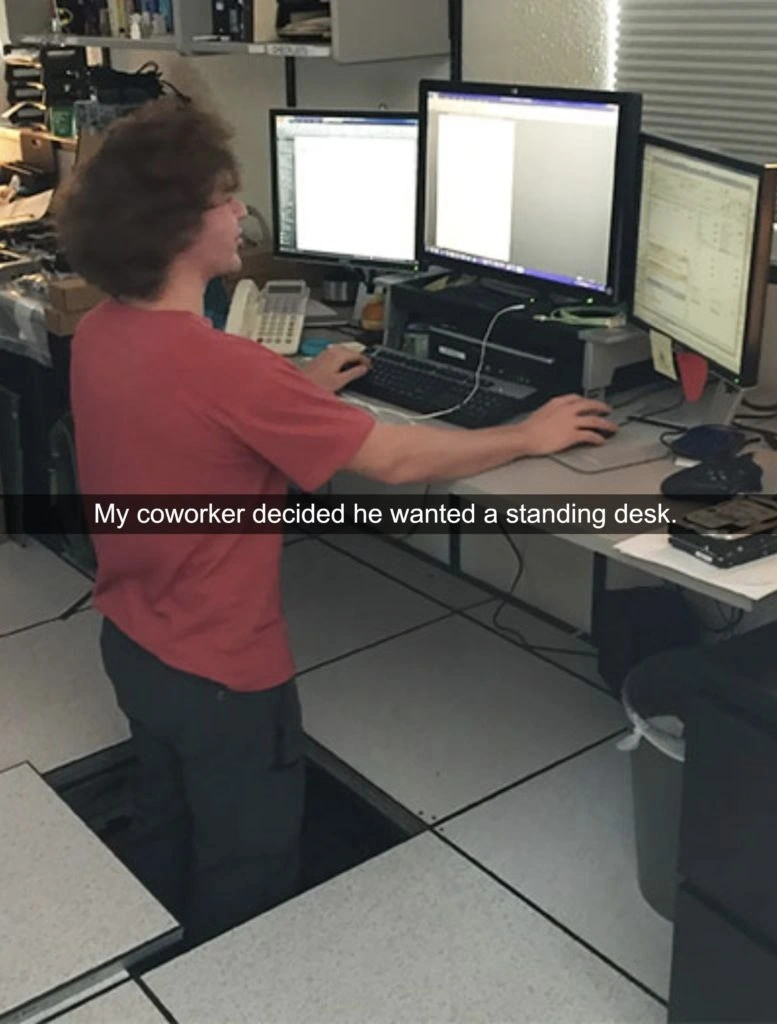
Imagine you’re too short to reach a shelf and you can’t get a stool. What do you do? One silly idea: dig a hole in the floor to make yourself “taller” relative to the shelf. That’s basically what happened here, but with a work desk! The programmer wanted to stand up while working, but his desk was built for sitting. Since he couldn’t raise the desk, he lowered the floor. He pulled out a floor panel and stepped down into a little pit, so now he’s the right height to use his computer while standing. It looks funny because nobody expects someone to literally stand in the floor at the office! It’s like a cartoon solution to a real problem. He solved his problem in a super creative way, and that surprise twist is what makes everyone laugh.
Level 2: Budget Ergonomics
Let’s break down what’s happening. Our developer wanted a standing desk – a desk tall enough to work at while standing up. Standing desks are popular for ergonomic reasons: standing part of the day can reduce back pain and improve posture, a big deal in DeveloperErgonomics when you spend long hours coding. But his office wouldn’t buy one (maybe due to budget or red tape), so he found a clever workaround. The office floor itself is special: it’s a raised access floor, meaning there’s an empty space under those square panels for running cables and air vents. By lifting out one floor panel, he created a DIY office setup: a pit to stand in! Now the fixed-height desk effectively behaves like a standing desk because he’s standing lower. It’s an improvised standing desk made by altering the floor instead of the furniture.
This solution is both funny and practical. It’s WorkplaceHumor because you’d never expect someone to remove part of the office floor just to be more comfortable at work. It shows the classic developer improvisation: using what’s available in unconventional ways. Think of it as an ergonomic_hack – a quick fix to meet his needs. Everyone else sits at their normal desks, but he’s literally one level down, typing away on his keyboard with three monitors like nothing happened. The caption “My coworker decided he wanted a standing desk” underscores the joke: he “decided” to get one, and this is the result. It implies a sort of rebellious creativity against corporate constraints. For a junior developer or someone new in the office, this scene is eye-opening: it teaches that in tech culture, engineers often solve problems creatively when official solutions are out of reach. It’s a literal example of DeveloperHumor – turning frustration into a gag. And it lightly pokes at corporate culture: instead of waiting weeks for approval or suffering silently, he fixed his environment DIY-style in minutes. Talk about being resourceful!
To clarify some terms: ergonomics is about designing a workplace for comfort and efficiency (like adjusting chair height, monitor level, etc.). A workaround is a temporary or creative solution to a problem when the normal solution is unavailable. Here, the normal solution would be “get a height-adjustable desk,” and the workaround is “use the building’s floor space to adjust height.” It’s a bit like propping up a wobbly table with a folded piece of paper – not how you’re supposed to do it, but it works when you need it. This developer’s stunt might not be OSHA-approved, but it sure is inventive. The whole office likely had a good laugh, and perhaps management got the hint that investing in proper equipment might be a good idea next time.
Level 3: Stack Underflow
In this scene, a developer literally stands knee-deep in the floor to achieve a makeshift standing desk. It’s an absurdist twist on DeveloperExperience (DX): if the desk won’t go up, the engineer goes down. The office has a raised access floor – a secondary floor of removable tiles often used in server rooms for cable management and cooling. Our inventive colleague popped open one of those data center floor tiles and stepped inside the gap. Now his triple-monitor setup, previously at sitting height, is perfectly at eye level for standing. This improvised_standing_desk solution screams EngineeringAbsurdity: repurposing building infrastructure to solve an ergonomic problem. It’s the physical-world equivalent of a hacky code fix, and every senior developer in the room is smirking in solidarity.
This scenario nails the CorporateCulture satire: many companies tout caring about employees’ health and productivity, yet when asked for a proper $300 standing desk, they hem and haw about budgets and approvals. So what’s a resourceful engineer to do? Workarounds, of course! This is the same hacker mentality developers apply in code – solving problems with whatever’s on hand – now applied to office furniture. Can’t get equipment through official channels? Find a creative backdoor (or in this case, a floor door :wink:). It’s a bit cynical and very ingenious: effectively a DIY office setup done with zero expenditure. The programmer has basically executed floorHeight-- in real life – decrementing the floor height variable – a sly nod to solving constraints by going one layer deeper.
From a senior perspective, there’s a metaphor here about technical debt and quick fixes. Rather than refactor the whole office or wait on a requisition (the “proper solution”), this developer shipped an ergonomic hack to production immediately. Sure, it’s not a long-term fix (Facilities might file a bug report about an open hole in the floor), but it unblocks the task at hand. Seasoned engineers recognize this pattern: sometimes you implement a kludge to keep things moving, especially when management is slow to respond. It’s both hilarious and painfully relatable that the path of least resistance literally involved removing resistance (floor panels). In true battle-hardened fashion, he’s treating bureaucracy as just another impediment to debug. If you can’t raise the desk, lower the developer. Mission accomplished, with a healthy dose of dark office humor.
Description
A photograph taken in an office with a raised tile floor, common in data centers or older IT environments. A young male developer with curly hair and a red shirt is seen working at his multi-monitor desk. A caption at the bottom reads, 'My coworker decided he wanted a standing desk.' The punchline is visual: instead of raising the desk, a floor tile has been removed, and the developer is standing in the resulting hole, effectively lowering himself to achieve the ergonomics of a standing desk with a standard-height table. The humor lies in the literal, low-tech, and pragmatic solution to a modern office problem, bypassing the need for expensive equipment. It's a classic example of an 'engineer's fix' - unconventional, slightly absurd, but ultimately effective, resonating with a culture that values clever workarounds over standard procedures
Comments
15Comment deleted
Why submit a ticket for a $1,200 ergonomic desk and wait for finance approval when you can just de-provision a floor tile and achieve the same SLA?
Who needs a sit-stand desk when you can achieve vertical scalability by relocating the runtime one access-floor layer down - zero procurement tickets, full backward compatibility with chair mode
After 20 years in tech, I've seen developers tunnel through firewalls, but this is the first time I've seen one tunnel through the raised floor just to avoid submitting a $2000 standing desk requisition to procurement
When your coworker implements a standing desk using the 'lower the floor' approach instead of 'raise the desk' - a perfect example of solving the inverse problem. It's technically correct (the best kind of correct), has zero dependencies on vendor hardware, and the rollback strategy is... well, let's just say it's a breaking change. This is what happens when you let engineers interpret requirements too literally: 'I need to stand at my desk' becomes 'I need the desk at standing height relative to me' - classic off-by-one error in the Z-axis. At least there's no version conflict with existing furniture
Procurement ETA Q3; SRE workaround - set raised_floor_tile=false and vertically scale the user process, with a small OSHA regression
Git commit: 'feat: standing desk via floor rebase' - now merging conflicts with the foundation
Procurement said sit-stand desks are Q4, so he implemented the feature at Layer 1 - pulled a raised-floor tile and called it vertical scaling
Its so funny, when memes appears here two-three days after it appeared in other publics Comment deleted
Same way some of images appear here early then in others 🤷♂️ Comment deleted
And some never appear in others Comment deleted
Ping 172800000 Comment deleted
Mars routing gateway Comment deleted
I'm seeing this first time, so... Thanks admin, nice di... memes! Comment deleted
Why are you so negative? People aren't always on the lookout for memes in Reddit. I have a channel and I post stuff (mostly links) from various places. You would say they are copied but the point of doing this is aggregating a good collection of internet stuff so that people can enjoy stuff without wandering from place to place. I want some more admins (or content posters) and yeah a worthy audience too, mine just doesn't interact. :-\ You can check it out: @quanf Comment deleted
Wow, i just said, its funny.. Comment deleted