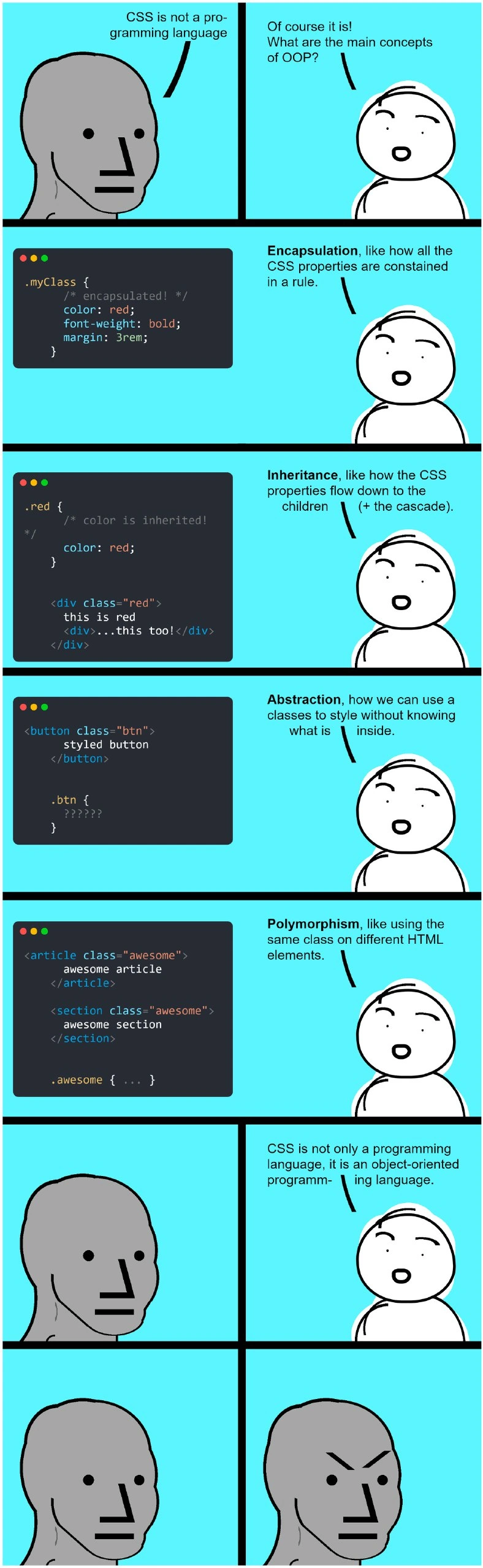
Comic argues CSS is an object-oriented programming language with OOP analogies
Why is this Frontend meme funny?
Level 1: Lego Blocks, Not Code?
Imagine two kids playing with LEGO blocks. One kid frowns and says, “Building with LEGO isn’t real building. You’re just snapping pieces together, that’s not like building a real house.” The other kid grins, holding up their just-finished LEGO house. “Of course it is real building!” they exclaim. “Look, I have a blueprint (the instructions) just like an architect’s plan. I encapsulated different rooms inside these walls. See how the color pattern I chose for the first floor is inherited by the second floor? I even used the same door design on the house and the garage – that’s like polymorphism, the same part working in two places! I built this whole thing without knowing how each brick is made – a bit of abstraction there. So my LEGO house follows all the rules of real building!” The first kid pauses, mouth slightly open, a silly look on their face, unsure how to respond.
In this simple story, the enthusiastic builder kid is doing what the developer in the meme did: using big concepts to justify that their way of doing something (playing with LEGO bricks) is just as legit as the real thing (constructing a house). It’s funny because, well, everyone knows playing with LEGO is much simpler than engineering a real building – but the kid’s eyes light up with pride as they draw those parallels. The humor and heart of it come from that earnest desire for their work to be respected, and the over-the-top reasoning they use. Just like the LEGO builder wants their creation seen as “real” building, the comic’s developer wants CSS seen as a “real” programming language. The joke lands when the skeptic is left speechless, whether it’s a friend who doesn’t know what to say, or a gray-faced NPC with no comeback. It’s a playful reminder that with enough creativity (and a big smile), you can make anything sound grand – even stacking plastic bricks, or writing styles for a web page!
Level 2: Styling with Classes
To understand the joke, let’s unpack the basics of both CSS and Object-Oriented Programming (OOP) in simple terms. CSS (Cascading Style Sheets) is the language that describes how HTML elements should look on a webpage – it’s all about colors, fonts, layouts, and spacing on the front end. When someone says “CSS is not a programming language,” they usually mean that CSS is more about declaring styles rather than writing algorithms or logical instructions. There’s no traditional logic in CSS (no loops, no if-else conditions in plain CSS). Instead, you write rules like “make all <h1> headings blue” or “give elements of class .button a padding of 10px.” CSS is declarative: you state what you want, and the browser figures out how to apply it, unlike a typical programming language where you also spell out the step-by-step procedure.
Now, OOP – Object-Oriented Programming – is a programming paradigm (way of organizing code) that centers around objects (think of an object as a bundle of data and functions) and classes (blueprints for creating objects). The main ideas (often called the “four pillars” of OOP in any intro to CS course) are:
Encapsulation: Hiding the details. You keep the inner workings of an object (its data and helper code) private, exposing only what other parts of the program need to use. It’s like a capsule with medicine – you can take the capsule without knowing what’s inside it exactly. In programming, this often means grouping related stuff together and controlling access. In the context of CSS, encapsulation is loosely comparable to how a CSS rule groups a bunch of style properties and confines their effect to elements that match a specific selector. For example, a CSS class like
.card { ... }will encapsulate styles for “card” elements – those styles won’t automatically leak out to other unrelated elements. This is akin to keeping variables inside a function or an object so that the rest of the code can’t mess with them directly. When the meme shows.myClass { color: red; font-weight: bold; margin: 3rem; }and calls it encapsulation, it’s highlighting that all these style properties (color, weight, margin) are encapsulated within the.myClassdefinition. Only things withclass="myClass"will get those styles, which is indeed like a little module of styling.Inheritance: In OOP, this means a class can inherit traits (properties and behaviors) from another class. Think of a “Car” class and a specialized “ElectricCar” class that automatically has all the features of Car but can add its own. In CSS, inheritance refers to how certain style properties naturally pass down from a parent HTML element to its children. For instance, if you set a
<div>to havecolor: red(making the text red), all text inside that<div>will usually inherit that red color, unless overridden. This is why in the comic, inside a<div class="red">the text of nested<div>s also appears red. It’s like a family trait in a family tree – the parent has a style, the kids get it too. CSS inheritance is not something you manually code like in OOP (it’s automatic for many CSS properties), but conceptually it’s similar enough that the meme equates the two. Cascade (the “C” in CSS) is also mentioned – that’s the set of rules the browser uses to decide which style wins when there are multiple styles applied to the same element (for example, an element could match two different classes, and you have to figure out which class’s rule has priority, based on specificity and order). The cascade is a bit like resolving conflicts in inherited traits: which grandparent did you get your eye color from? 😄 In simpler terms for a new dev: if two CSS rules apply to one element, the cascade decides which rule’s value to actually use. The comic lumps cascade with inheritance because both involve passing down styles, but keep in mind: inheritance is about properties flowing down the HTML tree, whereas cascade is about multiple sources of styles (like external CSS, internal<style>tags, inline styles) and specificity. Both are fundamental to how CSS works.Abstraction: In programming, abstraction means you work with an idea or interface, without needing to know the gritty details. It’s like driving a car: you turn the steering wheel right to go right – you don’t need to know exactly how the steering mechanism is attached and working under the hood. In code, you might call a function
drawCircle()without knowing the complex math that function uses to draw the circle; you just care that a circle appears. In CSS, the meme describes abstraction as using a class to style something without needing to know what’s inside that class’s definition. For example, if you use a ready-made class from a CSS framework (say you addclass="btn-primary"to a button using Bootstrap), you don’t have to open Bootstrap’s CSS file and read all the styles to know it’ll make your button blue and nicely padded – you abstractly know “this class will make my button look like a primary styled button.” The comic’s example<button class="btn"> styled button </button>with an empty.btn { ?????? }rule is basically saying: we have a button that looks styled, and we have a class named.btnthat did it, but we’re not showing you the contents – you don’t need to know them. That’s abstraction! For a newcomer, it’s helpful to realize that even using CSS can involve abstraction: you separate the what (adding a class in HTML) from the how (the actual CSS rules elsewhere). It’s the same mental concept as not needing to know how a library function is implemented in code – you trust a black box to do its job. In CSS, classes and IDs create those black boxes of style. This is especially clear if you’ve ever used someone else’s CSS library or a design system: you apply pre-defined classes to your HTML and magically get a polished UI without writing the CSS yourself. You’re leveraging abstraction in a frontend context.Polymorphism: This word comes from Greek roots meaning “many forms.” In OOP, it refers to the ability of different objects to be treated as instances of the same class through a common interface. It’s like having different brands of smartphones – they’re all phones (you can call, text on any of them), even if internally an Android and an iPhone work differently. In code, you might have a function that takes a “Shape” object and calls
.draw()on it, and whether you pass it a Circle, a Square, or a Triangle (all of which are Shapes), it still works – each shape class knows how to draw itself. Now, how in the world does that relate to CSS? The comic gives a simple example: one CSS class applied to different HTML element types. In their example,<article class="awesome">and<section class="awesome">both use the same.awesomeclass. Even though<article>and<section>are different semantic elements (one might be a blog post, the other a section of a page), from a styling perspective they can be treated the same – the.awesomeclass will give both a shared set of styles (say, gold border and yellow background, to live up to the “awesome” name 😃). So one could say the.awesomeclass is polymorphic: many elements (forms) can use it to exhibit the same styling behavior. Another way to see polymorphism in CSS is with things like responsive design classes – for instance, a class.hidden-mobilemight apply to a<div>, a<nav>, or a<img>tag and hide it on mobile screens, no matter what the element is. The same “message” (hide yourself on small screens) is understood by many different kinds of elements. For a junior dev, it’s key to notice that “class” in CSS is not the same as “class” in OOP, but the meme is jokingly treating them as if they were. In CSS, a class is just a selector that groups elements. In OOP, a class is a code template for objects. The overlap in terminology makes the punchline possible. So polymorphism here is really about reusability – write one style rule, and use it on various elements to achieve a consistent look. It’s not a term CSS folks usually use, but it’s a neat parallel to think about.
Phew! Now, the reason this whole comparison is funny is because it’s a bit like fitting a square peg in a round hole and saying “See, it fits if you twist it just right!” 😁. The developer in the comic earnestly goes through each OOP concept and finds a rough CSS equivalent. This is something a passionate frontend developer might do to champion CSS, especially when confronted with the dismissive "CSS isn’t real programming" argument. If you’re new to the field, you should know this debate has been around forever: some programmers (often those who work with traditional languages like C++, Java, etc.) look down on HTML/CSS, considering them too simple or just presentation tools rather than proper programming languages. It can feel a bit insulting to folks who specialize in CSS, because CSS can actually get quite complex and is essential for the web. So, the comic is a fun way to clap back at that dismissiveness by humorously claiming not only is CSS a programming language, it even satisfies the sacred principles of ObjectOrientedProgramming taught in CS classes!
Also, if you noticed the gray left character’s design: that’s the NPC meme format. NPC stands for Non-Player Character (like characters in video games that just repeat preset lines). In memes, the NPC face is often used to depict a stereotypical or conventional viewpoint – basically someone just repeating what they’ve heard without critical thinking. So here the NPC says “CSS is not a programming language” as a canned line. The white character is an original cartoon style, representing our clever developer who has an independent (and amusingly contrarian) thought process. The NPC’s silence in the last panels suggests he’s either dumbfounded or secretly irked because he can’t refute the well-crafted analogy. It’s a lighthearted jab at the kind of internet arguments where one side is smugly satisfied after making a clever point.
In summary, the comic uses each panel to draw a parallel between a core programming concept and a CSS feature:
- Encapsulation → CSS class rule scoping styles to that class.
- Inheritance → CSS inherited properties (and the cascade) passing styles to child elements.
- Abstraction → Using CSS classes without needing to know the internal styling details.
- Polymorphism → One CSS class giving the same look to different HTML element types.
For a newcomer or junior developer, this meme is a fun way to recall OOP vocabulary. You can actually remember these concepts by thinking of CSS examples now! Of course, remember that while these comparisons are insightful, CSS and OOP languages are fundamentally different tools. CSS is a stylesheet language – its primary role is styling content. It doesn’t make decisions or perform calculations (beyond some functions and the browser’s layout engine doing math for you). But as this meme shows, thinking about common principles across different tech domains can yield creative insights… or at least a good chuckle. The next time someone tries to tell you CSS isn’t “real” programming, you’ll have a witty comeback ready: “It has encapsulation, inheritance, abstraction, polymorphism… it even has classes in its syntax! What more do you want?” 😄 Watch their reaction; if they’re an NPC type, you might just get the same blank stare as in the comic.
Level 3: Cascading into OOP
At face value, calling CSS an object-oriented programming language seems ludicrous – and that’s exactly why this comic is hilarious. The stone-faced gray NPC on the left parrots a familiar refrain: “CSS is not a programming language.” This NPC character (a meme symbol for a generic, unthinking skeptic) represents those in the developer community who dismiss CSS as “not real code.” On the right, a cheerful developer avatar enthusiastically counters by mapping core Object Oriented Programming concepts onto CSS. Seasoned devs recognize these four OOP pillars – Encapsulation, Inheritance, Abstraction, and Polymorphism – and the joke lies in how cleverly (and absurdly) they’re applied to something as declarative as CSS. It’s a tongue-in-cheek way to elevate CSS from mere stylesheet to full-fledged programming paradigm, poking fun at long-running frontend language wars and the gatekeeping of what counts as “real” programming.
Let’s break down the OOP analogies that made the NPC go speechless, the same way a senior developer might grin at an inside joke:
Encapsulation – In classic OOP, encapsulation means bundling data and methods inside a class, exposing only what’s necessary through a public interface. In the comic, the dev points to a CSS class definition as an example of encapsulation. For instance:
.myClass { /* encapsulated! Only .myClass elements get these styles */ color: red; font-weight: bold; margin: 3rem; }Here, all styling properties (
color,font-weight,margin) are neatly packaged inside the.myClassblock. This CSS rule is like a little capsule of style – it applies only to elements with class.myClass, and nothing outside that selector is affected. That isolation is analogous to how an object in OOP keeps its internal state private. A seasoned dev knows CSS doesn’t have true access modifiers (you can’t exactly make a CSS property “private”), but scoping styles to a class is a rough stylistic equivalent. It’s a playful stretch: we encapsulate styling so that, say, a bold red button style doesn’t accidentally bleed onto a random<paragraph>element. The humor here is that we’re treating a simple CSS selector as if it’s a serious software module with hidden internals – a bit of DeveloperHumor that merges front-end simplicity with back-end vocabulary.Inheritance – In OOP, inheritance lets a class (child) inherit properties and methods from another class (parent). CSS, as any experienced front-end dev knows, has its own concept of inheritance through the DOM tree and the cascade. The comic’s example shows a
.redclass that colors text red, and an HTML snippet where a parent<div class="red">passes that text color down to its child<div>:.red { /* color is inherited by child elements */ color: red; }<div class="red"> This is red <div>...this text is red too!</div> </div>In CSS, many properties (like
color,font-family, etc.) inherit by default, meaning if you set a parent element’s text color, the children automatically get that color unless overridden. This is part of what the “Cascading” in Cascading Style Sheets refers to – styles flow downwards in the hierarchy. The developer in the meme quips that this is just like OOP inheritance: the parent element’s style properties are inherited by the child elements. Senior developers chuckle here because we know CSS inheritance is a built-in feature of the browser’s rendering engine, not a class hierarchy designed by a programmer. Yet, the analogy fits well enough to be funny. It even hints at the cascade (CSS’s rules for which style wins when multiple rules apply). The cascade’s complexity – with its specificity rules and !important flags – could be jokingly compared to messy multiple inheritance or overridden methods in OOP. (Ever had two CSS classes “competing” on one element? It’s like two base classes vying for control – something any veteran of CSS and OOP can relate to.) The meme exaggerates for effect, and that exaggeration lands because inheriting a red font color down a DOM tree does vaguely resemble a subclass inheriting a parent class’s red-colored property in an OOP scenario.Abstraction – Abstraction in programming means hiding complex implementation details behind a simple interface. In an object-oriented language, you might call a method without needing to know how it’s coded internally – you just trust what it does. The comic equates this to using CSS classes without needing to know which exact styles are inside. For example:
<button class="btn">Fancy Button</button>.btn { /* styles defined here */ /* ??? Imagine lots of CSS magic making the button look pretty */ background: linear-gradient(#4CAF50, #2E7D32); border-radius: 5px; color: white; padding: 10px 20px; }When a developer writes
<button class="btn">, they might be using a style from a framework or a predefined stylesheet. They don’t need to know exactly how.btnmakes the button look fancy – they just know that adding the class will produce a certain visual result. That’s CSS abstraction in action: the styling details are abstracted away into the.btnclass definition. The meme panel shows.btn { ?????? }to humorously indicate that the actual styles could be anything – the user of the class doesn’t need to care. For an experienced dev, this resonates with the idea of an API or interface: you use it without diving into its internals. It’s amusing because we usually talk about abstraction in terms of software architecture or library design, not in terms of a stylesheet. By elevating a mundane CSS class to the lofty concept of “abstraction,” the meme gives CSS a tongue-in-cheek promotion to software engineering technique. And honestly, any front-end veteran who’s worked with utility classes or CSS frameworks knows that this is a real convenience – you leverage someone else’s CSS (say, a.gridor.btn-primaryclass in Bootstrap) without knowing the nitty-gritty. The comic playfully reframes that as if you’re calling a method on an object – the method is “apply this class,” and you trust it to do the job.Polymorphism – In OOP, polymorphism means “many forms” – a single interface to entities of different types. It’s like having a function that can operate on different kinds of objects, or a method that subclasses override to do class-specific things, yet you call it the same way on each object. The developer in the comic illustrates polymorphism with a
.awesomeCSS class applied to different HTML elements:<article class="awesome">Awesome article</article> <section class="awesome">Awesome section</section>.awesome { /* Generic awesome styles that work on many elements */ padding: 1rem; border: 2px solid gold; background: #fffd72; }Here, one CSS class (
.awesome) is reused on an<article>and a<section>. These are different HTML tags (different “types” of element), but they both respond to the same styling rule. In effect,.awesomeis polymorphic: it doesn’t matter if it’s an article, a section, a div, or a span – attach class"awesome"and that element will don the same golden-border styling. This is a fun parallel to an OOP scenario where, say, you have different object types that implement a common interface calledAwesomeable– you can callmakeAwesome()on any of them and it works, even though internally each type might be a bit different. For a senior developer, the humor is how we’re applying a fancy term like polymorphism – which we usually reserve for complex patterns in languages like C++/Java or for talking about design patterns – to something as simple as reusing a CSS class. We might even think of CSS’s ability to apply the same class to multiple elements as a reusable component approach. In real life, this is just good CSS practice (write once, use everywhere needed), but describing it as polymorphism gives it an air of grandiosity that makes the meme punchline extra snarky. It’s the developer’s triumphant “gotcha!” moment: See? Same class, different elements – that’s polymorphism! Meanwhile, the NPC is left with a face that says, “Wait… what just happened?”.
By the final panel, the excited developer proclaims, “CSS is not only a programming language, it is an object-oriented programming language.” This declarative victory lap is intentionally over-the-top. It satirizes both the persistence of the css_vs_programming_language_debate and our tendency as developers to use big buzzwords to legitimize our tools. The gray NPC’s blank, then scowling expression is the comedic payoff – he has no counter-argument, possibly because the analogy was both silly and surprisingly thorough. Experienced developers know that technically, CSS isn’t object-oriented in the way languages like Java or Python are. There are no objects with methods, no inheritance hierarchies defined by the programmer, and no logic or loops (unless you count quirky CSS hacks or pre-processors). But that’s the beauty of this joke: it’s technically mapping one set of concepts onto another domain in a way that sounds convincing until you think about it. It’s a humorous case of FrontendHumor meeting CS fundamentals.
At a deeper level, this comic resonates with anyone who’s dealt with the subtle complexity of CSS. Sure, CSS doesn’t execute algorithms, but it has its own rules and gotchas that can tie your brain in knots – just like any programming language. The meme gives a nod to those underappreciated challenges by framing CSS in the grand terminology of computer science. And honestly, that’s a wholesome bit of developer humor: it unites the HTML/CSS folks and the CS theory folks under one joke. A grizzled backend engineer and a passionate frontend designer could both share a laugh here – the backend dev laughing at how CSS is being glorified with OOP jargon, and the frontend dev laughing because, hey, CSS does have features that feel like these concepts if you squint! In the end, the absurdity of calling CSS “object-oriented” is exactly what makes the meme memorable. It’s a sarcastic yet affectionate wink at the LanguageWars in tech – reminding us not to take these debates too seriously, because with enough creativity (or sophistry), you can prove almost anything… even that a stylesheet is an OO program.
Description
The meme is an eight-panel comic with a bright cyan background, a stone-faced grey NPC on the left column, and a cheerful white cartoon developer on the right column. Panel 1 shows the NPC saying "CSS is not a programming language" while the developer replies "Of course it is! What are the main concepts of OOP?". The developer then presents ".myClass { /* encapsulated! */ color: red; font-weight: bold; margin: 3rem; }" and explains "Encapsulation, like how all the CSS properties are constrained in a rule.", followed by ".red { /* color is inherited! */ color: red; } <div class=\"red\"> this is red <div>...this too!</div> </div>" with the comment "Inheritance, like how the CSS properties flow down to the children (+ the cascade).". He continues with "<button class=\"btn\"> styled button </button> .btn { ?????? }" saying "Abstraction, how we can use a classes to style without knowing what is inside.", then "<article class=\"awesome\"> awesome article </article> <section class=\"awesome\"> awesome section </section> .awesome { ... }" stating "Polymorphism, like using the same class on different HTML elements.". Concluding, the developer declares "CSS is not only a programming language, it is an object-oriented programming language." while the NPC remains speechless, humorously highlighting ongoing frontend language wars and mapping CSS behavior to classic OOP concepts
Comments
6Comment deleted
Sure, call CSS OOP - just remember the cascade is multiple inheritance, specificity is the method-resolution order, and !important is the intern sprinkling global state into prod
Wait until they discover that CSS has variables, functions, conditionals, and loops - then watch them argue it's not Turing complete while accidentally implementing Conway's Game of Life in pure CSS animations
Ah yes, the classic 'CSS isn't a programming language' debate - until someone maps OOP principles onto it and suddenly your stylesheet has better encapsulation than your microservices. Next they'll be arguing CSS has dependency injection because of CSS variables and custom properties. Though to be fair, if CSS is object-oriented, then my 10,000-line legacy stylesheet with !important scattered everywhere is definitely practicing the 'God Object' anti-pattern
By that logic, CSS specificity is diamond inheritance, the cascade is method-resolution order, and !important is the executive's runtime override
Sure, CSS is OOP - specificity is your inheritance chain, cascade layers are abstract classes, Shadow DOM is encapsulation, and !important is the unsafe cast you ship on Friday
Rust: Doing C++'s job across the stack, minus the 'undefined behavior roulette' that keeps kernel devs employed