Ad Networks as Westworld Directors: Shift the Page at the Perfect Tap
Why is this UX UI meme funny?
Level 1: The Carnival Ring Toss
It feels like a carnival game where the operator waits until you've aimed perfectly — and then nudges the bottles just as you throw. You go to tap the thing you wanted to read, the page hiccups, and your finger lands on an advertisement instead. The joke is the idea that somewhere there's a movie director in a dark room, watching your thumb through a camera, whispering "now" at the perfect moment. It's funny because that's exactly what it feels like every single time, and because deep down everyone suspects the game might actually be rigged.
Level 2: The Slot You Didn't Reserve
Layout shift happens when an element appears or resizes after the page has rendered, pushing everything else around. The browser doesn't know an ad banner is coming unless the developer reserves room for it, so when the ad's JavaScript finally injects an <iframe>, the content below jumps — by, say, half an inch, exactly the height of a banner. CLS is the metric that scores how much a page does this; Google uses it in search ranking, which is the industry's main stick for punishing jumpy pages.
The standard fixes are things every frontend developer learns early, usually after causing the problem once: give images explicit width and height attributes, wrap ad slots in containers with a fixed min-height, and avoid inserting content above what the user is already reading. If you've ever tapped "Accept" on a cookie banner and somehow ended up on a casino ad, you've experienced the failure mode firsthand — the tap target moved between your decision and your touch, a phenomenon UX folks describe as the page invalidating your input mid-gesture.
The meme's control-room conceit also maps to something real: ad delivery genuinely is centrally orchestrated. A script on the page calls out to an ad exchange, an auction runs among bidders, and a winner's creative gets streamed in — a whole backstage production deciding what appears in front of you and when, much like Christof cueing the sunrise.
Level 3: Cue the Layout Shift
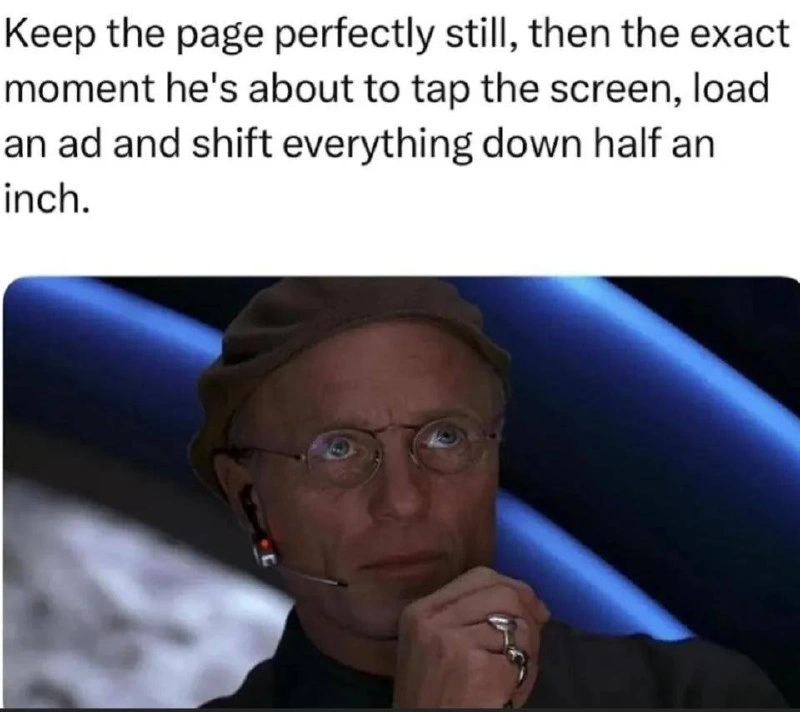
The image is Ed Harris as Christof from The Truman Show — beret, round glasses, headset, chin resting on his hand, the curved blue horizon of his fake-sky control dome glowing behind him. Christof is the director who orchestrates every second of an unwitting man's life from a hidden control room, and the caption casts him as the architect of the mobile web:
Keep the page perfectly still, then the exact moment he's about to tap the screen, load an ad and shift everything down half an inch.
The reason this lands so hard with web developers is that it personifies Cumulative Layout Shift (CLS) — one of Google's Core Web Vitals — as deliberate malice rather than incompetence. And the uncomfortable truth the meme gestures at: sometimes it is deliberate. The pattern of content reflowing precisely as your thumb descends, converting your "Read more" tap into an ad click, is well-known enough to have a regulatory name — ad networks and policy documents literally call it accidental click inflation, and engineered versions of it are textbook dark patterns. Misclicks register as engagement; engagement bills advertisers. The incentive gradient points exactly where the meme says it does.
The technical mechanics make the timing eerily plausible even without malice. Ads load asynchronously from third-party networks after the main content paints, their auction (header bidding, waterfall fallbacks) takes a human-perceptible few hundred milliseconds, and if the publisher never reserved space for the ad slot, the creative's arrival reflows everything below it. A few hundred milliseconds is also roughly how long a user takes to read a headline and commit to tapping. So the system behaves as if a director in a control room is watching your thumb — no conspiracy required, just unreserved ad slots and an auction that resolves at the worst possible moment. The fix has been known for a decade (reserve the slot with explicit dimensions, use min-height placeholders, set width/height on images), yet the misclick keeps cashing checks, which tells you whose incentives actually govern the page.
The Truman Show framing adds one more layer: like Truman, the user is the only person in the scene who doesn't know the environment is staged around their behavior.
Description
A meme pairing a tweet-style caption with a still of Ed Harris as the Man in Black/Robert Ford-era Westworld control-room scene - actually Ed Harris in The Truman Show as director Christof, wearing a beret, round glasses, and a headset, hand on chin, orchestrating from a dark control room with a curved blue horizon behind him. The caption reads: 'Keep the page perfectly still, then the exact moment he's about to tap the screen, load an ad and shift everything down half an inch.' The meme personifies cumulative layout shift (CLS) as a deliberate, maliciously timed directorial decision, capturing the universal mobile-web rage of ads reflowing content right as you tap
Comments
3Comment deleted
CLS isn't a metric, it's a conversion strategy - nothing drives ad clicks like loading the banner exactly one tap-latency before the user's thumb lands
sometimes it really feels like it Comment deleted
they actually make it on purpose 😔 Comment deleted