Skip to content
DevMeme
4376 of 7435
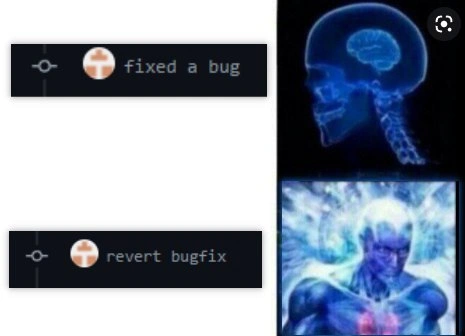
Galaxy-brain meme: reverting the bugfix is the ultimate git enlightenment
VersionControl Post #4789, on Aug 13, 2022 in TG

Galaxy-brain meme: reverting the bugfix is the ultimate git enlightenment

Why is this VersionControl meme funny?

Level 1: Just Undo It

Imagine you have a small problem, like a tiny leak in a boat. You put a patch on it to fix it, thinking that will help. But oops! – the patch you used is making the leak water flow in a weird way and now the boat is wobbling even more. In this situation, the smartest thing might be to actually take that patch off and go back to just a tiny leak, which you can manage, instead of a wobbly boat that might sink. This meme is joking that sometimes fixing something can accidentally make things worse, and when that happens, the really wise choice is to undo the fix. It’s like if you tied your shoelaces in a super complicated way to make your shoes tighter (to fix a loosening shoe), but then you can’t even walk properly. The best idea would be to untie those crazy knots and go back to how your laces were before. The big glowing brain in the picture is a funny way to say “this is galaxy-level smart.” In simple terms: the joke is that knowing when to just undo your change is a genius move. It makes us laugh because usually we think fixing a problem is always good – but here we see that undoing a bad fix can be even better, which is kind of a silly, unexpected twist that everyone can understand.

Level 2: Revert Saves the Day

This meme uses the popular expanding_brain_meme format to make a joke about software version control (specifically Git). In an expanding brain meme, each panel shows a brain growing more illuminated to humorously imply increasing levels of insight or enlightenment. Here, the top panel shows a small blue brain next to a Git commit message that says “fixed a bug”. The bottom panel shows the largest, galaxy-level brain glowing brilliantly next to a commit message “revert bugfix”. It’s a funny contrast: normally we’d think fixing a bug is the smart thing a programmer should do. But the meme suggests that, in some cases, undoing that bug fix is an even smarter move! This is a bit of ironic_commit_message humor that many developers appreciate, because it reflects real-life debugging lessons.

To understand this, let’s break down the terms. Git is a popular version control system that developers use to keep track of code changes. A commit in Git is like saving a snapshot of your code at a certain point, and you give each commit a message (like a label) describing what you did. For example, if you found an error (a bug) in the program and corrected it, you might create a commit with the message “fixed a bug”. That means the code was changed to solve a problem. Now, Git also has a command git revert which creates a new commit that undoes the changes of an earlier commit. If a commit had a mistake or caused issues, you can revert it to go back to the previous stable code. When you run git revert, it’s like saying, “make another commit that reverses what this bad commit did.” The commit message for that often says “Revert” and refers to the original change. For instance, a developer might literally write a commit message like “revert bugfix” to indicate they are undoing a bug fix that didn't go as planned.

Why would anyone undo a bug fix? Well, in BugFixing and Debugging_Troubleshooting, it’s common to discover that a fix can have side effects. Maybe the “fix” solved one problem but accidentally caused a new bug somewhere else (this new problem is called a regression, meaning something that was working has now broken again). Or perhaps the bug fix worked technically, but it had an unexpected impact on performance (e.g. the app became super slow) or on user experience. In such cases, if the new bug or side effect is worse than the original issue, the quickest solution is to revert the code back to how it was before the fix. It’s a bit like pressing Ctrl+Z (undo) in a text document when you realize the last edit messed things up. In software teams, especially when using Git for VersionControl, doing a revert is often the safest way to immediately restore a stable state of the code while you figure out a better solution for the original bug.

The meme is funny to developers because it exaggerates this idea. It implies that a truly smart programmer (the one with the gigantic galaxy brain) knows when not to deploy a certain fix. It’s playing on VersionControlHumor, highlighting a scenario every programmer eventually encounters: you proudly fix a bug and think you’re a hero, but then your fix breaks something else critical. Suddenly, you’re not a hero but a culprit, and the fastest way to redeem everything is to hit that undo button (i.e., commit a revert). The commit history snippet shown (with the little commit icons and text) looks just like something you’d see on GitHub or another Git platform – one commit says “fixed a bug” and right after it, another says “revert bugfix”. It tells a tiny story: we tried to solve it, it went wrong, so we stepped back. For a newcomer to programming, it might seem odd or funny that removing a fix can ever be the right call, but in practice it sometimes absolutely is. Part of growing as a developer is learning that not every quick fix is a good fix, and knowing when to back out a change can save a ton of time and trouble. The meme captures that lesson in a humorous way.

To put it simply, the first panel is the obvious approach: “I fixed the bug, good job.” The second panel is the wiser, hard-earned approach: “Actually, that fix caused chaos, so I reverted it for now.” It’s a lighthearted nod to the idea that sometimes the safest fix for a bad fix is to undo it. It resonates with anyone who’s broken something in production and had that “uh-oh” moment, followed by the relief of git revert. Junior developers might not have felt this yet, but give it time – your first revert feels like a superpower that magically makes the bad change go away. And as the meme jokingly suggests, recognizing when to use that superpower is its own form of enlightenment in the journey of BugFixing.

Level 3: Zen of Reverts

In this expanding brain dev meme, the punchline is that a commit message reading “fixed a bug” is shown with a tiny dim brain, while “revert bugfix” is paired with a radiant galaxy brain. It’s a tongue-in-cheek acknowledgement that sometimes the wisest solution in software isn’t to press forward with a bug fix at all costs, but to undo it. Seasoned engineers have all experienced that moment when a bugfix introduces an even nastier regression – the classic scenario: you patch one thing and suddenly three other things break. The meme humorously suggests that the truly enlightened developer knows when to say, “Nope, abort mission!” and roll back the change.

On the surface, it sounds backwards: why would reverting a fix be considered an upgrade in intelligence? The irony lands because any experienced developer in VersionControl will tell you there are days when removing code actually feels smarter than adding it. Imagine you deployed a hotfix on Friday evening (living the dream, right?) and within minutes monitoring alarms are blaring – your “fix” is leaking memory and knocking services over. The galaxy-brain move in that crisis is not doubling down on the buggy fix, but calmly running git revert to restore the last stable state. It’s essentially hitting “undo” on the deployment. That brings the system back to the safe zone and buys you time to debug properly. GitCommands like git revert exist for exactly this reason: they create a new commit that cleanly negates a previous commit. The enlightened dev chooses a surgical rollback over a stubborn crusade to make a risky patch work under pressure. As the meme implies, sometimes rolling back a bugfix demonstrates deeper wisdom than the initial fix, especially when the patch was rushed or the cure proved worse than the disease.

This meme also pokes fun at Git culture and commit etiquette. The left side shows a GitHub-style commit list with that familiar commit node icon and messages: first “fixed a bug”, then “revert bugfix”. Any developer who’s browsed a commit history laden with desperate messages (think “Revert previous commit – it broke everything”) will chuckle at this. The progression tells a story we know too well:

  1. Commit: “fixed a bug” – Developer confidently pushes a fix, likely closing a ticket or quelling a known issue.
  2. Next commit: “revert bugfix” – Reality hits. That fix backfired in QA or production, so they had to undo it.

It’s a mini-drama in two commits, and the galaxy brain image crowns the second act as the epic win. Why? Because it reflects hard-earned wisdom about Bugs and Debugging_Troubleshooting: understand when not to fight the code. A junior might stubbornly tweak the fix for hours, but a battle-scarred dev pragmatically says, “Ship stability now, fix properly later.” This is version control humor at its finest, playing on the idea that true Git enlightenment comes from respecting the Law of Unintended Consequences. You can almost hear the cynical veteran mantra: “The only code that can’t cause bugs is the code you never wrote.” By reverting, you’re effectively removing the new code (and its unintended effects), which often feels like a superpower when you’re firefighting an outage.

Another nuanced aspect is git history hygiene. Rather than panic-editing code or force-pushing to erase the faulty commit (which is dangerous on shared branches), an enlightened team carefully uses git revert so that the record shows exactly what happened – a bug was fixed, then that fix was undone. This transparency is healthy: anyone examining the log sees what broke and when it was backed out. It’s the engineering equivalent of keeping a paper trail. In Git, a revert commit literally inverts the changes of a specific previous commit, creating a new commit that undoes those changes. The meme’s big-brained sage implicitly understands that using a proper revert is cleaner and safer than hacking around the problem or pretending the bad commit never happened.

So, why is all of this funny enough to meme about? It’s the relief and irony rolled together. Every developer dreams of shipping flawless code, but reality is full of BugsInSoftware that laugh at our plans. Admitting that the best fix was to un-fix something takes humility – a trait you cultivate after breaking production a few times. The “galaxy brain” radiating pure light in the meme embodies that almost spiritual level of acceptance: “Yes, I have ascended. I now understand that sometimes doing less is doing more.” It’s a wry nod to the paradoxes of programming where, on rare but memorable occasions, reverting a change is the ultimate power move.

Description

The image is a two-panel 'expanding brain' meme. On the left of each panel is a dark GitHub-style commit row with the standard commit-dot icon. The top row reads the commit message “fixed a bug”; to its right is the smallest glowing-blue brain diagram. The lower row shows a commit that says “revert bugfix”, and to its right is the most radiant, cosmic ‘galaxy brain’ illustration symbolizing supreme intelligence (the face is blurred). The humor plays on version-control culture - depicting that, in some situations, rolling back a bug fix demonstrates deeper wisdom than the original patch, a familiar scenario for engineers wrestling with regressions and git history hygiene
Comments

6
Anonymous ★ Top Pick True mastery: revert the bug-fix, watch uptime bounce back, and let DORA think you just shipped a negative change-failure rate
  1. Anonymous ★ Top Pick

    True mastery: revert the bug-fix, watch uptime bounce back, and let DORA think you just shipped a negative change-failure rate

  2. Anonymous

    The cognitive load of a revert is calculating which of the 47 other things depended on that bug's specific behavior in production, multiplied by how many customers have already built workarounds you're about to break

  3. Anonymous

    Ah yes, the classic 'git revert' - the developer's equivalent of 'I meant to do that.' Nothing says senior engineering wisdom quite like realizing your bugfix introduced three new edge cases, broke backward compatibility, and somehow made the CI pipeline sentient. The real galaxy brain move? Reverting the revert after the standup when no one's watching, then blaming it on a merge conflict from that intern who left six months ago

  4. Anonymous

    Revert is deterministic; bugfix is a hypothesis - production only accepts proofs

  5. Anonymous

    Senior dev koan: The bugfix adds features; the revert uncovers architecture

  6. Anonymous

    Peak seniority is realizing “revert bugfix” has the best MTTR, the smallest blast radius, and lets you write the postmortem in daylight

Use J and K for navigation